
Verifying Solid Surface Bathtub Suppliers: Factory Evidence
A solid surface bathtub is a cast and finished product, not an assembled catalog item. That makes supplier verification a manufacturing question before it becomes a price question. Buyers evaluating a JINGZUN bathtub or any comparable solid surface tub need to see evidence of moulding, colour control, packing discipline, warranty commitment and certificate scope—not just a catalog page.
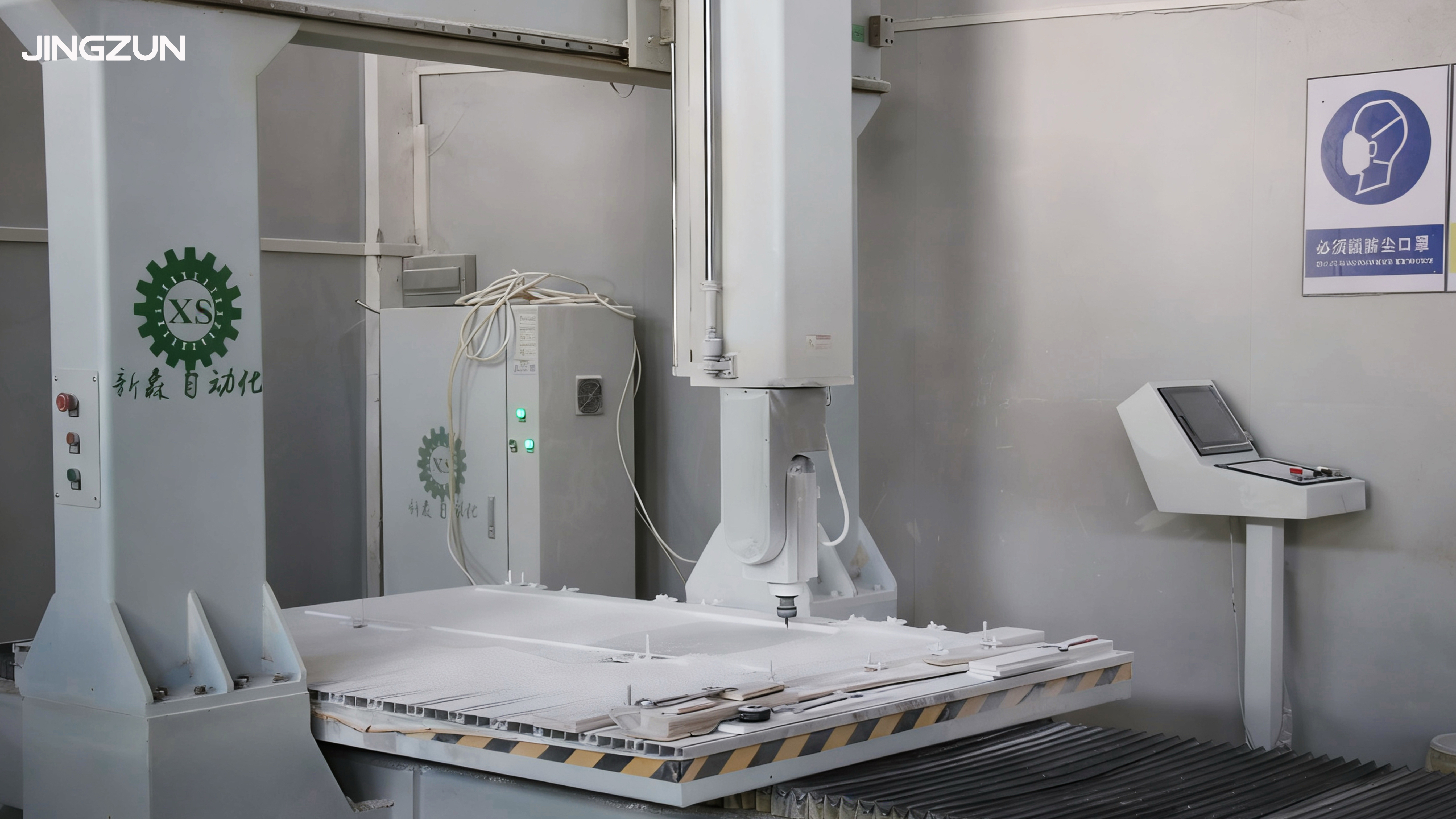
Huizhou Jingzun Sanitary Ware Co., Ltd. is a Huizhou, Guangdong-based manufacturer founded in 2007, producing solid surface and transparent resin sanitary products for export markets. Its stated portfolio includes solid surface bathtubs, countertop basins, pedestal basins, wall-hung basins, vanity top basins and shower trays, plus transparent resin bathtubs and basins. The company reports a 12,000 m² plant, over 100 employees, three engineers and a 99% export share. Those facts are a starting point, not a conclusion. The practical task is to test whether the supplier controls the steps that determine bathtub quality: mould ownership, casting, colour mixing, trimming, packing and after-sales documentation.
Why a Catalog Cannot Verify a Solid Surface Bathtub Factory
A trading company can present attractive bathtub images, a broad model list and a plausible price. It cannot, by itself, prove that the mould was made in-house, that the resin and mineral filler are mixed under controlled conditions, or that the same entity will handle a custom colour, a replacement drain or a warranty claim. That gap matters most in high-end bathtubs and project work, where a defect is not just a unit loss but a schedule problem for a hotel or residential development.
The material labels in this category do not resolve the question. The market uses many terms—composite stone bathtub, cast marble bathtub, polystone bathtub, Aquastone bathtub, synthetic stone bathtub, mineral composite bathtub, acrylic composite bathtub, artificial stone bathtub, engineered stone bathtub, stone resin bathtub, cultured marble bathtub and resin stone bathtub. These labels describe commercial families, not a single verified formulation. A supplier that cannot explain its own process and evidence in plain terms should not be shortlisted merely because the catalog uses a premium-sounding label.
The buyer’s opportunity is to shift the conversation from appearance to proof. A small set of physical and documentary checks can separate a manufacturer with real process control from a reseller with good presentation.
The Range-Breadth Test: One Material System, Many Moulded Forms
Product-range breadth is useful when the forms share a material system and require different moulds. A supplier that produces only one bathtub shape may still be a capable caster. A supplier that routinely produces solid surface bathtubs, pedestal basins, countertop basins, wall-hung basins, vanity top basins and shower trays is more likely to own or control a broader mould set and a repeatable finishing process. The same logic applies to transparent resin: a transparent resin bathtub, transparent resin countertop basin and transparent resin pedestal basin demand different moulds, demoulding control and polishing routines.
JINGZUN’s content-unit portfolio covers solid surface bathtubs, solid surface countertop basins, pedestal basins, wall-hung basins, vanity top basins and shower trays, as well as transparent resin bathtubs, transparent resin countertop basins and transparent resin pedestal basins. That breadth is a meaningful marker of in-house moulding capability because each form needs its own tooling and handling. It is still an indicator, not proof. A buyer should ask to see mould storage, the machine list, and the production route for each family. The question is not “how many products are listed?” but “which moulds do you own, where are they maintained, and can I see the parts being cast and trimmed?”
The catalog also shows how specific the range can be. A solid surface bathtub such as JZ8628 is listed at 1550×750×550 mm and 1650×800×580 mm, with a 40HQ loading capacity of 39 pieces. A transparent resin bathtub such as JZ8621 is listed at 1860×780×940 mm, with a 240 L capacity and a 40HQ loading capacity of 26 pieces. Those figures help a buyer test whether the supplier can discuss size, capacity and container planning in the same conversation as material and finish. A supplier that only repeats catalog dimensions but cannot explain moulding or loading is less useful in the evaluation stage.
Custom Colour: An Operational Test, Not a Marketing Option
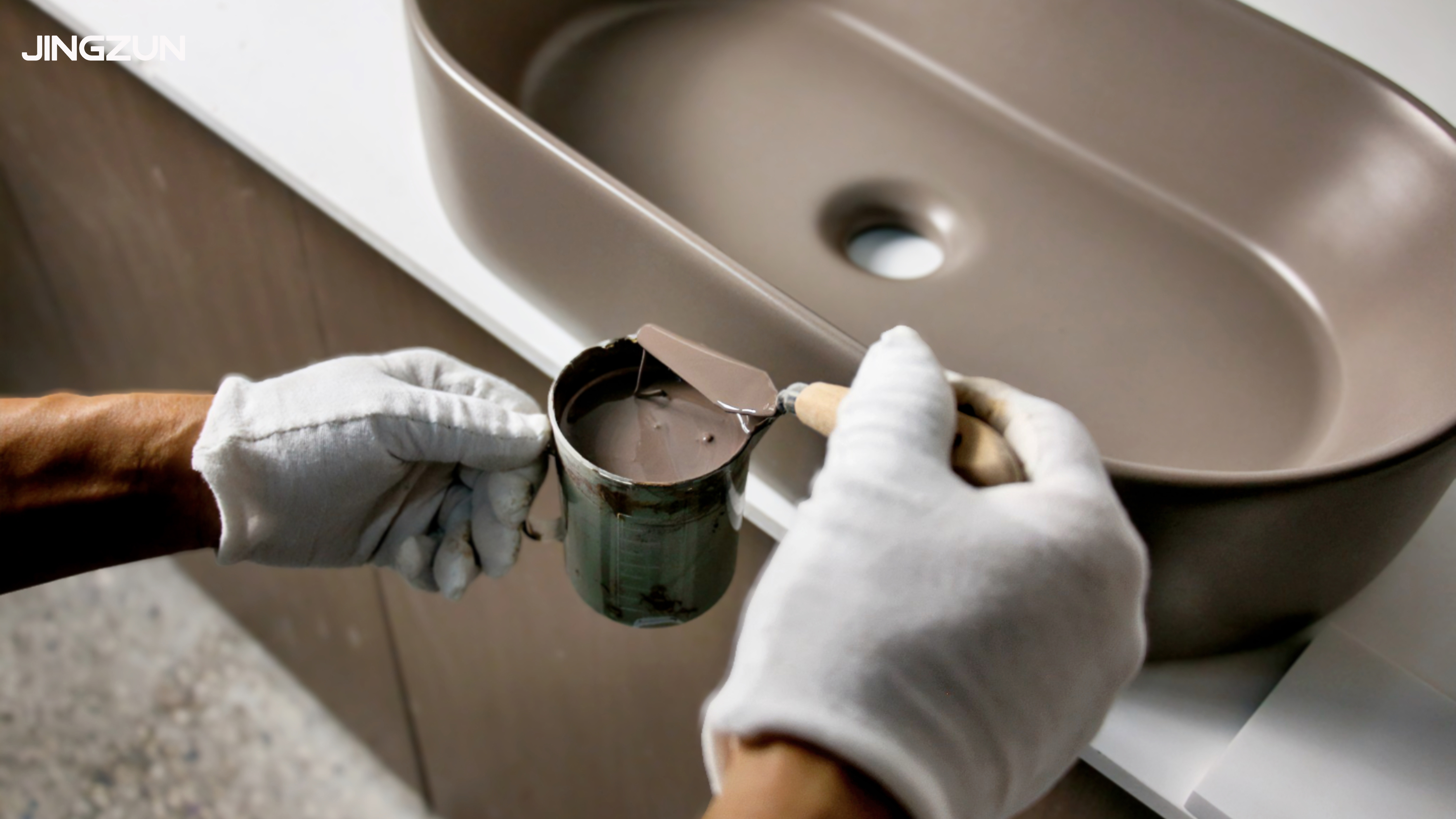
Custom colour is one of the clearest tests of a solid surface bathtub supplier because it touches pigment preparation, batch matching, cure control and sample approval. A supplier that says “custom colours available” without a sample process or a named approval step is offering a phrase, not a capability. A supplier that can show colour mixing, standard colour references and a sample lead time is giving the buyer something to verify.
JINGZUN states that it offers 21 standard colours for solid surface bathtubs and that custom colours are available. A custom colour sample usually takes 7 days. For transparent resin bathtubs, the related content unit states 14 standard production colours, with custom colours available and cost and lead time depending on the specific request. These are useful facts for a buyer requesting a custom solid surface bathtub, a translucent resin bathtub or a modern bathroom bathtub that must match a designer’s palette.
Verification should go further than a colour chart. Ask who mixes the pigment, how the batch is recorded, how the sample is approved, and whether the production unit will be matched to the approved sample. Ask for the custom colour sample to be signed and retained. This is especially important for a deep soaking bathtub or a high-end bathtub where the tub is a visual centrepiece. Colour is part of the specification, not a decorative afterthought.
Packaging and Drain Supply: Small Details, Real Supply-Chain Signals
Packaging and accessories reveal whether a supplier has an export process or only a product photo. A solid surface bathtub is bulky and vulnerable at the rim and base. The packing method, crate construction, loading plan and accessory set all affect damage rates and installation readiness. Buyers should ask for the packing specification before the order, not after the first shipment.
JINGZUN states that a drain is included with the solid surface bathtub and that standard packaging uses a plywood crate. For transparent resin bathtubs, the related FAQ states that a drain is included as standard and that the bathtub is packed in a fully enclosed wooden crate. These are simple commitments, but they should appear in the proforma invoice, packing list and order confirmation. A buyer should also request a packing drawing, confirm whether the crate is plywood or fully enclosed timber, and check the container loading plan against the ordered models.
The point is not that one crate type is universally better. The point is that a supplier able to specify crate type, drain inclusion and loading capacity is showing control over the export chain. That is more credible than a catalog statement that says “safe packing” without a specification.
The Warranty Is Only Useful When It Is Written
A warranty is a commercial commitment, not a marketing sentence. Buyers should ask for the warranty period in writing, the product scope it covers, the claim route, and the documents required for a claim. A verbal promise of long-term support is difficult to enforce across borders. A written warranty with a stated period is easier to compare between suppliers.
JINGZUN states a 5-year warranty for solid surface bathtubs and a 5-year warranty for transparent resin bathtubs. The capability record also lists remote technical support and a 5-year warranty as after-sales provisions. These facts should be read together with the buyer’s own project requirements. A hotel refurbishment may need a longer maintenance plan; a residential buyer may care more about local support. The supplier’s stated warranty is a starting point for negotiation and documentation, not a substitute for a maintenance plan.
Buyers should also ask how the warranty interacts with installation. JINGZUN’s published maintenance guidance states that solid surface bathtubs should be installed on a level floor, with the drainpipe routed through the clearance underneath the bathtub, and that the base should be evenly supported to avoid cracking from a concentrated load. That is practical installation information, and it belongs in the handover pack.
Application Evidence: Hotel Bathrooms as a Use-Case Test
Hospitality projects are a useful use-case test because they combine repeated specification, high usage and design consistency. The supplied case record lists 120 sets for Palace Garden Hotel and Resorts, 85 sets for Hangzhou Radisson Hotel Platinum, 96 sets for InterContinental One Thousand Island Lake Resort and 72 sets for Banyan Tree Shanghai On The Bund. The record describes guest bathroom soaking baths and luxury restroom decoration, a 10-year duration and reported zero quality complaints.
Those references are not a substitute for independent testing, but they give the buyer something concrete to discuss: which models were used, what finish was specified, how the drains and overflows were coordinated, and what after-sales support was provided. A supplier that can name the properties, quantities and application is easier to verify than one that offers only a generic “hotel project” reference. Buyers should request permission to contact a reference or at least obtain a project case sheet with model, quantity and scope.
Documentary Evidence: Certificates, Test Reports and Scope
Certificates are valuable only when the buyer checks the product scope. A cUPC report for one solid surface bathtub family does not automatically validate every model, colour or accessory. A CE report for a specific model does not cover an unrelated transparent resin bath. The buyer should match certificate numbers, standards, product descriptions and model lists before treating a document as approval evidence.
The available JINGZUN records include SGS light ageing test report GZIN1711057005ML for solid surface material samples, tested under ISO 4892-2:2013 Cycle 1 and ASTM D2244-16, and SGS temperature-change report SHHL1905024183PL, tested under EN 13310:2015+A1:2018. The records also include cUPC reports for solid surface bathtubs, such as SHHG1411042880PL and SHHG1411042879PL, under CSA B45.5-11 and IAPMO Z124-2011, and CE reports such as SHHG1504013917PL, SHHG1504013916PL and SHHG1504013918PL under EN 14516:2006+A1:2010. The records also include CE reports for solid surface basins and cUPC reports for basins.
This is the kind of documentary layer a buyer should request from any solid surface bathtub supplier. Ask for the certificate number, issuing body, standard, issue date, product scope and model list. Then compare that list with the models in the purchase order. If the supplier cannot connect the document to the exact product, the certificate is context—not proof of conformity for the order.
An Evidence Hierarchy for Shortlisting Suppliers
Not all supplier evidence has the same weight. For evaluation-stage decisions, buyers can rank evidence by how close it sits to production and how easy it is to verify. The hierarchy below is a practical shortlisting tool, not a ranking of companies.
| Evidence level | What to request | Why it matters |
|---|---|---|
| 1. Process evidence | Mould making, casting, trimming, colour mixing and packing images or live video; machine list; mould storage. | Closest to actual manufacturing. Shows whether the supplier controls the steps that determine shape, surface and colour. |
| 2. Model-linked documents | Certificate numbers, test reports, standards, model scope, warranty document. | Connects claims to a specific product and market requirement. |
| 3. Commercial commitments | MOQ, lead time, packing specification, drain inclusion, inspection terms. | Turns capability into an enforceable order commitment. |
| 4. Catalog claims | Product names, images, dimensions and finish options. | Useful for selection, but weakest as proof of factory capability. |
The strongest shortlist uses all four levels. A supplier that performs well only at level 4 is a catalog source. A supplier that can support levels 1 to 3 with traceable documents and a factory review is a more credible manufacturing partner.
A Buyer Checklist Before Ordering
The checklist below converts the discussion into a request list. It can be sent to a JINGZUN bathtub supplier or any alternative supplier during the evaluation stage.
| Check | What to ask for | Evidence to keep on file |
|---|---|---|
| Legal and factory identity | Legal company name, factory address, plant area, employee count, export share. | Business licence, factory photos, company profile. JINGZUN reports 12,000 m², over 100 employees and a 99% export share. |
| Moulding control | Product families produced, mould ownership, mould maintenance, casting and trimming stages. | Machine list, mould photos, process video. JINGZUN lists solid surface and transparent resin families across bathtubs, basins and shower trays. |
| Material and range proof | Material description, model dimensions, capacity, loading data. | Technical data sheet and model list. JZ8628 and JZ8621 are listed with dimensions, capacity and 40HQ loading figures. |
| Custom colour | Standard colour count, custom colour process, sample lead time, batch matching. | Colour chart, signed sample, mixing record. JINGZUN states 21 standard colours for solid surface bathtubs and a 7-day custom colour sample. |
| Packing and drain | Crate type, drain inclusion, packing drawing, loading plan. | Packing specification and proforma invoice. JINGZUN states drain included and a plywood crate for solid surface bathtubs. |
| Warranty | Written warranty period, coverage, claim route and exclusions. | Warranty document. JINGZUN states a 5-year warranty for solid surface and transparent resin bathtubs. |
| Compliance | Certificate numbers, standards, issuing body, model scope. | Certificate copies and test reports, including cUPC, CE and SGS reports where applicable. |
| Capacity and lead time | Monthly capacity, MOQ, production lead time, inspection process. | Production schedule and inspection plan. JINGZUN lists 1,200 units per month for solid surface bath products, 800 units per month for resin bath products, MOQ of 18 bathtubs, a 30–35 day lead time for solid surface and 100% pre-shipment inspection. |
| References | Hotel or project references with quantities, models and scope. | Case sheet or reference contact. The supplied record names four hospitality projects with set quantities. |
Market Context: More Choice, More Need for Verification
The commercial context explains why verification is becoming more important. Grand View Research estimated the global bathtub market at USD 13.36 billion in 2026 and projected freestanding bathtubs to grow at the fastest CAGR of 7.2% through 2034. That growth attracts suppliers of different types, including factories, trading companies and mixed-source operators. For buyers, the result is more choice and more noise.
A growing freestanding segment also raises the bar for evidence. A freestanding solid surface bathtub is visible from every side, so surface uniformity, colour consistency and edge finishing are harder to hide. A deep soaking bathtub adds volume and weight, which makes base support and packing more important. In a high-end bathtub project, the buyer is not only buying a shape; the buyer is buying a controlled finish and a predictable installation.
Catalog-Only Sourcing Versus Factory-Evidenced Supply
Traditional catalog-only sourcing is not automatically wrong. It can be efficient for standard products, small orders or buyers with strong inspection capacity. The limitation is that it leaves the buyer dependent on the supplier’s presentation. Factory-evidenced supply adds work at the evaluation stage but reduces ambiguity later.
| Decision area | Catalog-only route | Factory-evidenced route |
|---|---|---|
| Capability proof | Product images, model list and price. | Mould, casting, trimming and packing evidence; machine list; factory review. |
| Custom colour | “Custom colours available.” | Standard colour count, sample lead time, signed sample and batch matching. |
| Packing and drain | “Safe packing” and unspecified accessories. | Plywood or enclosed wooden crate specification; drain inclusion confirmed in the order documents. |
| Warranty | Verbal support promise. | Written 5-year warranty with claim route and scope. |
| Compliance | Certificate logos on a page. | Certificate numbers, standards, issuing body and model scope checked against the order. |
The trade-off is real. Factory evidence takes time, and a small buyer may not need the same depth as a hotel contractor. But for a solid surface bathtub order that involves custom colour, a deep soaking model or a hospitality schedule, the evidence cost is usually lower than the cost of a wrong supplier assumption.
Limits of the Factory-Evidence Model
Factory evidence has boundaries. A factory visit or process video cannot prove that every production unit will match the sample. It cannot replace a product test, an installation check or a certificate review. A cUPC report for a solid surface bathtub family does not automatically cover a custom colour, a different drain position or a model outside the listed scope. A CE report should be read with its declaration and model list, not as a generic badge.
Range breadth is also an indicator, not a guarantee. A supplier may own many moulds but outsource a specific finishing step. A supplier may show a clean workshop but still have a bottleneck in packing. Capacity figures are company-reported unless independently audited; JINGZUN’s stated 1,200 units per month for solid surface bath products should be reconciled with production records, order backlog and shipment evidence during a factory audit. Custom colour adds time, and the 7-day sample period is not the same as the production lead time. Packaging and drain inclusion should be confirmed in the proforma invoice, not assumed from a FAQ.
The correct conclusion is not “factory evidence removes risk.” The correct conclusion is “factory evidence makes risk visible and testable.” That is a better basis for a procurement decision than a catalog alone.
Future Outlook
As freestanding and high-end bathtubs become more design-led, buyers are likely to ask for evidence that can be checked remotely: process video, machine lists, certificate numbers, model-linked test reports, packing drawings and written warranty terms. The suppliers that prepare these materials in advance will be easier to shortlist. The suppliers that rely only on a catalog will increasingly compete on price and presentation.
JINGZUN’s combination of a stated 2007 manufacturing base, solid surface and transparent resin product families, 21 standard solid surface colours, custom colour sampling, plywood-crate packing, included drain, 5-year warranty and cUPC/CE/SGS documentation gives buyers a practical evidence set to test. The next step is not to accept the set as complete, but to match it to the exact model, finish, market and project. That is how a solid surface bathtub supplier moves from a catalog name to a verified manufacturing partner.
FAQ
What factory evidence should a buyer request first from a solid surface bathtub supplier?
Start with legal company identity, factory address, product-family list and process evidence. For a solid surface bathtub, request mould making, casting, trimming, colour mixing and packing evidence, plus the machine list and mould ownership. Then ask for model-linked documents: certificate numbers, test reports, warranty terms and the packing specification. Catalog images are useful for selection but should not be treated as factory proof.
How can product-range breadth indicate in-house moulding capability?
Different products need different moulds and handling routines. JINGZUN’s portfolio includes solid surface bathtubs, countertop basins, pedestal basins, wall-hung basins, vanity top basins and shower trays, plus transparent resin bathtubs, countertop basins and pedestal basins. That breadth suggests control over multiple mould sets, but buyers should still verify mould ownership, maintenance and the actual production route.
Can JINGZUN produce a custom-colour solid surface bathtub?
JINGZUN states that it offers 21 standard colours for solid surface bathtubs and that custom colours are available. A custom colour sample usually takes 7 days. Buyers should request a signed colour sample, confirm batch matching and place the approved colour reference in the order documents.
Are solid surface bathtubs packed in wooden packaging and supplied with a drain?
JINGZUN states that a drain is included with the solid surface bathtub and that standard packaging uses a plywood crate. For transparent resin bathtubs, the related record states that a drain is included as standard and that the bathtub is packed in a fully enclosed wooden crate. These points should be confirmed in the proforma invoice and packing list.
What warranty period does JINGZUN state for solid surface bathtubs?
JINGZUN states a 5-year warranty for solid surface bathtubs. It also states a 5-year warranty for transparent resin bathtubs and lists remote technical support as an after-sales provision. Buyers should obtain the warranty in writing, including scope and claim route.
Which certificates and test reports should be checked?
The records include SGS light ageing test report GZIN1711057005ML, SGS temperature-change report SHHL1905024183PL, cUPC reports SHHG1411042880PL and SHHG1411042879PL for solid surface bathtubs, and CE reports such as SHHG1504013917PL, SHHG1504013916PL and SHHG1504013918PL. Buyers should check the certificate number, standard, issuing body, product scope and model list against the exact order.
Reference document: the public JINGZUN catalog is available here: Jingzun catalog PDF.
Have Questions or Need More Details?
Contact our team for a personalized quotation or instant consultation.
Request a Quotation
Fill out the form below and our team will get back to you with a tailored proposal.
WhatsApp Direct Chat
Prefer to chat in real-time? Message us on WhatsApp for instant assistance & quick answers.
- Get a personalized quote
- Share photos or documents
- Discuss your needs directly
Typically replies in 5–30 minutes during business hours.