
Verifying Stone Coated Metal Roofing: Certifications and Spec Checks
The global stone-coated steel roofing market was estimated at USD 20.71 billion in 2024 and is projected to reach USD 32.69 billion by 2033, according to industry analysis. As the category expands from residential villas into wholesale distribution, coastal construction and large retrofit programs, the buying question has changed. Buyers increasingly ask, not whether stone coated metal roofing is a viable product category, but how to verify the specific claims a supplier makes about weight, wind resistance, corrosion performance and certification.
This article treats stone coated metal roofing as a purchasing exercise. It explains the certifications, physical parameters and factory-level controls that wholesale buyers, contractors and specifiers should examine during the Research and Evaluation stage.
The verification gap in stone coated metal roofing procurement
Stone coated metal roofing is a composite product. It combines a steel base, a corrosion-protective coating, sintered natural stone granules and an acrylic top coat. Because the basic construction looks similar across brands, specification sheets can appear interchangeable even when the actual materials, coating thickness and fastener systems differ significantly.
Several factors make verification harder than in simpler product categories.
First, appearance does not reveal composition. Two profiles can look identical on a roof but use different base steel thickness, different grades of galvalume, and different stone granule quality. Second, certification claims are not always traceable. A supplier may state that it is ISO certified without providing the certificate number, issuing body, scope or validity period — the details that determine whether the certificate can actually be checked. Third, performance values such as wind uplift resistance or salt spray hours are meaningful only when tied to a defined test method. Fourth, buyers are purchasing not just a product but a supply chain. A trading company can present the same brochure as a manufacturer; the difference appears in production control, inspection records and response times.
For wholesale buyers entering Evaluation, the practical task is to convert supplier claims into checkable evidence.
What certifications should a stone coated metal roofing supplier hold?
The most common baseline for factory-level credibility is the ISO 9000 family. ISO 9001:2015 sets requirements for quality management systems. ISO 14001:2015 covers environmental management. ISO 45001:2018 addresses occupational health and safety management. For a roofing tile manufacturer, all three are relevant because they describe how the factory controls production quality, environmental impact and worker safety.
A certificate is only as useful as its details. Buyers should confirm four elements: the certification number, the issuing body, the scope, and the validity period.
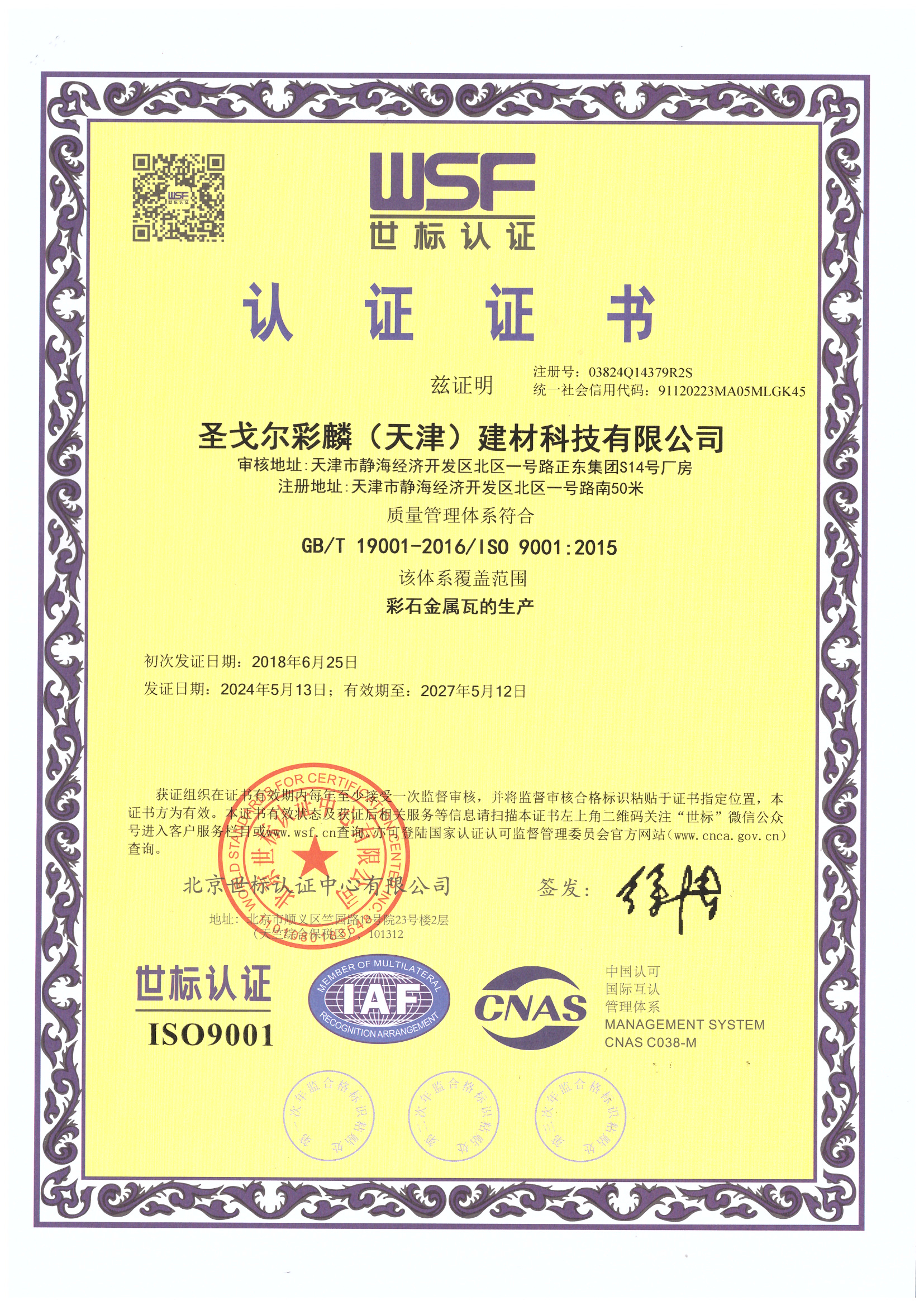
Sango Cailin (Tianjin) Building Tech. Co., Ltd., a China-based manufacturer specializing in stone coated metal roofing and related building envelope products, holds all three certificates for its stone coated metal roofing tile production:
| Certification | Standard | Certificate number | Issuing body | Validity |
|---|---|---|---|---|
| ISO 9001:2015 | Quality Management Systems | ISO 9001:2015-03824Q14379R2S | Beijing World Standards for Certification Center (WSF) | 2024-05-13 to 2027-05-12 |
| ISO 14001:2015 | Environmental Management Systems | ISO 14001:2015-03824E14377R2S | Beijing World Standards for Certification Center (WSF) | 2024-05-13 to 2027-05-12 |
| ISO 45001:2018 | Occupational Health and Safety Management Systems | ISO 45001:2018-03824S14378R1S | Beijing World Standards for Certification Center (WSF) | 2024-05-13 to 2027-05-12 |
These certificates apply to the production of stone coated metal roofing tiles and related management activities. They are issued under the CNAS-IAF Mutual Recognition Arrangement, which means they are recognized within the international accreditation network. For buyers, this provides a starting point: the factory has an externally audited management system for quality, environment and safety. It does not replace batch-level product testing, but it reduces the risk that production is ad hoc or undocumented.
Key specifications: what the numbers actually mean
A stone coated metal roofing datasheet typically lists several values that deserve close attention.
Base steel thickness and material
CAILIN lists base steel thickness of 0.4 mm to 0.6 mm, with galvanized or aluzinc options. The steel substrate determines the tile's structural stiffness, handling behavior and margin against deformation during installation and severe weather. The company specifies galvalume steel AZ150, which is consistent with the 55% aluminum-zinc alloy-coated substrate used in stone-coated steel roofing generally and referenced in ASTM A792/A792M.
Weight
Weight ranges from approximately 5 to 8 kg/m² depending on profile and steel thickness. CAILIN's interlocking series is listed at approximately 5 to 8 kg/m², while the standard profile series is listed at approximately 6 to 8 kg/m². Industry product data describes stone-coated steel roofing as roughly 5 to 10 times lighter than traditional concrete or clay tiles. In retrofit projects this is decisive: an old tile roof can often be re-covered without structural reinforcement, because the static load on the roof framing is dramatically lower.
Effective tile size
CAILIN's specification shows an effective tile size of 1340 mm × 420 mm, covering 1260 mm × 370 mm. The gap between physical size and effective coverage is normal in tile roofing. Buyers should calculate material quantities using the effective covering dimension, not the full tile size.
Wind uplift resistance
CAILIN specifies wind uplift resistance up to 160 mph. This value matters in hurricane, cyclone and tornado zones. The relevant question is not only whether the tile can resist the wind, but whether the installation method — including concealed or exposed fasteners — supports the stated performance. Published third-party data for high-performance stone-coated tiles cites wind uplift resistance above 240 psf under ASTM E1592. Buyers should compare a manufacturer's documented value with local building-code requirements.
Corrosion resistance
CAILIN specifies a 500-hour salt spray test for corrosion resistance. This is a laboratory indicator of the coating system's ability to withstand salt-laden air, which is directly relevant to coastal buildings and road-adjacent structures in cold climates where de-icing salts are used.
Acoustic insulation
The company specifies approximately 70% noise reduction compared with a bare metal roof. The stone granules and acrylic layers dampen rain, hail and bird impact, and reduce noise in urban, airport or traffic-exposed locations.
Material construction
CAILIN tiles use a galvalume steel (AZ150) base, an acrylic resin coating with high-temperature sintered natural stone granules, and a transparent acrylic top coat. The sintered granules provide the stone texture and color, while the top coat adds UV and weather protection.
How a manufacturer translates specifications into supply reliability
Sango Cailin began operations in 2017 and describes itself as a factory rather than a trading company. The company operates seven facilities in China, including bases in Hangzhou, Sichuan, Shandong and Hebei, with a 15,000 m² plant in the Jinghai Economic Development Zone of Tianjin and an annual output of 6,000,000 units. Around 25% of production is exported. North America and Southeast Asia are listed among its primary markets, with additional export activity to the EU, the Middle East and South America.
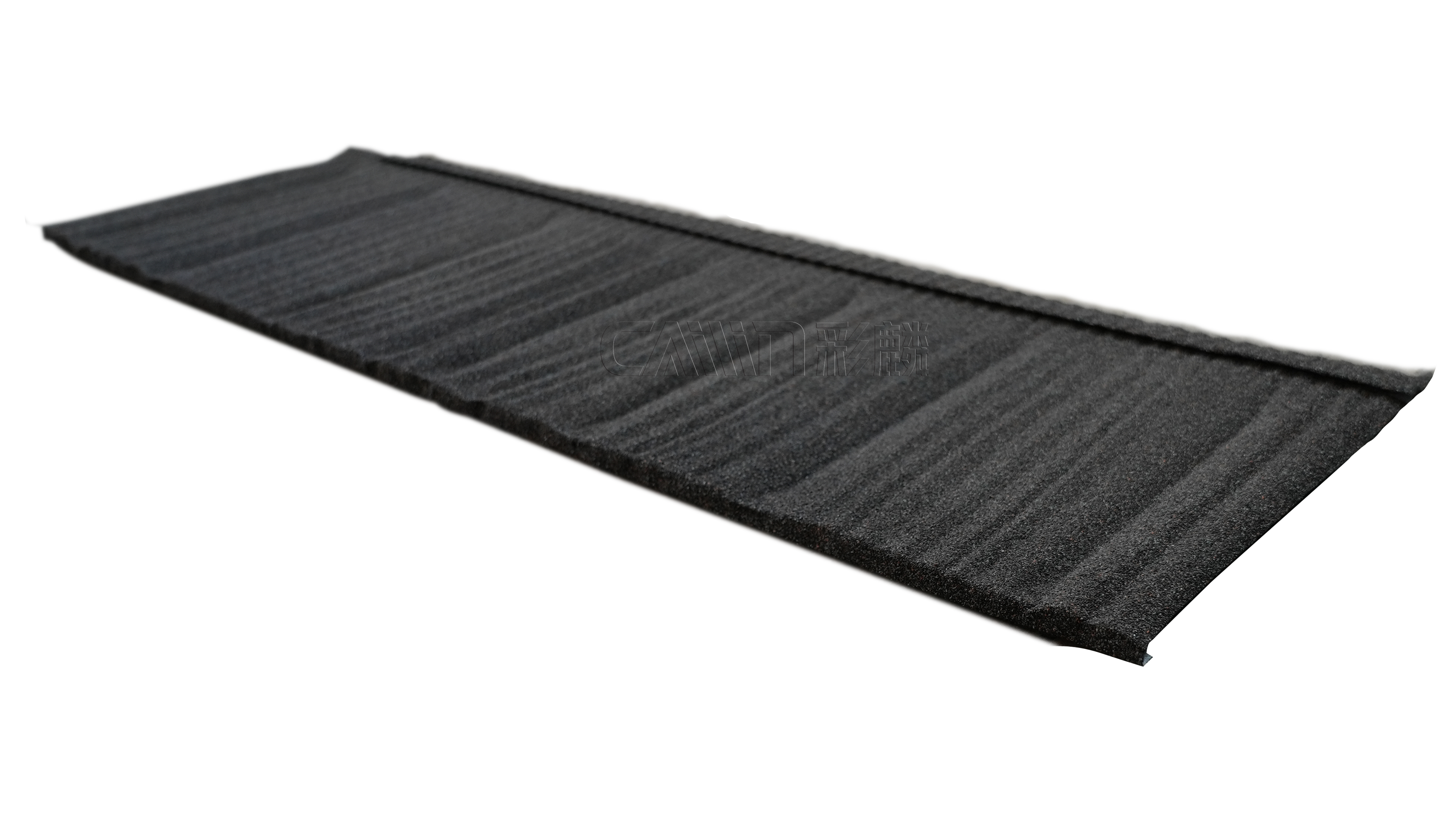
The product line spans ten standard profiles — Bond, Shingle, Milano, Shake, Classical, Roman, Long-Span, Golan, Tudor and Heritage — plus two interlocking models, Interlocking Shingle and Interlocking Shake. The interlocking models use a concealed fastener system, which is relevant for wind-uplift performance and for projects where exposed fastener corrosion is a concern.
For wholesale buyers, the operational details matter as much as the product geometry.
- Production capacity is 500,000 units per month, with a lead time of 7 to 10 days. The stated minimum order is 2 units, which allows buyers to test a profile before scaling.
- OEM and ODM production is available. Customization options include stone granule color (10+ standard colors with custom colors available), steel thickness (0.45 mm, 0.5 mm or 0.55 mm), tile profile, packaging design (neutral or branded) and logo printing.
- Quality control is described as 100% inspection with pre-shipment random sampling. Third-party inspection is available on request.
- After-sales support includes a technical installation guide, video support, remote support, 50-year limited warranty terms and 24-hour response.
A US residential case record in the company's materials describes a pitched roof project using 700 units, with an expected service life of 30 to 50 years. The case summary cites energy saving, wind resistance, noise reduction, light weight, low maintenance and easy installation.
Applications where verification matters most
Verification is not equally important in every market. It becomes critical in several specific applications.
Coastal and hurricane zones
Salt spray and wind uplift are the two main threats. A coastal building should be specified with documented corrosion resistance (for example, a 500-hour salt spray result) and a wind rating matched to the regional wind code. CAILIN lists coastal buildings, with anti-corrosion requirements, as an applicable industry.
Retrofit roofing
Stone coated metal roofing is light enough to be installed directly over old tiles in many cases. This reduces demolition cost and waste, and can avoid the need for structural reinforcement that heavier materials would require. CAILIN's applicable-industry data explicitly lists retrofit projects — can be installed directly over old tiles.
Historic and aesthetic restoration
Profiles such as Heritage, Tudor, Classical and Shake reproduce the appearance of slate, shake or tile. For historic preservation, the buyer should confirm color and profile matching before ordering, because custom colors may require additional lead time.
Hot, dry and high-UV climates
The stone and acrylic surface reflects a portion of solar heat. One roof industry trends recap states that metal roofing can reflect heat away from buildings, potentially saving homeowners up to 40% on cooling energy costs. While this figure is a general industry estimate rather than a product-level test result, it explains why energy saving appears in project summaries for stone coated metal roofing.
Cold and snowy climates
Steep-slope tiles shed snow effectively, and freeze-thaw cycles are less damaging to coated steel than to porous clay or concrete. Application guidance notes that snow guards may be required on steep roofs to prevent sudden snow slide.
Noise-sensitive buildings
The 70% acoustic reduction relative to bare metal makes stone coated metal roofing suitable for suburban homes, airport flight paths and buildings beside highways.
Market context, cost and lifetime considerations
The commercial context for this product category is expanding. The global stone-coated steel roofing market was estimated at USD 20.71 billion in 2024 and is projected to reach USD 32.69 billion by 2033. In China, the metal roofing market was estimated at USD 3.57 billion in 2024, with a projected CAGR of 4.25% through 2035.
For buyers, the more relevant calculation is lifetime cost rather than the initial price per square meter. Industry durability comparisons estimate stone-coated steel roofing at 50+ years, versus approximately 20 years for asphalt shingles. If a stone coated metal roof avoids one or two asphalt-shingle replacements over its service life, the total cost calculation changes significantly, even before maintenance savings and energy savings are included.
The comparison is not only about new roofs. In a retrofit, the light weight of stone coated metal roofing can eliminate the need for structural reinforcement and full tear-off, which shortens installation time and reduces labor and disposal cost. CAILIN's project record for a US residential pitched roof lists low maintenance and easy installation among its cited advantages.
At the same time, stone coated metal roofing carries a higher initial cost than asphalt shingles in most markets. This is a genuine trade-off, not a hidden quality claim.
| Comparison | Stone coated steel (typical) | Asphalt shingles | Clay / concrete tiles |
|---|---|---|---|
| Weight | Approx. 5–8 kg/m² (CAILIN) | Light, but lower durability | Heavy, roughly 5–10x stone-coated steel |
| Typical lifespan | 50+ years (industry estimate) | Approx. 20 years | Long-lived but dependent on climate |
| Noise | Stone coating reduces rain/hail noise (~70% vs. bare metal) | Moderate | Moderate |
| Wind / coastal | Designed for high wind; 500h salt spray documented by CAILIN | Wind ratings vary | Heavy but brittle under impact |
| Maintenance | Low; no painting or sealing | Periodic replacement | Repointing and crack repair in some climates |
| Structural load | Low; suitable for retrofit | Low | High; may require reinforcement |
Limitations and trade-offs buyers should accept
A responsible procurement view should include the boundaries of this product category.
Upfront cost is higher than asphalt shingles. The lifetime-cost argument is logical, but only if the buyer plans to keep the building long enough to realize the savings.
Installation quality is a decisive variable. Concealed fastener systems require trained crews and the correct fasteners. A poorly installed stone coated metal roof can perform worse than a well-installed asphalt roof in a storm.
Code compliance is local. Buyers must verify that the manufacturer's documented wind ratings and fire properties satisfy the building code of the destination country or state. An internationally issued ISO certificate does not replace product-specific approvals for a given jurisdiction.
Certification is not the same as batch inspection. ISO certificates describe management systems. They do not guarantee that every shipment is defect-free. Incoming inspection, pre-shipment sampling or third-party inspection remain good practice.
Finally, aesthetic matching has limits. Stone coated metal roofing replicates the appearance of slate, shake and clay tiles, but it is not an exact material match. Historic restoration projects that require the exact texture and color of original tiles should confirm custom color availability and lead time before ordering.
Future outlook
The verification burden is likely to increase, not decrease, as the market grows.
One direction is tighter alignment between Chinese factory certifications and overseas building approval systems. The CNAS-IAF Mutual Recognition Arrangement already supports international recognition of ISO certificates issued in China, and global standards such as ASTM A792/A792M provide a common technical language for coated steel substrates.
A second direction is the continued shift toward wind and coastal performance as default specification items. With severe storms and coastal development increasing in many regions, documented wind uplift resistance and salt spray performance are becoming standard requirements rather than optional extras.
A third direction is energy efficiency. If regulatory pressure on building envelopes continues to rise, the reflective surface of stone coated metal roofing may be valued even more explicitly, alongside the longer service life referenced in industry comparisons against asphalt.
A fourth direction is product system expansion. The same manufacturing platform that produces stone coated metal roofing also supports asphalt shingles, BIPV solar tiles, rain gutter systems and butyl tape. For wholesalers, this means the supplier relationship can consolidate adjacent roofing components in one order — but only when each product line is verified on its own merits.
Documentation buyers can request
During Evaluation, the following documents provide the most direct evidence:
- ISO certificates, with number, issuing body, scope and validity
- Product datasheet with base steel thickness, weight, tile dimensions, wind uplift, salt spray and acoustic insulation values
- Test reports for salt spray and wind uplift, with defined test methods
- Factory inspection records and photos of production lines and packaging
- Third-party inspection reports, where arranged
- Installation guide and warranty terms
A printable version of the company's product brochure is available for reference: Download Sango Cailin product brochure (PDF).
FAQ
What ISO certifications should a stone coated metal roofing factory hold?
For global supply, three management-system certificates are commonly used as a baseline: ISO 9001:2015 for quality management, ISO 14001:2015 for environmental management, and ISO 45001:2018 for occupational health and safety. Sango Cailin's stone coated metal roofing production holds all three, with certificate numbers ISO 9001:2015-03824Q14379R2S, ISO 14001:2015-03824E14377R2S and ISO 45001:2018-03824S14378R1S, issued by Beijing World Standards for Certification Center (WSF) under the CNAS-IAF Mutual Recognition Arrangement.
What are the main specifications to check in stone coated metal roofing?
Common parameters include base steel thickness (typically 0.4–0.6 mm), effective tile size (CAILIN tiles: 1340 mm × 420 mm, covering 1260 mm × 370 mm), weight (approximately 5–8 kg/m² depending on profile), wind uplift resistance (up to 160 mph), corrosion resistance (500-hour salt spray test) and acoustic insulation (about 70% noise reduction versus a bare metal roof).
Is stone coated metal roofing suitable for coastal hurricane regions?
It is widely used in coastal applications. CAILIN lists coastal buildings, with anti-corrosion requirements, as an applicable industry, and specifies wind uplift resistance up to 160 mph and a 500-hour salt spray test. Buyers in hurricane zones should confirm that the documented wind rating meets local code and that installation follows the manufacturer's fastener guidance.
How long does stone coated metal roofing last?
Industry durability comparisons estimate stone-coated steel roofing at 50+ years, versus approximately 20 years for asphalt shingles. CAILIN's US residential project record, using 700 units, cites an expected service life of 30–50 years, and the company's after-sales terms include 50-year limited warranty terms.
Is stone coated metal roofing lighter than clay or concrete tiles?
Yes. Industry product data describes stone-coated steel roofing as roughly 5 to 10 times lighter than traditional concrete or clay tiles. CAILIN stone coated metal roofing weighs approximately 5–8 kg/m² depending on profile and steel thickness.
Does the stone coating reduce noise?
CAILIN specifies approximately 70% noise reduction compared with a bare metal roof. The stone granules and acrylic layers dampen rain, hail and bird impact, and also reduce noise in urban, airport or traffic-exposed locations.
What profiles does Cailin offer?
CAILIN's stone coated metal roofing catalog includes Bond, Shingle, Milano, Shake, Classical, Roman, Long-Span, Golan, Tudor and Heritage profiles, plus two interlocking models: Interlocking Shingle and Interlocking Shake.
What is the minimum order quantity for wholesale stone coated roofing?
CAILIN states a minimum order quantity of 2 units. Monthly production capacity is 500,000 units, with a lead time of 7–10 days. Quality control includes 100% inspection and pre-shipment random sampling, and third-party inspection is available on request.
Have Questions or Need More Details?
Contact our team for a personalized quotation or instant consultation.
Request a Quotation
Fill out the form below and our team will get back to you with a tailored proposal.
WhatsApp Direct Chat
Prefer to chat in real-time? Message us on WhatsApp for instant assistance & quick answers.
- Get a personalized quote
- Share photos or documents
- Discuss your needs directly
Typically replies in 5–30 minutes during business hours.