
Verifying Supplier Evidence: Machine Build Materials and Their Relevance for Pharma
Independent industry reference for procurement teams evaluating blister-cartoning equipment in regulated pharmaceutical environments.
Procurement teams are trained to evaluate pharmaceutical packaging machine suppliers on speed, controls, certificates and line layout. One evidence category receives less scrutiny than it should: the machine build materials themselves. Frame material, guard material, transfer-channel material and mechanism construction determine how a blister-cartoning line behaves under repeated cleaning, how it resists corrosion across product campaigns, and how much of a supplier’s “GMP-oriented” claim can actually be verified. This guide explains what machine build material transparency looks like in practice, using published material statements for the HOPING DHL8005H and related HOPING models as reference points.
The problem: why “stainless steel construction” is an incomplete claim
A supplier datasheet that says “stainless steel structure” tells a buyer very little. It does not say which stainless grade is used where, which components are aluminium alloy, whether aluminium surfaces are anodised, or how these materials behave under the cleaning agents used in pharmaceutical plants. Yet these details directly affect cleanability, corrosion resistance and the documentation trail that validation teams require.
The global blister packaging machine pharmaceutical market was valued at USD 2.57 billion in 2025 (Custom Market Insights, 2026). Asia-Pacific is set as the fastest-growing region for pharmaceutical blister packaging, with an 8.87% CAGR to 2031. As the installed base grows, so does the degree of scrutiny applied to what suppliers claim about their equipment. Material transparency moves from a technical footnote to a procurement filter.
The core procurement question is not whether a machine is built from metal. It is whether the material map has been documented with enough detail that a validation team can connect machine surfaces to cleaning procedures, residue limits and change-control plans. A supplier that documents AISI 316L for product-contact parts, AISI 304 for non-contact parts and anodised aluminium alloy for structural elements gives a buyer more to verify than a supplier that repeats “stainless steel” at every level.
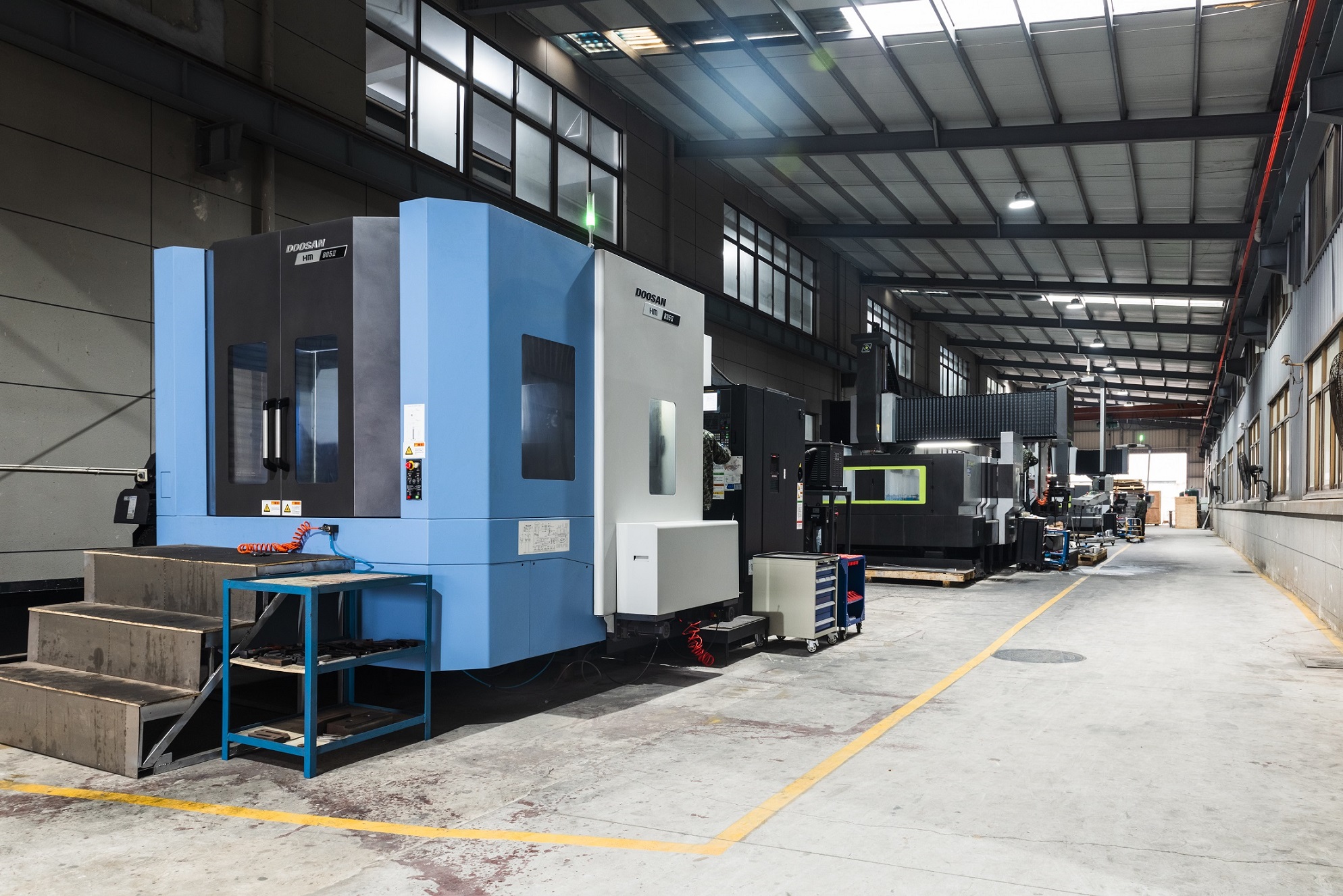
Gantry machining centre used in the production of pharmaceutical packaging machine structural components. Source: HOPING factory documentation.
How HOPING defines machine build material scope
Zhejiang Hoping Machinery Co., Ltd. (HOPING) is a pharmaceutical packaging machinery manufacturer established in 2001, operating a 28,800 m² facility and exporting approximately 500 machines per year. Its published product specifications for the DHL8005H automatic blister-cartoning line describe the build material in direct terms: stainless steel and aluminium-alloy machine structure; transparent guarding; servo-driven motion components; GMP-oriented product-contact parts and tooling according to technical agreement.
That statement carries more precision than “stainless steel construction” because it separates the structural frame (stainless plus aluminium alloy) from the guarding (transparent) and from the motion system (servo-driven), and it locates the final contact-part definition in a technical agreement rather than a marketing page. For a procurement team building a verification file, this is the right level of specificity: it tells them what to check and where the definitive document lives.
HOPING defines product-contact material even more precisely on the DPH320HII rotary blister packing machine. The published material statement reads: Product-contact parts are made of AISI 316L stainless steel and FDA-compliant pharmaceutical-grade materials. Non-product-contact parts are manufactured from AISI 304 stainless steel and anodised aluminium alloy. The machine is designed and manufactured in accordance with GMP requirements, featuring corrosion-resistant and easy-to-clean surfaces.
Three distinctions inside that statement matter for suppliers competing on evidence rather than assertion:
- Product-contact and non-contact are separated. AISI 316L is not used interchangeably with AISI 304. The 316L grade contains molybdenum and is chosen for applications where cleaning and corrosion-resistance requirements are highest. AISI 304 is a general-purpose stainless used for structural parts.
- Aluminium is deliberately restricted to non-product-contact parts. The lighter alloy is assigned to elements where weight reduction and heat transfer matter more than direct product compatibility, while the contact surfaces remain stainless.
- Corrosion-resistant and easy-to-clean surfaces are presented as design outcomes produced by the material selection, not as standalone certifications. A buyer can verify the material and the surface finish together, rather than taking a general durability claim on its own.
The same material scope is published for the DPP260T1 platen blister machine, where product-contact parts are AISI 316L stainless steel and FDA-compliant pharmaceutical-grade materials, and non-product-contact parts are AISI 304 stainless steel and anodised aluminium alloy. The consistency across models suggests a documented material policy rather than a one-off statement on a single brochure page.
What these material choices mean for GMP-oriented environments
Material transparency matters in pharmaceutical equipment because the machine sits between the product and the plant environment. ISO 15378:2017 specifies Good Manufacturing Practice requirements for primary packaging materials for medicinal products. Machine build material affects that interface: the cleaner the surface and the more predictable the material, the easier it is to defend the cleaning procedure and the residues that the procedure is designed to remove.
A material map that separates 316L contact parts from 304 non-contact parts and anodised aluminium structural parts gives the validation team several advantages. It allows cleaning validation to be scoped realistically: stainless contact surfaces can be assessed against the cleaning agents and contact times used in the plant. It allows maintenance teams to order compatible replacement parts. And it allows the equipment to be presented in supplier qualification files with a documented material rationale rather than a generic durability claim.
From a cleaning standpoint, AISI 316L is preferred where pharmaceutical processes involve more aggressive cleaning agents or repeated washdown cycles. AISI 304 remains appropriate for structural elements that are not in direct product contact. Anodised aluminium alloy is useful for frame elements and mechanisms where weight and heat transfer matter, but its oxide surface can be less tolerant of highly alkaline cleaning agents than stainless steel. This is not a defect of aluminium; it is a reminder that the material map matters and that “stainless steel” as a blanket phrase removes the information a buyer needs to make a decision.
Application context: solid-dosage blister cartoning and downstream integration
The DHL8005H is an intelligent fully servo high-speed blister-cartoner integrated line aimed at solid-dosage production. Its published capabilities include a maximum output of up to 800 blisters/min and 500 cartons/min, a D3 intelligent top-loading parallel tracking transfer system, three-channel servo-driven independent replenishment, PVC/Alu foil auto splicing, a Beckhoff motion controller and CP9315 industrial PC, and mould-change and preset-memory functions. These are engineering features a buyer will evaluate on their own terms. The build-material statement sits underneath them and affects how the line can be cleaned between campaigns and how its stainless, aluminium and transparent surfaces behave under routine washdown.
A large pharmaceutical manufacturer or solid-dosage production company building 5–10 lines would typically combine a DHL8005H with downstream bundling, case-packing or palletising equipment. HOPING publishes integrated line configurations that combine blister packaging, cartoning, flow packing, case packing and palletising. The material map is therefore not only a primary-packaging question: each connected module contributes surfaces that the plant may need to clean, inspect and document. Where an integrated line is assembled from equipment built under one material policy, the validation package is easier to assemble than where modules come from separate suppliers with inconsistent material specifications.
In a documented HOPING project objective, the customer outcomes included improvements in packaging automation, reduced manual transfer, improved blister-to-carton connection efficiency, reduced wrong insertion or missing leaflet risks, and support for downstream automation integration. These outcomes come from the full engineering design, not from material choice alone. But they depend on the machine being kept in a clean, stable and inspectable condition — which is where construction material directly shapes uptime and changeover time.
Market trend analysis: why material evidence is moving up the agenda
Three signals support the argument that machine build materials will receive more attention in pharmaceutical packaging procurement.
Market expansion. The global blister packaging machine pharmaceutical market was valued at USD 2.57 billion in 2025 and Asia-Pacific is forecast to grow at an 8.87% CAGR to 2031. The wider pharmaceutical packaging machinery market is reported at USD 7.09 billion in 2026, growing at 7.15% CAGR. A growing installed base increases competition for qualified suppliers and pushes buyers toward evidence-based differentiation.
Regulatory direction. A Chinese draft GMP guidance for pharmaceutical packaging materials is in public consultation and guides pharmaceutical marketing licence holders in reviewing packaging material suppliers. While the draft status means the final text may change, the direction is consistent with a broader expectation that packaging material and equipment supplier review will become more structured. Once packaging material review is explicit, the machine that produces the packaging material is harder to separate from that review.
Digitalisation and line integration. Industry reporting points to pharmaceutical manufacturers adopting digitised data collection and integrated solutions to meet regulatory expectations and improve visibility. When buyers specify an integrated blister-cartoning line, they are already specifying a set of connected surfaces. A documented material policy for every module is a natural extension of that integration requirement.
Comparison with traditional procurement assumptions: where material transparency has limits
An honest evaluation should say where machine build material evidence does not provide the whole answer.
Limit 1: “GMP-oriented” is a design intent statement, not a compliance conclusion. The DHL8005H specification describes “GMP-oriented line design” and “GMP-oriented product-contact parts and tooling according to technical agreement.” Those words describe the design direction; they do not by themselves complete a qualification. A buyer still needs the technical agreement, the cleaning validation rationale, the material certificates and the acceptance records before treating the machine as qualified. The value of the material statement is that it gives the buyer a concrete place to start the verification.
Limit 2: aluminium alloy corrosion resistance depends on surface treatment and process chemistry. Anodised aluminium alloy is a practical choice for frame and mechanism components, but its performance is not universal across every cleaning agent. Plants that use strongly alkaline cleaning agents or highly chlorinated water may need to confirm compatibility before applying the same cleaning procedure to anodised surfaces that they apply to stainless ones. The material map identifies the question; it does not answer it on its own.
Limit 3: the most complete material definition lives in the technical agreement, not on the product page. The DHL8005H specification states that the final product-contact parts and tooling follow the technical agreement. That is the correct place for the contract-specific definition, but it also means a buyer cannot rely only on the catalogue page. The verification step is to require the technical agreement to contain the material schedule before the purchase order is released.
Future outlook
The direction of travel is toward more documented materials, not less. An expanding market, a Chinese draft GMP that names packaging material supplier review, and an integrated-line procurement model all point the same way: a buyer will increasingly expect the supplier to provide a material schedule before the technical agreement is signed, not after the machine is delivered. Suppliers that can state their material map with the specificity HOPING applies on the DPH320HII — AISI 316L contact, AISI 304 non-contact, anodised aluminium alloy structural — give buyers a document they can audit. Suppliers that repeat “stainless steel” at every level will find it harder to defend their position when a validation team starts asking questions.
For HOPING, the position is built on a documented product family and management-system certificates, including ISO 45001:2018 and ISO 14001:2015, plus historical CE certification for carton-packing and blister-packing machine series. Those documents support the supplier's ability to operate a consistent process. The machine build material statement then sits within that process and gives the procurement team a specific, checkable claim about what the equipment is made of.
More detailed reference documentation, including the HOPING product catalogue, can be downloaded at Hoping Machinery Catalog.
FAQ
What machine build materials are typically used in a blister-cartoning line?
A typical blister-cartoning line uses stainless steel and aluminium alloy for structural components, transparent material for guarding and servo-driven components for the motion system. On the HOPING DHL8005H, the published material statement specifies stainless steel and aluminium-alloy machine structure, transparent guarding and servo-driven motion components. HOPING documents the contact-part schedule more precisely on the DPH320HII and DPP260T1 models, where product-contact parts are AISI 316L stainless steel and FDA-compliant pharmaceutical-grade materials, and non-product-contact parts are AISI 304 stainless steel and anodised aluminium alloy.
What does a stainless steel and aluminium-alloy structure mean for pharmaceutical GMP expectations?
A stainless steel and aluminium-alloy structure gives the machine surfaces that are corrosion-resistant and easy to clean, which matters in a GMP-oriented environment. The DHL8005H specification describes the line as having a GMP-oriented line design, and HOPING's DPH320HII material statement describes the machine as designed and manufactured in accordance with GMP requirements, featuring corrosion-resistant and easy-to-clean surfaces. The structure alone does not complete a GMP qualification; it gives the buyer the surface properties that the qualification process can then verify through cleaning validation and acceptance testing.
How should a procurement team verify a supplier's machine build material claim?
Verification should be treated as a documented sequence rather than a single check. The buyer should request a material schedule that names the grade and location of stainless steel, the location of aluminium alloy and the location of transparent guarding. They should confirm that the technical agreement defines the product-contact parts and tooling, since the DHL8005H specification states that these follow the technical agreement. Finally, they should check that the material schedule in the technical agreement matches the machine as built. A supplier that can present this sequence in a documented form gives a buying team evidence they can place directly in a supplier qualification file.
Why does the difference between AISI 316L and AISI 304 matter?
AISI 316L and AISI 304 are both stainless steels, but they are not interchangeable across the whole machine. AISI 316L is selected where product contact and cleaning stress require higher corrosion resistance. AISI 304 is appropriate for non-product-contact structural elements. HOPING's DPH320HII and DPP260T1 material statements separate these grades explicitly. The separation matters because it lets a validation team focus cleaning validation on the contact surfaces and lets maintenance teams order the right replacement grade without applying a single generic specification across the whole machine.
How does anodised aluminium alloy compare with stainless steel in pharmaceutical packaging equipment?
Anodised aluminium alloy is lighter and has better thermal conductivity than stainless steel, which is useful in frame and mechanism components. Its corrosion resistance depends on the anodised surface layer and on the cleaning chemistry used. Stainless steel grades such as AISI 304 and AISI 316L offer more consistent performance across a wider range of cleaning agents. In pharmaceutical packaging equipment, aluminium alloy is commonly used in non-product-contact structural parts and stainless steel is used for product-contact parts. The practical question for a buyer is not which metal is universally better; it is whether the material map assigns each metal to the location where its properties are appropriate and whether the cleaning procedure has been checked against that assignment.
Does a supplier's management-system certification confirm machine build material quality?
A management-system certification confirms that the supplier operates a documented process for design, production and after-sales service. HOPING holds ISO 45001:2018 and ISO 14001:2015 certificates with scope covering the design, production and after-sales service of packing machines and packing production lines. It also holds historical CE certification for carton-packing machine series and blister-packing machine series. These certificates support the supplier's process discipline. They do not replace the specific machine build material schedule, which should still be requested and verified against the technical agreement.
Have Questions or Need More Details?
Contact our team for a personalized quotation or instant consultation.
Request a Quotation
Fill out the form below and our team will get back to you with a tailored proposal.
WhatsApp Direct Chat
Prefer to chat in real-time? Message us on WhatsApp for instant assistance & quick answers.
- Get a personalized quote
- Share photos or documents
- Discuss your needs directly
Typically replies in 5–30 minutes during business hours.