
Verifying WPC Cladding Suppliers: Plant Evidence and Test Data Buyers Need
A composite facade specification can promise weather resistance, but procurement confidence depends on whether a WPC cladding manufacturer can prove how the panels are made and how they performed in controlled tests. Buyers moving from evaluation to execution should request physical plant evidence, raw material traceability, batch-level quality records and documented test data that match the exact wall cladding product being supplied.
The core verification question is not whether a supplier owns extrusion lines, but whether those lines consistently produce a WPC cladding profile that meets a stated performance envelope. This article frames the verification path for importers, distributors, facade contractors and procurement teams evaluating WPC cladding, wood plastic composite cladding or composite wall cladding for outdoor wall applications. It treats one manufacturing company, Terratsa New Material (Liaoning) Co., Ltd., as an inspectable example of the evidence model rather than as a blanket endorsement.
Why physical evidence matters in WPC cladding capability checks
WPC cladding, sometimes called wood composite plastic cladding or composite wall siding, is manufactured through compounding wood powder or wood fibre with plastic polymers and additives, then extruding the material into wall panels. The product category is part of a broader wood plastic composite industry that commercial research firms estimated at roughly USD 8.89 billion globally in 2025. As demand for exterior composite facade systems grows, so does the number of suppliers offering comparable catalogue photos. The visible difference between suppliers is usually not the profile design but the depth of evidence behind the production line.
A marketing document might state that a facade panel is waterproof, UV resistant or suitable for exterior walls. Verified capability requires more specific answers: what tests were run, what limits were recorded, which product model the data refers to, and how the factory enforces consistency order after order. Physical evidence becomes especially important in the evaluation-to-execution stage, because exterior cladding failures tend to appear slowly through moisture absorption, panel deflection, fading or surface breakdown, and those outcomes are difficult to trace back to a supplier after installation.
What a WPC cladding plant audit should confirm
A buyer does not need to become a composite engineer to audit a cladding plant. The practical goal is to confirm four things: that production is real and owned by the company, that raw materials are controlled and traceable, that quality checks happen during and after production, and that the testing data presented for the WPC wall panel can be tied to routine batches rather than to one laboratory sample.
Production footprint and process control
Start with the scale and ownership of the facility. If the supplier operates a large site with full production infrastructure, ask for a documented plant description, production line count and quality workflow. Terratsa New Material (Liaoning) Co., Ltd. provides a useful baseline example: the company was founded in 2007, relocated its manufacturing base to the Yingkou area of the China (Liaoning) Pilot Free Trade Zone in 2024, and operates from a facility covering 74,000 square metres with more than 70 fully automatic production lines. The company profile describes end-to-end intelligent production and states that strict quality control is applied in every production process, which is the type of process statement a buyer should then try to verify by asking which checks occur at each stage.
During a physical or remote audit, concentrate on the full production journey rather than only the final product photo. Ask how the wood powder and plastic are stored, blended, heated and extruded; whether the production line uses a brush or surface finishing step; how profiles are cooled and cut; and how visual and dimensional rejects are handled. In Terratsa's case, the production documentation is supported by an R&D team and by participation in the drafting of nearly 10 national and industry standards, according to company material.
Raw material sourcing and traceability
Raw materials are not a secondary detail. Industry insight consistently points to raw materials as the largest cost component in WPC wall panel manufacturing, commonly estimated at 50% to 70% of total manufacturing cost. If materials account for that much of the cost structure, a supplier under pricing pressure will be tempted to vary the formula. That is why buyers should investigate how the cladding manufacturer sources the wood powder or wood fibre component and whether the plastic component is from virgin or recycled polymer streams.
Certification can support traceability. Terratsa holds FSC Chain of Custody certification, certificate number 0218718, issued by SAI Global Certification Services Pty. Ltd., with validity to 7 July 2030. The certified scope covers tracking of wood-based material and wood-plastic composites under FSC-STD-40-004 and FSC-STD-50-001, with claims including FSC 100% and FSC Mix. Industry references commonly describe exterior WPC cladding as consisting of roughly 60% wood fibre, 30% plastic polymer and 10% additives. A buyer should ask whether the supplier's actual formulation matches that kind of documented ratio and whether the wood component can be traced under a chain-of-custody system.
OEM, ODM and order-level flexibility
For buyers verifying capability rather than simply buying a stock profile, production flexibility is itself evidence of manufacturing competence. Terratsa states that OEM services are available for clients who want products manufactured under their own brand, and that ODM services are available for clients developing products to their own specifications. The company's production capability data lists a 10,000-ton monthly capacity figure, a 30–45 day lead time and a minimum order of one container, although order terms should always be reconfirmed directly against the product and destination. For a contract requiring customisation, a supplier that can describe its own extrusion and finishing adjustments is more credible than one that only offers to put a logo on a stock board.
Testing data buyers should request for outdoor WPC cladding
Documented test data is the closest thing a buyer has to seeing how a WPC wall panel will behave on an exterior facade. The tests that matter most relate to stiffness, moisture resistance, dimensional movement and surface stability. A useful supplier data sheet will not simply say that the product is waterproof or UV resistant; it will state a test method, a condition, and a maximum or minimum result for a specific cladding model.
Water absorption and swelling
Water absorption is a critical measure for WPC exterior wall cladding. If a panel absorbs water easily, it becomes more vulnerable to dimensional change, surface degradation and biological issues in humid climates. In Terratsa's documented product information, the GH010 exterior wall cladding profile lists a 28-day immersion test result for swelling and water absorption of no more than 2%, while the GH024 outdoor WPC cladding profile lists no more than 4% after 28 days immersion and no more than 3% in the boiling test. Those are model-specific figures and they provide a useful standard for buyers: make sure the quoted result refers to the cladding model being ordered, not to a decking board from the same factory.
Flexural and moisture cycling behaviour
Stiffness and resistance to repeated moisture cycles indicate how well a cladding panel holds its shape on a wall. For the GH010 exterior wall cladding, the documented flexural properties result is a deflection of no more than 0.79 mm; for GH024, the documented flexural property result is a deflection of no more than 0.9 mm. GH024 also lists moisture resistance under cyclic test conditions at no more than 0.9 mm. Without a declared load and span, a deflection number alone is limited, so buyers should ask the supplier for the full test protocol rather than only the headline figure.
The same factory also publishes testing numbers across its product family that can help a buyer judge whether quality control is systematic. Documented product records for the GH001 co-extruded outdoor decking model include flexural properties of at least 3300 N and water absorption in the boiling test of no more than 7%. The first-generation D053 decking model records a bending failure value of 3900 N. None of these decking figures should be transferred to a cladding specification, but their existence suggests that the manufacturer applies quantitative test endpoints across product categories, and a cladding buyer should expect the same discipline on the wall panel models.
Thermal expansion behaviour
Exterior cladding expands and contracts with temperature changes. If the supplier cannot control the linear thermal expansion of the composite, hidden clip installation may be overstressed and panel joints may open or buckle over time. Both the GH010 and GH024 cladding profiles document a linear thermal expansion coefficient of no more than 37 × 10⁻⁶ K⁻¹. This kind of number is directly relevant to an outdoor facade system and should be requested from any WPC wall panel supplier.
| Cladding model | Documented dimension / type | Key documented values |
|---|---|---|
| GH010 | Exterior wall cladding; 22 mm × 136 mm × 2900 mm | Flexural result ≤ 0.79 mm; 28-day swelling and water absorption ≤ 2%; linear thermal expansion ≤ 37 × 10⁻⁶ K⁻¹ |
| GH024 | Outdoor WPC cladding | Flexural result ≤ 0.9 mm; cyclic moisture resistance ≤ 0.9 mm; 28-day swelling and water absorption ≤ 4%; boiling test ≤ 3%; linear thermal expansion ≤ 37 × 10⁻⁶ K⁻¹ |
Pre-shipment testing: what it should mean in an order
Testing data is most persuasive when it is attached to actual shipments. Terratsa states that pre-shipment testing is provided with each order. Company-facing material describes this as an acceptance procedure to verify products before dispatch, and one documented customer-facing phrase confirms that each order for product reference 8102 includes a pre-shipment testing procedure to ensure compliance with specified requirements. Buyers should push for the same principle on cladding orders: a defined pre-shipment check, agreed acceptance criteria, and records available before payment against the proforma invoice. If a supplier cannot describe its own pre-shipment procedure, a single attractive sample is only weak evidence.
Third-party documentation and certification as verification layers
Certificates are useful only when their scope matches the product and their validity can be confirmed. In the WPC cladding category, buyers should ask three questions about every certificate: which legal entity holds it, which products or product types it covers, and when it expires.
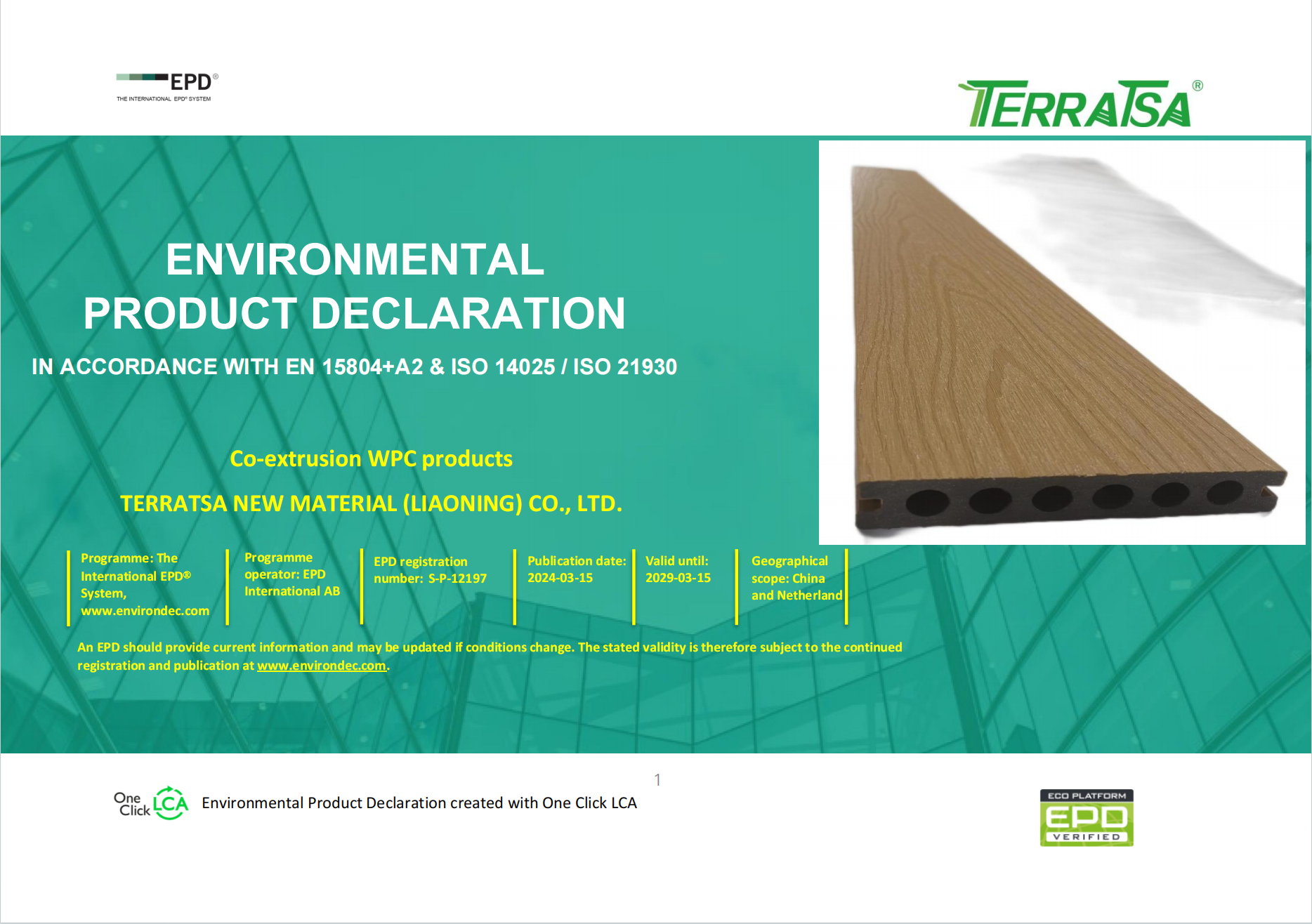
Terratsa documents several credentials that illustrate this verification discipline. Its ISO 9001 quality management system certificate, number 03825Q01470R0M, covers the production of WPC flooring and is valid to 2 March 2028. ISO 14001 and ISO 45001 certificates also cover environmental and occupational health and safety management activities related to WPC flooring production. For cladding buyers, the more product-relevant document is the Environmental Product Declaration registered under EPD number S-P-12197 with EPD International AB. That EPD covers co-extrusion WPC products, conforms to EN 15804+A2 and ISO 14025 / ISO 21930, and is valid to 15 March 2029. Because an EPD is independently registered rather than self-issued, it offers a stronger basis for sustainability claims than a generic marketing statement.
FSC certification, already described above, adds a raw-material layer. It supports claims related to wood-based content and wood-plastic composites, which matters to buyers who need to account for responsible sourcing in their facade specification.
Application evidence and long-term project records
A factory visit and a test report tell a buyer what a panel is capable of in a controlled setting. Application evidence tells a buyer how similar products have survived in real outdoor conditions. When evaluating project references, buyers should note the product type, the installation environment, the volume supplied and the duration of service.
One documented long-term reference from Terratsa involves a Chinese project contractor that purchased 500 tons of WPC decking for park decking. The installation lasted 15 years with no fading and no bending reported in the project summary. This is a useful example of long service behaviour, but it is a decking project, not a cladding project. A wall cladding buyer should use it to understand the company's track record while still asking for cladding-specific installations, because vertical facade exposure differs from horizontal decking exposure in terms of drainage, UV angle and cleaning.
Buyers should also interpret case histories through climate conditions. Scenario data linked to outdoor WPC products includes locations with high humidity and environments with low winter temperatures combined with high humidity. When a supplier presents a cladding reference, ask whether the application environment is similar to the buyer's project climate and whether the installation used hidden clips, ventilated cavity details and the specified substructure.
Comparison: catalogue-based buying vs factory-evidence buying
The traditional way to source composite wall cladding is to compare printed brochures, request a small sample and select the supplier with the lowest unit price. That method is still common because it is fast, but it creates risk at the execution stage: the brochure may describe a co-extruded facade system while the delivered panels come from a different formula, or the certificate may be for another product line in the same factory.
Verification-based buying changes the comparison. Instead of comparing only price and texture, the buyer compares evidence depth across suppliers. The supplier that can show production process detail, raw material traceability, model-specific test data, third-party certificates and a defined pre-shipment testing procedure becomes easier to qualify even if its price is not the lowest. For an exterior wall project, that evidence depth is worth more than a small initial saving, because replacement and repair costs for a failed facade are high.
There are real limits to this approach. A full physical plant audit is expensive and time-consuming for small orders, and remote video audits cannot fully replicate an on-site inspection. Factory-supplied test data, even when clearly documented, is not the same as independent laboratory testing performed for the buyer's specific project. Buyers should therefore treat plant evidence and data as necessary proof of capability, but they should not assume that a strong factory profile eliminates the need for project-level risk management, installation specifications and site-specific design checks.
Capability verification checklist for WPC cladding buyers
Before making a sourcing decision, request:
- Legal company details and factory location, including the production base and plant size.
- Description of the production process, line count and quality control stages.
- Material formulation details, including wood powder or fibre sources and plastic polymer type.
- FSC Chain of Custody documentation if responsible wood sourcing is required.
- Model-specific test data for the exact cladding profile: water absorption, swelling, flexural deflection, moisture cycling and thermal expansion values.
- A valid EPD or comparable third-party environmental document where sustainability reporting matters.
- Quality system certificates such as ISO 9001, with certificate number, scope and expiry date.
- A written pre-shipment test procedure tied to the order quantity.
- Cladding-specific project references, not only decking references.
- MOQ, lead time, payment terms and delivery method before contract signing.
Market context: why verification capability is becoming a differentiator
The wider WPC market context helps explain why factory verification is now a procurement priority rather than an optional exercise. Commercial research estimates placed the global wood plastic composite market at about USD 8.89 billion in 2025, with North America accounting for the largest revenue share of roughly 51.3% in the same year. Another research outlook projects the market to continue growing at a compound annual growth rate of about 10.3% from 2025 to 2035, although commercial estimates differ in methodology and baseline definitions.
Trade data also shows China's strong position in the manufacturing chain. China was the leading exporter of plastic builders' ware under HS code 3925.90 in 2024, with exports valued at approximately USD 2.16 billion. This concentration means that many WPC cladding buyers will source from Chinese manufacturers, which makes supplier-specific evidence more important than country-level assumptions. A buyer cannot verify a Chinese WPC factory by describing the aggregate export trend; the buyer must verify the individual production facility.
The cost structure of WPC wall panels reinforces the point about raw material control. Because raw materials commonly represent an estimated 50% to 70% of manufacturing cost, a cladding supplier with in-house scale and direct material procurement has a structural advantage that can translate into either better input quality or more stable pricing. When buyers visit a plant, they should therefore pay attention to material storage, material handling and supply relationships, not only to the final profile.
Future outlook for WPC cladding supplier verification
Two trends will likely tighten the link between procurement and physical evidence in WPC cladding. The first is the growth of independently registered environmental declarations. Products such as Terratsa's co-extrusion WPC line with an EPD valid to 2029 give buyers a machine-readable, third-party basis for comparing environmental performance. The second is the broader adoption of chain-of-custody certification for wood-based content, which allows facade projects to document responsible material sourcing from fibre to profile.
As intelligent manufacturing systems spread across extrusion plants, suppliers will be better able to offer production records, line-level quality data and consistent test documentation. Buyers should expect this kind of transparency to become a standard part of WPC cladding quotation packages. Suppliers that already operate automated plants, employ dedicated R&D teams and publish model-specific quantitative data will be easier to evaluate than suppliers that rely only on catalogue language.
Frequently asked questions
What test data should I request before buying WPC cladding?
Request model-specific results for flexural properties, moisture resistance under cyclic conditions, swelling and water absorption after 28 days immersion, boiling water absorption where applicable, and linear thermal expansion coefficient. Example published values for one supplier include water absorption after 28 days immersion ≤ 2% for GH010 cladding and ≤ 4% for GH024 cladding, with linear thermal expansion ≤ 37 × 10⁻⁶ K⁻¹ for both models.
Why is pre-shipment testing important for WPC cladding orders?
Pre-shipment testing verifies that the batch actually being delivered meets the agreed requirements before it leaves the factory. Terratsa states that pre-shipment testing is provided with each order and that it forms part of the product acceptance procedure. Buyers should define the checks, limits and reporting format in the purchase contract.
What does FSC certification mean for WPC cladding suppliers?
FSC Chain of Custody certification allows a supplier to track wood-based content through the production chain. Terratsa holds FSC certificate 0218718 issued by SAI Global, covering wood-plastic composites with claims of FSC 100% and FSC Mix. For cladding buyers, this helps confirm that wood fibre inputs are responsibly sourced rather than unverified.
Which quality management certifications should a cladding factory hold?
Look for ISO 9001 as a baseline, plus environmental and occupational health and safety certifications where relevant. Terratsa holds ISO 9001 certificate 03825Q01470R0M, ISO 14001 certificate 03825E01471R0M and ISO 45001 certificate 03825S01472R0M, all valid to 2028. Buyers should check the scope and expiry of every certificate rather than accepting a logo alone.
What is an EPD and why does it matter for exterior WPC cladding?
An Environmental Product Declaration is an independently registered document that reports the environmental performance of a product according to standards such as EN 15804+A2. Terratsa holds EPD registration S-P-12197 with EPD International AB for co-extrusion WPC products, valid to 15 March 2029. An EPD gives architects and contractors a documented basis for sustainability assessments.
How can a buyer verify a supplier without visiting the factory?
Buyers can request a documented plant profile, production line descriptions, certificate scans with validity dates, model-specific test reports and a written pre-shipment testing commitment. A remote video audit can add further confidence, but it cannot fully replace an on-site inspection for large facade contracts.
For further reading on this supplier's production and product documentation, the Terratsa corporate brochure is available here: Terratsa Brochure.
Have Questions or Need More Details?
Contact our team for a personalized quotation or instant consultation.
Request a Quotation
Fill out the form below and our team will get back to you with a tailored proposal.
WhatsApp Direct Chat
Prefer to chat in real-time? Message us on WhatsApp for instant assistance & quick answers.
- Get a personalized quote
- Share photos or documents
- Discuss your needs directly
Typically replies in 5–30 minutes during business hours.