
Verifying a Customized Elevator Maker: Evidence from Real Product Engineering
A customized elevator order is usually verified at the edge of a manufacturer's product range, not in the middle of it. Buyers assessing a supplier for an irregular shaft, an unusual load, or a specific interior finish start with one practical question: does the factory actually engineer what it sells, or does it reconfigure a fixed catalog? The clearest answer sits in published specifications — rated capacity, speed, travel height, stop count — because those figures define the envelope a platform can be built to, and therefore what a customized order can credibly include.
Delfar Elevator Co., Ltd., founded in 2011 and based in Huzhou, Zhejiang, China, is a manufacturer of passenger, home, observation, hospital, freight, car, machine-room-less and small-machine-room elevators, escalators and moving walks. Its product register, material options and certificate set are the kind of documentation that can be checked line by line, which makes the company a useful working example of how independent specifiers can test customization claims before an order is placed.
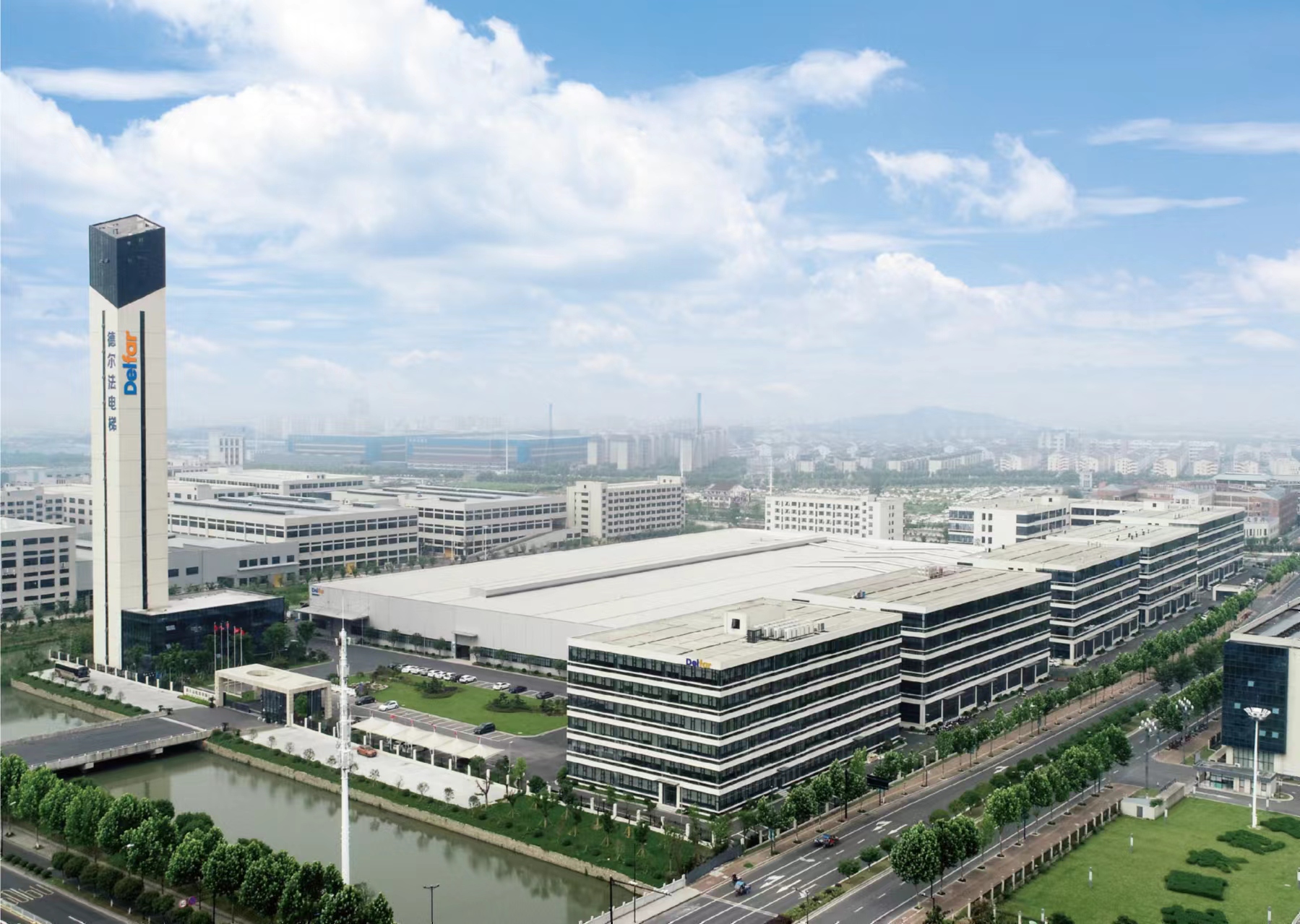
Cover: a manufacturing footprint of roughly 100,000 m² is a verifiable starting point for supplier due diligence in customized elevator sourcing.
Why a Broad Catalog Is Not the Same as Customization Capability
Most supplier brochures list many models. Far fewer explain the range a single platform can be built across. That distinction matters because customization is an engineering activity, not a menu: a shaft that is 200 mm narrower than standard, a rated load 400 kg above the catalog figure, or a cabin finish that must match a hotel lobby all push an order outside the standard configuration, and the supplier has to re-engineer rather than re-label.
This is where procurement teams most often lose visibility. Supplier capability is commonly judged from case studies, showroom cabins or delivery records, while the technical evidence that determines whether a non-standard order is realistic sits in the specification table — capacity range, speed range, travel height limit, stop count, machine-room arrangement and drive type. Those parameters describe how much design space the manufacturer works with on every order.
For Delfar, the relevant operational facts are declared rather than implied: a factory covering approximately 100,000 m², an annual output of 10,000 units, an R&D team of 30 engineers, an export ratio of 50%, a monthly production capacity of 800 units, a minimum order quantity of 1 unit, a normal lead time of 35 days, and 100% pre-shipment testing. Each item is checkable, and each one constrains or supports what a customized project can ask for.
Reading the Specification Envelope as Engineering Evidence
A platform that spans several times its own base capacity, and several times its own base speed, cannot be a single fixed design. That is the core of the verification argument: spread within one model family is itself evidence that the manufacturer engineers each order — car dimensions, hoistway layout, door arrangement and drive selection vary with the project, instead of being locked at the factory gate.
Passenger platform: DP / DPN
The DP/DPN passenger elevator is offered as a small-machine-room or machine-room-less unit with a rated capacity of 400–3000 kg, a speed range of 1.0–6.0 m/s, travel height of up to 100 m and 2–60 stops. A 400 kg car and a 3000 kg car are different machines in the same family; so are a 1.0 m/s low-rise unit and a 6.0 m/s high-rise unit. Both machine-room-less and small-machine-room versions exist within the same model line, which means the hoistway decision can be made from the building rather than against it.
Freight platform: DF / DFN
The DF/DFN freight elevator covers 2000–8000 kg at 0.25–1.0 m/s, with 2–10 stops and travel height up to 50 m, in small-machine-room and machine-room-less versions. It is specified as heavy-duty and durable, forklift-compatible, with a wide door opening and large cabin space with flexible dimensions. For a warehouse or production plant, the door opening and cabin flexibility matter more than the headline capacity, because pallet and forklift dimensions decide whether the unit is usable at all.
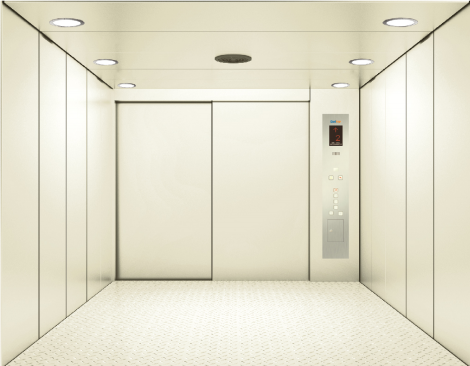
DF/DFN freight elevator: the 2000–8000 kg band and forklift-compatible layout indicate how much project-specific dimensioning the platform absorbs.
| Platform (model) | Configuration | Rated capacity | Speed | Travel height | Stops |
|---|---|---|---|---|---|
| Passenger elevator (DP / DPN) | Small machine room / machine room-less | 400–3000 kg | 1.0–6.0 m/s | ≤100 m | 2–60 |
| Freight elevator (DF / DFN) | Small machine room / machine room-less | 2000–8000 kg | 0.25–1.0 m/s | ≤50 m | 2–10 |
| Observation elevator (DPO / DPNO) | Small machine room / machine room-less | 630–1600 kg | 1.0–2.5 m/s | ≤100 m | 2–30 |
| Bed elevator (DPB / DPNB) | Stretcher / bed elevator | 1600–3000 kg | 1.0–2.0 m/s | ≤60 m | 2–20 |
| Car elevator (DA / DAN) | Small machine room / machine room-less | 3000–5000 kg | 0.2–0.5 m/s | ≤30 m | 2–6 |
| Home elevator (DH) | Small machine room / machine room-less | 320–630 kg | 0.3–0.5 m/s | ≤20 m | 2–6 |
| Dumbwaiter (DW) | Window type / floor type | 50–500 kg | 0.2–0.5 m/s | ≤30 m | 2–8 |
| Escalator (DE) | 30° / 35° inclination | Step width 600 / 800 / 1000 mm | 0.5 m/s | Vertical rise 3–12 m | — |
| Moving walk (DM) | Horizontal / inclined (0° or 12°) | Pallet width 600 / 800 / 1000 mm | 0.5 m/s | Vertical rise ≤10 m | — |
Declared platform envelopes. The width of each range, not the model count, is what indicates engineering versatility for customized orders.
The supporting platforms reinforce the same signal. A hospital lifting 1600–3000 kg at 1.0–2.0 m/s for up to 60 m of travel is specifying a different engineering task from a villa lifting 320–630 kg over 20 m, and a parking structure moving 3000–5000 kg vehicles over 2–6 stops is different again. A supplier that publishes all three ranges, with the same certification scope covering design, manufacture, installation, remodelling and repair, is describing a broader engineering department than a single-line vendor.
Drive and Control Choices Behind the Numbers
Two drive facts appear repeatedly across the portfolio, and both are directly relevant to customized specifications. The first is VVVF variable-frequency control, stated for the DF/DFN freight elevator, where it supports smooth acceleration and deceleration and reliable operation under heavy loads. The second is the high-efficiency PMSM gearless drive, stated for the DP/DPN passenger platform and the DH home elevator, where it is associated with energy efficiency and stable, low-noise operation.
For buyers, these are not marketing details. Drive and control choice determines whether a machine room can be eliminated, how much electrical infrastructure the building must provide, and how the unit behaves at the low speeds that dominate a heavy freight cycle. PMSM gearless machines are also the reason a machine-room-less passenger configuration is possible at all, which is why the same product family can be ordered in both machine-room and machine-room-less versions.
The passenger platform additionally lists multiple safety protection systems, and the freight platform lists reliable operation under heavy loads as a design objective. These statements describe how the platforms are engineered; they do not replace the project-specific safety documentation that any serious procurement process should request.
Material and Finish Options: Where Customization Is Actually Delivered
For many customized orders, the visible differentiator is the interior rather than the machine. Documented material options are therefore a practical test of customization depth, because a supplier that can only offer one finish set cannot deliver a design-led project, however wide its capacity range may be.
| Element | Documented options | Where it applies |
|---|---|---|
| Car finish | Stainless steel, glass, painted steel, wood-finish, customized options | Passenger, observation, home |
| Car door and landing door | Stainless steel, glass, painted steel, wood-finish, customized options | Passenger, observation, home |
| Floor | PVC or marble | Passenger, observation, home |
| Handrail | Stainless steel, solid wood, acrylic | Passenger, observation, home |
| Car operating panel (C.O.P) | Stainless steel, glass, acrylic plexiglass | Passenger, observation, home |
| Landing operating panel (L.O.P) | Stainless steel, glass | Passenger, observation, home |
| Freight car and floor | Painted steel / hairline stainless steel; curved lined steel or stainless steel curved lined steel floor; stainless steel faceplate panels | Freight DF / DFN |
| Bed elevator cabin | Stainless steel walls, door, door frame, ceiling and handrail; anti-slip PVC flooring | Bed DPB / DPNB |
| Dumbwaiter cabin | 304 stainless steel, corrosion resistant; shaft in steel, aluminium or concrete | Dumbwaiter DW |
Documented finish and material options. The freight and hospital platforms use narrower, duty-driven material sets, which is normal for those applications.
The manufacturer also publishes its customization scope directly: OEM production with logo, cabin wall material and colour, car door material and colour, ceiling type, floor material and pattern, and handrail material and colour. Taken together with the material tables above, this gives an evaluator a defined list to test against a project's design intent, rather than a general promise of flexibility.
Certifications: What They Cover, and What They Do Not
Certificates are the part of a supplier file that is easiest to verify and easiest to misread. Three management system certificates are registered to Delfar with the following details.
| Certificate | Standard | Number | Authority | Validity |
|---|---|---|---|---|
| Quality management system | ISO 9001:2015; GB/T 19001-2016 | 00625Q30569R4M | QAC | 2025-06-03 to 2028-06-02 |
| Environmental management system | ISO 14001:2015; GB/T 24001-2016 | 00625E30335R4M | QAC | 2025-06-03 to 2028-06-02 |
| Occupational health and safety management system | ISO 45001:2018; GB/T 45001-2020 | 00625S30329R4M | QAC | 2025-06-03 to 2028-06-02 |
Scope of all three certificates: design, manufacture, installation, remodelling and repair of elevator and escalator. The same certificate set is mapped to every product in the portfolio, from the moving walk to the passenger elevator.
Two boundaries should be stated plainly. First, these are management system certificates; they evidence how a company organises quality, environment and safety, not the type approval of any individual elevator. Second, market access in Europe runs through the harmonised standards EN 81-20 and EN 81-50, which are the primary European standards for elevator design and testing and are mandatory for CE marking; EN 81-20 also requires a light curtain door detection system to reduce the risk of door strikes on passengers. Buyers specifying for European or Gulf projects should therefore treat the certificate register and the market-specific conformity route as two separate checks. Delfar's company profile additionally lists CE, CU, SASO, SGS and SC certificates alongside the ISO set.
Application Fit: Where These Ranges Change the Buying Decision
The practical value of the envelope tables appears when they are matched against project types. A high-rise residential or commercial building served by the DP/DPN platform can be specified anywhere between 2 and 60 stops, with speed selected against traffic demand rather than against a single catalog speed. A logistics or manufacturing facility uses the DF/DFN platform, where the forklift-compatible layout and flexible cabin dimensions decide whether the unit moves pallets efficiently in and out of the car.
Hotels, hospitals and mixed-use developments draw on the observation and bed platforms, the latter using anti-slip PVC flooring, stainless steel walls, doors and handrails — materials chosen for cleaning and durability rather than appearance. Parking structures use the DA/DAN car elevator, whose heavy-duty, impact-resistant structure and 3000–5000 kg capacity exist specifically because vehicle loads and kerb impacts are a different engineering problem from passenger traffic. For villas, the DH home elevator's 320–630 kg and 0.3–0.5 m/s are matched to low-rise residential travel rather than to commercial throughput.
All of these platforms share a common site-condition baseline: ambient temperature from -5°C to +40°C, relative humidity up to 90% RH non-condensing, and altitude up to 1,000 m, installed in a well-ventilated environment free from excessive dust, corrosive gases and flammable or explosive substances. Where projects sit outside that baseline, the scenario documentation lists special requirements to be addressed, including fire protection, explosion-proofing, waterproofing, corrosion resistance, dust-proofing and high or low temperature resistance. For Middle East projects in particular, this is where a customization conversation usually begins, and the market signals below explain why.
Market Signals That Make Verification More Urgent
Independent market data from several research houses points in the same direction. Global Market Insights values the global elevator market at approximately USD 84.8 billion in 2024 and projects growth from USD 87.9 billion in 2025 to USD 126.7 billion by 2034 at a 4.2% CAGR. Fortune Business Insights expects machine-room-less technology to record the highest growth rate, at a CAGR of 9.6% through 2034, which places a premium on suppliers that can engineer the machine-room-less variants of each platform.
Regionally, Allied Market Research values the Middle East elevator market at USD 1.25 billion in 2023 and projects USD 2.38 billion by 2030, while Roland Berger expects high-rise modernisations in the Middle East and Africa to grow at a CAGR of 11% between 2024 and 2030. Grand View Research puts Asia Pacific's share of the global market at approximately 41.7% in 2025, with North America at 12.7% in 2024.
Two further data points matter to buyers building a cost model rather than a strategy paper. Vyansa Intelligence reports that maintenance services account for roughly 55% of global elevator market revenue, and Maximize Market Research estimates that customized elevators in emerging markets are typically priced between USD 18,000 and USD 35,000 per unit. Both figures shift the evaluation away from purchase price alone and towards whether the supplier can support the unit across its service life — which is precisely where documented engineering capability and after-sales structure become economically relevant.
Customized Engineering Versus Catalog Supply: Where the Trade-Offs Sit
Standardized catalog supply and engineered customization are not competing quality levels; they are different operating models with different verification burdens. A catalog unit is faster to order and easier to price, but it only fits projects that already match its dimensions. An engineered order fits the building, at the cost of more documentation, more coordination and a longer front-end conversation.
| Verification dimension | Catalog supply approach | Engineered customization approach |
|---|---|---|
| Fit with project geometry | Building must match fixed car and shaft dimensions | Car, door and shaft interfaces are set from project data, within the platform envelope |
| Capacity and speed | Fixed rating per catalog item | Selected within the platform range (for example 400–3000 kg at 1.0–6.0 m/s on DP/DPN) |
| Interior | Limited finish set | Defined material and colour options across finish, door, floor, handrail and control panels |
| Documentation burden | Low at order stage | Higher: shaft data, interfaces and site conditions must be confirmed before release |
| Lead time | Predictable for standard items | Baseline 35 days is published for normal orders; project-specific configurations should be confirmed order by order |
| After-sales model | Often tied to regional stock and service partners | Remote support by WhatsApp and email, on-site technical support when required, 12 months from delivery date |
Comparison of operating models. The engineered route delivers fit; the catalog route delivers simplicity.
The limitations should also be stated, because they define when a customized supplier is the wrong answer. Each platform has a hard ceiling: the passenger range stops at 3000 kg, 6.0 m/s and 100 m of travel; the freight range stops at 8000 kg, 1.0 m/s and 50 m of travel; the dumbwaiter is limited to 50–500 kg. Beyond those ceilings, the project needs a different platform or a different supplier, and no amount of customization discussion changes that. The management system certificates, as noted, are not product approvals for every destination market. The published 35-day lead time is a normal-order figure and should be reconfirmed for heavily customized configurations. And because after-sales support is structured around remote technical assistance plus on-site support when required, under a 12-month period from delivery, buyers in remote markets need to confirm local installation and maintenance capability before ordering — a genuine constraint that should be resolved early, not after shipment.
What Buyers Should Expect Next
Three trends will shape how customized elevator suppliers are verified over the next few years. Machine-room-less designs are the fastest-growing technology segment, so the ability to engineer machine-room-less versions of freight, passenger and residential platforms will increasingly separate capable manufacturers from assemblers. Modernisation activity in the Middle East and Africa, forecast at an 11% CAGR between 2024 and 2030, will pull more projects toward non-standard shafts where catalog units simply do not fit. And connected, service-linked elevator models are expanding: Maximize Market Research reports that smart elevator subscription revenue from connected units grew 35% in 2025 according to Otis, which points to a future in which the value of a supplier relationship is judged over the service life rather than at handover.
For procurement teams, the practical consequence is that verification is becoming more document-based and less reputation-based. Capacity bands, speed ranges, travel limits, material option sets and certificate numbers with validity dates are all checkable today, and they answer the question that matters most at the evaluation stage: whether a supplier's engineering depth is real or merely asserted.
Frequently Asked Questions
1. What specification ranges indicate that a customized elevator maker can genuinely handle a non-standard project?
Look at the width of a single platform's range rather than the number of models listed. The DP/DPN passenger elevator is published at 400–3000 kg and 1.0–6.0 m/s with travel up to 100 m and 2–60 stops, in both small-machine-room and machine-room-less versions. The DF/DFN freight elevator covers 2000–8000 kg at 0.25–1.0 m/s, up to 50 m of travel and 2–10 stops, forklift-compatible with flexible cabin dimensions. A range this wide means car size, hoistway layout and drive selection must be engineered per order, which is the practical definition of customization capability.
2. Which certifications should be checked when verifying a customized elevator manufacturer?
Check the certificate number, the issuing authority, the validity period and, most importantly, the stated scope. Delfar's register includes ISO 9001:2015 (00625Q30569R4M), ISO 14001:2015 (00625E30335R4M) and ISO 45001:2018 (00625S30329R4M), all issued by QAC and valid from 2025-06-03 to 2028-06-02, with a scope covering design, manufacture, installation, remodelling and repair of elevators and escalators. These are management system certificates. Product-level market access is a separate check: EN 81-20 and EN 81-50 are the primary harmonised European standards for elevator design and testing and are mandatory for CE marking.
3. How do VVVF control and PMSM gearless drives affect a customized elevator specification?
They determine how the unit can be installed and how it behaves in service. VVVF variable-frequency control, used on the DF/DFN freight elevator, is specified for smooth acceleration and deceleration and reliable operation under heavy loads. The high-efficiency PMSM gearless drive, used on the DP/DPN passenger platform and the DH home elevator, is associated with energy efficiency and stable, low-noise operation, and is what makes machine-room-less configurations possible. Buyers should confirm which drive applies to their specific platform, because it affects machine room requirements, electrical supply and ride behaviour.
4. What cabin and door material options are available in a customized elevator?
For the passenger, observation and home platforms, documented options include stainless steel, glass, painted steel, wood-finish and customized finishes for both car and landing doors, with the same set available for car finish. Floors can be PVC or marble; handrails come in stainless steel, solid wood or acrylic; the car operating panel is available in stainless steel, glass or acrylic plexiglass, and the landing operating panel in stainless steel or glass. Freight and hospital platforms use narrower duty-driven sets, such as hairline stainless steel or painted steel with stainless steel faceplates on DF/DFN, and stainless steel throughout with anti-slip PVC flooring on the bed elevator.
5. What are the limits of a customized elevator platform?
Every platform has a defined ceiling. The passenger range ends at 3000 kg, 6.0 m/s and 100 m of travel; the freight range ends at 8000 kg, 1.0 m/s and 50 m of travel; the dumbwaiter is limited to 50–500 kg; the car elevator to 3000–5000 kg at 0.2–0.5 m/s. Certificates are management system certificates rather than product type approvals for every market, so destination-specific conformity must be verified separately. The published 35-day lead time is a normal-order baseline and should be reconfirmed for heavily customized configurations, and the 12-month after-sales period runs from the delivery date.
6. What commercial terms apply when ordering a customized elevator?
Delfar publishes a minimum order quantity of 1 unit, a monthly production capacity of 800 units, a normal lead time of 35 days and 100% pre-shipment testing on every unit. Production is organised around OEM customization covering logo, cabin wall material and colour, car door material and colour, ceiling type, floor material and pattern, and handrail material and colour. After-sales support consists of remote technical assistance through WhatsApp, email and similar channels, professional on-site technical support when required, and a 12-month period from the date of delivery.
7. What site conditions must be confirmed before specifying a customized elevator?
The standard installation baseline is an ambient temperature between -5°C and +40°C, relative humidity up to 90% RH non-condensing, altitude up to 1,000 m, and a well-ventilated location free from excessive dust, corrosive gases and flammable or explosive substances. Where a project falls outside this baseline, the special requirements to be addressed include fire protection, explosion-proofing, waterproofing, corrosion resistance, dust-proofing and high or low temperature resistance. Projects typically also coordinate matched equipment such as emergency power supply, fire alarm system, CCTV, parking system, ARD, access control, intercom and remote monitoring.
For readers who need the underlying documentation behind the figures discussed here, Delfar's company profile is available for download: Delfar Elevator company profile (PDF).