
Vertical Application Guide: Selecting Specialized Steel Belt Systems for Sulphur Pastillation, Resin Cooling, and Food Processing in 2026
1. Industry-Specific Requirements for Steel Belt Applications
The selection of a steel belt system is rarely a one-size-fits-all decision. Different verticals impose unique demands that directly impact material choice, equipment design, and supplier capability. Understanding these nuances is the first critical step for any procurement manager.
1.1 Chemical Processing: Sulphur & Resin Pastillation
- Thermal Shock Resistance: Molten sulphur (120–150°C) or hot-melt resins (180–250°C) require belts that can withstand rapid cooling without warping or cracking.
- Corrosion Resistance: Sulphuric acid residue demands stainless steel or specially coated surfaces. Stainless steel belts (austenitic chromium-nickel grades) are preferred for their corrosion resistance and strength.
- Uniform Granulation: The steel belt’s flatness and surface finish directly affect droplet formation and cooling efficiency. A belt with ±0.045 mm thickness tolerance (as achieved by BPS/EPS carbon belts) ensures consistent pastille size.
- Environmental Compliance: Closed-loop water cooling with uncontaminated, recyclable water is mandatory in many jurisdictions. Integrated cooling systems must be designed for zero discharge.
1.2 Food Processing: Baking, Steaming & Chocolate Conveying
- Hygiene & Cleanability: Stainless steel belts (e.g., 304 or 316L) with smooth, non-porous surfaces are essential to meet FDA and EU food contact regulations. PTFE-coated steel belts offer additional non-stick properties for sticky dough or chocolate.
- Uniform Heat Distribution: Tunnel ovens and steam ovens rely on the steel belt’s thermal conductivity. Carbon steel belts with high thermal conductivity (approx. 50 W/m·K) ensure even baking of cakes, bread, and steamed products.
- Custom Fabrication: Edge retainer strips, V-ropes for tracking, and flights for inclined conveying must be food-grade and easily removable for cleaning. BPS/EPS offers UK/Germany origin V-ropes and customized retainers.
- Product Integrity: For chocolate conveying, the belt must maintain a consistent temperature to prevent blooming or melting. A stainless steel belt with active temperature control can reduce waste rates by up to 20%.
1.3 Industrial Cooling: Resin & Powder Flaking
- High Cooling Efficiency: Double-belt resin cooling flakers require belts with excellent heat transfer coefficients. Carbon steel belts (dark oxide layer) absorb and release heat rapidly, enabling compact equipment footprints.
- Mechanical Load: Epoxy and polyester resin coolers involve heavy rolls and scrapers. Belts must exhibit high static and fatigue strength. BPS/EPS carbon steel belts are heat-treated to achieve >1,000 MPa tensile strength.
- Precision Flaking: Uniform flake thickness (0.5–5 mm) demands a belt surface with high flatness (< 0.3 mm/m) and straightness. Customizable crushing sizes are supported by adjustable scraper systems.
2. Three Core Supplier Capabilities for Specialized Applications
While price and delivery are important, the following three competencies separate reliable suppliers from commodity vendors.
2.1 Industry-Specific Engineering Experience
A supplier that has delivered multiple Sulphur Pastillator or Resin Steel Belt Cooler systems possesses accumulated knowledge in spray distribution, water nozzle placement, and belt tensioning. BPS/EPS, with its global team of 40+ engineers and service centers in Shanghai, Beijing, and Guangzhou, has designed over 100 pastillation lines for clients in the Middle East, Southeast Asia, and Europe. Their Epoxy Steel Belt Cooler solutions, for instance, incorporate proprietary water flow adjustment that reduces cooling time by 15% compared to conventional designs.
2.2 Compliance and Certifications
| Standard | Required For | BPS/EPS Compliance |
|---|---|---|
| ISO 9001:2000 | Quality management system | ✓ Certified |
| ISO 14001:2004 | Environmental management | ✓ Certified |
| ATEX Directive (EU) | Explosive atmospheres (e.g., sulphur dust) | Available upon request (custom design) |
| FDA/EU 1935/2004 | Food contact materials | Stainless steel belts meet surface roughness ≤0.8 µm |
Furthermore, BPS/EPS maintains an ISO 9001:2000 certificate (see certificate) and ISO 14001:2004 (certificate), ensuring traceable manufacturing processes and environmental responsibility.
2.3 Robust After-Sales and Repair Services
Steel belts in harsh environments inevitably suffer wear, cracks, or loss of tension. A dedicated service center with rapid response is invaluable. BPS/EPS operates a maintenance center in Shanghai offering:
- On-site crack welding repair (see welding repair photo)
- Steel belt insert repair for localized damage
- Rubber V-rope bonding and replacement (using UK/Germany origin materials)
- Emergency maintenance with 48-hour response for clients in China and nearby regions.
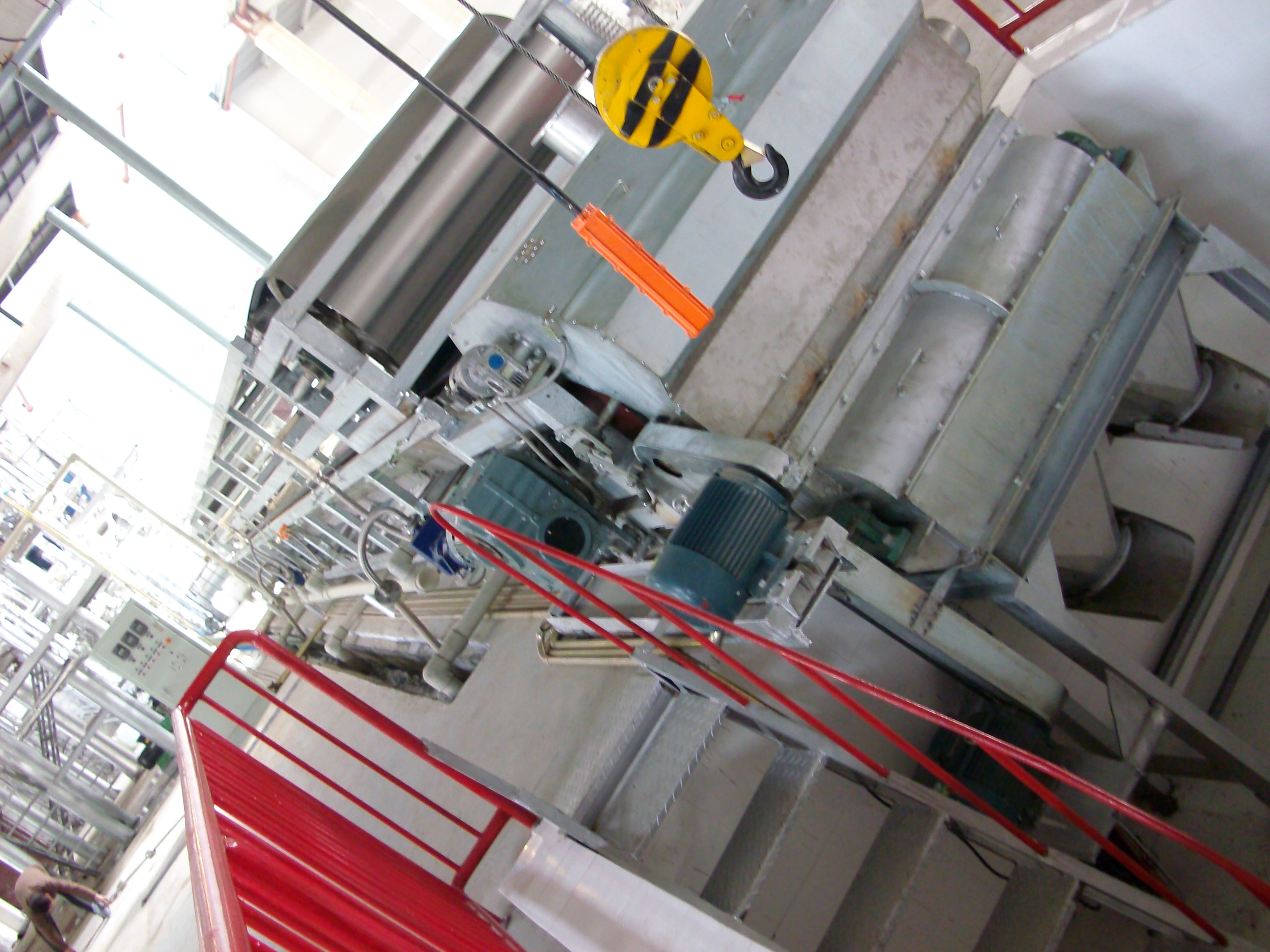
3. Case Study: Optimizing a Sulphur Pastillation Line in the Middle East
Client Profile: A large petrochemical company in Saudi Arabia required a new Sulphur Pastillator to replace an outdated rotary drum system. The key challenges were uniform granule size (2–6 mm), water conservation in an arid region, and compliance with local environmental regulations.
Solution Provided by BPS/EPS:
- Supplied a complete carbon steel belt system (open-length, on-site welded) with a width of 1,200 mm and length of 24 m. The belt’s surface was treated with a dark oxide layer for optimal thermal release.
- Designed a custom water spray bank that recycled 95% of cooling water via a closed-loop filtration system, reducing fresh water consumption by 1,500 m³ per year.
- Integrated an automatic belt tracking system with rubber V-ropes (made in Germany) to maintain alignment under varying loads.
- Provided on-site installation supervision and operator training by BPS/EPS engineers from the Shanghai service center.
Results:
- Particle size distribution: 95% within 3–5 mm (target 90%)
- Cooling water contamination: zero – water reused without treatment in other processes
- Belt life: already exceeding 3 years without major repair, based on bi-annual inspection data
- Client annual production capacity increased by 25% compared to previous drum system
This case demonstrates how BPS/EPS leverages its deep application expertise in Sulphur Pastillator systems to address both process efficiency and sustainability goals.
4. Key Cooperation Recommendations for Buyers
To ensure a successful partnership, consider these four touchpoints when engaging a steel belt and equipment supplier like BPS/EPS:
4.1 Define Industry Standards Early
Specify the exact regulatory framework (ATEX, FDA, Chinese GB, EU) during the request-for-quotation (RFQ) stage. For Sulphur Pastillation, include explosion-proof design for the electrical cabinet and spray area. BPS/EPS can adapt its standard Steel Belt Cooler design to meet ATEX Zone 22 requirements.
4.2 Require On-Site or Virtual Plant Survey
A supplier’s general arrangement drawing is not enough. Insist on a detailed site survey to measure floor space, available utilities (water pressure, electrical power), and ambient conditions (humidity, dust). BPS/EPS engineers routinely travel to client sites globally, or can conduct a comprehensive virtual assessment using 3D models and video conferencing.
4.3 Agree on Spare Parts and Emergency Response Plan
Even the best belts need replacement or repair. Negotiate a spare parts package including at least one emergency belt section, V-ropes, and critical seals. For BPS/EPS, the Shanghai central warehouse stocks common sizes of carbon steel belts and stainless steel belts, enabling same-day dispatch for local clients. For international buyers, a lead time of 2–3 weeks is standard.
4.4 Validate Commissioning and Training Commitments
Ensure the supplier provides hands-on training for your maintenance team on belt welding, V-rope replacement, and tension adjustment. BPS/EPS offers a full commissioning package that includes a 3-day on-site training program and a digital operation manual. After commissioning, a scheduled 6-month follow-up maintenance visit is recommended to catch early wear.
Conclusion: The Strategic Value of a Specialized Partner
Selecting the right steel belt supplier is not merely a procurement exercise—it is a strategic decision that impacts production uptime, product quality, and environmental compliance. As the market moves toward integrated solutions that combine belt, equipment, and service, buyers should prioritize partners with proven industry-specific track records. BPS/EPS, with its comprehensive portfolio—from Double-belt resin cooling flaker to Steel belt bakery tunnel oven and Chocolate Steel Belt Conveyor—exemplifies the value of such integration. Backed by ISO certifications, a global service network, and a mission to “serve globally based in China,” BPS/EPS is positioned as a reliable partner for demanding applications.
By applying the framework outlined in this guide—understanding specific application needs, evaluating core supplier capabilities, validating through case studies, and structuring cooperative agreements—procurement professionals can confidently navigate the 2026 market and secure a supplier that delivers long-term operational excellence.
For further technical discussions or to schedule a plant survey, contact BPS/EPS at: Phone: +86-13916661495 / +86-21-68904153 Email: ken.feng@bpstek.com / sales@bpstek.com Website: www.bpstek.com Address: No.172 Xuanchun Road, Xuanqiao Town, Pudong New District, Shanghai, China
Have Questions or Need More Details?
Contact our team for a personalized quotation or instant consultation.
Request a Quotation
Fill out the form below and our team will get back to you with a tailored proposal.
WhatsApp Direct Chat
Prefer to chat in real-time? Message us on WhatsApp for instant assistance & quick answers.
- Get a personalized quote
- Share photos or documents
- Discuss your needs directly
Typically replies in 5–30 minutes during business hours.