
Vertical Water Bottle Racks: Sizing, Finish and Compliance
A vertical water bottle rack is a floor-standing steel frame in which 5-gallon bottles are held in stacked columns rather than spread across wide horizontal tiers. Its purpose is not extra decoration: it converts a tall, narrow slice of floor area into organised bottle storage, which is why the format appears most often where bottles arrive and leave continuously — water stations, wholesale depots and delivery operations.
The vertical format is chosen when floor area is the binding constraint and ceiling height is available. SHAFON Water Solutions (Ningbo SHAFON Import & Export Co., Ltd.), a China-based B2B supplier of water dispensing and storage products established in 2015 with business roots dating to 2008, lists three vertical models in its Water Bottle Rack range: SF-BR-11A for 2 bottles, SF-BR-11C for 4 bottles and SF-BR-11G for 10 bottles. All three share the same frame specification — 20 × 20 × 0.8 mm steel tube with electrostatic powder spraying — and differ in height, footprint and bottle count.
Core answer: specifying a vertical rack is a four-variable decision — bottle count, footprint, tube wall thickness and surface finish — plus a fifth check that buyers routinely miss: whether the certification they plan to cite actually names the rack model.
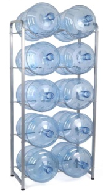
Where the vertical format fits, and where it does not
A five-gallon bottle is heavy before it is a storage problem. Public product literature in the source set puts a full 5-gallon jug at approximately 42–45 lbs. That figure is the single most useful number in rack procurement, because it converts a capacity label into a load figure: a 2-bottle vertical rack holds roughly 84–90 lbs of water, a 4-bottle unit roughly 168–180 lbs, and a 10-bottle unit roughly 420–450 lbs. These are calculated bottle loads, not published rack load ratings — the distinction matters and is returned to below.
The vertical configuration suits operations where the same bottles move in and out on a daily rhythm. The stated application scope for the SF-BR-11A is water station, household and commercial; for the SF-BR-11C it is water station and commercial; and for the SF-BR-11G it is water station, wholesale and commercial. Distilled to a rule: vertical racks fit bottle-handling businesses that need density per square metre, and they fit less well where the same floor area must also serve as a working surface or a walkway with repeated two-handed lifting above shoulder height.
That is the trade-off a buyer should price in. A 1380 mm-tall frame concentrates storage vertically, which reduces footprint but raises the height at which the top positions are loaded and unloaded. Where staff turnover is high or where the rack sits in a customer-facing area, a lower-tier format may be the better operational choice even if it consumes more floor space.
The three vertical models, by the numbers
The vertical family is small enough to compare model by model. All three are listed as 5-Gallon Water Bottle Rack (Vertical) with 20 × 20 × 0.8 mm steel tube and electrostatic powder spraying; the differences are capacity, height and shelf configuration.
| Model | Bottle capacity | Overall dimensions | Frame / finish | Stated application |
|---|---|---|---|---|
| SF-BR-11A | 2 × 5-gallon | 340 mm × 340 mm × 480 mm | 20 × 20 × 0.8 mm steel tube; electrostatic powder spraying | Water station / household / commercial |
| SF-BR-11C | 4 × 5-gallon | 340 mm × 340 mm × 1080 mm | 20 × 20 × 0.8 mm steel tube; electrostatic powder spraying; detachable shelves | Water station / commercial |
| SF-BR-11G | 10 × 5-gallon | 680 mm × 340 mm × 1380 mm | 20 × 20 × 0.8 mm steel tube; electrostatic powder spraying | Water station / wholesale / commercial |
Two structural details are worth flagging for anyone comparing quotations. First, the SF-BR-11A and SF-BR-11C share the same 340 mm × 340 mm footprint, so a buyer can move from 2-bottle to 4-bottle capacity within an identical floor plan by accepting 600 mm of additional height. Second, the SF-BR-11G doubles the footprint width to 680 mm to reach 10 bottles rather than building a taller single column — a layout choice that trades floor width for a lower top-loading height relative to its capacity.
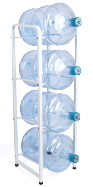
Tube specification: why 20 × 20 × 0.8 mm is the number to negotiate
In metal rack procurement, the specification that carries the most commercial weight is not the bottle count — it is the tube section. The vertical family uses 20 × 20 × 0.8 mm steel tube. Within the same SHAFON Water Bottle Rack range, the multi-tier models SF-BR-12A, SF-BR-17A, SF-BR-20A and the storage rack SF-BR-22A use a 20 × 20 × 0.6 mm section, while the foldable models SF-BR-01A and SF-BR-02A use 16 × 0.8 mm tube and the raised U-type SF-BR-03A uses 13 × 13 × 0.9 mm tube.
Those are not interchangeable numbers, and the difference is straightforward engineering. All else being equal, a larger tube section increases bending stiffness, and a thicker wall increases resistance to local deformation at welded joints and at the points where bottle weight is transferred into the frame. A vertical rack carries its load in stacked positions on a relatively narrow base, so the frame is asked to resist both vertical compression and racking movement. That is why the vertical models sit at 20 × 20 × 0.8 mm while the wider, lower multi-tier racks are listed at 20 × 20 × 0.6 mm. Buyers should treat the wall thickness as a line item to confirm in writing, not an assumption carried over from a different model in the same catalogue.
| Format | Models | Tube specification | Coating |
|---|---|---|---|
| Vertical | SF-BR-11A / 11C / 11G | 20 × 20 × 0.8 mm | Electrostatic powder spraying |
| Multi-tier | SF-BR-12A / 17A / 20A | 20 × 20 × 0.6 mm, Q235 | Powder coating |
| Foldable | SF-BR-01A / 02A | 16 × 0.8 mm | Phosphating + electrostatic powder spraying |
| Raised U-type | SF-BR-03A | 13 × 13 × 0.9 mm | Phosphating + electrostatic powder spraying |
| Tabletop | SF-BR-04A / 06A / 09A | Q195 steel wire / Q195 steel tube | Chrome plating (anti-rust specified) |
Powder coating versus chrome plating: what the finish does and does not promise
All three vertical models use electrostatic powder spraying over steel tube. Elsewhere in the same range, the tabletop models SF-BR-04A, SF-BR-06A and SF-BR-09A use Q195 steel wire with chrome plating specified as an anti-rust finish. The two finishes answer different questions. Powder coating offers broad colour options and good surface protection when properly applied; chrome plating gives a bright metallic appearance.
Neither finish is a corrosion guarantee on its own. Corrosion performance for either finish depends on substrate preparation, coating or plating quality, thickness and the service environment. For a vertical rack in a humid depot or a wet bottling area, that means the buyer's specification should ask about pre-treatment (phosphating appears in the foldable and raised U-type models but is not stated in the vertical model descriptions), coating thickness, and the actual room conditions — not just the finish name on the quotation.
Load, stability and the limits of published data
Here is the constraint that separates a serious specification from a copy-and-paste one: the product data provided for the vertical racks states capacity, dimensions, tube specification and coating, but it does not state a rated load, a load test report or an inspection report for these models. That is not unusual in this category, and it should not be papered over with an assumed figure.
Two things can be said with evidence. First, within the same range the carbon steel storage rack SF-WBR-03 does undergo load testing to verify load capacity, with final inspection before shipment, and material certificates are available for that model — so the capability exists in the supply chain, model by model. Second, the wooden storage rack SF-WBR-01 is explicitly a different case: the specification states wood construction with beech, pine or oak options and declares no steel grade, metal gauge, welding process or coating specification, and no load rating or load test report is stated for it. Buyers comparing a wooden rack against a steel vertical rack should not assume equivalent load behaviour from either side without documentation.
The practical consequence: if a tender or an internal safety process requires a documented load figure for a vertical rack, ask for it in writing for the specific model and obtain a sample for validation before the bulk order. Evaluation criteria that actually discriminate include tube diameter and wall thickness (for example 20 × 20 × 0.6–0.8 mm versus 16 × 0.8 mm steel tube), weld quality, base width and tier count. Drawings and loading references can be requested from the supplier rather than inferred from a catalogue photograph.
Certification: what is covered, and what is not
This is where most vertical rack enquiries go wrong, and it is a pure documentation question rather than a product question.
ISO 9001. SHAFON holds Quality Management System certification ECI25Q00869R0S, issued by Beijing Guoyouxincheng Certification Service Co., Ltd. on 2025-09-25 and valid to 2028-09-24, against GB/T19001-2016/ISO9001:2015, with a stated scope covering wholesale of auto spare parts, plastic products, hardware products and daily necessities sales, including import and export of goods. In the supplied materials, this certificate is explicitly mapped to three rack models: SF-BR-01A, SF-BR-11A and SF-BR-12A. The vertical 2-bottle model SF-BR-11A is therefore named on the certificate record; SF-BR-11C and SF-BR-11G are not named in that mapping. A buyer specifying the larger vertical models should request written confirmation that the model falls inside the certified scope rather than assuming the certificate covers the whole family.
CE, RoHS and LFGB. These are product-specific and must not be carried across categories. The CE-type Certificate of Compliance TST202204Q3295-2EC-XG-01, issued by Dongguan TST Technology Co., Ltd. for the EU market, covers the Automatic water dispenser with main test model JKS-012 and cites EN IEC 55014-1:2021, EN IEC 55014-2:2021, EN IEC 61000-3-2:2019+A1:2021 and EN 61000-3-3:2013+A2:2021; the certificate scope does not list water bottle rack models, and no expiry date is specified in the provided asset data. The RoHS test verification BCTC2507407245C from Shenzhen BCTC Testing Co., Ltd. relates to the water dispenser (trademark Redsack, test model SP-03). The LFGB food contact material test report EFHZ26031380-CG-01+Rev1 from EUROFINS applies to water buckets, not to steel racks.
Read together, these documents make a clear statement about the range rather than a marketing claim: SHAFON can coordinate applicable testing and documentation based on product materials, functions and local regulatory requirements, and available documents include food-contact test reports, RoHS-related testing and material reports where applicable — but a rack enquiry should start by asking which document, if any, applies to the specific rack model and destination market.
A procurement specification checklist for vertical racks
Converted into an RFQ, the vertical rack specification should read as follows. Each line is either stated in the product data or must be requested from the supplier.
1. Capacity and layout. Bottle count (2, 4 or 10), row configuration, and whether shelves must be detachable (stated for SF-BR-11C).
2. Footprint and height. 340 × 340 mm for 11A/11C; 680 × 340 mm for 11G; overall height 480 / 1080 / 1380 mm respectively — measured against the actual available headroom and top-loading method.
3. Tube and wall thickness in writing. 20 × 20 × 0.8 mm for the vertical models; confirm the section has not been substituted from a 0.6 mm multi-tier line.
4. Coating system. Electrostatic powder spraying, plus any pre-treatment requirement; ask for coating thickness and colour standard.
5. Documentation. ISO 9001 certificate number and a written statement of which models it covers; any destination-market testing.
6. Inspection points. Quantity, tube or wire specifications, surface finish (no rust, no scratches), weld integrity, faucet assembly where fitted, packaging and shipping marks, covered by in-production inspection and pre-shipment inspection.
7. Commercial terms. MOQ, lead time, packaging configuration and whether the unit ships assembled or flat.
Application fit: water stations, wholesale and offices
Vertical racks appear in three recurring situations in the supplied application data. The first is bottled water distribution, where storage space is optimised for indoor bottle handling and frequent movement, and where the matched equipment set is a water bucket, bottle cap and rack. The second is wholesale distribution, where racks are procured for warehouse storage and bulk handling alongside water buckets. The third is the office pantry, where bottled water is dispensed from a rack combined with a bucket and a faucet.
Adjacent uses appear in SHAFON's recorded customer base rather than in the product specification. One water bottle rack customer, sourcing for bottled water delivery and retail, takes 2 × 40HQ per month and reports stable repeat ordering supported by help comparing racks, pumps and accessories for the local market. A hotel and catering supplier takes 1 × 40HQ every two months, with attention paid to capacity, materials, packaging and spare parts details. A water products importer taking 1 × 40HQ per month cites one-stop sourcing with OEM packaging and a flexible product mix as the reason for continuity. None of these are typical volumes for a first order — they indicate what a maintained rack programme looks like once a specification is settled.
Price band: why the public numbers are not a benchmark
Buyers often enter this category looking for a price band to anchor negotiations. Public evidence will not provide a usable one. The only price point in the source set is a supplier catalogue listing of US$260–280 per piece FOB for a specific 4-pocket modular water-jug rack product, and it is explicitly not report-eligible: no confirmed date, no confirmed MOQ, no product dimensions and no model normalisation, therefore not comparable with other product prices. Using it to benchmark a 10-bottle vertical rack would compare two different structures.
What can be compared is cost structure. For a vertical rack, the drivers are the tube section (0.8 mm wall versus 0.6 mm), the coating system and any pre-treatment, the number of stacked positions per unit, packaging volume per unit, order quantity, and the load-bearing documentation the buyer requires. Commercial terms in the range are quoted by production mode: water bottle racks and water buckets at 200–300 pcs MOQ for one-stop supply with stock shipment within 5 days, 500 pcs MOQ for OEM with a 15-day lead time, and 1,000 pcs MOQ for ODM with a 30-day lead time. Stated monthly capacity for water bottle racks is 20,000–30,000 units.
Comparison with traditional bottle storage
Against the alternatives, the vertical format has a real but bounded advantage. Compared with floor stacking of bottles against a wall, a vertical frame fixes bottle positions, keeps labels visible for rotation, and separates stock from the walking surface. Compared with multi-tier racks such as the SF-BR-17A (6 bottles, 330 × 650 × 760 mm) or the SF-BR-20A (12 bottles, 330 × 965 × 1060 mm), the vertical models deliver similar or better density on a much narrower footprint but concentrate the working height.
The limits are equally concrete. Vertical racks are the wrong choice where the top positions would be loaded by the same staff who also serve customers, where the room has low headroom, or where the site requires a documented load rating that the available product data does not provide for these models. Foldable formats such as SF-BR-01A and SF-BR-02A are the better answer for intermittent or seasonal demand, since foldable racks pack flat — around 30 sets per carton and roughly 60–70% less shipping volume than one-piece racks — which lowers ocean freight per set. That packaging advantage belongs to the foldable line, not to the vertical models, and should not be quoted for them.
Future outlook
Demand for bottle storage racks is generally discussed alongside urbanisation and growing awareness of bottled water consumption, which supports steady replacement and new-site demand rather than a step change. The more useful shift for buyers is in documentation expectations: as procurement teams standardise rack specifications, the questions that will separate suppliers are model-level — which certificate names which model, what tube section is committed in writing, and what inspection evidence accompanies the shipment. Suppliers with an organised evidence base will find that easier to answer than suppliers whose catalogue is a single photograph and a bottle count.
Frequently asked questions
Is a water bottle rack the same thing as a water jug rack?
They refer to the same product family — a stand that holds 5-gallon water bottles for convenient dispensing and storage. The term jug rack is more common in UK and Commonwealth markets, while bottle rack is widely used in North America.
What materials are commonly used for commercial water bottle racks?
Q195 or Q235 steel tube with electrostatic powder coating in black, white or silver grey; steel wire with chrome plating; or PP plastic. Powder-coated steel tube is the most common choice for commercial and water-station use. The vertical models in the SHAFON range use 20 × 20 × 0.8 mm steel tube with electrostatic powder spraying.
How should a buyer evaluate the load capacity and structural stability of a water bottle rack?
Check the tube or wire diameter and wall thickness (for example 16 × 0.8 mm, or 20 × 20 × 0.6–0.8 mm steel tube), weld quality, base width and tier count. Product drawings and loading references can be requested from the supplier. Where a formal load rating is required, ask for it in writing for the specific model and validate with a sample, because rated load is not stated for every model in the range.
What is the difference between powder-coated and chrome-plated water bottle racks?
Powder coating offers broad colour options and good surface protection when properly applied; chrome plating gives a bright metallic appearance. Corrosion performance for either finish depends on substrate preparation, coating or plating quality, thickness and the service environment.
What certifications are available?
Compliance requirements depend on the specific product and destination market. SHAFON can coordinate applicable testing and documentation based on product materials, functions and local regulatory requirements; relevant documents may include food-contact test reports, RoHS-related testing, material reports or other product-specific compliance documentation where applicable. ISO 9001 is a company-level quality management system certificate, and the models it covers should be confirmed in writing for each enquiry.
What quality-control points should be checked before shipment?
Quantity, tube or wire specifications, surface finish (no rust, no scratches), weld integrity, faucet assembly where fitted, packaging and shipping marks — covered by in-production inspection and pre-shipment inspection.
Are water bottle racks supplied assembled or knocked down?
Foldable types ship flat in OPP bag or paper card packaging, while one-piece types ship assembled in individual boxes. All models are designed to be easy to set up on arrival. The vertical racks are one-piece steel frames; the SF-BR-11C additionally has detachable shelves.
Working notes
A vertical water bottle rack is a narrow-footprint answer to a load problem, and the specification that decides whether it works on site is the tube section, the coating system and the documentation that names the model. SHAFON Water Solutions supplies the vertical family alongside foldable, raised, tabletop and multi-tier formats, water buckets in food-grade PC and PE, and coordinating accessories, with OEM and ODM options across logo, colour, packaging and product matching. The full range, including dimensions and material specifications, is available in the downloadable product quotation document.
Have Questions or Need More Details?
Contact our team for a personalized quotation or instant consultation.
Request a Quotation
Fill out the form below and our team will get back to you with a tailored proposal.
WhatsApp Direct Chat
Prefer to chat in real-time? Message us on WhatsApp for instant assistance & quick answers.
- Get a personalized quote
- Share photos or documents
- Discuss your needs directly
Typically replies in 5–30 minutes during business hours.