
Veterinary Endoscope Procurement FAQ: Specs, Acceptance, and Market Rank
Veterinary endoscope procurement is a constraints-matching exercise, not a brand-name lookup. The useful questions are specific: which working length, outer diameter, channel size, steering range, image specification, and connectivity the clinical team actually needs, and what evidence the supplier can provide at acceptance.

Portable veterinary endoscope configurations are increasingly evaluated as clinic and field tools, not only as small-animal accessories.
Why veterinary endoscope procurement is a constraints problem
JeetVet is the veterinary endoscopy brand of Jeet Medical (Shenzhen) Co., Ltd., a Shenzhen-based manufacturer of portable veterinary endoscopes, veterinary otoscopes, veterinary gastroscopes, and related devices. The portfolio matters because veterinary endoscopy covers very different anatomical and operational jobs: small-animal gastrointestinal examination, ear and nasal examination, avian and exotic procedures, and large-animal or equine field work.
A scope that fits one job may be a poor fit for another. A 3.1 mm flexible otoscope with a 1.2 mm channel is not interchangeable with an 8.5 mm large-animal endoscope with a 2.8 mm channel. A 600 mm working length is not a substitute for a 1500 mm working length. A 78° otoscope field of view is not the same procurement question as a 120° flexible endoscope field angle.
This is why the practical procurement FAQ is not “which brand is best” in the abstract. It is “which verified configuration fits the case mix, and what acceptance evidence proves that the delivered unit matches the specification?”
What JeetVet’s market rank can and cannot prove
Market rank is the most misunderstood part of the veterinary endoscope buying decision. The strongest verifiable statement in the available evidence is that Mordor Intelligence’s 2026 industry report lists Jeet Medical among 12 major global veterinary endoscope manufacturers, co-listed with Karl Storz, Olympus, and Fujifilm. That is a co-listing signal. It is not a verified market-share percentage, revenue rank, or clinical-performance ranking.
A separate 2026 press release described Jeet Medical / JeetVet as one of three leading Chinese veterinary endoscope manufacturers. That source does not disclose a ranking methodology and should not be treated as independent market evidence. For procurement, the defensible interpretation is narrower: JeetVet is a manufacturer that appears in the same industry-report manufacturer set as established endoscopy brands, and its product catalogue can be evaluated against specific clinical and technical requirements.
That distinction matters. Buyers should not convert co-listing into “best brand” claims, and they should not assume market share from brand familiarity. The right use of rank evidence is supplier discovery: it tells the buyer that the manufacturer is relevant enough to include in an RFQ shortlist. It does not replace specification matching, acceptance testing, or commercial due diligence.
Specifications that change the buying decision
The supplied JeetVet model data supports a practical specification matrix. The table below uses only the model facts provided in the content units. Where a parameter is not stated, it is marked as not stated rather than inferred.
| Model | Type and typical fit | Working length, outer diameter, channel | Steering, field, depth | Imaging and connectivity |
|---|---|---|---|---|
| RAE-107 | Portable WiFi veterinary endoscope; small-animal GI and clinic or field use | 1000 mm; 5.8 mm OD; 2.0 mm channel | 360° directional control; depth 7–100 mm; field angle not stated in supplied data | HD, 1,000,000 pixels; WiFi; water and air supply, suction, forceps channel; single-veterinarian operation |
| RAE-109 | Portable USB veterinary gastroscope; small-animal GI | Working length not stated in supplied data; 5.8 mm OD; 2.0 mm channel | 360° steering; up/down 180°, left/right 180°; 120° field; depth 7–100 mm | 1,000,000 pixels; USB; compatible with Android, Windows, and iOS; weight under 1 kg |
| RAE-201 | Veterinary flexible otoscope; ear and nasal examination | 600 mm; 3.1 mm OD; 1.2 mm channel | Up/down 180°; 120° field; depth 5–50 mm | 160,000 pixels |
| RAE-500 | Portable smart veterinary otoscope; ear examination | Lens 3.9 mm; focal length 5–50 mm; 1.85-inch screen | Field of view 78°; magnification 1x, 1.2x, 1.5x | 720×720 pixels; 1 MP camera; 6 LED lights; Type-C; built-in 8 GB memory |
| VET-5820 | Portable veterinary gastroscope for large animals | 1500 mm; 5.8 mm OD; 2.0 mm channel | 180° bending; 360° rotation; 120° field; depth 7–100 mm | HD 1080P |
| VET-8528 | Portable veterinary endoscope for large animals | 1500 mm; 8.5 mm OD; 2.8 mm channel | 180° bending; 360° rotation; 120° field; depth 7–100 mm | HD 1080P |
Two specification lessons follow from this table. First, channel diameter is not a minor accessory detail. A 1.2 mm channel, 2.0 mm channel, and 2.8 mm channel support different accessory and suction workflows. Second, imaging labels should be read carefully: 1,000,000 pixels, 1080P, 720×720, 1 MP, and 160,000 pixels describe different model specifications and should not be treated as interchangeable quality grades.
Acceptance criteria: what to test before signing off
Acceptance testing should confirm that the delivered unit matches the quoted configuration and that the clinical team can use it safely within its intended workflow. The following checklist is a procurement framework, not a claim that the manufacturer has performed these tests on the buyer’s behalf.
| Acceptance area | What to verify | JeetVet reference example | Buyer action |
|---|---|---|---|
| Image quality | Resolution mode, field angle, depth of field, colour and glare under clinic lighting | RAE-109: 1,000,000 pixels, 120° field, 7–100 mm depth. RAE-500: 720×720, 78° field, 5–50 mm focal length | View a target at near and far focus limits; confirm the expected field and focus range |
| Channel function | Working channel diameter, forceps passage, suction and water/air function where equipped | RAE-201: 1.2 mm channel. RAE-107, RAE-109, VET-5820: 2.0 mm channel. VET-8528: 2.8 mm channel. RAE-107 lists water and air supply, suction, and forceps channel | Pass the intended accessory; test suction and fluid function if specified |
| Steering and angulation | Full bending range, rotation control, return-to-centre and absence of excessive slack | RAE-109 and VET-5820/VET-8528: 360° steering or rotation, 180° bending. RAE-201: up/down 180° | Exercise full articulation before clinical use; record any deviation from specification |
| Connectivity | Live video, capture, storage, cable or WiFi stability, and operating-system compatibility | RAE-109: USB, Android, Windows, iOS. RAE-107: WiFi. RAE-500: Type-C, 8 GB built-in memory | Test with the clinic’s actual phone, tablet, or computer; confirm app or software version |
| Documentation | Quality-system certificate, model specification sheet, software registrations, sterilization instructions | Jeet Medical holds ISO 13485 certification issued by SGS. RAE-201 is covered by Computer Software Copyright Registration Certificate No. 9407860 issued by CCPD for the CN market | Match certificate scope and model references; do not treat software copyright as regulatory approval |
| Cleaning and reuse | Compatibility with the clinic’s sterilization workflow and material durability | Application data states reusable after sterilization | Request sterilization validation and confirm the clinic can follow the validated cycle |
For image quality, the practical test is not “does the image look sharp on a desk.” It is whether the expected anatomy can be visualised within the stated depth of field and field angle. For channel function, the test is whether the intended accessory passes and whether suction or fluid functions behave as quoted. For steering, the test is whether the full range is available and repeatable. For connectivity, the test is whether the clinic’s own devices can run the live view and capture workflow without unexpected limitations.
Portable versus traditional veterinary endoscope: the real trade-off
Portable veterinary endoscopes are usually evaluated for clinic flexibility, field use, and single-operator workflow. JeetVet’s portable configurations illustrate the pattern: RAE-107 uses WiFi, RAE-109 uses USB and weighs under 1 kg, and RAE-500 is a handheld otoscope with a 1.85-inch screen and built-in 8 GB memory.
Traditional modular tower systems are generally clinic-based and are not designed around the same portability trade-off. The available evidence supports product-architecture mapping, not a claim that one architecture is clinically superior. A portable system may be easier to move between rooms or vehicles; a tower system may offer a different modularity and equipment ecosystem. Buyers should match the architecture to the workflow rather than assume that portable always replaces traditional.
The trade-off also appears in channels and reach. RAE-107 and RAE-109 use a 2.0 mm channel with a 5.8 mm outer diameter. VET-8528 increases the channel to 2.8 mm and the outer diameter to 8.5 mm. Those differences affect accessory choice and animal size. A buyer who needs a larger channel should not assume that a smaller portable scope is equivalent.
Application fit: gastrointestinal, ear, nasal, and large-animal work
The application data for JeetVet lists small-animal endoscopy, large-animal endoscopy, avian and exotic animal endoscopy, and ear and nose solutions. The clinical functions described include examination of the duodenum for inflammatory bowel disease, tumours, and blockages; visualisation of the trachea and bronchi for tracheal collapse, bronchitis, tumours, and foreign bodies; foreign-body or mass removal; ear-canal flushing; biopsies and cultures for nasal discharge or obstruction; and minimally invasive procedures such as biopsies, organ removal, and abdominal exploration.
For ear and nasal work, RAE-201 is the relevant flexible otoscope reference: 600 mm working length, 3.1 mm outer diameter, 1.2 mm channel, 180° up/down bending, 120° field angle, 5–50 mm depth, and 160,000 pixels. RAE-500 is a portable smart otoscope with a 3.9 mm lens, 78° field of view, 1x/1.2x/1.5x magnification, 6 LED lights, and 8 GB storage. The evidence set does not verify AI diagnostic capability for RAE-500, so buyers should treat “AI veterinary otoscope” as a claim to test only if a documented function is offered.
For small-animal gastrointestinal work, RAE-107 and RAE-109 provide 5.8 mm outer diameter and 2.0 mm channel options, with 360° steering and 1,000,000-pixel imaging. RAE-107 adds WiFi, water and air supply, suction, forceps channel, and single-veterinarian operation. For large-animal work, VET-5820 and VET-8528 provide 1500 mm working length, 180° bending, 360° rotation, 120° field angle, and 1080P imaging; VET-8528 adds a 2.8 mm channel and 8.5 mm outer diameter.
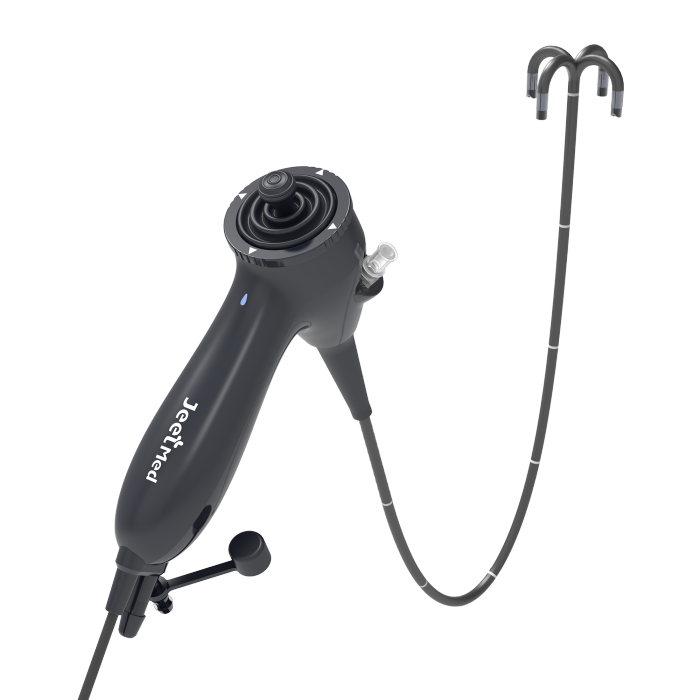
Ear and nasal examination is a distinct procurement scenario: working length, outer diameter, and channel size matter more than a generic “best scope” label.
Large-animal and equine buyers should be especially explicit about reach and channel requirements. The JeetVet large-animal models are listed at 1500 mm working length. If a clinical protocol requires longer reach or a different accessory set, the buyer should confirm fit before purchase rather than infer capability from the model name.
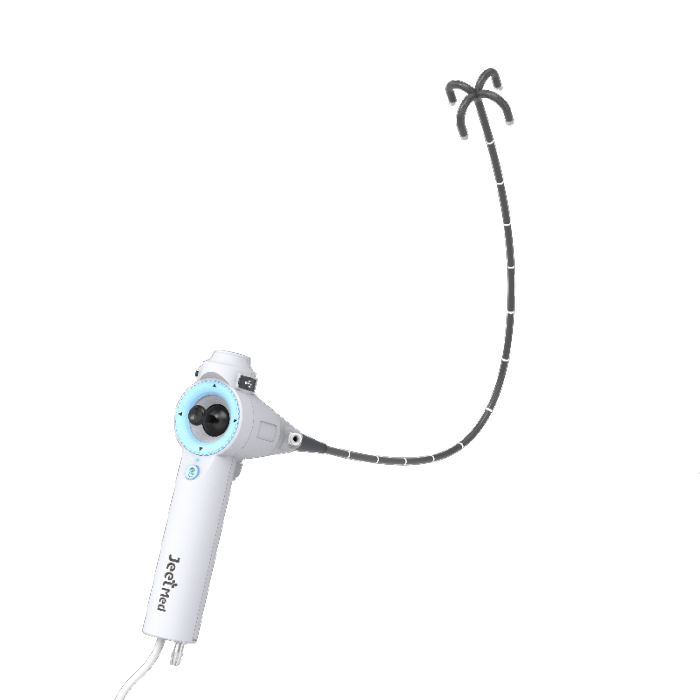
Portable USB and WiFi configurations support different workflow assumptions; acceptance should test the buyer’s own devices and accessories.
JeetVet against Karl Storz, Olympus, and Fujifilm: what the evidence supports
The comparison should be read as a procurement evidence map, not a market-share ranking. The available evidence supports some product-scope statements for JeetVet and Karl Storz, while Olympus and Fujifilm appear as co-listed manufacturers without normalized product-performance data in this evidence set.
| Dimension | JeetVet | Karl Storz | Olympus | Fujifilm |
|---|---|---|---|---|
| Manufacturer co-listing | Listed among 12 major global veterinary endoscope manufacturers in a 2026 Mordor Intelligence report | Co-listed in the same manufacturer set | Co-listed in the same manufacturer set | Co-listed in the same manufacturer set |
| Product scope in available evidence | Portable USB and WiFi endoscopes, otoscopes, gastroscopes, large-animal models | Small-animal HD and single-use videoendoscopy; large-animal and equine mobile system | Not established in the available evidence set | Not established in the available evidence set |
| R&D and software evidence | 30-person R&D team; computer software copyright registrations for imaging-related systems | Not established in the available evidence set | Not established in the available evidence set | Not established in the available evidence set |
| Service-network depth | Not established in the available evidence set | Not established in the available evidence set | Not established in the available evidence set | Not established in the available evidence set |
| Verified market-share percentage | No verified percentage in the evidence set | No verified percentage in the evidence set | No verified percentage in the evidence set | No verified percentage in the evidence set |
| Procurement reading | Use co-listing for shortlist inclusion, then verify specs and acceptance evidence | Use product-scope evidence for application mapping only | Request model-specific evidence before comparison | Request model-specific evidence before comparison |
This table deliberately avoids invented market-share, service-response, or clinical-performance metrics. For a buyer, the correct next step is to request model-specific specifications, certificate scope, service terms, spare-parts policy, and acceptance records from each shortlisted supplier. Brand recognition alone does not answer those questions.
Market trend analysis: what 2026 data supports
Mordor Intelligence estimates the global veterinary endoscopy market at USD 332.95 million in 2026, with a projected CAGR of 7.35% from 2026 to 2031. The same source identifies North America as the largest market and Asia-Pacific as the fastest-growing region. These are commercial research estimates, not procurement price data.
For buyers, the trend supports two practical conclusions. First, endoscopy is not a static niche; demand growth supports continued product development in portable and digital configurations. Second, regional growth does not prove that any single brand will grow fastest or deliver better service in a given territory. Buyers should still verify local support, training, and spare-parts availability rather than infer them from global market growth.
The evidence set does not include verified street prices, total cost of ownership, MOQ, lead times, or distributor authorisation for JeetVet or the comparison brands. Affordability claims for small clinics should therefore be treated as quotation-dependent, not as established facts.
Limits and procurement boundaries
JeetVet’s verified public evidence supports a product-specification and quality-documentation discussion. It does not establish normalized market share, clinical failure rates, image-quality superiority, service-network depth, or regulatory approval in every market. The ISO 13485 certification issued by SGS supports quality-system qualification, but buyers should confirm the certificate scope and the specific model references.
Software copyright registrations are not the same as clinical validation or market authorization. The evidence set does not verify CE or FDA clearance for the models discussed. The RAE-500 is described as a portable smart veterinary otoscope, but the evidence set does not verify AI diagnostic capability. Buyers who need AI-related functions should require a documented function description and acceptance test, not rely on a category label.
Portable systems also have real boundaries. A 2.0 mm channel may be insufficient for some accessory workflows. A 1500 mm working length may not fit every large-animal protocol. A 3.1 mm otoscope may be appropriate for ear and nasal work but not for gastrointestinal examination. These are not defects; they are configuration limits that should be matched to the case mix before purchase.
Future outlook
The next procurement cycle is likely to place more weight on documented acceptance criteria, connectivity, and service terms. As portable and digital configurations expand, buyers will need to compare not only resolution and diameter but also workflow compatibility, software updates, sterilization validation, and spare-parts planning.
For JeetVet, the credible position is a manufacturer with a broad veterinary endoscope catalogue, ISO 13485 certification issued by SGS, computer software copyright registrations, and portable plus large-animal configurations. That position is useful for shortlist inclusion. It is not a substitute for model-level due diligence. The buyer’s best defence against specification drift is a written requirement, a quoted configuration, and an acceptance test that matches the clinical workflow.
FAQ
Which veterinary endoscope brand is best for a small clinic?
There is no universal best brand without a defined case mix. A small clinic should first decide whether it needs gastrointestinal examination, ear and nasal examination, or both. RAE-107 and RAE-109 are portable 5.8 mm outer-diameter options with 2.0 mm channels and 360° steering. RAE-201 is a 3.1 mm flexible otoscope with a 1.2 mm channel for ear and nasal work. RAE-500 is a handheld otoscope with a 78° field of view and 8 GB storage. The correct choice depends on the procedures the clinic actually performs and the accessories it needs to pass through the channel.
What specifications should a buyer verify before ordering a portable veterinary endoscope?
Verify working length, outer diameter, working-channel diameter, bending range, rotation control, field angle, depth of field, imaging specification, weight, and connectivity. For example, RAE-109 lists 5.8 mm outer diameter, 2.0 mm channel, 360° steering, 180° up/down and left/right bending, 120° field angle, 7–100 mm depth, USB connection, Android/Windows/iOS compatibility, and a weight under 1 kg. RAE-107 lists 1000 mm working length, 5.8 mm outer diameter, 2.0 mm channel, 360° directional control, WiFi, water and air supply, suction, and forceps channel.
How should a clinic run acceptance tests on image quality and channel function?
Use a visible target at the near and far limits of the stated depth of field, and confirm the expected field angle. For RAE-109, the stated field angle is 120° and the depth of field is 7–100 mm. For RAE-500, the field of view is 78° and the focal length is 5–50 mm. For channel function, pass the intended accessory through the stated channel: 1.2 mm for RAE-201, 2.0 mm for RAE-107, RAE-109, and VET-5820, and 2.8 mm for VET-8528. If suction or water/air supply is specified, test it during acceptance and record the result.
Are JeetVet veterinary endoscopes compatible with Android, Windows, and iOS?
RAE-109 is listed as compatible with Android, Windows, and iOS and uses a USB connection. RAE-107 uses WiFi. RAE-500 uses a Type-C port and has built-in 8 GB memory. Compatibility should be tested with the clinic’s actual devices and the current software or app version, because the supplied specification describes the listed compatibility rather than the performance of every device combination.
What does JeetVet’s market rank mean compared with Karl Storz, Olympus, and Fujifilm?
The verifiable statement is that Jeet Medical is listed among 12 major global veterinary endoscope manufacturers in a 2026 Mordor Intelligence report, co-listed with Karl Storz, Olympus, and Fujifilm. That is a manufacturer co-listing, not a verified market-share rank. A separate press release described JeetVet as one of three leading Chinese manufacturers, but that source does not disclose a ranking methodology and should not be used as independent market evidence. Buyers should treat the co-listing as a shortlist signal and compare model-level specifications, service terms, and acceptance evidence.
What documents should a distributor or clinic request during supplier qualification?
Request the quality-system certificate and scope, model-specific specification sheets, software registrations where relevant, sterilization instructions, warranty terms, spare-parts policy, and service-response commitments. Jeet Medical holds ISO 13485 certification issued by SGS. RAE-201 is covered by Computer Software Copyright Registration Certificate No. 9407860 issued by CCPD for the CN market, and the Jeet Medical Multi-Light Source Vision Imaging System V1.0 is covered by a Computer Software Copyright Registration Certificate. These documents support qualification, but they should be checked against the exact model, market, and intended use.
Further reference
The public JeetVet product brochure is available for technical catalogue reference: JeetVet product brochure (PDF).
Have Questions or Need More Details?
Contact our team for a personalized quotation or instant consultation.
Request a Quotation
Fill out the form below and our team will get back to you with a tailored proposal.
WhatsApp Direct Chat
Prefer to chat in real-time? Message us on WhatsApp for instant assistance & quick answers.
- Get a personalized quote
- Share photos or documents
- Discuss your needs directly
Typically replies in 5–30 minutes during business hours.