
Vetting Long-Term Air Filter Suppliers: Consistency & Range
Vetting Long-Term Air Filter Suppliers: Consistency & Range
Air filter sourcing decisions are usually made on a sample, a specification sheet and a quotation. The risk surfaces much later — when a grade designation is redefined, a media specification shifts without notice, or a model quoted in year one is no longer described the same way in year three. For procurement teams moving from evaluation into execution, supplier consistency is not a soft relationship metric; it is the variable that determines whether a multi-year agreement stays technically valid.
This analysis examines long-term air filter supply through two lenses. Consistency asks whether a supplier defines the same efficiency grade, the same media and the same model in the same way across orders and years. Range asks whether that supplier covers enough industries and efficiency tiers to remain useful when the buyer's own requirements change. Henkaes — the trading name of Nantong Henka Environment Solutions Co., Ltd, an air filter manufacturer founded in 2004 and located in Haimen District, Nantong City, Jiangsu Province, China — is used as a working example throughout. The article separates what can be verified from what a buyer still has to check.
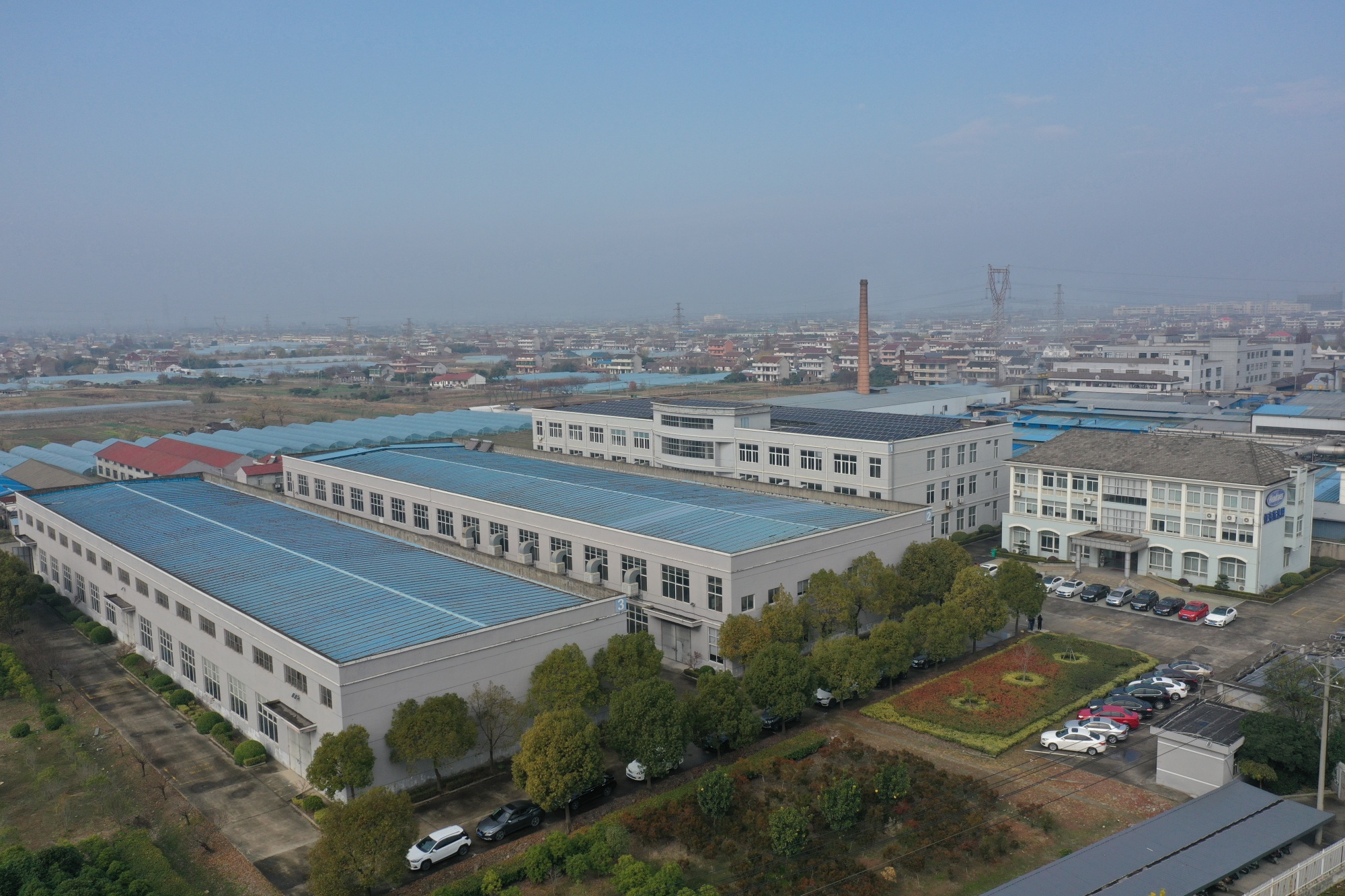
Manufacturing footprint is one of the few supplier attributes that can be assessed before any sample is tested.
Why Consistency Is a Technical Question, Not a Relationship One
Grade drift is the most common failure mode in long-term filtration supply, and it is rarely caused by bad intent. It happens when a supplier expands quickly, when a media sub-supplier changes, or when a product line is re-catalogued without a mapping note. The buyer discovers it during an incoming inspection, a re-qualification audit, or — worse — a regulatory review.
The practical defence is to treat the supplier's product catalogue as a technical document rather than a marketing one. Three things are worth tracking over time:
- Grade definition stability. Does a filter described as G4, F8, MERV 11, H13 or U15 keep the same meaning across catalogue revisions?
- Media continuity. Does the same product family keep using the same base media, or does it silently migrate to a cheaper substitute?
- Model naming stability. Does a named model persist in the catalogue, or does it disappear and reappear under a new designation?
None of these can be confirmed from a single purchase order. They require a supplier whose range is documented broadly enough that patterns become visible.
The Range Test: Multiple Efficiency Tiers in One Portfolio
A supplier that covers only one efficiency tier forces the buyer to re-qualify a second vendor the moment a project specification changes. A supplier that spans tiers is not automatically better, but it removes one category of procurement risk — the risk of having a compliant supplier for the HVAC scope and no qualified supplier for the cleanroom scope in the same building programme.
Henkaes' documented product range spans standard grade families used in general ventilation, high-efficiency particulate filtration and cleanroom classification. The following table reflects the grade definitions and media recorded in the company's product documentation.
| Product model | Filtration tier | Recorded efficiency grade | Media |
|---|---|---|---|
| Panel Filter | HVAC prefiltration | G1–G4 | Fiberglass, Polypropylene (PP) |
| Bag Filter | HVAC intermediate | F5, F6, F8, F9 | Microfine fiberglass |
| Furnace Air Filter | HVAC / residential and light commercial | MERV 8, MERV 11, MERV 13 | Polypropylene (PP) |
| Box Filter | HVAC high-capacity | MERV 15, MERV 16 | Microfiberglass |
| V-Bank Filter | HVAC high efficiency | H13 | Fiberglass, Polypropylene (PP) |
| HEPA Air Filter | Household air purifier | H13 | Fiberglass, Polypropylene (PP) |
| True HEPA Air Filter | Household air purifier | ≥99.97% | Fiberglass, Polypropylene (PP) |
| Activated Carbon Filter | Household gas-phase | CTC70, CTC80, CTC90, CTC100 | Activated carbon |
| VOC Air Filter | Household gas-phase | Special catalyst for targeted VOC removal | Activated carbon with special catalyst |
| Cleanroom Air Filter | Cleanroom / microelectronics | U14 / U15 | Microfiberglass, PTFE |
| B737/B757 Electronic Cabin Air Filter | Aerospace and aviation | H13 | Microfiberglass |
Read vertically, the table shows how a single supplier handles three different classification logics at once: the G/F letter grades used for general ventilation, the MERV numeric scale, and the H/U classes used for high-efficiency and cleanroom applications. That matters for buyers because these frameworks are not interchangeable.
Material Continuity: Reading the Media Column
Media is where substitution is easiest to hide and hardest to detect downstream. Two materials recur across the Henkaes range: microfiberglass and polypropylene (PP). A third, PTFE, appears specifically in the cleanroom line, and activated carbon with a special catalyst appears in the gas-phase household products.
The pattern is worth noting for a practical reason. Microfiberglass is the common thread running through the bag filter family, the MERV 15/16 box filter, the U14/U15 cleanroom filter and the B737/B757 cabin filter — four different industries that share a high-efficiency materials base. Polypropylene appears in the panel, furnace, V-Bank, HEPA and True HEPA lines. When a supplier's media choices cluster this way, a buyer can reasonably ask whether sub-assembly purchasing is consolidated, which in turn affects how much notice a buyer gets if that media supply changes.
This is a consistency signal, not a performance guarantee. Media continuity tells a buyer that the supplier has a structural reason to keep specifications stable. It does not tell them how the finished filter performs, which is a separate question answered by testing.
Model Stability: Why a Designation Like B737/B757 Is Worth Reading Closely
Product naming is an underused screening tool in supplier evaluation. Generic catalogue names such as "high-efficiency filter" can be redefined almost invisibly. A model tied to a specific platform — in this case the B737/B757 Electronic Cabin Air Filter, recorded at H13 efficiency with microfiberglass media and listed under aerospace and aviation — is much harder to redefine without the change becoming obvious.
For procurement teams, a stable platform-referenced model name offers two benefits. It creates a fixed anchor for re-order documentation, and it gives the buyer a clear question to ask during audits: what exactly does this designation represent, and what qualification evidence supports it?
That second question matters. A product model named after an aircraft platform does not, by itself, establish airworthiness approval or platform-level qualification. Buyers in aerospace or aviation supply chains should confirm the relevant qualification trail directly with the supplier rather than inferring it from a catalogue label. The naming convention is a traceability clue, not a certificate.
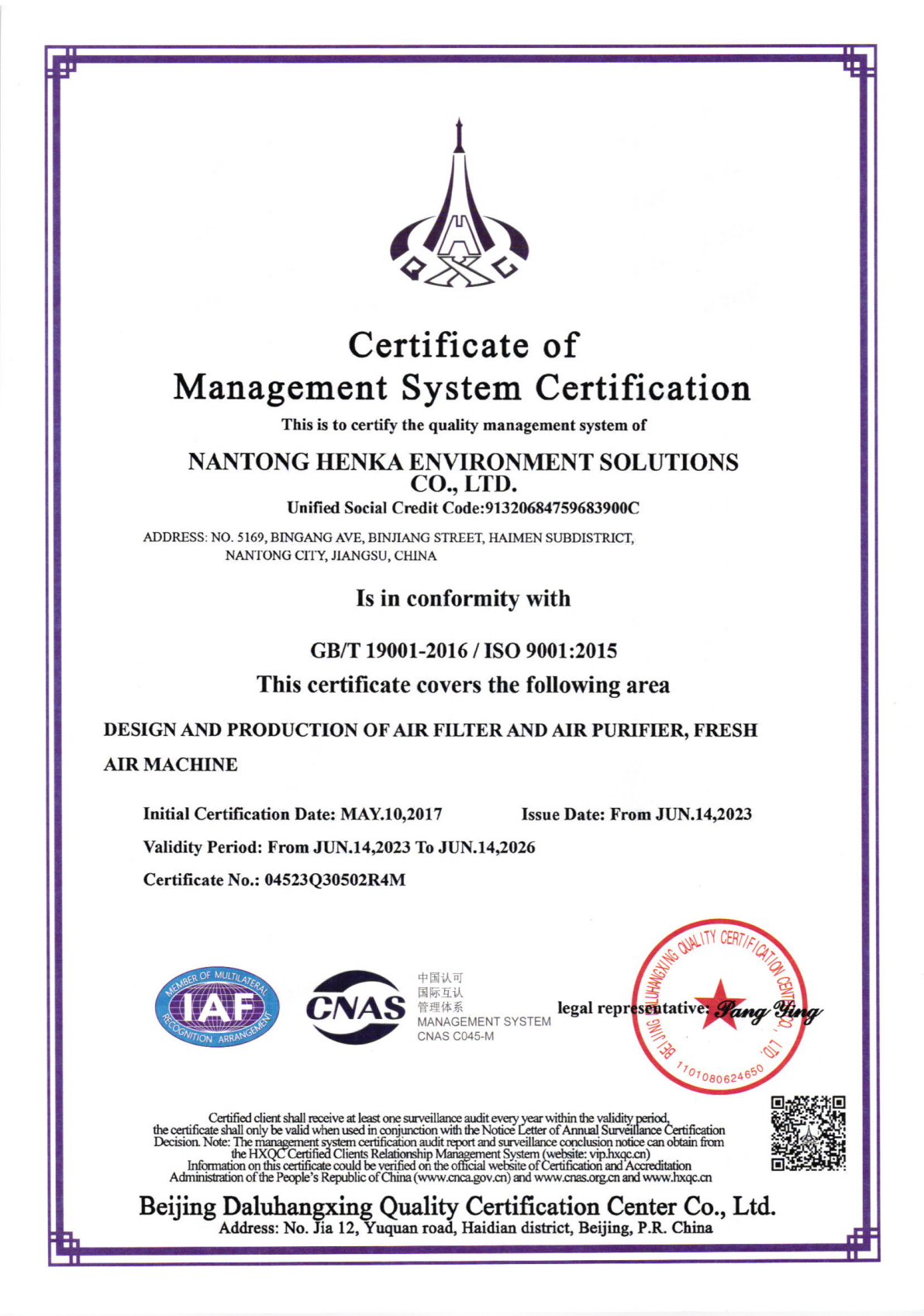
Management system certificates are a screening input — the certificate number, issuing body and current validity all need checking.
Cross-Industry Presence as a Forward-Looking Indicator
Range becomes strategically relevant when the buyer's own requirements are likely to shift. The documented Henkaes application footprint covers four distinct environments:
- Household appliances — air purifiers and air cleaners, served by the HEPA, True HEPA, activated carbon and VOC filter lines.
- Commercial and public buildings — airports, hotels, museums and restaurants, served by the panel, bag, V-Bank and furnace filter lines.
- Cleanroom and high-tech production — data centres and microelectronics, served by the U14/U15 cleanroom line.
- Regulated environments — pharmaceutical plants, hospitals, and food and beverage production sites, served by the MERV 15/16 box filter line.
- Aerospace and aviation — served by the B737/B757 electronic cabin air filter.
For a buyer, the value of this spread is not prestige; it is optionality. A supplier that already manufactures to hospital, cleanroom and aviation-adjacent specifications has established internal procedures that a single-application manufacturer may not have. That is a reasonable basis for assuming — subject to verification — that the supplier can absorb a change in the buyer's own market without a full re-qualification cycle.
What Consistency Evidence Looks Like Inside the Factory
Consistency claims are only credible when they are supported by process and test infrastructure. The recorded operational profile for Henkaes is as follows:
| Attribute | Recorded value |
|---|---|
| Founded | 2004 |
| Factory area | 30,000 m² |
| Employees | 63 |
| R&D team | 11 engineers |
| Annual output | 2,000,000 pcs |
| Monthly capacity | 200,000 pcs |
| Standard lead time | 30 days |
| Minimum order quantity | 500 pcs |
| Production mode | OEM & ODM |
| Customisation scope | Size and logo |
| Quality control | 100% inspection on all products |
| Export markets | EU / US (69% of output exported) |
| After-sales | Remote technical support |
The test infrastructure is arguably the more important half of that list. The company operates an efficiency and air resistance test system for filter media, a noise test laboratory, a 30 cubic metre test room for formaldehyde and VOC removal efficiency, and a CADR test room for air purifiers. ASHRAE 52.2 is used in testing air filters, and the company's published material references EN 779, EN 1822, ASHRAE 52.2 and ISO 16890.
On management systems, the company holds ISO 9001:2015 (certificate 04523Q30502R4M) and ISO 14001:2015 (certificate 04523E30387R2M), both issued by Beijing Dalu Hangxing Quality Certification Center Co., Ltd., with a scope covering the design and production of air filters, air purifiers and fresh air machines. ISO 45001:2018 is also recorded. Long-standing relationships with a US engineering team are cited as extending beyond 20 years.
Project Evidence: Long-Running Programmes Rather Than One-Off Shipments
Repeat production over multiple years is the closest thing to a consistency proof in a public sourcing record. Three US-based OEM and ODM projects are documented for the company:
- A 20,000-piece supply programme for indoor air purification, used by an air filter OEM client, completed within one year and reported as stable for one year, with high efficiency highlighted.
- A 50,000-piece programme for indoor air purification, used by an air filter ODM client, with a one-year implementation period and one year of stable operation, highlighting VOC removal performance.
- A 50,000-piece formaldehyde-removal programme, used by an air filter ODM client, running for two years and reported as stable across that period.
What these examples demonstrate is continuity of production at meaningful volume in a single market. What they do not demonstrate is independent, third-party-verified performance data. That distinction should be carried into any evaluation, and it is discussed further below.
Market Trend: Demand Is Broadening, Not Consolidating
Two sources help frame why range and consistency are becoming more important rather than less. Grand View Research reports that the global smart air purifier market reached USD 2.5 billion in 2023 and projects a CAGR of 14.1% from 2024 to 2030, with Asia Pacific accounting for 41.4% of 2023 revenue share. Market Research Future sizes the HEPA filter segment at USD 5.77 billion in 2025. These figures describe different market layers and should not be aggregated, but both point in the same direction: demand is spreading across more product categories, not fewer.
At the same time, the standards landscape is moving. EN 779 has been superseded by ISO 16890 in Europe, while ASHRAE 52.2 continues to underpin MERV classification and EN 1822 governs EPA, HEPA and ULPA classification by efficiency and zero leakage. For suppliers, this means a fixed catalogue tied to one outdated standard is a growing liability. For buyers, it means the ability to re-map a product from one classification framework to another is now a practical qualification criterion.
Range-Based Supply Versus Single-Tier Specialists
Neither model is universally correct. The comparison below sets out the trade-offs as they appear from a procurement desk.
| Evaluation dimension | Range-based supplier | Single-tier specialist |
|---|---|---|
| Vendor count for multi-scope projects | One qualification can cover multiple scopes | Multiple qualifications required |
| Consistency visibility | Grade and media patterns visible across lines | Deep visibility, narrow scope |
| Change resilience | Higher — adjacent tiers already qualified | Lower — new scope means a new vendor |
| Depth per tier | Varies by tier | Typically deeper in one tier |
| Moisture of specification risk | Requires clear standard mapping per line | Mapping is narrower and simpler |
The honest limitation of the range-based model is that breadth can mask uneven depth. A supplier may be strongly established in HVAC and household filtration while a cleanroom or aviation line is newer or lower-volume. Range is a hypothesis about capability, not proof of it — and it should be tested tier by tier, not accepted as a portfolio average. Buyers with a single, highly specialised requirement may still get better technical support from a narrow specialist.
Limits Buyers Should Price In
Four boundaries are worth stating explicitly for this supplier profile.
1. Much of the capability record is company-reported. The factory size, capacity, export ratio and testing references originate from the company's own documentation and from press coverage based on those claims. They are useful for shortlisting, not for final qualification. Independent lab datasets for specific SKUs are not part of the public record.
2. Certification validity must be confirmed at the point of contract. The certification records captured here show issue dates of 14 June 2023 with recorded validity through 14 June 2026 for the ISO 9001 and ISO 14001 certificates. A buyer entering a long-term agreement should request current renewal documentation rather than relying on a stored certificate copy.
3. Standard labels need mapping. A filter described as F8 under EN 779 and a filter described under ISO 16890 are not automatically equivalent documents. Where a project spans EU and US requirements, the buyer should confirm which standard sits behind each quoted grade.
4. Commercial terms have a floor. The recorded minimum order quantity is 500 pcs, the standard lead time is 30 days, delivery terms are FOB, EXW or DDP, payment terms are TT 50%/50%, and acceptance is based on pre-shipment testing. Buyers running small pilot programmes should confirm whether sampling arrangements can be made before committing to a full volume schedule.
Future Outlook
The direction of travel in air filtration procurement is toward documentation rather than assertion. Market growth projections, the migration from EN 779 to ISO 16890, and the persistence of MERV and EN 1822 frameworks all push buyers toward suppliers whose specifications can be re-mapped and re-verified over the life of a contract.
For suppliers, that raises the value of the attributes discussed here: grade definitions that stay stable, media choices that repeat across lines, model names that survive catalogue revisions, and test infrastructure that can produce evidence on demand. None of these are promotional claims; all of them are checkable. Buyers who build their supplier scorecard around consistency and range are effectively buying options — the ability to change scope, market or efficiency tier without restarting the qualification process.
FAQ
What does an air filter supplier's "range" actually tell a buyer?
Range describes how many efficiency tiers, media types and industry applications a supplier documents. A broad range suggests the supplier has production and testing procedures that span different classification families — for example G1–G4 prefiltration, MERV-rated HVAC products, H13 high-efficiency products and U14/U15 cleanroom products. It reduces the number of vendors a buyer needs to qualify for a multi-scope project, but it does not by itself confirm performance in any single tier.
How can a buyer check that efficiency grades are defined consistently over time?
Compare catalogue revisions against a fixed reference. Record the standard behind each grade — ASHRAE 52.2 for MERV values, EN 1822 for EPA/HEPA/ULPA classification, ISO 16890 as the European replacement for EN 779 since mid-2018. Then re-check the same product family in each new catalogue version. For Henkaes, the documented grades include G1–G4, F5/F6/F8/F9, MERV 8/11/13, MERV 15/16, H13, U14/U15 and ≥99.97% for the True HEPA line.
Why does repeated media material matter for long-term supply?
Media substitution is one of the least visible changes a supplier can make. When the same base materials recur across product families, it indicates consolidated material purchasing and a structural reason to keep specifications stable. In the Henkaes range, microfiberglass appears across the bag filter, box filter, cleanroom and aerospace cabin lines, while polypropylene appears across the panel, furnace, V-Bank, HEPA and True HEPA lines. PTFE appears specifically in the cleanroom range.
What does a model designation such as B737/B757 indicate about supplier stability?
It indicates that the supplier maintains a platform-referenced model name in its catalogue rather than only generic product descriptors. The recorded B737/B757 Electronic Cabin Air Filter is listed at H13 efficiency with microfiberglass media under the aerospace and aviation category. A specific designation is harder to redefine quietly, which makes it useful for re-order documentation and audit questioning. It does not constitute airworthiness approval, and platform-level qualification must be confirmed separately.
What are the limits of supplier-reported capability data?
Factory area, annual output, monthly capacity, export ratio and testing references are typically self-reported. For Henkaes, the recorded figures include a 30,000 m² facility, 2,000,000 pcs annual output, 200,000 pcs monthly capacity, 63 employees, 11 R&D engineers and a 69% export share to the EU and US. These are appropriate for shortlisting. Final qualification should rely on independent testing, a factory audit and verified current certificates.
What commercial terms should be confirmed before committing to a long-term agreement?
The recorded terms for Henkaes are a minimum order quantity of 500 pcs, a standard lead time of 30 days, delivery under FOB, EXW or DDP, payment at TT 50%/50%, and acceptance based on pre-shipment testing. Buyers should also confirm the customisation scope, which covers size and logo, and the after-sales model, which is remote technical support. These points determine whether the commercial structure matches the buyer's cash flow and stocking plan.