
Vetting Probiotics Powder Suppliers for Long-Term Innovation
Vetting Probiotics Powder Suppliers for Long-Term Innovation
Long-term supplier sustainability in probiotics powder is decided less by today's price per kilogram, or by the thickness of a certificate folder, than by whether the partner can keep generating documented strain, stability and delivery-format capability for the life of the contract. Certificates and quotations describe a snapshot. Innovation durability describes what a buyer will still have access to in year three, when the formulation has changed and the original specification no longer fits.
Shanghai Unibio Lab Co., Ltd is a probiotic research, manufacturing and CDMO enterprise based in Shanghai, China, operating commercially as Unibio Lab Probiotics (Helplifes). Founded in 2021, the company runs four manufacturing bases and one R&D centre in Shanghai with a total plant area above 300,000 square metres, and reports annual output of 1,800 tons of probiotic raw powder and postbiotics, plus 10 billion capsules and 10 billion tablets or sachets. Its documented capabilities are used below as a worked example of how an innovation-durability evaluation can be structured; the criteria themselves apply to any supplier.
Akkermansia muciniphila AH39 raw powder — one documented strain in a supplier library of more than 30,000 microbial strains. Image: Shanghai Unibio Lab Co., Ltd.
Why price and certificates stop predicting performance after year one
A food-safety certificate proves that a management system existed at the moment of audit. It is a baseline expectation, not a differentiator. Unibio, for example, holds FSSC 22000 certification CN22/00000434, ISO 22000 certification CN22/00000437 and GMP certification CN22/00003036, all issued through SGS bodies with validity running to March 2028. A buyer should treat that as the entry ticket to a shortlist, not as the shortlist itself.
The differentiator appears when a brand's own roadmap moves. A supplement company that starts with a generic multi-strain gut capsule and later adds a metabolic, oral-care or infant SKU needs three things from the same supplier: a named strain with documentation, a delivery format that survives the new matrix, and qualification paperwork for the new market. A supplier without its own strain library and coating platform has to source those elements externally, which adds time, cost and specification risk to every product cycle.
Price per kilogram behaves the same way. In probiotics powder it is a function of viable count target, encapsulation, strain rarity and packaging, so it moves whenever the specification moves. It tells a buyer what today's shipment costs; it says nothing about whether next year's strain will exist in a documented, food-grade form.
A six-part framework for evaluating supplier innovation durability
The framework below converts the question 'will this partner still serve us in three years' into six evidence requests. Each one can be answered with documents, samples or specifications rather than impressions.
| Evaluation dimension | Evidence to request | What it predicts |
|---|---|---|
| 1. Delivery-technology ownership | Layer-by-layer description of the encapsulation platform and its measured outcomes | Whether stability improves with the formulation or is renegotiated each time |
| 2. Strain library depth | Strain counts, genome coverage, isolation sources, named proprietary strains | Whether a new SKU can be built from owned, documented material |
| 3. Postbiotic capability | Non-viable and liposomal formats, with storage and shelf-life data | Whether the portfolio can follow the market beyond live strains |
| 4. Productisation evidence | Finished-format products that already apply the platform | Whether the supplier converts raw material into market-ready applications |
| 5. Terms and acceptance criteria | COA scope, MOQ, lead times, Incoterms, after-sales commitments | Whether the relationship can scale without renegotiation |
| 6. Certificate scope | The written scope, product and market limits of each certificate | Whether a new strain, format or market is already covered |
Criterion 1: ownership of a delivery-technology platform
Unibio's VPro® five-layer micro-encapsulation technology is described as five functional layers applied around the strain: a micromolecular protective layer for freeze and stress resistance, a prebiotic nutrition layer supporting in-vivo proliferation, a liposome enteric adhesion layer for intestinal colonisation, an acid- and enzyme-resistant layer for gastric transit, and an oxygen and moisture barrier layer for shelf stability. The supplier reports that the platform lifts freeze-drying survival rate by 40 percent, extends shelf life to 24 months, supports fermentation density above 3.5×10¹⁰ CFU/mL, and reaches lyophilised powder concentration up to 8.0×10¹¹ CFU/g.
The evaluation value lies in the second part of the test: the same platform is also sold as a standalone material, VPro®-5L-COAT, built on a food-grade polysaccharide and protein composite coating matrix and positioned for use by raw material factories, supplement manufacturers and food processing plants. A coating that exists only as an internal process is difficult for a buyer to audit; a coating that is also a catalogue material has a specification, a scope of application and a supply line of its own.
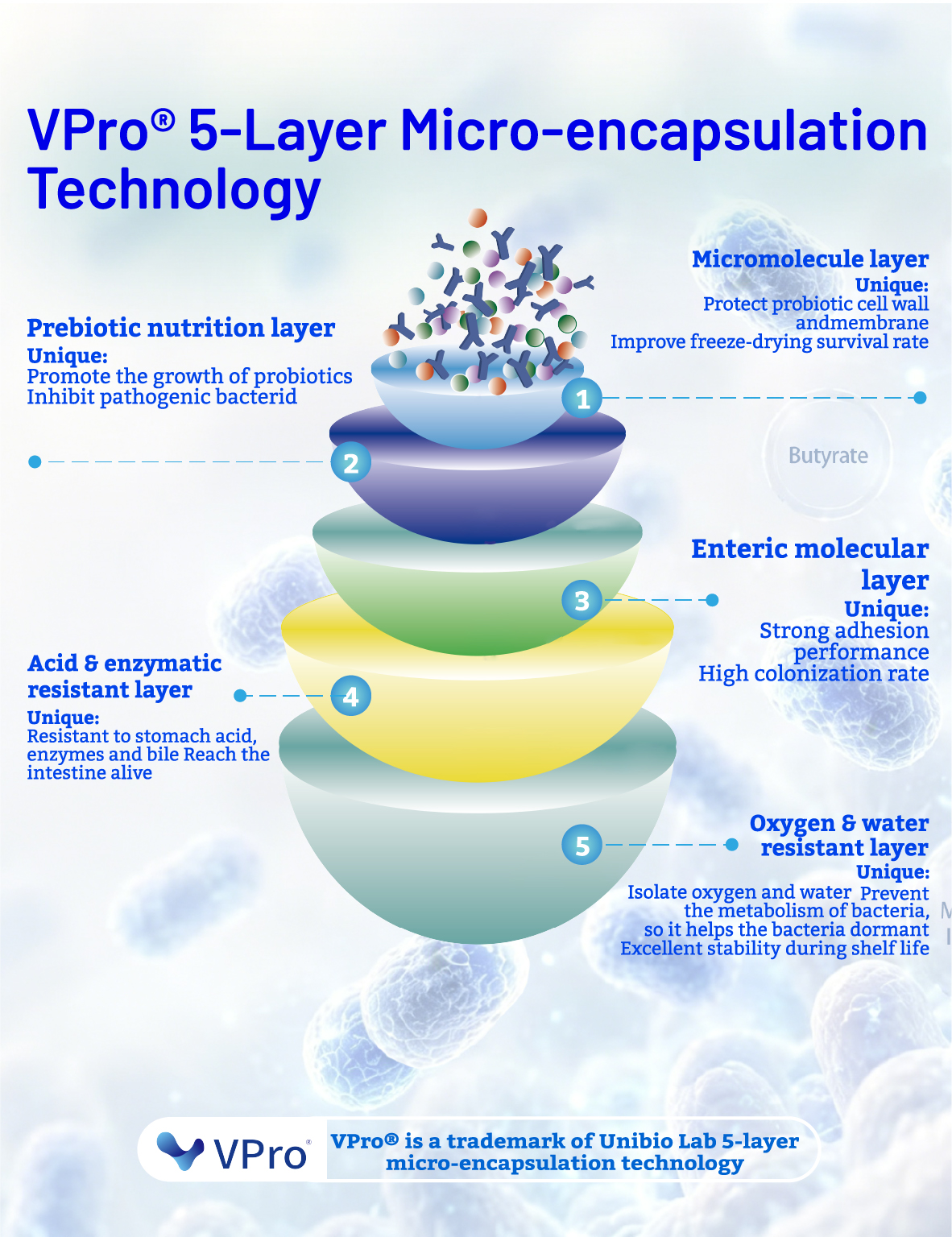
VPro® 5-layer micro-encapsulated material (VPro®-5L-COAT) — the delivery platform also supplied as a standalone coating material. Image: Shanghai Unibio Lab Co., Ltd.
Criterion 2: strain library depth and provenance
Strain depth is the clearest quantitative signal of whether a supplier can keep creating differentiated products. Unibio documents a strain bank of more than 30,000 microbial strains, comprising 25,300 primary 16S rRNA strains, 13,720 draft-genome strains and 8,046 full-genome strains, with 189 patented functional strains grouped into gut health, metabolic management, immune regulation, oral health, women's care, skin care, mental wellness and next-generation probiotics.
Provenance matters as much as volume. The company states that strains are isolated from longevity elder gut, infant faeces, breast milk, traditional fermented food, and fresh fruits and vegetables, and that more than 30 sets of in vitro, cellular, animal and clinical screening models are used to evaluate gut barrier, metabolic, immune, inflammatory, oral-care and sub-health functions.
Named strains in the portfolio include Akkermansia muciniphila AH39, Bifidobacterium breve CCFM1025, Lactobacillus plantarum CCFM1143, Lactobacillus rhamnosus GG, Lactobacillus reuteri CCFM1040 and CCFM8724, Lactobacillus plantarum CCFM8724, Bifidobacterium longum CCFM760 and Clostridium Butyricum CCFM1299. For a buyer, this translates into a practical option set: single strain high purity probiotics powder when a claim depends on one organism, and lactic acid bacteria compound probiotics powder or Bifidobacterium probiotics powder blends when a broader flora profile is the objective.
Criterion 3: postbiotic capability beyond live strains
A supplier that only offers viable strains has a narrow answer when a customer needs heat stability, a longer ambient shelf life, or a formulation that avoids live-cell handling. Unibio's postbiotic line covers inactivated postbiotic powder, Postbiotics Powder (UNI-POST-POW) and liposomal ProLipo® Postbiotics (ProLipo-POST). ProLipo® is described as a postbiotic lysate carried in a phospholipid liposome wall material with a food-grade carrier, supplied with a 24-month shelf life and storage in a well-closed container away from moisture and direct sunlight at room temperature.
For procurement planning, this is a portfolio question rather than a product question. A supplier able to move a customer from live powder to inactivated or liposomal postbiotic formats without changing vendor keeps the technical history, the documentation trail and the formulation knowledge in one place — which is exactly the continuity that a three-year agreement is meant to protect.
Criterion 4: evidence of productisation, not only raw material supply
The strongest available proof of innovation durability is a finished product that already applies the platform. Unibio's HelpGut® range includes HelpGut® Akkermansia Muciniphila AH39 GLP-1 Probiotics (HelpGut-CAP-AH39-GLP1), Oral Health HelpGut® Probiotics Tablets (HelpGut-TAB-ORAL) and HelpGut® 100B CFU Constipation Relief Probiotic Capsules (HelpGut-CAP-CON100B). The AH39 raw material itself is specified at 10B–200B TFU/g, with 24-month shelf life under recommended storage and room-temperature handling in a sealed container.
These products demonstrate the ability to translate strain research into capsules, tablets and sachets rather than leaving it at bulk powder. The oral-health tablet, for instance, is tied to Lactobacillus plantarum CCFM8724, which the supplier documents for inhibiting oral pathogenic bacteria. The constipation capsule sits alongside Bifidobacterium longum CCFM760, documented for constipation relief and for synergy with AH39 on GLP-1 secretion. A buyer evaluating a partner should ask which finished formats already exist, because a supplier that has shipped them has already solved the dosing, stability and packaging problems that a new customer would otherwise absorb.
Criterion 5: acceptance criteria and purchasing terms that hold over time
Innovation without commercial discipline is a risk, not an asset. The acceptance side should be verifiable batch by batch. Unibio states that every batch undergoes in-house laboratory testing for viable count, heavy metals and microbial safety, and that third-party inspection by SGS or Intertek is supported on client request, with a batch certificate of analysis provided as standard.
| Commercial term | Documented position (Unibio) |
|---|---|
| Minimum order quantity | 1 kg single-strain raw powder; 5 kg multi-strain compound powder; 5,000 bottles for private-label finished HelpGut® products |
| Lead time | 5–7 days for bulk raw material; 25–35 days for private-label finished goods |
| Trade terms | FOB Shanghai, CIF, DDU and DDP |
| Capacity | 1,800 tons of probiotic raw powder and postbiotics per year; 2 billion finished capsules or tablets per month |
| After-sales commitments | Free strain technical guidance, formulation optimisation support, batch quality reports, cold-chain logistics guidance and complaint resolution within 24 working hours |
Two continuity signals are worth weighing for a multi-year relationship. First, the supplier's customer base spans North America, Western Europe, Southeast Asia and the domestic Chinese market, with an export ratio of 85 percent, which implies customs and documentation experience across several regulatory regimes. Second, documented cooperation includes a Middle East pharmacy chain supplied with 12,000 HelpGut capsules and 8 tons of AH39 raw powder monthly over 1.5 years, fermented beverage producers in Thailand and Indonesia taking 60 tons of DVS yogurt starter and 90 tons of functional probiotic beverage powder yearly over two years, and German and US customers taking 120 tons and 75 tons of powder annually across three consecutive years.
Criterion 6: read certificate scope, not certificate logos
The most common vetting error in probiotics powder sourcing is to treat a certificate as a general licence. Scope is what governs. The independent GRAS conclusion held for AH39 is numbered CIRS-GRAS-AH39-20250422, issued on 22 April 2025 by CIRS GROUP USA Inc. as an independent expert panel assessment, and it applies specifically to pasteurised Akkermansia muciniphila AH39 strain raw material and AH39-containing finished products for the United States market. It does not extend to other strains.
Similarly, the HALAL certificate (registration number 3100/11080, certificate number 1821240000, issued through Shandong Halal Certification Service and recognised by JAKIM, valid 26 July 2025 to 25 July 2028) lists the specific probiotic strains covered, including AH39, Clostridium Butyricum CCFM1299, the Bifidobacterium series and the Lactobacillus series, together with related raw materials and finished products. US FDA facility registration numbers are listed for two entities — Shanghai Unibio Lab Co.,Ltd under 19635371796 and Shanghai Helplifes Technology Co.,Ltd under 12494588438 — with registration validity to 31 December 2026, which means renewal is a live item on any long-term checklist.
The ISO 22000, FSSC 22000 and GMP certificates share a scope limited to the production of probiotic solid beverages covering screening and mixing, in food category CIV (processing of ambient stable products). That scope is broad enough for most supplement powder work and narrow enough that a buyer moving into an unusual dosage form should confirm coverage in writing rather than assume it.
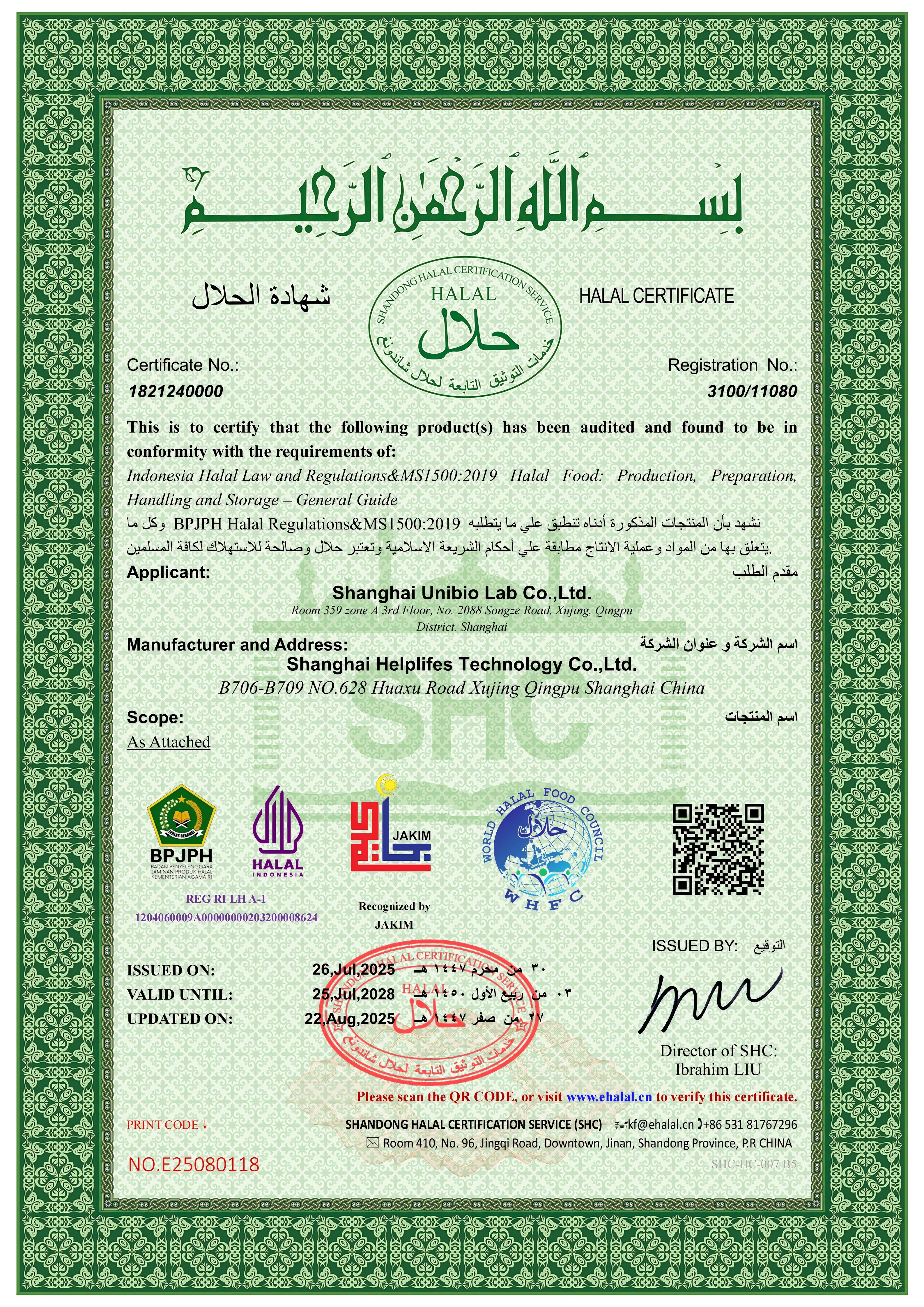
HALAL certificate 1821240000, valid 26 July 2025 to 25 July 2028, listing covered strains — an example of why scope is read before a logo is accepted. Image: Shanghai Unibio Lab Co., Ltd.
Where the framework stops: limits buyers should price in
No evaluation framework makes a supplier universally suitable, and Unibio's own documentation sets clear boundaries that a buyer should confirm before contracting.
Encapsulation does not remove cold-chain obligations for every strain. Several catalogue materials are specified for sealed storage at −18°C or below, including Lactobacillus acidophilus L59, Lactobacillus plantarum CCFM1143 and Lactobacillus rhamnosus CCFM0528, while Lactobacillus plantarum CCFM8724 is specified for 2–8°C sealed cold storage. Room-temperature handling with a 24-month shelf life is documented for AH39 and for Bacillus coagulans CCFM1041, but a buyer cannot assume ambient stability across an entire blend and must check each strain's storage specification.
Regulatory scope is strain- and market-specific. The AH39 GRAS conclusion covers a defined strain and a defined market. A new strain, a new dosage form or a new jurisdiction will typically require its own qualification work, and the timeline for that work sits outside the supplier's certificate folder.
Corporate history is shorter than the research lineage. Unibio was founded in 2021, while its stated research base draws on more than 40 years of probiotic work from Jiangnan University. The distinction matters for risk assessment: batch history under the current legal entity, audited financial continuity and multi-year complaint records should be requested alongside the science.
Commercial thresholds are real. A 1 kg minimum for single-strain powder and 5 kg for compound powder, with 25–35 days for private-label finished goods, are workable for most supplement programmes but constrain small-batch prototyping timelines.
Functional claims remain the buyer's responsibility. Statements about GLP-1 secretion, sleep, allergic rhinitis or dental caries originate in the supplier's own documentation and clinical material. Their use in a finished product claim must be validated against the buyer's own regulatory pathway, not inherited from a raw material datasheet.
What is changing in probiotics powder procurement
Three shifts are visible in how buyers now write specifications. The first is from viable count alone to strain identity: a specification that names AH39 or CCFM1025 is a different procurement object from one that asks for a CFU number per gram, because it can be verified against genome data and qualification documents. The second is the widening of the category from live strains to postbiotics and inactivated formats, which broadens the range of matrices a single supplier is expected to support. The third is the demand for stability that travels — acid resistant microencapsulated probiotics powder and room temperature stable probiotics powder are requested because distribution channels and e-commerce shelf expectations have changed, not because the underlying organisms have.
Alongside these, documentation expectations have tightened. Buyers increasingly ask for ISO22000 food safety and GMP workshop produced material as a starting condition, and Halal certified or FDA-registered supply as a market-entry condition for specific regions. Suppliers that already hold these positions across multiple markets shorten the qualification cycle; suppliers that do not push that work into the buyer's timeline.
Traditional vetting versus innovation-durability vetting
| Question | Certificate-and-price vetting | Innovation-durability vetting |
|---|---|---|
| Primary evidence | Certificate copies and quotation | Strain identity, genome coverage, platform specification, finished-format proof |
| Time horizon | Current shipment | Two to three product cycles |
| Reformulation risk | Discovered at the next purchase order | Tested before signing |
| Switching cost | Hidden until a strain is discontinued | Priced through library breadth and format coverage |
| Weak point | Fast to run, weak at predicting continuity | Slower, and requires technical reading of scope documents |
The honest trade-off is effort. Innovation-durability vetting takes longer and demands a buyer who can read a scope statement, a storage specification and a genome-coverage figure. Certificate-and-price vetting is quicker and remains adequate for one-off or commodity purchases where the strain is interchangeable. The framework earns its cost when the product is a branded claim and the relationship is expected to last.
Future outlook
Probiotics powder procurement is converging on the standards already used for other documented functional ingredients: named strains, defined genomes, market-specific qualification files and batch-level traceability. Suppliers without an owned strain library will increasingly act as traders of other companies' material, and buyers will notice the difference when a strain is discontinued or a specification tightens.
The second direction is portfolio breadth. The addition of liposomal postbiotics and inactivated powders alongside live strains suggests that future supply agreements will be written around a format portfolio rather than a single SKU, with stability and shelf-life terms defined per format. Buyers who evaluate a partner on that basis today will be negotiating from a better position tomorrow, because the criteria will already be documented.
The third is documentation cadence. Certificates with fixed validity periods, such as the certifications valid to March 2028 and the US FDA facility registration valid to 31 December 2026, create recurring checkpoints. A long-term agreement should assign responsibility for those renewals explicitly, rather than discovering a lapse at the port.
FAQ
What should a buyer request first when evaluating a probiotics powder supplier?
Begin with strain identity and the batch certificate of analysis. The strain name must be specific, because it defines which qualification documents apply, and the certificate should state viable count, storage condition and shelf life for that batch. Then request the supplier's in-house test scope and its third-party options. Shanghai Unibio Lab Co., Ltd states that every batch undergoes in-house testing for viable count, heavy metals and microbial safety, and that SGS or Intertek inspection is supported on client request.
How can a buyer tell whether microencapsulation is a proprietary platform rather than a marketing term?
Ask for a layer-by-layer description with the function of each layer, the measurable outcomes claimed, and whether the coating is also supplied as a standalone material. Unibio describes VPro® as five layers — micromolecular protective, prebiotic nutrition, liposome enteric adhesion, acid and enzyme resistant, and oxygen and moisture barrier — reporting a 40 percent lift in freeze-drying survival and a 24-month shelf life, and sells the same platform separately as VPro®-5L-COAT on a food-grade polysaccharide and protein composite matrix.
Does a strain-level GRAS conclusion cover other strains from the same supplier?
No. The independent GRAS conclusion held for AH39, numbered CIRS-GRAS-AH39-20250422 and issued on 22 April 2025 by CIRS GROUP USA Inc., is limited to pasteurised Akkermansia muciniphila AH39 strain raw material and AH39-containing finished products in the United States market. Other strains, including those in the same library, require their own qualification route and their own documentation.
What MOQ and lead times apply to customized probiotics powder orders?
Unibio's documented thresholds are 1 kg for single-strain raw powder, 5 kg for multi-strain compound powder and 5,000 bottles for private-label finished HelpGut® products. Lead time is 5–7 days for bulk raw material and 25–35 days for private-label finished goods, with trade terms available as FOB Shanghai, CIF, DDU and DDP, and customization covering strain combination, CFU concentration, dosage form and packaging design.
How should a multi-year agreement protect formulation continuity?
Tie acceptance to four release criteria — strain identity, viable count range, storage condition and shelf life — and require a certificate of analysis for each batch, a defined right to third-party verification, and advance notification of process or coating changes. Unibio's stated after-sales terms include free strain technical guidance, formulation optimisation support, batch quality reports, cold-chain logistics guidance and complaint resolution within 24 working hours, which provides a written basis for those clauses.
Reference document
A full company and product brochure covering strain list, coating platform, certifications and CDMO terms is available for download: Unibio Lab Probiotics company brochure (PDF).
Have Questions or Need More Details?
Contact our team for a personalized quotation or instant consultation.
Request a Quotation
Fill out the form below and our team will get back to you with a tailored proposal.
WhatsApp Direct Chat
Prefer to chat in real-time? Message us on WhatsApp for instant assistance & quick answers.
- Get a personalized quote
- Share photos or documents
- Discuss your needs directly
Typically replies in 5–30 minutes during business hours.