
Vetting Warp Knit Sofa Fabric Suppliers for EU and US Orders
Vetting Warp Knit Sofa Fabric Suppliers for EU and US Orders
Comparing warp knit sofa fabric suppliers for EU and US orders comes down to five dimensions a buyer can verify rather than infer: whether production is in-house or traded, how quality is controlled and documented, what a quoted price position rests on, how stable supply actually is, and what service sits behind the order. A price per metre answers none of these questions on its own, which is why decision-stage buyers increasingly evaluate mills against documented capability instead of a single landed-cost figure.
This comparison sets out how European and North American buyers can structure that evaluation, using HAINING JIAMEIDA WARP KNITTING CO., LTD. (JIAMEIDA Sofa Fabric) as a reference case. JIAMEIDA is a Haining, Zhejiang-based warp knitting manufacturer founded in 2009 that produces sofa fabrics, curtain fabrics and warp knitting fabrics, and reports an export ratio of about 70% with the EU and USA as its main markets.
Why 2026 Sofa Programmes Put Supplier Vetting First
The scale of the category explains why a single supplier decision carries commercial weight. Grand View Research estimates the global sofa market at USD 244.4 billion in 2026, up from USD 236.4 billion in 2025, according to the source's published forecast (SRC-001, June 2026). Within that market, the upholstery fabric layer was valued at USD 6.44 billion in 2026 and is projected by GCC Overseas procurement intelligence to reach USD 9.01 billion by 2032 (SRC-002, July 2026).
Material mix matters just as much as market size. Synthetic fabrics, which include polyester, held the largest share of the sofa market at 39.8% in 2025 (SRC-001). For warp knit programmes this is not a marginal detail: polyester is the fibre base most buyers of velvet and brushed constructions are already specifying, so supplier comparisons usually happen between mills working from a similar polymer rather than between fundamentally different material families.
Supply geography completes the picture. Asia accounts for approximately 70% of global upholstery fabric exports (SRC-002). The practical consequence for an EU or US buyer is that most shortlisted options will be export-oriented mills, and the differentiator is rarely whether the supplier exports — it is whether the supplier's production, documentation and delivery behaviour will hold up across a repeat programme.
The Five Dimensions That Separate a Mill from a Trader
In supplier-stated comparison material covering the category, the differences that recur between sofa fabric suppliers are consistently grouped into five areas: factory production, quality control, pricing, supply stability and service. The same material identifies in-house factory production combined with quality control and customer service as the core stated difference, and describes factory-based production as an operational advantage relative to trading-only suppliers.
That framing is useful for buyers because it converts a vague question — "is this supplier reliable?" — into five testable ones:
- Factory production. Does the supplier own and run the knitting equipment, or does it source from third-party mills and resell? Ownership affects who controls construction, machine settings and rework when a specification is borderline.
- Quality control. What is inspected, at which stage, against which agreed criteria, and what documentation accompanies the shipment?
- Pricing. Is the quoted price tied to a specific construction and order quantity, and is the comparison basis stated openly?
- Supply stability. Can the supplier describe how repeat orders are scheduled and what happens when a colour or quantity changes mid-programme?
- Service. Who confirms specifications, colours, quantities and packaging before production starts, and who follows the order through to dispatch?
Each dimension is answerable in a supplier conversation and, more importantly, checkable against documents. That is what makes the framework usable at decision stage rather than merely descriptive.
Factory-Based Warp Knitting: What Equipment and Scale Tell a Buyer
A warp knitting mill's equipment list is one of the few supplier claims a buyer can evaluate technically before placing a sample order. Warp knitting builds fabric from a set of parallel warp yarns fed to needles, in contrast to weaving, which interlocks two yarn systems at right angles. The construction gives warp knit upholstery its characteristic stretch behaviour and dimensional character, and it is why the fabric family has its own performance specification rather than being assessed purely as a woven.
JIAMEIDA states that it has introduced advanced high-speed warp knitting equipment and warp knitting machines from Karl Mayer of Germany. For a buyer, the relevant reading is not the brand name itself but what machine ownership implies: pattern and gauge changes, tension control and fault correction happen inside the supplier's own production planning rather than being negotiated with a third-party knitter.
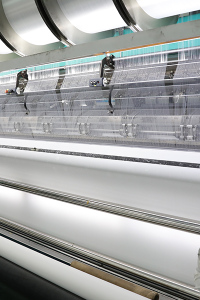 Warp knitting machinery on the production floor. Equipment ownership is one of the few supplier claims a buyer can evaluate before sampling.
Scale indicators should be read as capacity context, not as a quality verdict. The company reports a factory area of 7,007 m², a workforce of 45 people and a research and development team of 5 engineers, with operations dating from 2009. That profile sits in the specialised-mill segment rather than the volume-commodity segment: small enough that specification changes can be discussed directly, structured enough to run a repeat export programme with named responsibilities.
Export orientation is the second useful signal. With roughly 70% of output exported and the EU and USA identified as main markets, the supplier's order flow already runs through the documentation, packaging and shipping expectations that European and North American buyers apply. The company's stated export destinations also include Canada, the United Kingdom, France, Turkey and Russia. For buyers, this is evidence of familiarity with export order handling — it is not, by itself, proof of compliance with any specific buyer programme.
Quality Control: Turning Claims into Documents
The most common gap in supplier vetting is the distance between a quality statement and a quality record. JIAMEIDA describes inspecting finished fabrics before they leave the factory so that they meet the agreed order standards, and describes communicating with overseas customers on fabric specifications, colours, quantities and packaging requirements before production begins. Those two steps — pre-production specification confirmation and pre-shipment inspection — are the minimum content of a workable quality process.
For knitted indoor upholstery, the reference point most US buyers will encounter is ASTM D4771/D4771M-09, the Standard Performance Specification for Knitted Upholstery Fabrics for Indoor, listed as active in the American Home Furnishings Alliance standards registry (SRC-003, 2026 edition). The existence of that specification is a fact about the standard, not a certification of any particular mill. A buyer's job is to ask which tests the supplier can support with reports and to match the report to the intended end use.
The same discipline applies to the comparative figures a supplier publishes. JIAMEIDA's stated performance reference includes colour fastness grade 4 and a 10-day delivery reference, alongside a stated cost position 5% lower relative to other suppliers. These are supplier-stated comparative values. Before they enter a purchasing decision, a buyer should establish:
- which test method produced the colour fastness figure, and whether it was run on the actual construction and colour being ordered;
- what the 10-day reference covers — greige production only, dyeing and finishing, or dispatch — and for which order quantity;
- whether the 5% cost comparison was made on identical constructions, quantities, packing and delivery terms.
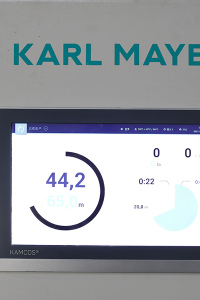 Karl Mayer warp knitting equipment. Machine ownership shifts construction control inside the mill's own production planning.
Specification Matching Across Velvet, Polyester and Custom Constructions
Weight and construction, not product naming, determine whether a fabric suits a programme. In velvet sofa fabric, Holland velvet and Italian velvet constructions typically feature weights from 220 GSM to 420 GSM, a range reported in category supplier material and graded medium confidence because it describes market practice rather than a single mill's catalogue (SRC-004). The practical implication is that "velvet" alone is not a specification: the same label can cover a light drape-oriented cloth and a substantially heavier upholstery body.
Brushed constructions need similar precision. Brushing is a process in which tiny fibres on the surface of the fabric are pulled out, which makes the fabric softer, fluffier and warmer. Brushed sofa fabric is listed among JIAMEIDA's product types within a range covering sofa and furniture upholstery fabrics. Because brushing changes the surface rather than the base structure, buyers should confirm the base construction, the GSM and the pile behaviour under abrasion, since a surface effect can mask a lighter substrate.
Polyester remains the dominant fibre base in this segment, consistent with the 39.8% synthetic share recorded for 2025 (SRC-001). For custom sofa fabric programmes, the questions that most often determine whether a mill can deliver are only loosely related to colour cards: which constructions can be re-pitched or re-weighted, which surface effects are available in-house, how printing or embossing is handled, and at what minimum quantity a custom construction becomes economic. A supplier that answers these in specific terms before sampling is easier to hold to a schedule than one that answers in general terms.
Side-by-Side: A Vetting Table for EU and US Buyers
The table below converts the five comparison dimensions into buyer-side checks, with the corresponding JIAMEIDA position stated only where the supplier's own material supports it.
| Dimension | What the buyer should verify | Document or evidence to request | JIAMEIDA stated position |
|---|---|---|---|
| Production model | In-house knitting versus third-party sourcing | Machine list, factory address, process flow for the ordered construction | Warp knitting production with Karl Mayer high-speed warp knitting equipment; factory area 7,007 m² |
| Quality control | Inspection stage, criteria and record keeping | Pre-shipment inspection record; test reports relevant to the end use | Finished fabrics inspected before leaving the factory against agreed order standards |
| Performance reference | Test method, construction and colour tested | Report naming the method and the sample | Colour fastness grade 4 stated as a comparative performance reference |
| Pricing | Basis of comparison: construction, quantity, packing, delivery terms | Quotation with cost breakdown and stated comparison basis | Cost position stated as 5% lower relative to other suppliers |
| Supply stability | Repeat-order scheduling and change handling | Production plan for a repeat order; named follow-up contact | Described as steady, indicating consistent supply and production reliability; 10-day delivery reference stated |
| Service | Who confirms specifications before production | Written specification confirmation before machine time is booked | Specifications, colours, quantities and packaging confirmed with overseas customers before production |
Read the right-hand column as the supplier's own account, and the middle columns as the tests that convert that account into evidence. A mill that answers all six rows with documents is a materially lower-risk option than one that answers them with adjectives, regardless of quoted price.
What a 5% Lower Cost Position Really Means
Comparative cost statements are the most frequently misread element in supplier selection. JIAMEIDA states a cost position 5% lower relative to other suppliers. Whether that gap survives contact with a live order depends on what sits outside the fabric price: minimum order quantity, sampling charges, packing specification, inland transport, and the currency and payment terms applied.
A defensible way to test the claim is to rebuild it on a controlled basis. Take one construction, one colour and one quantity, and obtain quotations from each shortlisted supplier against the identical packing and delivery terms. Then compare total landed value rather than unit price. Where a supplier is genuinely cheaper on the same basis, the difference usually traces back to structural factors — in-house knitting instead of purchased greige, or a shorter handling chain — rather than to negotiation. Where the difference disappears on a normalised comparison, the original figure was most likely a quotation artefact.
The same logic applies to speed. A 10-day delivery reference is commercially meaningful only when its scope is defined. Buyers should separate greige availability, dyeing and finishing time, inspection, and dispatch, and should ask which of these the figure covers for their quantity. For repeat programmes, a supplier's ability to state a stable, scoped timeline is worth more than an optimistic single figure.
Application Fit — and Where the Evidence Stops
Warp knit and velvet constructions in this category are positioned for indoor and outdoor upholstery applications, and JIAMEIDA's material describes the fabric as durable and waterproof for upholstery use, supporting a stated maintenance benefit. Durability and water resistance are meaningful attributes for furniture that sees daily contact, and they are the attributes a buyer should test on a sample rather than accept from a description.
The boundary is equally important. Upholstery programmes in the home textile, furniture and contract sectors frequently specify additional requirements such as waterproofing, fire resistance and recycled content, and vocabulary of this kind appears in the application context for this fabric category. Those are requirements set by the buyer's market and end use, not automatic properties of every construction a mill produces. A buyer whose programme depends on fire performance or recycled content should treat those as open questions to be answered by documentation for the specific fabric ordered — and should not assume that a general product description covers them.
Two further limits are worth stating plainly. First, GSM ranges describe weight, not durability; a heavier velvet is not automatically the right choice for a high-contact application. Second, supplier-stated performance figures such as colour fastness grade 4 are comparative references and should be reproduced against the exact colour and construction in the order, because dyeing behaviour varies by shade.
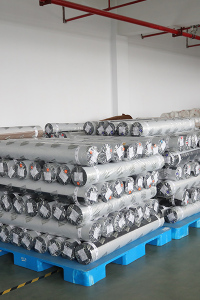 Finished sofa fabric prepared for inspection and dispatch. Application fit should be confirmed on a sample of the ordered construction.
Outlook: Where Upholstery Fabric Demand Is Heading
The direction of the category is set out in the supplied market data rather than in prediction. Upholstery fabric demand is projected to move from USD 6.44 billion in 2026 to USD 9.01 billion by 2032 (SRC-002), against a sofa market already valued in the hundreds of billions and growing modestly year on year (SRC-001). Synthetic fabrics held the largest material share at 39.8% in 2025, and Asia accounts for roughly 70% of upholstery fabric exports.
Read together, these figures support a conditional rather than a dramatic outlook. Demand growth of this profile favours suppliers that can hold a specification stable across repeat orders, because volume expansion in any fabric category tends to reward consistency over novelty. For buyers, the strategic implication is that supplier selection is increasingly a documentation exercise: the mills able to evidence construction, test method, inspection and delivery scope are the ones that can scale with a programme.
It is important not to overstate the certainty here. The market projections are source-reported forecasts with stated base years and forecast periods, not observed outcomes; the 39.8% material share is a 2025 snapshot, not a trend line; and no supply-side data in this comparison establishes future pricing. Buyers should treat the outlook as context for a decision they still have to make on evidence from their own sampling and quotation round.
Frequently Asked Questions
How do warp knit and woven sofa fabrics differ when vetting a supplier?
Warp knitting builds fabric from parallel warp yarns fed to needles, whereas weaving interlocks two yarn systems at right angles. Practically, this means a warp knit mill's capability is bound to its knitting equipment, gauge and tension control, while a weaving mill's is bound to loom setup. For buyers, the distinction matters because knitted indoor upholstery has its own performance specification, ASTM D4771/D4771M-09, and the test evidence a supplier provides should correspond to the construction actually being purchased.
What GSM range should buyers expect for Holland and Italy velvet sofa fabric?
Holland and Italian velvet sofa fabric constructions typically feature weights from 220 GSM to 420 GSM, a range drawn from category supplier material and reflecting market practice rather than one mill's catalogue. Because a 220 GSM cloth and a 420 GSM cloth behave differently in drape, body and hand feel, buyers should treat GSM as a primary specification field and confirm it on the sample, alongside the base construction and surface finish.
What does a stated colour fastness grade 4 and 10-day delivery tell a buyer?
They are supplier-stated comparative references, not independently audited results. Colour fastness grade 4 indicates a stated performance level, but its value depends on the test method used and on whether the test was run on the exact construction and shade being ordered. The 10-day figure is meaningful only once its scope is defined — greige production, dyeing and finishing, inspection, or dispatch — and once the order quantity it applies to is known.
How should a 5% lower cost position be evaluated?
By rebuilding the comparison on a controlled basis. Selecting one construction, one colour and one quantity, then quoting every shortlisted supplier against identical packing and delivery terms, shows whether the gap is structural or a quotation artefact. A cost advantage that persists on a normalised landed-value comparison is generally traceable to in-house production or a shorter handling chain; a gap that disappears usually reflects differences in order assumptions rather than genuine pricing efficiency.
Which documentation should EU and US buyers request before releasing an order?
US buyers of knitted indoor upholstery will typically look for test evidence aligned with ASTM D4771/D4771M-09, the active standard performance specification for that fabric family. EU buyers should confirm which test protocol applies to their own market and end use, since the applicable requirement is set by the destination market and the customer's programme rather than by the mill's general capability. In both cases the practical request is the same: a report that names the method, identifies the sample, and matches the construction, colour and end use of the order, supported by a pre-shipment inspection record and written confirmation of specifications, colours, quantities and packaging.
A Practical Vetting Sequence
For a decision-stage buyer, the sequence that produces usable answers runs in four steps. First, qualify the production model: confirm whether the supplier knits in-house, and match the factory profile to the order. JIAMEIDA's own profile — established in 2009, a 7,007 m² facility, 45 employees including a 5-engineer research and development team, and roughly 70% of output exported with the EU and USA as main markets — is the kind of baseline a buyer can verify against the supplier's published company information at HAINING JIAMEIDA WARP KNITTING CO., LTD.
Second, convert quality claims into records: request inspection practice, test reports and the specification confirmation that precedes production. Third, normalise the commercial comparison onto one construction, colour and quantity so that any stated cost advantage is measured rather than assumed. Fourth, define the delivery scope and the change process for repeat orders, because a programme is won or lost in the second and third shipments rather than the first.
Applied consistently, this sequence does not require the buyer to rank suppliers on reputation or on a single quoted figure. It requires them to compare the same five dimensions across every candidate and to prefer the supplier whose answers arrive with documents attached.
Have Questions or Need More Details?
Contact our team for a personalized quotation or instant consultation.
Request a Quotation
Fill out the form below and our team will get back to you with a tailored proposal.
WhatsApp Direct Chat
Prefer to chat in real-time? Message us on WhatsApp for instant assistance & quick answers.
- Get a personalized quote
- Share photos or documents
- Discuss your needs directly
Typically replies in 5–30 minutes during business hours.