
Vetting a Porcelain Tile Supplier for Capacity and Continuity
A commercial porcelain tile programme rarely fails at the specification stage. It fails eighteen months later, when the second phase needs 4,000 m² of a colour that has quietly been discontinued, or when the certificate attached to the tender pack expired before the handover date. Continuity — not unit price — is the variable that decides whether a tile specification survives to completion.
This article sets out a supplier evaluation framework for long-cycle commercial work, built on three checks: manufacturing continuity, certification durability, and export support depth. It uses ALL KING CERAMICS as a worked example, because a framework is only useful when it is tested against real, checkable evidence.
Why Continuity Outranks Price in Long-Cycle Tile Procurement
A porcelain tile order for a shopping mall or a hotel renovation looks like a purchase. Structurally, it behaves like a multi-year service agreement. Three failure modes account for most of the damage:
Batch drift between phases. Fired porcelain varies by calibre and tonality. A supplier that cannot hold a reference batch across phases forces the buyer into either attic stock over-ordering or visible colour joints at the phase boundary.
Certificate lapse or scope mismatch. A quality management certificate with a lapsed surveillance audit, or a certificate whose scope does not cover the specific format being purchased, is a documentation problem that becomes a handover problem.
Capacity crowding at peak season. Suppliers with strong order books and undisclosed capacity constraints deprioritise low-margin replacement orders. The project that ordered 15,000 m² at launch may find its 600 m² replacement order queued behind a new full-container customer.
Each failure mode has a corresponding check. The framework below converts them into evidence requests a buyer can put in writing.
The Three-Pillar Evaluation Framework
Long-term supplier evaluation should produce a defensible shortlist, not a preference. The three pillars translate into specific documents and specific numbers.
| Pillar | Question it answers | Evidence to request | Failure signal |
|---|---|---|---|
| Manufacturing continuity | Can they still make this tile in two years, at the same colour and calibre? | Plant area, headcount, engineering staff, annual and monthly output, format matrix | Output disclosed only as "large" or as a single inflated annual figure |
| Certification durability | Is the certificate current, in scope, and issued by a body the buyer's specifier recognises? | Certificate number, issuing body, scope, validity window, surveillance cycle | Photograph of a certificate with no number or issuer legible |
| Export support depth | Do they run documentation, packaging and reorders for overseas projects as routine, or as exceptions? | Export share of sales, market count, packing method, lead time, reorder and batch-tracking terms | Export treated as occasional, with no batch-tracking mechanism |
Manufacturing Continuity: How to Read a Capacity Claim
ZIBO ALL-KING CERAMICS CO., LTD (ALL KING CERAMICS) is a Chinese porcelain tile manufacturer and direct exporter based in Zibo, established in 2011, operating a 60,000 m² production facility with approximately 320 staff and a 25-engineer research and development team.
Those four data points matter more than they first appear. A plant area of 60,000 m² and a headcount of roughly 320 indicate a single integrated site rather than a fragmented network of outsourced kilns — which is what allows a specific calibre to be reproduced rather than re-sourced. Established in 2011, the company has operated through fifteen years of format transitions and glaze reformulations, which is the practical test of whether a discontinued SKU can be re-engineered.
The headline capacity figure is 12–16 million m² per year. Buyers routinely misread this number, so it is worth unpacking:
Annual output is a range, not a promise. A 12–16 million m² band reflects format mix: large-format 60x120 cm slabs occupy kiln width differently than 60x60 cm tiles. A buyer specifying large format should assume the lower end of the range for that format, not the midpoint.
Monthly output is the binding constraint. Stated monthly capacity is 1.2 million m². A 15,000 m² project — the scale recorded in the company's commercial project portfolio — represents roughly 1.25% of one month's output. That is a useful ratio to compute for any supplier: if a single project consumes a large share of monthly capacity, schedule risk is real; if it consumes a small share, the risk shifts to order sequencing rather than raw throughput.
Engineering staff size is a continuity proxy. A 25-engineer R&D team is the resource that re-develops a colour match when a pigment supplier changes, and that answers a reorder request eighteen months after the original batch.
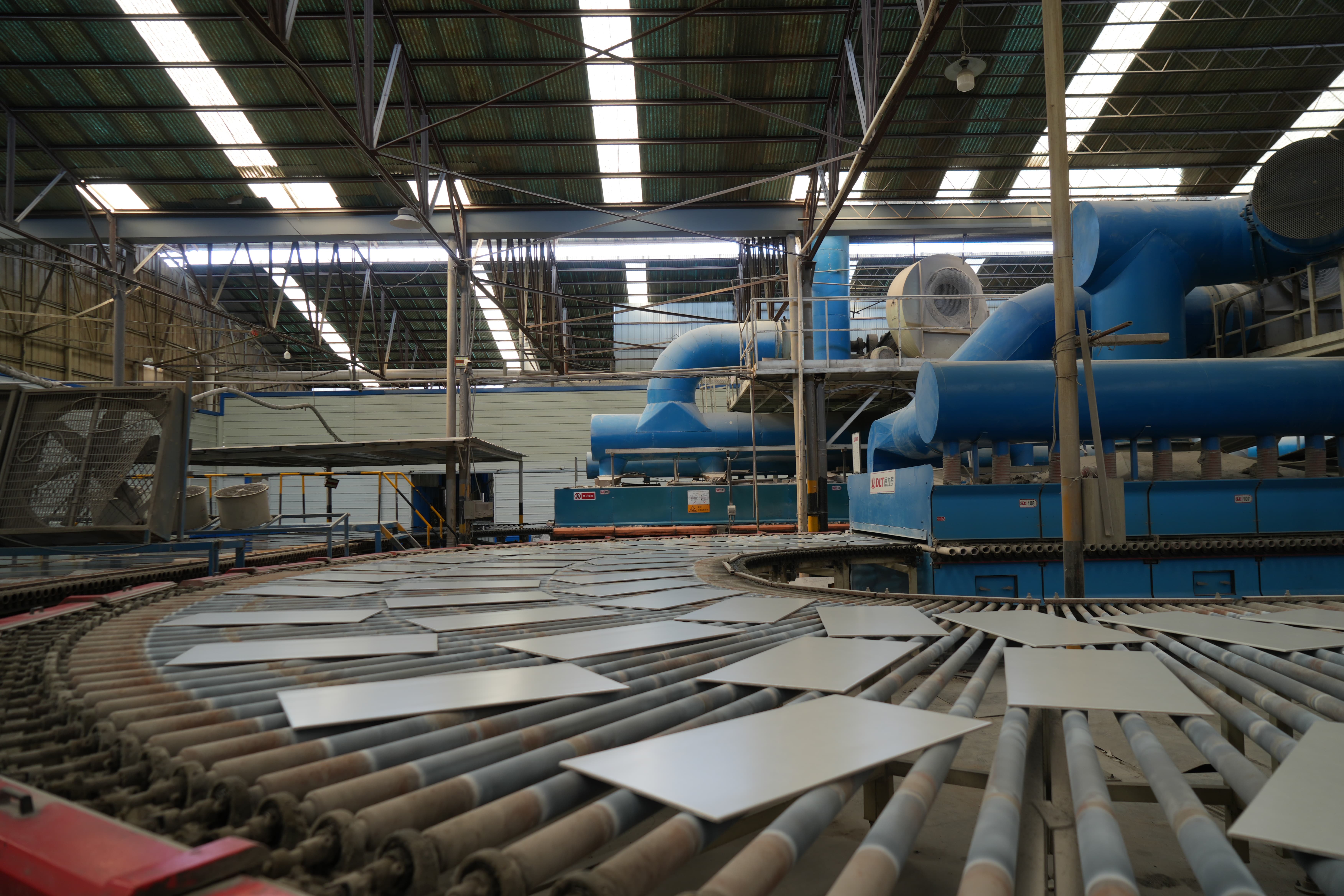
A single integrated production site, rather than a network of outsourced kilns, is the structural basis for reproducing a specified calibre across project phases.
Certification Durability: What a Certificate Number Actually Proves
Certification is the pillar most often reduced to a PDF attachment. In long-cycle procurement, three questions separate a durable certificate from a decorative one: who issued it, what scope it covers, and whether it is still under surveillance.
ALL KING CERAMICS holds an ISO 9001:2015 certificate numbered 0350521Q30166R1M, issued by XQCC, applied to global markets. Separately, it holds a CE certificate numbered AC 50163816 0001, issued by TUV, for the EU market.
The distinction between the two is not administrative. ISO 9001:2015 is a quality management system certification: it attests that the process governing production, inspection and corrective action is documented and audited. It does not certify the performance of an individual tile. The CE certificate is a product-conformity instrument for the EU market, tied to declared performance characteristics rather than to management process. A buyer who treats one as a substitute for the other will either over-request documentation or under-verify performance.
A practical verification sequence for either certificate:
1. Read the number, not the logo. The certificate number — 0350521Q30166R1M or AC 50163816 0001 — is what can be traced to the issuing body. A framed certificate photograph without a legible number is not evidence.
2. Confirm the issuing body's standing. XQCC and TUV are the named issuers here; the buyer's compliance team should confirm they are recognised for the market being served.
3. Match scope to the product actually purchased. A management-system certificate covers the site and process; the buyer still needs confirmation that the 60x120 cm range is inside the audited scope.
4. Check the surveillance cycle. ISO 9001:2015 certification is maintained through periodic audits. A certificate that is valid on the tender date but lapses before handover creates a documentation gap at the worst possible moment.
The company additionally states that its porcelain tiles comply with ISO 13006, the international standard for ceramic tile definitions, classification and characteristics. Buyers should hold this as a specification reference and pair it with batch-level test records rather than treating it as a standalone guarantee.
Export Support Depth: Why 70% Matters
Export ratio is an underused screening metric. A supplier whose exports represent 70% of sales — the figure ALL KING CERAMICS reports — runs export documentation, sea-freight packaging and reorder handling as a routine operating function, not as a favour to a single large customer. The company exports to more than 15 countries, with markets including Australia, New Zealand, South Korea, Vietnam, Malaysia, the Philippines, Russia, Ukraine, the UAE, Iraq, Peru, Colombia, Chile and Panama.
For a project buyer, that depth converts into concrete terms:
OEM/ODM as standard, not bespoke. Customisation covers size and thickness, surface finish, OEM brand logo and packaging, marble vein pattern variation, and anti-slip rating. For a developer running a private-label range across multiple sites, that removes a re-negotiation step at every phase.
Lead time stated in production days. Quoted lead time is 7–10 days. Buyers should read this correctly: it is production time, not door-to-door time, and excludes sea freight, port handling and inland delivery. For project scheduling, the production window is the controllable part; the transit window should be modelled separately.
MOQ structured for phase ordering. Minimum order is 400 m² per design, with trial orders acceptable. That per-design threshold is low enough to support a validation phase before a full project release — but it is per design, so a multi-colour scheme multiplies the commitment.
After-sales tied to batch identity. The stated support package includes damage compensation, online installation guidance, 24/7 technical consultation, and batch tracking with reordering support. Batch tracking is the operationally significant item: without it, the other three cannot be delivered consistently.
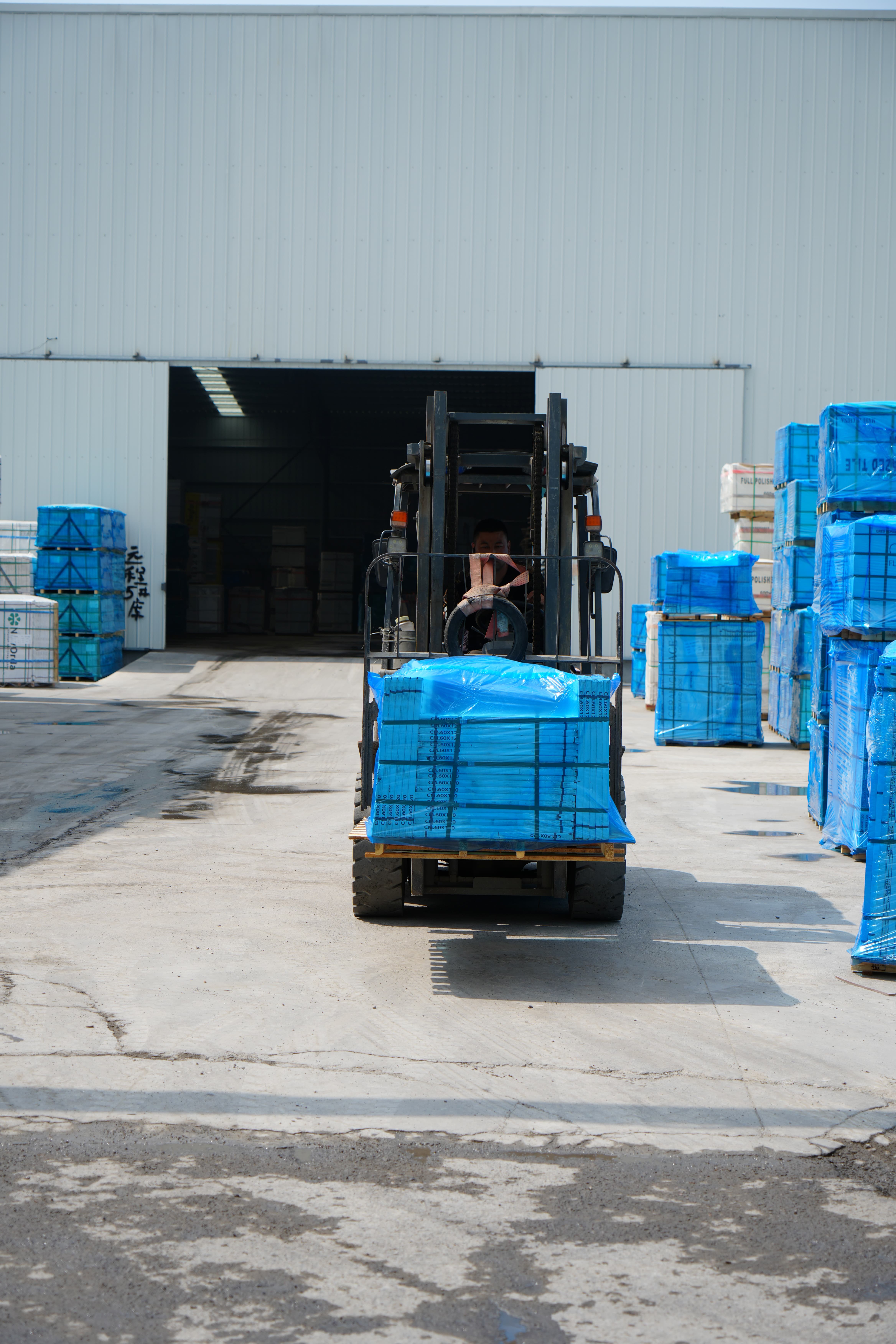
An export share of 70% of sales indicates that documentation, sea-freight packing and reorder handling are routine functions rather than exceptions.
The 60x120 cm Line: Specification and Acceptance Criteria
60x120 cm porcelain tile is the flagship format at ALL KING CERAMICS, supported by a wider matrix of 60x60 cm, 80x80 cm, 100x100 cm and 75x150 cm formats. The published technical profile for the 60x120 cm porcelain range is as follows.
| Parameter | Published value | Procurement implication |
|---|---|---|
| Thickness | 9.0–10.5 mm | Suited to floor and wall applications with appropriate substrate preparation |
| Water absorption | < 0.5% (vitrified) | Supports wet-area and frost-exposed specification |
| Abrasion resistance | PEI 4 / PEI 5 | Appropriate to high-traffic commercial flooring |
| Mohs hardness | 6–7 | Resists surface scratching under continuous footfall |
| Breaking strength | ≥ 1300 N | Relevant to handling loss rates and slab breakage claims |
| Modulus of rupture | ≥ 35 MPa | Indicates load-bearing capacity under specified installation |
| Packing | 2 pcs/box = 1.44 m²/box | 1,000 m² requires 695 boxes — plan pallet and container counts accordingly |
| Slip rating | R10/R11 standard; R12 via customisation | R11/R12 must be ordered as a specification, not assumed from stock |
Internal quality control at the plant is described as 100% automated flatness and sizing checks, piece-by-piece visual inspection, and random laboratory testing on each batch. These are supplier-side controls. A buyer's acceptance criteria should sit alongside them, not replace them.
A workable acceptance clause set for a 60x120 cm commercial supply:
Retain a sealed reference sample signed by both parties, and reference it by batch number in the purchase order.
Record calibre and tonality codes on every carton and in the project file, so a later phase can be matched against a written record rather than a visual memory.
Define a reorder window that extends beyond practical completion — typically through the defects liability period — and confirm batch-tracking support in writing.
Specify box yield in the contract at 1.44 m² per box, so that quantity reconciliation at delivery is arithmetic rather than argument.
Installation requirements belong in the same document. The product requires tile adhesive and grout, a levelling system and tile spacers, with appropriate subfloor preparation — particularly relevant for large-format 60x120 cm where lippage is the most common site complaint.
Where This Profile Fits — and Where It Does Not
The recorded application conditions for this product line are high traffic, frost and freeze-thaw exposure, wet and slippery environments, thermal shock, and heavy surface load. Anti-slip ratings of R10/R11 apply, with R12 achievable through customisation, and the stated compliance reference is ISO 13006.
Strong fit: shopping mall flooring, hotel lobbies and renovation projects, apartment developments, healthcare and educational buildings, mixed-use developments, commercial kitchens and other wet, high-frequency traffic zones, and wall cladding where frost resistance is specified.
Company-reported project record: 15,000 m² delivered across hotel lobby, commercial mall flooring, office building facade, high-end apartment bathrooms and airport departure hall applications, with client types spanning commercial real estate developers, general contractors, building materials wholesalers, hospitality procurement agencies and architectural design firms. The company reports 100% project acceptance on that record; buyers should treat it as a supplier statement and validate against their own inspection regime.
Genuine limits: the 60x120 cm line at 9.0–10.5 mm is a floor and wall format, not a 20 mm structural outdoor paver — projects requiring raised structural paving need a different product family. R12 slip resistance is a customisation order rather than standard stock, which extends the planning lead time. The 400 m² per-design MOQ, while modest, penalises schemes with many low-volume colourways. And the 7–10 day figure is production time only; freight and port dwell sit outside it.
Market Trend Analysis: Why Continuity Checks Are Becoming Standard
Several verifiable industry signals explain why supplier continuity is moving from a procurement instinct to a formal tender requirement.
Commercial construction is the demand centre. Commercial construction accounts for 37% of total global tile demand, according to market research published via Market Research Future. Commercial buyers are, by definition, repeat buyers with multi-phase programmes — which makes batch continuity a commercial issue rather than a technical nicety.
Supply concentration remains Asian. China was the leading exporter of ceramic products in 2024, with an export value of USD 18.3 billion, according to the Observatory of Economic Complexity. For buyers in Australia, the Middle East, Latin America and Southeast Asia, supplier continuity checks are largely a question of vetting Chinese manufacturer-exporters directly rather than through intermediaries.
Slip standards have become quantitative. The R11 anti-slip rating corresponds to a grip range on inclined planes of 19° to 27° under the DIN 51130 oil-wet ramp test. That is a measurable specification, which means a supplier's claim can be tested against a stated method rather than accepted as a descriptor.
Sustainability documentation is simplifying for porcelain. According to USGBC guidance published via WhyTile, porcelain tiles are inherently exempt from LEED VOC FloorScore requirements because high-temperature kiln firing destroys organic matter. This lowers the compliance burden at specification — but only if the buyer can evidence the product actually is porcelain, which returns to the same certificate and specification check.
Market size forecasts vary by methodology. One commercial estimate puts the global tile market at USD 265.21 billion in 2024, projected to reach USD 587.72 billion by 2035. Such forecasts are useful for direction, not for procurement decisions, because published methodologies differ. Buyers should treat market-size figures as context and capacity figures as evidence.
Direct Manufacturer-Exporter vs. Trading Intermediary
The comparison that matters for long-cycle projects is not between tile designs but between supply structures. A trading intermediary can be faster and more flexible on small mixed orders; a direct manufacturer-exporter is generally stronger on continuity. Neither is universally better.
| Dimension | Direct manufacturer-exporter (ALL KING CERAMICS profile) | Trading intermediary |
|---|---|---|
| Capacity transparency | Site area, headcount and output disclosed at plant level | Capacity usually indirect; dependent on third-party allocation |
| Certificate traceability | Certificate numbers tied to the operating site | Certificates belong to upstream mills; scope mapping is the buyer's task |
| Batch continuity for reorders | Batch tracking and reordering support are part of the service package | Depends on whether the original mill is still willing to run the batch |
| Customisation range | Size, thickness, finish, vein pattern, branding and anti-slip rating | Negotiated per order between buyer and mill |
| Small or fragmented orders | 400 m² per design MOQ applies; multi-colour schemes multiply the commitment | Can consolidate across mills, often at lower minimums |
| Route to remedy | Direct to production; faster root-cause resolution but no third-party buffer | Adds a negotiation layer between buyer and mill |
The decisive limitation for the direct model is minimum order granularity: a project with six distinct colourways is committing to 2,400 m² before any trial, unless trial orders are negotiated separately. For projects where design variety outranks continuity, an intermediary structure may genuinely be the better fit.
Future Outlook
Three shifts are likely to reshape how buyers evaluate porcelain tile suppliers over the next procurement cycles.
Evidence requests will consolidate into supplier dossiers. Tender packs increasingly ask for certificate numbers, scope statements and output data in a single structured file rather than as loose attachments. Suppliers that already publish verifiable identifiers — such as ISO 9001:2015 certificate 0350521Q30166R1M and CE certificate AC 50163816 0001 — are structurally advantaged in that format.
Batch traceability will move from after-sales to pre-sales. Reorder support that depends on a buyer requesting it after a problem emerges is reactive. The more mature model embeds batch identity into the original purchase order, so continuity is contractual from day one.
Slip performance will keep hardening as a filter. With R11 defined quantitatively at 19° to 27° under DIN 51130, and R12 increasingly requested for commercial kitchens and public circulation areas, suppliers that treat slip rating as a customisation option rather than a stock attribute will need to quote accordingly. Buyers should plan that lead time into the programme rather than discovering it at order stage.
None of these shifts make price irrelevant. They change what price is being compared: not cost per square metre at order, but cost per square metre delivered across the full project life, including replacement and reorder risk.
Frequently Asked Questions
What does "long-term porcelain tile supply" mean for a commercial project?
It means the supplier can deliver the same specified calibre and tonality across multiple phases and through the defects liability period, not only at first order. In practice it requires three capabilities: reproducible manufacturing at the original site, a current certificate set that does not lapse mid-project, and a batch-tracking mechanism that allows a reorder to be matched to the original production run.
How should a buyer assess a tile supplier's manufacturing continuity?
Ask for plant area, headcount, engineering staff, annual output and monthly output, then express the project quantity as a share of monthly output. ALL KING CERAMICS reports a 60,000 m² facility, approximately 320 staff, 25 R&D engineers, 12–16 million m² annual output and 1.2 million m² monthly output. A 15,000 m² project against 1.2 million m² monthly capacity represents about 1.25% of one month's production, which is a materially different risk position from a project that consumes a fifth of monthly output.
How do you verify an ISO 9001:2015 certificate for a porcelain tile supplier?
Verify four things: the certificate number, the issuing body, the scope, and the validity window including surveillance audits. ALL KING CERAMICS holds ISO 9001:2015 certificate number 0350521Q30166R1M, issued by XQCC, applied to global markets. Because ISO 9001:2015 certifies a quality management system rather than an individual product, the buyer should additionally confirm that the format being purchased falls within the audited scope.
What does a CE certificate cover for porcelain tiles sold into the EU?
A CE certificate is a product-conformity instrument tied to declared performance characteristics for the EU market, and it is distinct from a management-system certification. ALL KING CERAMICS holds CE certificate AC 50163816 0001, issued by TUV, for the EU market. Buyers should request the declaration of performance that accompanies the certificate and confirm it covers the specific format and finish being specified.
What MOQ and production lead time apply to a custom 60x120 cm porcelain tile order?
ALL KING CERAMICS lists a minimum order quantity of 400 m² per design, with trial orders acceptable, and a production lead time of 7–10 days. The MOQ applies per design, so a scheme with several colourways multiplies the total commitment. The lead time covers production only and does not include sea freight, port handling or inland delivery, which should be scheduled separately by the buyer.
Can a 9.0–10.5 mm porcelain tile be used for outdoor paving?
The 60x120 cm porcelain range at 9.0–10.5 mm thickness is a floor and wall format. It is specified for wet, high-traffic and frost-exposed conditions with anti-slip ratings of R10/R11, and R12 through customisation, but it is not a 20 mm structural outdoor paver. Projects requiring raised structural paving or vehicular loading need a different, thicker product family. Slip rating and thickness are separate specification variables and should be evaluated independently.
Full technical and format documentation for ALL KING CERAMICS is available in the company catalogue.
Have Questions or Need More Details?
Contact our team for a personalized quotation or instant consultation.
Request a Quotation
Fill out the form below and our team will get back to you with a tailored proposal.
WhatsApp Direct Chat
Prefer to chat in real-time? Message us on WhatsApp for instant assistance & quick answers.
- Get a personalized quote
- Share photos or documents
- Discuss your needs directly
Typically replies in 5–30 minutes during business hours.