
Vibration-Damped Silent Tools for Deep Cutting in Aerospace, Military, and Shipbuilding
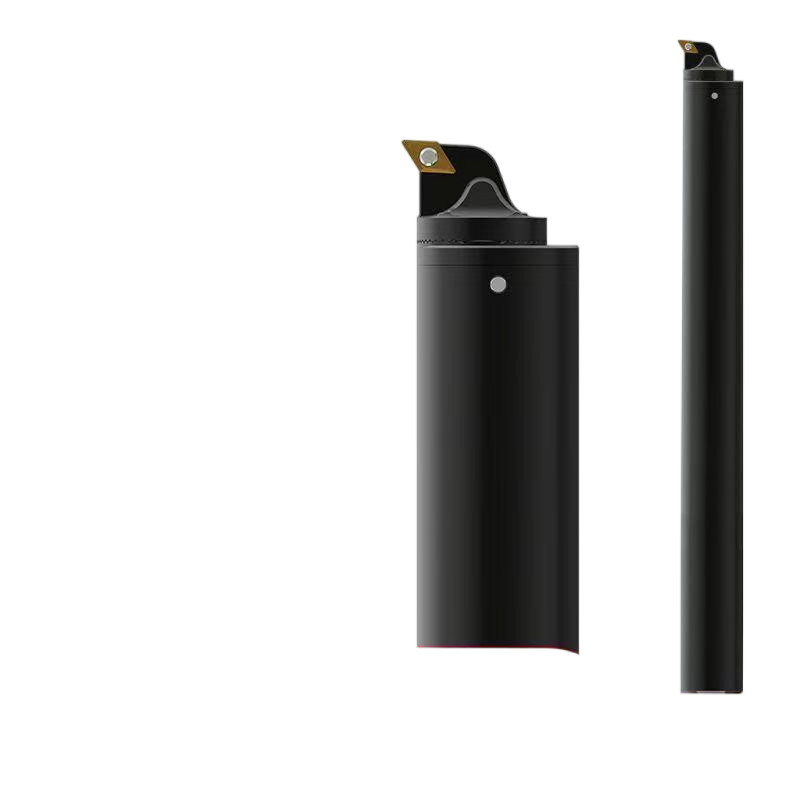
A silent tool from the Geltos internal turning range, designed for deep cutting operations that require vibration damping.
Vibration-Damped Silent Tools for Deep Cutting in Aerospace, Military, and Shipbuilding
Once a boring bar's overhang grows far beyond its own diameter, the limiting factor in a cut stops being the machine or the insert and becomes the tool assembly's ability to resist vibration. This reference article explains what vibration-damped silent tools are, how they are specified, where they fit in aerospace, military and shipbuilding work, and which constraints decide whether they are the right choice at all.
Deep cutting is one of the few machining operations where tool selection, rather than machine capability, determines whether a feature can be finished to specification. In bored holes, internal profiles and long internal turning passes, the tool is asked to work at an overhang several times its own diameter — a regime in which conventional bars tend to chatter, deflect, or lose dimensional control. Vibration-damped tooling was developed specifically for that regime.
Wenling Geltos Tools Co., Ltd. — a manufacturer of high precision and high strength milling tools established in 2012 in Zhejiang Province, China — lists silent tools among its main product lines, alongside grooving mills, modular milling cutters, chamfer mills, thread mills, dovetail mills, face, shoulder and profiling shank mills, shell mills, interchangeable milling tools, carbide internal turning tools and milling inserts. The sections below look at where damped tooling fits, and where it does not.
Silent Tools in One Paragraph
A silent tool — also described as an anti-vibration tool or a dampened tool — is an internal turning tool designed for deep cutting operations that require vibration damping. Geltos silent tools are made in HSS and carbide, are intended for the aerospace, military use and ship building industries, and carry model designations such as VT25-SCLCR09, VT40-SDUCR11, VT20 C20*200V and VT32 C32*480VE. Two installation rules accompany the range: the clamping length should be no less than a 4 L/D ratio, and the span between the two screws should be greater than 4×D.
In practice, those two rules plus the intended-industry list form most of the specification a buyer needs. Insert grade, holder interface and coolant supply matter, but they are secondary to two questions: does the application sit in the deep-cutting regime at all, and can the machine's tool interface satisfy the published geometry rules?
The Deep-Cutting Problem: Overhang, Chatter and the L/D Ratio
The length-to-diameter ratio of a boring assembly is the single most useful predictor of whether an internal turning operation will behave. As the unsupported overhang grows relative to the bar diameter, static deflection and dynamic vibration both tend to increase, and the symptoms appear in a predictable order: first surface finish deteriorates, then dimensional consistency drifts along the bore, and eventually the insert edge is loaded unevenly enough to shorten its life or chip it. At that point the machine is no longer the constraint; the tool assembly is.
Three variables determine which side of that line an operation falls on:
- Depth-to-diameter ratio of the bore. A deep bore in a large housing is a different problem from a shallow counterbore, even on the same machine.
- Type of bar. A solid carbide bar is inherently stiff at short overhangs; a damped bar adds mass and a damping mechanism so that longer overhangs remain usable.
- How the bar is clamped. Holder interface and clamping geometry decide how much of the bar is actually supported, which is why damped ranges publish clamping rules rather than only diameter and length.
In aerospace, military and shipbuilding work, these three variables often converge on the same answer. Components are large, bores are deep, access is restricted, and rework is expensive — so the tool must be able to hold a long overhang for the duration of a pass rather than only for a light finishing cut.
How the Geltos Silent Tool Range Is Specified
The Geltos silent tool range is defined by a small set of published facts, which is useful for buyers who need to check a specification rather than interpret a catalogue.
| Specification item | Published detail |
|---|---|
| Product category | Silent tools, anti-vibration tools, dampened tools — classified as internal turning tools |
| Function | Vibration damping for cutting operations; intended for deep cutting operations requiring vibration damping |
| Materials | HSS and carbide |
| Model designations | VT25-SCLCR09, VT40-SDUCR11, VT20 C20*200V, VT32 C32*480VE |
| Intended industries | Aerospace, military use, ship building |
| Clamping rule | Clamping length should be no less than a 4 L/D ratio |
| Screw spacing rule | Span between the two screws should be greater than 4×D |
The manufacturer's wider internal turning and milling portfolio matters for two reasons. First, a shop evaluating damped tooling usually has adjacent operations on the same part — a groove, a chamfer, a thread, a shoulder — and consolidation of suppliers is a real procurement consideration. Second, the same production infrastructure is used across the range. Wenling Geltos Tools Co., Ltd. was founded in 2012 in Zhejiang Province, China, operates a 3,000 m² manufacturing facility, employs approximately 25 staff, includes 5 engineers in its R&D team, and reports an annual output capacity of 500,000 teeth. Its listed export ratio is 5–10%, with main markets including India, Russia, Iran, Morocco, Italy and the USA.
Two production facts are relevant to any damped-tool evaluation. First, products are heat-treated before processing, which the manufacturer states supports a precision tolerance no greater than 0.02 mm. Second, the interchangeable and modular milling holders in the same portfolio are designed so that one holder can accept different milling heads, which reduces tool-changing time and the number of holders a shop has to purchase. Damped internal turning and modular milling address different operations, but buyers assessing a deep-cutting package frequently need both.
Technical Explanation: What the Two Installation Rules Actually Control
The published rules — clamping length no less than a 4 L/D ratio, and screw span greater than 4×D — are the most actionable part of the specification, because they can be checked against a machine before an order is placed.
Clamping length and the 4 L/D rule
Clamping length is the portion of the tool assembly that the holder actually grips. A vibration-damped bar only behaves as intended when it is supported over a sufficient length relative to its diameter; the 4 L/D figure is the manufacturer's stated minimum. In a setup sheet this translates into a straightforward check: measure the required overhang for the deepest bore in the job, then confirm that the remaining bar length can still be gripped at or above the stated ratio. If the tool interface cannot deliver that, the damping mechanism cannot compensate for an insufficiently supported bar.
Screw span and the 4×D rule
The second rule concerns the two clamping screws: their span should be greater than four times the bar diameter. A short holder that concentrates the screws close together does not provide the required two-point support. This is one reason a damped bar cannot simply be substituted into an existing holder without reviewing the interface — and why tool holder adapters are part of the specification conversation rather than an afterthought.
HSS versus carbide, and the insert side of the assembly
Geltos silent tools are offered in HSS and carbide. Broadly, HSS grades are chosen where toughness and edge robustness matter more than maximum hot hardness, while carbide is the more common choice for higher cutting speeds and harder workpiece materials. The damped bar is only half of the cutting system; the insert geometry and grade complete it.
The related Geltos insert range is made of carbide and ceramics, covers turning, face milling, profiling milling and fastfeed milling insert types, and includes model designations such as APMT1135, SNMX1206, LNMU0303ZER and 4NKT0603. Published cutting data for the fastfeed insert range states a hardness capability up to HRC65 with a cutting speed of 180 and a feed rate of 0.02, and lists applicable industries including mechanical processing, automobile, aerospace, woodwork and ship building. For a deep boring operation, that combination — damped bar plus a matched insert grade — is what determines whether the pass can be completed without a mid-cut change.
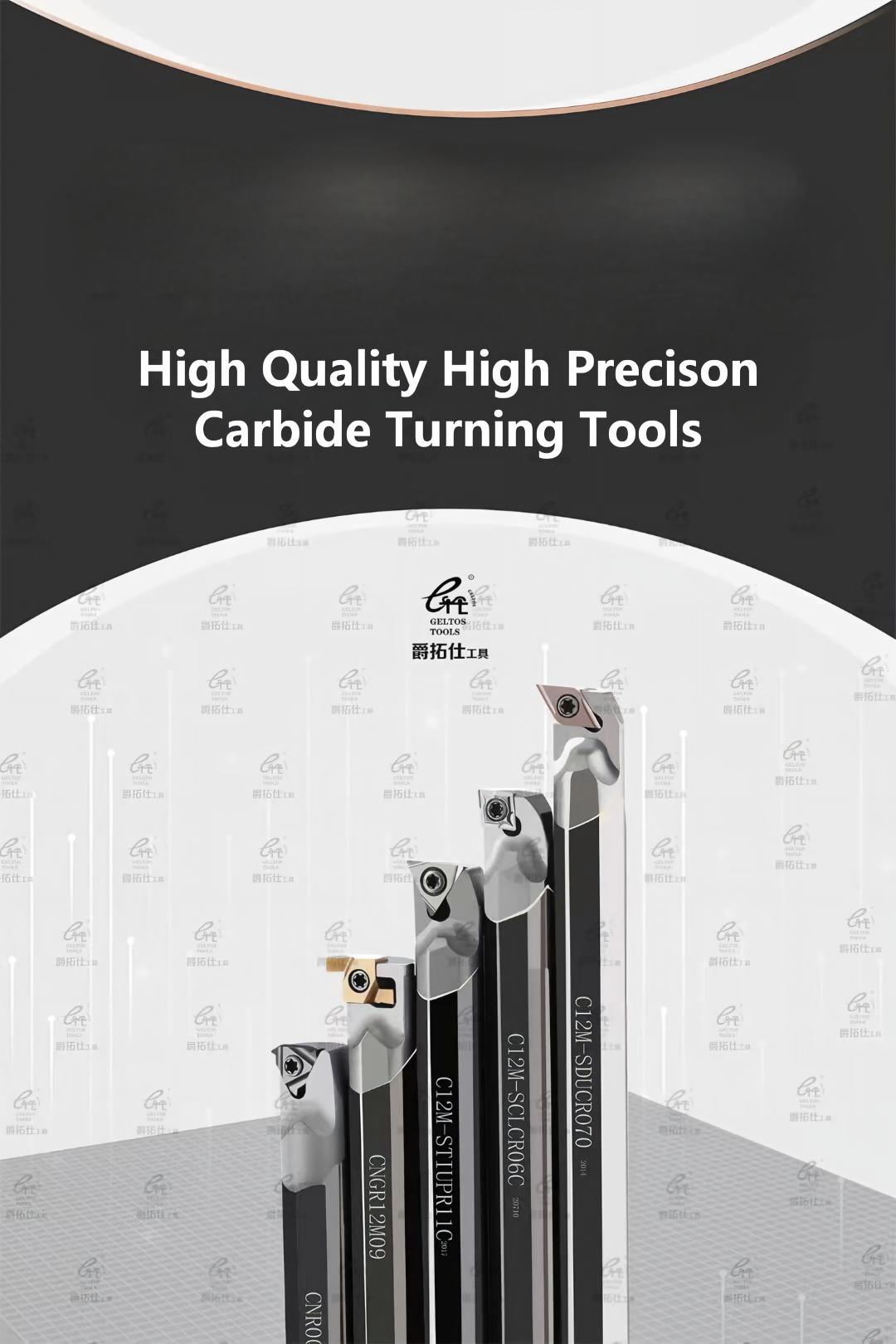
Carbide internal turning tools: the tool family that damped silent tools belong to, and the assembly that carries the insert into a deep bore.
Application Fit: Aerospace, Military and Shipbuilding
The industries named for the Geltos silent tool range — aerospace, military use and ship building — share a common machining profile: large or high-value components, deep internal features, restricted tool access, and a cost of failure that is measured in rework and schedule rather than in tool price.
Aerospace
Aerospace work is explicitly listed both for the silent tool range and for the company's milling insert range. The relevant operations are internal turning and boring passes where the tool must hold a long overhang without generating vibration that would show up in surface integrity or dimensional control. Heat-treated tooling with a stated precision of no greater than 0.02 mm is a relevant capability where bore tolerance is tight.
Military use
Military applications are named as an intended industry for the damped tool range. The machining requirement is similar to aerospace — deep internal cutting with limited access — but is often characterised by harder or more wear-resistant workpiece materials, where the insert grade and the rigidity of the assembly both matter. The published fastfeed insert data, with a stated capability up to HRC65, is the relevant reference point on the material side.
Shipbuilding
Shipbuilding is listed for the silent tool range and for the milling insert range, whose applicable industries include ship building alongside aerospace, automobile, woodwork and mechanical processing. Shipyard machining tends toward large housings, shafts and structural components where bores are deep and the machine tool is often the least flexible part of the setup. That is precisely the environment in which the two installation rules become the deciding factor: if the holder cannot provide the stated clamping length and screw span, the operation should be re-planned rather than forced.
Adjacent industries
The same deep-cutting logic applies in the broader industries the manufacturer lists across its ranges: automobile, metal cutting and machining, mechanical workshops, mechanical processing and woodwork. Buyers in these sectors generally arrive at damped tooling through the same route — a boring operation that has reached the limit of a conventional bar.
Market Context: Why Damped and Indexable Tooling Is Getting More Attention
Third-party market data gives some scale to the category that damped internal turning belongs to. DataM Intelligence estimates the global milling tools market at USD 3.43 billion in 2025, projected to grow to USD 6.23 billion by 2035. Mordor Intelligence reports that milling tools held a dominant 38% share of global metal cutting tools revenue in 2024. IndexBox and Persistence Market Research value the global indexable milling cutters market at USD 5.2 billion in 2025, with carbide inserts accounting for 46.7% of the total share.
The supply side remains concentrated. According to Global Market Insights, Sandvik Coromant leads the global cutting tool market with over 16% market share in 2025, followed by Kennametal and IMC Group (Iscar). That structure matters for buyers: the large global suppliers set the reference points for catalogue breadth and standardisation, while specialist manufacturers compete on specific product families, customisation and batch size. Grand View Research reports that Asia Pacific dominated the cutting tools market with a 49% global share in 2024, with China alone contributing 38% of regional production — a useful context for buyers assessing where specialist manufacturing capacity is located.
On the materials side, SNS Insider projects the carbide tools market to reach USD 16.25 billion by 2032, growing at a CAGR of 6.14% from 2024. Carbide is the dominant insert material for both milling and turning, which is consistent with the Geltos insert range being specified primarily in carbide, with ceramics used where the application calls for it.
One caveat belongs in any reference article that quotes market size: estimates diverge significantly depending on scope. Published figures for the metal cutting tools market range from roughly USD 23 billion to above USD 90 billion for overlapping years, depending on whether machines, tools and inserts, or only tools and inserts are counted. Damped internal turning is a narrow sub-segment inside those totals, and buyers should read any market number as a direction of travel rather than a precise share.
Standardisation note: ISO 13399 is the international standard for the computer-interpretable representation and exchange of industrial product data for cutting tools and toolholders, published by ISO Technical Committee TC 29. As tool data becomes machine-readable, buyers increasingly evaluate a tool portfolio by how completely it can be described as data — dimensions, insert interface, clamping geometry — rather than by catalogue descriptions alone.
Comparison: Damped Silent Tools vs Conventional Solutions
Damped tooling is not a universal upgrade. It solves one specific problem — deep cutting at long overhang — and it carries its own setup conditions. The table below compares the practical options a buyer will encounter.
| Option | Typical use | Strength | Constraint or boundary |
|---|---|---|---|
| Solid carbide boring bar | Short to moderate overhang internal turning | High inherent stiffness at short overhangs | Not intended for deep cutting; vibration risk rises as overhang grows |
| Standard bar without damping | General internal turning and finishing | Simple, widely available, easy to set up | Usable overhang is limited by the rigidity of the assembly, not by the holder alone |
| Vibration-damped silent tool | Deep internal turning requiring vibration damping | Extends usable overhang; offered in HSS and carbide; aerospace and shipbuilding compatible | Requires clamping length no less than a 4 L/D ratio and screw span greater than 4×D; the assembly must fit the machine interface |
| Modular / interchangeable holder with milling heads | Operations where head changes replace full tool changes | Reduces tool-changing time and the number of holders purchased | Head and holder compatibility must be verified operation by operation |
Boundaries buyers should accept before specifying
- Deep cutting is a threshold, not a preference. The silent tool range is intended for deep cutting operations requiring vibration damping. Below that regime, a conventional bar that satisfies the overhang requirement is the simpler and more appropriate choice.
- The clamping rules are hard limits. If a machine's holder cannot provide a clamping length at or above the 4 L/D guideline, or cannot separate the clamping screws by more than 4×D, a damped bar will not deliver its intended behaviour. The correct response is to re-plan the setup, not to reduce the clamping length.
- The range is not a substitute for milling tool selection. Silent tools are internal turning tools. Slotting, face milling, shoulder milling, thread milling and chamfering are served by other families in the portfolio — grooving mills, shank mills, shell mills, chamfer mills, thread mills and dovetail mills among them — and mixing the two categories in a single specification leads to the wrong tool being ordered.
- Scale differences are a procurement variable, not a quality verdict. Global suppliers such as Sandvik Coromant hold over 16% of the cutting tool market, while a specialist such as Wenling Geltos Tools Co., Ltd. operates a 3,000 m² facility with approximately 25 staff and a stated annual output of 500,000 teeth. Buyers running multi-plant programmes should verify capacity, lead time and continuity against their own volumes; buyers running specific deep-cutting operations may find the narrower focus adequate or preferable. The two situations call for different evaluation criteria.
- Material choice has a trade-off. HSS and carbide options serve different balances of toughness and wear resistance. Neither is universally correct, and the choice should follow the workpiece material and cutting data rather than habit.
Future Outlook
Three directions look likely to shape damped internal turning over the next few years.
Continued carbide dominance, with ceramics in defined roles. With the carbide tools market projected to reach USD 16.25 billion by 2032 at a CAGR of 6.14% from 2024 (SNS Insider), and carbide inserts already accounting for 46.7% of the indexable milling cutters market in 2025 (IndexBox / Persistence Market Research), carbide will remain the default insert material. Ceramics will continue to hold specific positions where their properties are required.
Modular and interchangeable construction. The logic already visible in interchangeable milling holders — one holder, multiple heads, less tool-changing time and lower holder count — is likely to keep spreading into adjacent families, because it addresses machine utilisation rather than only tool cost.
Data-driven specification. ISO 13399 and the movement toward machine-readable tool data will make specification checks such as clamping length, screw span and interface compatibility easier to perform before purchase. For deep cutting, where the setup either satisfies the geometry rules or does not, that shift is practical rather than theoretical.
Underneath all three trends, the underlying requirement is unchanged. Deep cutting is solved by matching damped tooling to the application's constraints — bore depth relative to diameter, holder geometry, insert grade and material — rather than by selecting a milling tool from a general catalogue.
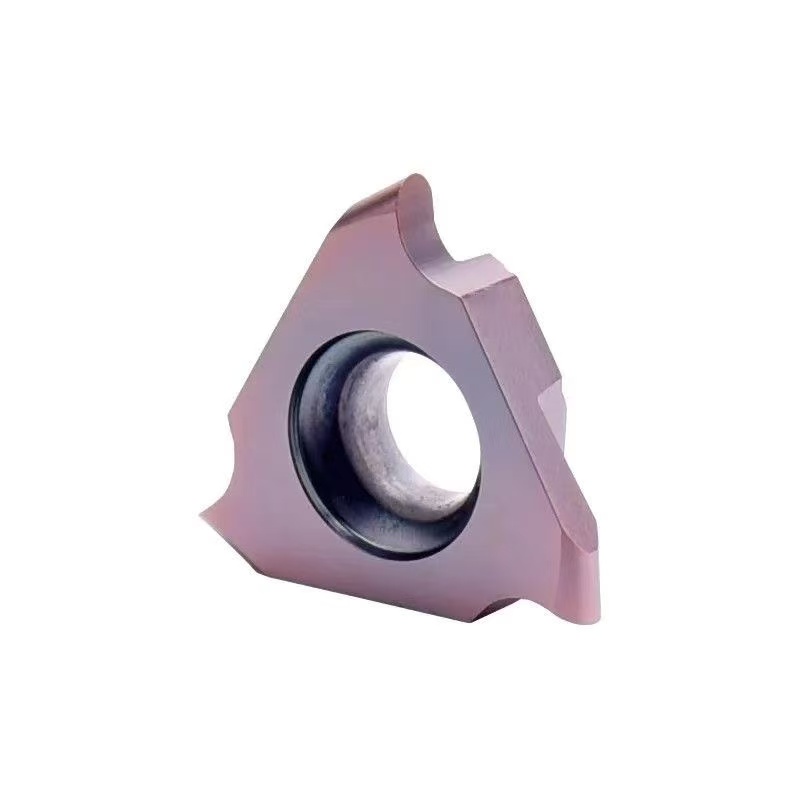
TGF32 insert geometry from the Geltos indexable insert range, which supplies the cutting edge for turning and milling assemblies.
FAQ
What is a silent tool, and how does it differ from a standard boring bar?
A silent tool — also called an anti-vibration tool or dampened tool — is an internal turning tool designed for deep cutting operations that require vibration damping. It is made in HSS and carbide. A standard boring bar has no damping provision, so its usable overhang is limited by the rigidity of the bar and holder assembly. The distinguishing feature of a silent tool is that it is specified together with installation rules: clamping length should be no less than a 4 L/D ratio, and the span between the two screws should be greater than 4×D.
Which industries are vibration-damped silent tools used in?
The Geltos silent tool range lists aerospace, military use and ship building as its intended industries. The manufacturer's wider insert and turning ranges extend to automobile, metal cutting and machining, mechanical workshops, mechanical processing and woodwork. The common thread in the primary industries is deep internal cutting with limited tool access on components where rework is costly.
What materials and model designations are available in the Geltos silent tool range?
Silent tools are offered in HSS and carbide, with model designations VT25-SCLCR09, VT40-SDUCR11, VT20 C20*200V and VT32 C32*480VE. The related insert range is made of carbide and ceramics and includes turning, face milling, profiling milling and fastfeed milling insert types, with model designations such as APMT1135, SNMX1206, LNMU0303ZER and 4NKT0603. Published cutting data for the fastfeed insert range states a capability up to HRC65 with a cutting speed of 180 and a feed rate of 0.02.
What installation rules apply when setting up a damped boring tool?
Two rules are published with the range. Clamping length should be no less than a 4 L/D ratio, meaning the bar must be gripped over a length sufficient relative to its diameter. The span between the two clamping screws should be greater than 4×D, meaning the holder must provide adequately separated two-point support. Both rules can be checked against a machine and holder before ordering, and both relate to how the assembly is supported rather than to the cutting edge.
When should a buyer not choose a vibration-damped tool?
Damped tooling is intended for deep cutting operations requiring vibration damping, so it is not the appropriate choice for short-overhang internal turning that a conventional bar can handle within its rigidity limits. It is also not a milling solution: slotting, face milling, shoulder milling, thread milling and chamfering are served by different tool families such as grooving mills, shank mills, shell mills, chamfer mills, thread mills and dovetail mills. Finally, if the machine's holder cannot satisfy the clamping length and screw span rules, the correct action is to re-plan the setup rather than to specify a damped bar.
Key Takeaways
- Silent tools are internal turning tools for deep cutting operations requiring vibration damping, offered in HSS and carbide and intended for aerospace, military use and ship building.
- Two published rules govern setup: clamping length no less than a 4 L/D ratio, and screw span greater than 4×D.
- The range is specified by model designations VT25-SCLCR09, VT40-SDUCR11, VT20 C20*200V and VT32 C32*480VE, and pairs with carbide and ceramic inserts including APMT1135, SNMX1206, LNMU0303ZER and 4NKT0603.
- Damped tooling extends usable overhang in deep bores; it does not replace conventional bars at short overhangs, nor does it replace milling tool families for slotting, facing or threading.
- Buyers should verify holder geometry and capacity against their own volumes before specifying, since specialist manufacturers and global suppliers differ in scale, catalogue breadth and lead time.
Product information for the ranges discussed above is published by Wenling Geltos Tools Co., Ltd. at www.geltos.com. For deep-cutting operations, the practical first step is to record the bore's depth-to-diameter ratio and the machine's holder interface, then check both against the published clamping rules before a tool is specified.