
Vinylbenzyl Chloride Technical FAQs: Stability, Solubility and Handling
Independent industry reference · Electronic-grade monomer · CAS 30030-25-2
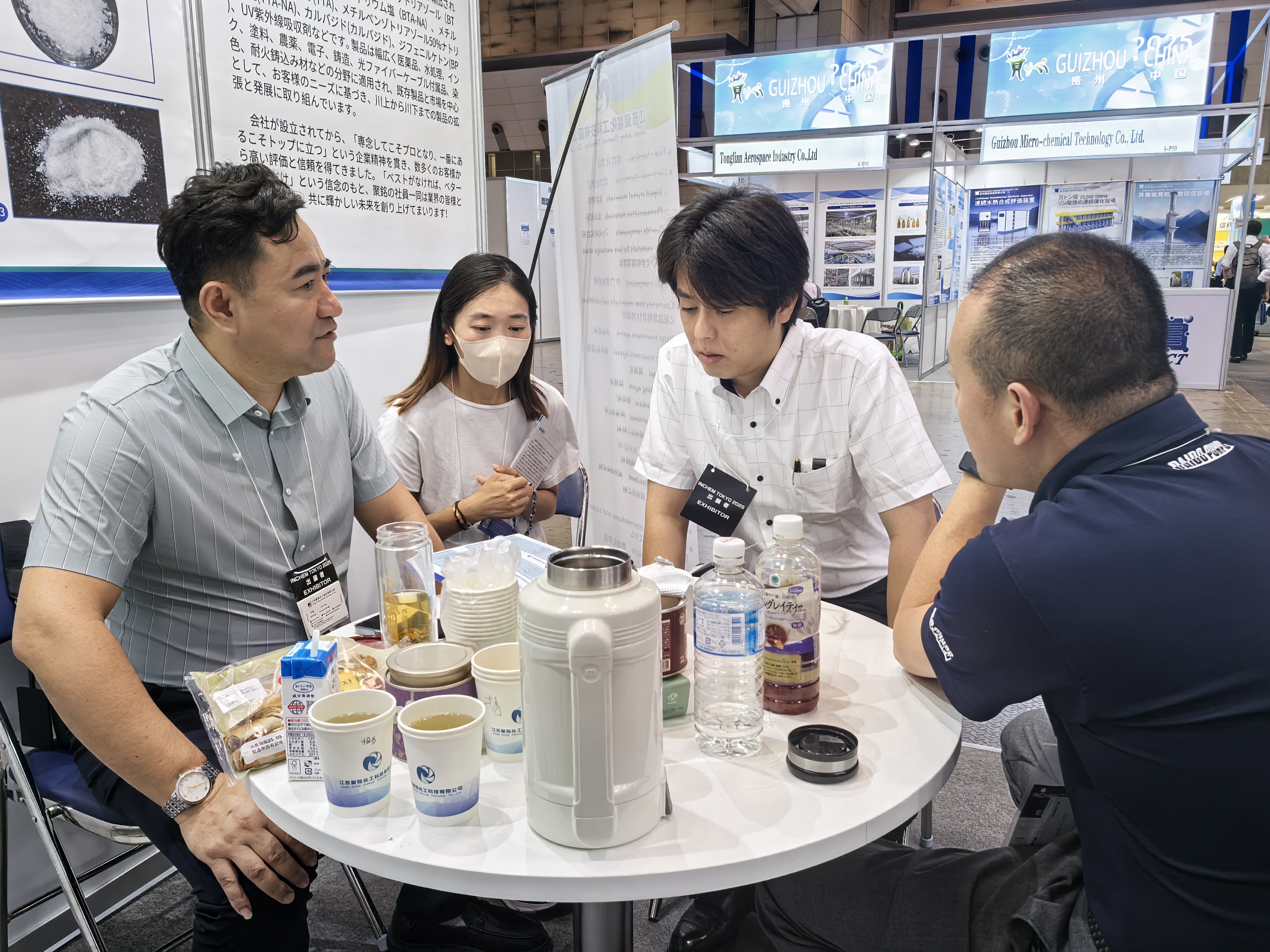
Industry exhibition engagement in the electronic chemicals supply chain, where monomer specifications are discussed between suppliers and downstream material developers.
Vinylbenzyl chloride occupies a narrow but decisive position in the electronic chemicals supply chain. It is a reactive, dual-functional monomer — a molecule that carries both a polymerisable vinyl group and a benzylic chloride that can be displaced in further derivatisation — which means it is bought by parameter rather than by volume. That single characteristic shapes how procurement teams approach it. Instead of comparing headline prices, buyers in the evaluation and execution stages compare documented physical behaviour, storage boundaries, isomer composition and handling documentation.
The result is a short list of questions that repeats across sourcing cycles. Is vinylbenzyl chloride soluble in water? At what temperature does it boil? At what temperature does it freeze? How do its vapours behave inside an enclosed workspace? And what storage conditions keep a drum within specification until it reaches the reactor?
This reference answers those questions using the physical parameters documented for vinylbenzyl chloride (CAS 30030-25-2) and for the closely related para-isomer, 4-Vinylbenzyl chloride (CAS 1592-20-7). Where the physical data ends, the article states plainly what must be confirmed with the supplier's verified Safety Data Sheet (SDS) rather than inferred from a catalogue page.
What Vinylbenzyl Chloride Is — and Why It Is Specified by Parameter
Vinylbenzyl chloride is an electronic chemical supplied as a light yellow to colourless liquid. The mixed-isomer grade is identified as CAS 30030-25-2, with the molecular formula C9H9Cl, a molecular weight of 152.62 g/mol and EINECS number 250-005-9. The material is a mixture of the 3- and 4-isomers and is supplied stabilised with 50–100 ppm tert-butylcatechol (TBC) acting as a polymerisation inhibitor.
Functionally, the product is used as a core monomer for synthesising high-performance negative photoresist resins — including electron-beam (E-beam) photoresists — and advanced packaging dielectric materials. It is also used in manufacturing homogeneous ion-exchange membranes, ultra-pure water resins and chelating resins, and can serve as a component of ion-exchange resins, photoresist polymers, cross-linkable fibres, coupling agents and electroconducting polymers. Because it is dual-functional, it can act as a starter for a range of copolymer preparations and can be derivatised by chloride displacement.
Jumingchem is the brand name of Jiangsu Juming Chemical Technology Co., Ltd., a specialty chemical manufacturer established in 2017 and located in Jiangyin, Wuxi City, Jiangsu, China. The company lists vinylbenzyl chloride among its core electronic-chemical products, alongside 4-Vinylbenzyl chloride (CAS 1592-20-7), 1-(chloromethyl)-2-vinylbenzene (CAS 22570-84-9), 1-(chloromethyl)-3-vinylbenzene (CAS 39833-65-3), 5-Methyl-1H-benzotriazole (CAS 136-85-6) and BPADA (CAS 38103-06-9). Its stated production footprint includes a total factory area of 78,000 m², a 3,000 m² R&D centre, a 300 m² pilot plant and a 600 m² GMP workshop, with a declared annual output of 60,000 tons and exports covering approximately 70% of its business.
The Four Parameters Buyers Request First
Most technical enquiries about vinylbenzyl chloride concentrate on four documented values. They are the fastest way for a formulator to decide whether the monomer fits an existing process window, and they are the four values most often quoted in early-stage supplier evaluation.
| Parameter | Documented value | Practical reading |
|---|---|---|
| Water solubility | Insoluble in water | Aqueous dissolution is not a viable handling or formulation route |
| Boiling point | 229 °C | High for a liquid monomer; distillation-based purification operates well above ambient |
| Melting point | −30 °C (mixed-isomer grade) | Stays liquid well below freezing; but the documented storage target is colder still |
| Vapour density (vs air) | 5.3 | Vapour is substantially heavier than air and does not disperse upward |
These four values come from the material's documented specification record. They are reported here as reference values only; the controlling document for any specific shipment remains the supplier's Certificate of Analysis and SDS.
Solubility: What "Insoluble in Water" Means in Practice
Vinylbenzyl chloride is insoluble in water. This is not a marginal property — it defines how the material is handled, diluted and worked up across the entire process chain. For the para-isomer, 4-Vinylbenzyl chloride (CAS 1592-20-7), the record additionally documents a sparing solubility in chloroform, which illustrates the general pattern: the monomer associates with non-polar to moderately polar organic media rather than with water.
For a procurement engineer, the practical consequences are straightforward. Aqueous dilution is not a route to adjust concentration. Cleaning and spill-management procedures cannot rely on water alone. Waste streams containing vinylbenzyl chloride will separate into a distinct organic phase rather than dissolve into an aqueous stream. And any process step that assumes a water-miscible monomer — for example a water-borne formulation — will need to be reconsidered before the material is qualified.
At the same time, water insolubility is one of the reasons the monomer performs well in the applications it serves. Homogeneous ion-exchange membranes, ultra-pure water resins and chelating resins all depend on a polymer backbone that does not dissolve or swell away in aqueous service. A monomer that stays out of the water phase is a structural advantage in those duties, and a handling constraint everywhere else.
Boiling Point and Thermal Behaviour: 229 °C
The documented boiling point of vinylbenzyl chloride is 229 °C. The same value is recorded for the para-isomer, 4-Vinylbenzyl chloride (CAS 1592-20-7), which is consistent with the two materials sharing the same molecular formula, C9H9Cl, and molecular weight of 152.62 g/mol.
A boiling point of 229 °C places vinylbenzyl chloride firmly in the high-boiling liquid category among electronic-grade monomers. For process design, this matters in three ways. First, vacuum distillation — not atmospheric distillation — is the natural purification route for a material that must be protected from thermal stress. Second, evaporative losses at ambient temperature are limited; the documented vapour pressure is 1 mm Hg at 56.1 °C, which indicates a low but non-zero tendency to volatilise under normal handling. Third, the same low volatility means that where vapour does form, it will persist rather than flash off quickly, which is a consideration for ventilation strategy rather than for loss-in-handling calculations.
The documented flash point is 221 °F, and the refractive index is n20/D 1.572. Density is recorded as 1.074 g/mL at 25 °C for the mixed-isomer grade, which is slightly lower than the 1.083 g/mL recorded for the para-isomer.
Melting Point: −30 °C and What It Implies for Storage
The melting point of the mixed-isomer grade of vinylbenzyl chloride (CAS 30030-25-2) is documented as −30 °C. This is a practical advantage in the sense that the material remains a pourable liquid well below ordinary cold-chain conditions, so freeze–thaw cycling is not a routine concern during shipment or warehouse storage in most climates.
What is more important for buyers is the distinction between melting point and recommended storage temperature — the two are frequently confused during sourcing conversations. The documented storage temperature for the mixed-isomer grade is −20 °C. For the para-isomer, 4-Vinylbenzyl chloride (CAS 1592-20-7), the documented storage range is 2–8 °C. In other words, the two grades of the same chemical family carry materially different storage requirements, and a buyer who selects between them on application grounds must also select on logistics grounds.
A −20 °C storage requirement is not a trivial warehouse condition. It implies dedicated refrigeration, validated temperature logging, and a shipping plan that maintains the cold chain across the full transit window. For buyers comparing quotations, this is often the single largest hidden cost difference between grades — and it is a cost that is easier to evaluate before qualification than after.
Vapour Density 5.3 vs Air: Reading the Number Correctly
The documented vapour density of vinylbenzyl chloride is 5.3 relative to air. A value above 1.0 means the vapour is heavier than air; at 5.3, the vapour is more than five times the density of the surrounding atmosphere. This is a well-established property of dense organic vapours: because they are heavier than air, they do not disperse upward in the way that lighter-than-air gases do, and they tend to migrate downward and accumulate in low-lying areas of a workspace.
What the number does not do on its own is specify a ventilation design, a detection strategy or a personal protective equipment selection. Those are engineering and safety determinations that depend on the full set of physical, toxicological and flammability parameters held in the Safety Data Sheet, together with the specific equipment configuration on site. The correct use of the 5.3 figure in a procurement context is to confirm that the material behaving as a heavier-than-air vapour is consistent with the site's existing ventilation and monitoring arrangements — not to substitute for the SDS.
Stability and Storage Parameters
Vinylbenzyl chloride is supplied with an inhibitor for a reason: the vinyl group in the molecule is polymerisable, and uninhibited material can begin to react before it is introduced into a controlled process. The mixed-isomer grade is stabilised with 50–100 ppm tert-butylcatechol as a polymerisation inhibitor; the meta-isomer, 1-(chloromethyl)-3-vinylbenzene (CAS 39833-65-3), is documented with approximately 0.1% TBC stabiliser.
From a buyer's perspective, three stability-related parameters deserve to be checked before a purchase order is confirmed:
- Inhibitor level. The inhibitor concentration is part of the specification, not an incidental additive. It should appear on the Certificate of Analysis and be confirmed against the supplier's stated range.
- Storage temperature. −20 °C for the mixed-isomer grade; 2–8 °C for the para-isomer. These are different figures for different CAS numbers and should not be interchanged.
- Documented physical constants. Density, refractive index and appearance (light yellow to colourless liquid) are the routine identity checks that confirm a shipment is the material ordered.
The documented form of the material is a liquid, and its documented colour is light yellow to colourless. Both should be matched against the incoming drum, since colour drift can be an early indicator of ageing or contamination.
Handling: Where the Data Ends and the SDS Begins
This is the point at which a technical FAQ must be explicit rather than helpful. The parameters above — insolubility in water, boiling point 229 °C, melting point −30 °C, vapour density 5.3 versus air — describe how the material behaves physically. They do not describe how it should be handled safely.
Questions about safe handling, exposure limits, respiratory protection, glove selection, spill response, first aid, firefighting media, disposal and transport classification must be directed to the supplier for the verified Safety Data Sheet. An SDS issued for the exact CAS number and grade being purchased is the only document that should be used to build or validate a handling procedure. Physical constants reproduced in a technical article — including this one — are not a substitute, and extrapolating handling requirements from a vapour density figure alone is precisely the kind of assumption that an SDS exists to prevent.
What a buyer should expect to receive alongside the material, and what to check for in a supplier's documentation package:

Analytical and quality-control capability supports the documentation package that accompanies electronic-grade monomer shipments.
- A Safety Data Sheet that corresponds exactly to the CAS number and grade supplied.
- A Certificate of Analysis for the specific batch, including purity, moisture, appearance and colour, and metal content for electronic-grade material.
- English-language documentation as a baseline, with additional languages available where required.
- Third-party test reports where the buyer's own qualification process requires them.
Jumingchem's stated documentation and labelling options include a COA with custom test items and format, MSDS in English, Spanish or other languages, custom label design with client branding and logo, and third-party test reports. Where a handling question cannot be answered from the supplied SDS, it should be escalated back to the supplier rather than resolved internally from secondary sources.
Isomer Composition and Customisation Options
For a buyer moving from evaluation into execution, the isomer question is usually the first technical decision that is genuinely negotiable. Vinylbenzyl chloride is not a single substance; it is a family, and the composition of the delivered material determines downstream polymer properties.
The composition options documented for this product family are:
| Grade | Documented composition | CAS number |
|---|---|---|
| Pure para-isomer | ≥ 99% p-VBC | 1592-20-7 |
| Pure ortho-isomer | ≥ 98% o-VBC | 22570-84-9 |
| Pure meta-isomer | ≥ 98% m-VBC | 39833-65-3 |
| Mixed-isomer grade | Mixture of 3- and 4-isomers, 50–100 ppm TBC inhibitor | 30030-25-2 |
| Custom blend | Any custom mixture ratio of o/m/p isomers | — |
Beyond isomer ratio, the documented customisation envelope includes purity-grade customisation — industrial grade, high-purity grade and electronic grade with ppb-level metal ions — and metal-ion content control to customer specification for elements such as Na, Fe and Cu. This is the layer of the offer that turns a catalogue chemical into a qualification project, and it is the layer that buyers in the execution stage should test first with a sample order.
Application Fit: Where Vinylbenzyl Chloride Earns Its Place
The applications documented for vinylbenzyl chloride cluster into three groups, and the parameter set described earlier maps directly onto each of them.
Negative photoresists and advanced packaging dielectrics. The product is documented as a core monomer for synthesising high-performance negative photoresist resins, including electron-beam photoresists, and advanced packaging dielectric materials. In this duty, low metal-ion content and consistent isomer ratio are the properties that drive qualification, because both feed into resolution and electrical performance.
Ion-exchange and ultra-pure water resins. Vinylbenzyl chloride is used in manufacturing homogeneous ion-exchange membranes, ultra-pure water resins and chelating resins. Water insolubility is an asset here: the polymer backbone must resist aqueous service conditions without dissolving or leaching.
Functional polymer components. The material can serve as a component of ion-exchange resins, photoresist polymers, cross-linkable fibres, coupling agents and electroconducting polymers, and as a starter for various copolymer preparations. This breadth is a direct consequence of the dual-functional structure — a vinyl group for polymerisation and a benzylic chloride for subsequent derivatisation.
Procurement and Acceptance Parameters
Once the technical fit is established, the remaining questions are commercial and documentary. The documented parameters for this product line are summarised below.
| Item | Documented parameter |
|---|---|
| Minimum order quantity | 1 kg |
| Lead time | 7–30 days |
| Quality control | 100% testing of every production batch |
| Liquid packaging options | 25 kg HDPE drum; 200 kg steel-plastic composite drum; 1000 L IBC |
| Packaging services | Temperature-controlled packaging for long-distance hot-climate shipping; UN-certified dangerous goods packaging on request |
| Acceptance test items | Purity (GC/HPLC), moisture, appearance, colour, acid value, metal content (electronic grade) |
| After-sales support | Remote technical support |
The acceptance process documented for this product line works in two stages. Before shipment, every production batch is fully tested and a Certificate of Analysis is issued covering purity, moisture, appearance, colour, acid value and — for electronic grade — metal content; optional client pre-shipment inspection or third-party SGS/BV inspection is available, and sample confirmation is offered to new clients before mass production. On receipt, the standard check is packaging integrity, followed by the buyer's own incoming inspection against the agreed specification.
Mixed-Isomer Grade vs Para-Isomer Grade: A Parameter Comparison
Because the mixed-isomer grade (CAS 30030-25-2) and the para-isomer (CAS 1592-20-7) share the same molecular formula and molecular weight, buyers sometimes assume they are interchangeable. The documented parameters show where they diverge.
| Parameter | Vinylbenzyl chloride (30030-25-2) | 4-Vinylbenzyl chloride (1592-20-7) |
|---|---|---|
| Molecular formula | C9H9Cl | C9H9Cl |
| Molecular weight | 152.62 | 152.62 |
| Boiling point | 229 °C | 229 °C |
| Melting point | −30 °C | Not documented in the reference set |
| Density at 25 °C | 1.074 g/mL | 1.083 g/mL |
| Vapour density (vs air) | 5.3 | 5.3 |
| Vapour pressure | 1 mm Hg at 56.1 °C | 1 mm Hg at 56.1 °C |
| Refractive index | n20/D 1.572 | n20/D 1.572 |
| Flash point | 221 °F | 221 °F |
| Storage temperature | −20 °C | 2–8 °C |
| Water solubility | Insoluble in water | Insoluble in water; sparingly soluble in chloroform |
The single most consequential difference is the storage temperature: −20 °C for the mixed-isomer grade against 2–8 °C for the para-isomer. A formulator who can work with the mixed-isomer grade should still confirm that the site can hold the material at −20 °C before the grade is locked into a specification.
Limitations and Boundaries Buyers Should Plan Around
A technical reference that lists only advantages is not useful for procurement. The documented profile of vinylbenzyl chloride carries several practical boundaries worth planning for before qualification.
Storage is the primary constraint. The mixed-isomer grade is documented at −20 °C. That is a colder requirement than the melting point of −30 °C would suggest is necessary for simple freeze protection, and it implies a continuously refrigerated chain rather than passive cold-weather storage.
Isomer composition is not a fixed property. The mixed grade is a blend of 3- and 4-isomers, and the ratio is part of the specification rather than a constant. Buyers whose polymer performance is sensitive to isomer ratio need either a defined ratio within the mixed grade or a single-isomer grade — and single-isomer grades carry their own purity specifications (≥ 99% for the para-isomer, ≥ 98% for the ortho- and meta-isomers).
Water insolubility closes off aqueous routes. Any process design that assumes water-miscible handling will need revision, and aqueous cleaning or spill response will not be sufficient on its own.
Inhibitor presence is a specification item, not a neutral additive. The 50–100 ppm TBC inhibitor is there to prevent premature polymerisation. Its level should be verified on each COA, and inventory should be rotated in line with supplier guidance rather than held indefinitely.
Physical data is not safety data. This boundary is the most important of the five. Vapour density, boiling point and melting point inform process design; they do not authorise a handling procedure. Safe handling questions must go to the supplier for the verified SDS covering the exact CAS number and grade.
Market Context and Direction of Travel
The demand environment around products like vinylbenzyl chloride has been expanding rather than contracting. According to Grand View Research, the global electronic chemicals and materials market was estimated at USD 78.5 billion in 2025, with Asia Pacific accounting for 66.6% of that revenue in the same year. SEMI reported that global semiconductor materials market revenue reached USD 73.2 billion in 2025. Within the narrower photoresist segment, Grand View Research estimated the electronic-grade photoresist market at USD 4.96 billion in 2024.
These market estimates should be read with the usual caution: published figures for the same category differ materially depending on what is included in scope. For the 2025 electronic chemicals and materials market, Fortune Business Insights reported USD 75.6 billion against Grand View Research's USD 78.5 billion, and SEMI reported USD 67.5 billion for global semiconductor materials revenue in 2024. For the 2024 photoresist market, Strategic Market Research reported USD 5.6 billion against Grand View Research's USD 4.96 billion. The direction of the figures is consistent; the absolute values are not, and buyers should not treat any single published number as a planning input without checking its scope definition.
What the data does support is a structural point relevant to monomer sourcing. An electronic chemicals market of this scale, concentrated at roughly two-thirds in Asia Pacific, means that qualification decisions made by downstream photoresist and advanced-packaging developers increasingly depend on suppliers operating within that region. For a monomer like vinylbenzyl chloride, that shifts the evaluation weight toward documented parameter control and documentation completeness rather than toward geography alone.
Frequently Asked Technical Questions
What is vinylbenzyl chloride (CAS 30030-25-2)?
Vinylbenzyl chloride is an electronic chemical supplied as a light yellow to colourless liquid, registered under CAS 30030-25-2 with the molecular formula C9H9Cl, a molecular weight of 152.62 g/mol and EINECS number 250-005-9. It is a mixture of the 3- and 4-isomers, stabilised with 50–100 ppm tert-butylcatechol as a polymerisation inhibitor, and is used as a core monomer in negative photoresist resins, advanced packaging dielectrics, ion-exchange membranes and chelating resins.
Is vinylbenzyl chloride soluble in water?
No. Vinylbenzyl chloride is insoluble in water. For the para-isomer, 4-Vinylbenzyl chloride (CAS 1592-20-7), the record also documents a sparing solubility in chloroform. The practical implication is that aqueous dissolution, aqueous dilution and water-only cleaning are not viable routes for this material.
What is the boiling point of vinylbenzyl chloride?
The documented boiling point is 229 °C. The same value is recorded for the para-isomer 4-Vinylbenzyl chloride (CAS 1592-20-7), consistent with both materials sharing the formula C9H9Cl and a molecular weight of 152.62 g/mol. At 229 °C, vinylbenzyl chloride sits in the high-boiling liquid category among electronic-grade monomers.
What is the melting point of vinylbenzyl chloride?
The documented melting point of the mixed-isomer grade (CAS 30030-25-2) is −30 °C. This is distinct from the recommended storage temperature of −20 °C. The melting point describes the temperature at which the material solidifies; the storage temperature describes the condition under which it should be kept. Buyers frequently conflate the two, and the difference matters for warehouse planning.
What does a vapour density of 5.3 versus air mean?
A vapour density of 5.3 relative to air means the vapour is more than five times as dense as the surrounding atmosphere. Vapours heavier than air do not disperse upward; they tend to move downward and accumulate in low-lying areas. The figure is a physical property that informs process and ventilation review. It does not by itself determine a ventilation design, a detection strategy or protective equipment selection — those are determined from the supplier's SDS together with the specific site configuration.
How should vinylbenzyl chloride be stored?
The documented storage temperature is −20 °C for the mixed-isomer grade (CAS 30030-25-2) and 2–8 °C for the para-isomer (CAS 1592-20-7). Both grades are supplied with an inhibitor — 50–100 ppm tert-butylcatechol for the mixed grade — and the inhibitor level is a specification item that should be confirmed on the Certificate of Analysis for each batch rather than assumed.
Can vinylbenzyl chloride be supplied as a single isomer or a custom mixture?
Yes. The documented composition options are a pure para-isomer at ≥ 99% p-VBC (CAS 1592-20-7), a pure ortho-isomer at ≥ 98% o-VBC (CAS 22570-84-9), a pure meta-isomer at ≥ 98% m-VBC (CAS 39833-65-3), and any custom mixture ratio of the o/m/p isomers. Purity grade can also be specified across industrial, high-purity and electronic grade, with metal-ion content controlled to customer specification for elements such as Na, Fe and Cu.
Where can safe handling information be obtained?
From the supplier's verified Safety Data Sheet for the exact CAS number and grade being purchased. Questions about exposure limits, respiratory protection, glove selection, spill response, first aid, firefighting media and transport classification should be directed to the supplier rather than inferred from physical constants such as boiling point, melting point or vapour density. The SDS is the controlling document for any handling procedure.
What are the minimum order quantity, lead time and packaging options?
The documented minimum order quantity is 1 kg, with a lead time of 7–30 days. Liquid vinylbenzyl chloride is available in 25 kg HDPE drums, 200 kg steel-plastic composite drums and 1000 L IBCs. Temperature-controlled packaging is offered for long-distance shipping in hot climates, and UN-certified dangerous goods packaging is available on request. Every production batch is 100% tested, with a Certificate of Analysis issued per shipment.
Which applications use vinylbenzyl chloride?
Vinylbenzyl chloride is used to synthesise high-performance negative photoresist resins, including electron-beam photoresists, and advanced packaging dielectric materials. It is also used in manufacturing homogeneous ion-exchange membranes, ultra-pure water resins and chelating resins, and can serve as a component of ion-exchange resins, photoresist polymers, cross-linkable fibres, coupling agents and electroconducting polymers. Its dual-functional structure allows it to act as a starter for copolymer preparations and to be derivatised by chloride displacement.
Summary for Buyers
Vinylbenzyl chloride is a parameter-driven purchase. Four values — insoluble in water, boiling point 229 °C, melting point −30 °C and vapour density 5.3 versus air — answer most of the initial technical questions raised during evaluation. Two further parameters decide the execution stage: the storage temperature, which differs between the mixed-isomer grade at −20 °C and the para-isomer at 2–8 °C, and the isomer composition, which is a negotiable specification rather than a fixed property.
Everything beyond that boundary belongs to the SDS. Safe handling questions should be directed to the supplier for documentation that corresponds to the exact CAS number and grade being purchased, because physical constants inform process design but do not authorise a handling procedure.
For a fuller view of Jumingchem's electronic-chemical product range, service capabilities and documentation options, the company catalogue is available for download: Jiangsu Juming catalogue (PDF).