
Viscosity to Capping: A Cosmetic Filling Machine Buyer FAQ
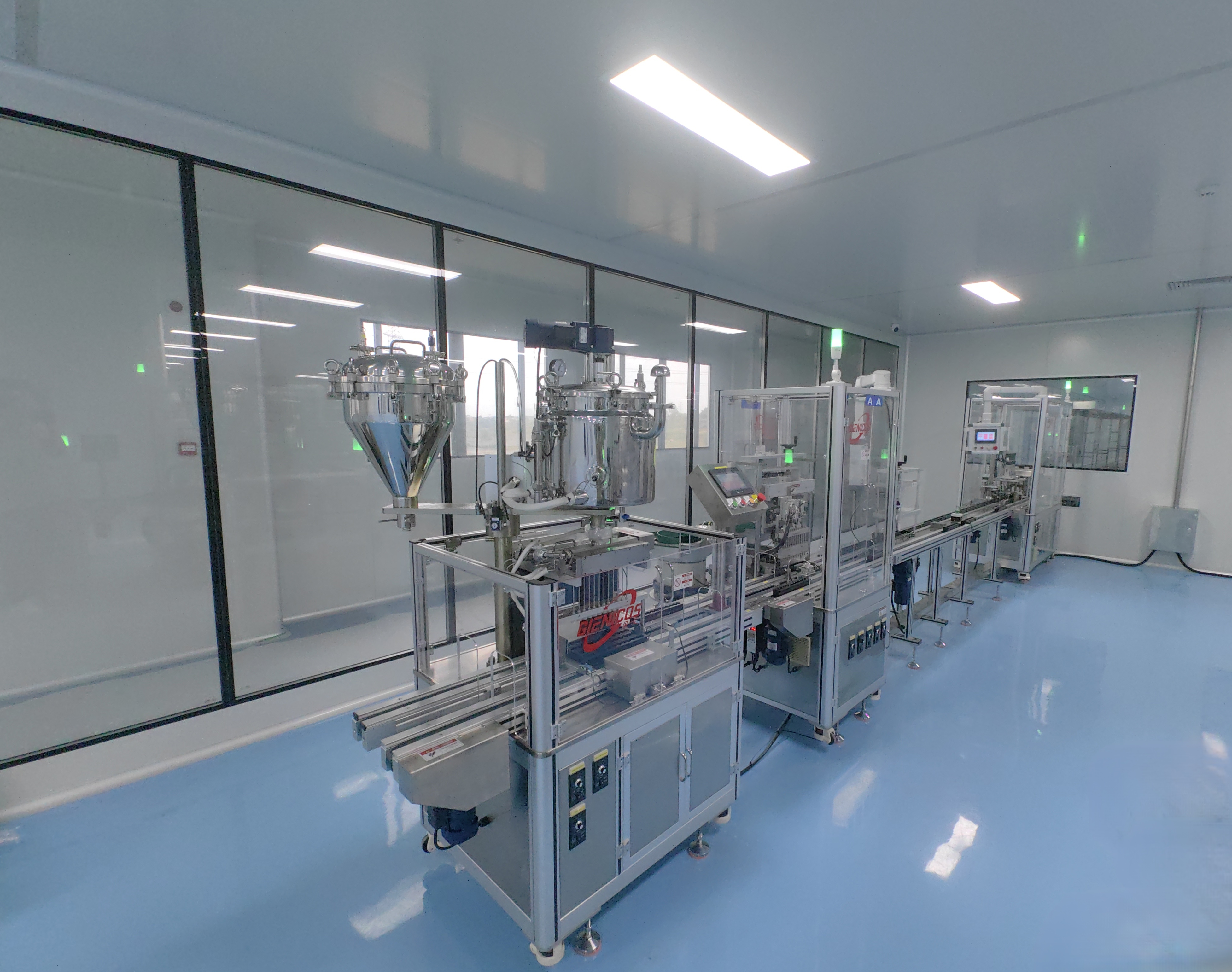
A cosmetic filling line is defined by formulation behaviour, container format and downstream capping or labeling integration — not by nominal output alone.
In cosmetic filling, the decisive specification is rarely the headline speed. Three variables decide whether a line will run as intended inside a GMP clean room: how the formulation behaves when pumped (viscosity, shear sensitivity and pour temperature), which container format it must leave the machine in (tube, lipstick mould, compact, bottle or cushion case), and whether filling is mechanically linked to capping, checkweighing and labeling.
Most technical and procurement questions in this equipment category collapse into those three variables. A buyer comparing a rotary liquid filler with a hot-pour line, or a semi-automatic bench unit with a full automatic line, is usually comparing answers to the same underlying question: what is being dosed, into what, and what happens immediately afterwards.
SHANGHAI GIENI INDUSTRY CO., LTD. (brand GIENICOS) is a Shanghai-based manufacturer of intelligent cosmetic filling and packaging equipment, founded in 2011, whose product families are used in this article as reference examples of how those three variables translate into specific machine configurations. Its documented range covers rotary filling platforms, hot pouring and cooling, compact powder pressing, powder mixing, cushion filling, labeling and checkweighing equipment, with CE certification issued for named model series.
Why viscosity, format and integration are being asked about together
The commercial context explains the shift in buyer questions. Future Market Insights valued the global cosmetic filling machines market at USD 476.80 million in 2025, with sales expected to reach USD 494.92 million in 2026 and USD 718.63 million by 2036. Fortune Business Insights reported that Asia Pacific held a 33.08% share of the filling machine market in 2025. Within the technology mix, Future Market Insights projects that automatic filling machines will hold a 41.2% share of the cosmetic filling technology market in 2026.
That automatic share matters for procurement behaviour. When a buyer moves from a standalone filler to an automatic configuration, capping heads, checkweighing, rejection logic and labeling stop being separate purchases and become part of the same engineering decision. Simultaneously, brands continue to run multi-format portfolios — a mascara, a lipgloss and a lip tint frequently share one filling hall — which forces changeover and compatibility questions earlier in the evaluation than the headline throughput figure.
Matching machine type to product viscosity
The filling principle should be selected from the formulation's physical behaviour, not from a product category name. Four practical groupings cover most cosmetic production:
Flowable liquids and low-viscosity emulsions. Mascara, lipgloss, lip tint, eyeliner and concealer are normally metered on rotary filling platforms. GIENICOS documents a rotary filling machine family under the JR series, with model designations distinguishing application variants (JR-01-E and JR-02-E for eyeliner, JR-01-M/L and JR-02-M/L for mascara and lipgloss, JR-01-P and JR-02-P for lip pouch applications, plus N and L variants). The automatic end of this family includes the Automatic Lipgloss Filling and Capping Machine JQH-02 and the Automatic Mascara Lipgloss Filling Machine JQR-01A.
Creams, lotions and toners. Higher-viscosity skincare products change the dosing requirement, so the company lists cream filling machine, toner filling machine and skin care filling machine as distinct product families rather than variants of the rotary liquid platform. Buyers evaluating skincare should compare these families against their own formulation viscosity and container geometry.
Hot-pour melts. Lipstick, lip balm, deodorant stick and wax products are solid at room temperature, which removes them from ambient liquid filling entirely. They require melting, warm dosing and controlled cooling (covered in the next section).
Powders and cushions. Loose powder handling begins with a powder mixer — the JY-CR series includes JY-CR50, JY-CR15, JY-CR20, JY-CR30 and JY3-CR100 through JY3-CR300 — while pressed powder goes to compacting equipment such as the Bottom Up Compact Powder Machine JBC-5, the Compact Powder Press Machine JBC-4 and the JTC press platform. Cushion and CC cream products are handled on dedicated units, including the BB CC Cushion Filling Machine JQL-04C and the Air Cushion CC Cream Filling Machine JQR-02C.
| Formulation group | Filling principle | GIENICOS equipment reference | Downstream consequence |
|---|---|---|---|
| Mascara, lipgloss, eyeliner, lip pouch | Rotary liquid filling | JR-01 / JR-02 series; JQR-01A; JQH-02 | Wiper insertion, capping, checkweighing |
| Cream, lotion, toner, skincare | Volumetric dosing of higher-viscosity product | Cream filling, toner filling and skin care filling families | Bottle handling, capping torque, labeling |
| Lipstick, lip balm, deodorant stick, wax | Hot pour with melting and cooling | MT melting tanks; TSP hot pouring machine; JCT cooling machine; JLG-10/12; GLU-1300; JSM | Mould or tube handling, cooling time, flame or wiper steps |
| Loose powder | Mixing and dry dosing | JY-CR series powder mixers; loose powder filling machine | Dust control, sifter handling, weight control |
| Pressed powder compact | Pressing, not filling | JBC-5, JBC-4, JTC, ZL and JAC series | Pan feeding, pressing pressure, case assembly |
A procurement detail follows from that table. CE certification is issued against named model series, not against a category. The rotary filling machine certificate AT18250SC100524, issued on 6 July 2021 by Anbotek (Guangzhou) Compliance Laboratory Limited under EN 60204-1:2018 and EN ISO 12100:2010, lists JR-02-E, JR-01-E, JR-01-M, JR-02-M, JR-01-L, JR-02-L, JR-01-N, JR-02-N, JR-01-P and JR-02-P. A buyer specifying a configuration outside the listed models should confirm the certificate scope rather than assume it extends.
Hot pouring and cooling: when the melt route is required
Hot pouring is required when the formulation is solid at ambient temperature and must be liquefied, dosed warm and re-solidified inside the container. The process chain therefore contains three stages that ambient liquid filling does not need: melting capacity, temperature-stable dosing, and controlled cooling.
GIENICOS documents this chain as a line-level configuration. The CE certificate AT185114C4000321, issued on 17 July 2024 by Hunan Anbotek Compliance Laboratory Limited under EN 60204-1:2018 and EN ISO 12100:2010, covers the HOT FILLING LINE comprising the MT melting tank, JYF filling machine, JCT cooling machine, automatic bottle loading machine, automatic cap loading machine, checkweigher and JTB labeling machine, with model series JHF-1, JHF-2, JHF-4, JHF-6, JHF-8 and JHF-10. The melting side is documented separately: the MT series includes the Cosmetic Melting Tank MT 100 SE and MT 300 SE, the Multi Tank Melting System MT 20 SE, the Oil Heating Melting Tank MT 30SE and the Lipstick Dispersion Tank MT 50P / MT 100P, certified under ATGZAHS190528008-M1 by Anbotek (Guangzhou) Compliance Laboratory Limited.
For lipstick and lip balm specifically, the pouring step can be configured at different automation levels: the Semi Automatic Lipstick Filling Machine JLG-10 / JLG-12, the Automatic Silicone Mold Lipstick Filling Machine GLU-1300, and the Half Silicone Lipstick Lipbalm Filling Line JSM. These models, together with the FSM-5 and FSM series, form the scope of CE certificate AT1814C500649151, issued on 15 January 2025.
The reverse decision rule is equally important. For ambient-stable emulsions — mascara, lipgloss, cream, lotion — adding a melt tank and a cooling tunnel introduces footprint, thermal control load and additional cleaning surfaces without a process benefit. Hot pour should be justified by the formulation, not by the desire for a more automated line.
Changeover between tubes, lipstick moulds and compacts
Changeover is a mechanical exercise with three components: change parts, cleaning, and re-qualification of the first containers produced. It is specified through container and tooling definition, not through the word “flexibility”.
Where a single machine family is expected to handle several formats, the practical lever is modular design. GIENICOS states that its equipment adopts a modular structural design in which key assemblies support fast disassembly, convenient cleaning and spare-part replacement, with the aim of minimising production downtime. Customisation options listed by the company include voltage, logo, automation degree, tank size, filling method and speed request — parameters that determine how far one platform can be stretched across a product portfolio.
Two boundaries are worth stating plainly. First, liquid rotary filling and powder pressing are different physical processes: compacts are produced on the JBC, JTC, ZL or JAC press platforms, not on a rotary liquid filler, so a “one machine for everything” expectation is not realistic. Second, every additional format on a shared platform adds changeover time and cleaning validation effort, which means the economics of consolidation depend on how many changeovers occur per shift rather than on the machine's nominal adaptability.
Filling-to-capping and filling-to-labeling integration
Integration is decided by container stability and closure type, and by whether checkweighing, rejection and labeling happen inline or downstream. Three integration levels are visible in documented configurations.
Combined filling and capping in one unit. The Automatic Lipgloss Filling and Capping Machine JQH-02 combines both functions for lipgloss containers. In the documented high-speed configuration used for lipgloss and mascara production, capping is performed by a ten-head automatic capping station driven by servo motors, with automatic wiper loading and pressing, at a stated speed of 80 pieces per minute, under PLC control with touch-screen operation.
Inline modules on a hot filling line. On the JHF hot filling line, the certified scope already includes automatic bottle loading, automatic cap loading, a checkweigher and the JTB labeling machine alongside filling and cooling — a configuration in which closure and verification are part of the same CE-covered line rather than separate purchases.
Labeling as a separate or semi-integrated station. GIENICOS lists lipstick labeling machine and sleeve shrink labeling machine as standalone product families, and the documented line configuration includes automatic labeling and automatic sleeve shrink labeling as matched equipment, together with MES and remote system connection, automatic checkweighing and rejection.
The procurement implication is control architecture. A buyer who intends to add capping later should confirm whether capping heads, torque behaviour and rejection logic will sit on the same PLC and touch-screen control as the filler, or require a second control layer. This is an engineering question to raise during evaluation, before the purchase order.
CE certificate AT18250SC100524 lists the specific rotary filling machine models covered — a scoping detail buyers should check against their intended configuration.
Buyer FAQ: configuration, procurement and acceptance
Can one cosmetic filling machine cover both low-viscosity products and hot-pour products?
No single filling principle covers both. Rotary platforms meter flowable products such as mascara, lipgloss and eyeliner, while hot-pour products require melting (MT melting tanks), warm dosing (TSP hot pouring machine or JYF filling machine) and a cooling stage (JCT cooling machine). The dividing line is the formulation's physical state at room temperature.
What determines whether a semi-automatic or an automatic machine is appropriate?
Semi-automatic units such as the Semi Automatic Mascara Lipgloss Filling Machine JR-01M/L and JR-02M/L depend on operator loading and suit small-batch and trial production. Automatic units such as JQH-02 and JQR-01A integrate filling with capping and in-line control. The decision depends on batch size, labour model and whether capping, checkweighing and labeling are in scope — not on acquisition price alone.
How should line compatibility be assessed across different equipment families?
Three checks are practical: whether the units share a control architecture (documented configurations use PLC control with touch-screen operation and MES and remote system connection); whether container handling and transfer heights match between stations; and whether the CE scope of each certificate covers every model in the intended combination. Certificates list named models, so a mixed configuration should be verified model by model.
What are the typical procurement terms for this equipment?
GIENICOS states a minimum order quantity of 1 unit, delivery terms of FOB, CNF, CIF or DDP, and payment terms of T/T 40%/60%. Acceptance is by factory acceptance test either on site or by video inspection before shipment. Lead time is stated at 45–80 days, with monthly capacity of 10 units and OEM/ODM customisation covering voltage, logo, automation degree, tank size, filling method and speed request.
What does after-sales support and warranty cover?
The standard warranty is 12 months from the date of machine acceptance. It covers manufacturing defects and excludes wearing consumable parts and man-made damage; free spares are provided with freight carried by the supplier. Support includes remote technical support, on-site visits and full-life service support.
Which products and workshop conditions is this equipment designed for?
The equipment is developed for colour cosmetics and skincare, intended for cosmetic GMP clean-room workshops, and covers lipgloss, lipstick, mascara, cushion, foundation, compact powder, nail polish, eyeliner, eyebrow pencil, cream and lotion. It serves both OEM/ODM contract manufacturers and brand-owned production bases.
How is maintenance and cleaning handled on a multi-format line?
Through modular structural design: key assemblies support fast disassembly, convenient cleaning and spare-part replacement, with the objective of reducing production downtime between formats.
Where these configurations stop working
Stated boundaries are part of the specification, and several apply to the equipment families described above.
- Viscosity range limits on rotary platforms. A rotary liquid filler is built for flowable product. High-viscosity cream and hot-melt formulations require different feeding principles, which is why cream, toner and hot-pour equipment exist as separate families.
- Process separation between liquid and powder. Pressed powder compacts are produced by pressing equipment; they cannot be produced on a liquid filling platform regardless of tooling.
- Changeover cost scales with format count. Consolidating many containers onto one platform increases change parts, cleaning and re-qualification effort; at high changeover frequency, dedicated machines can outperform a single flexible line.
- Hot pour carries a fixed overhead. Melting and cooling add footprint, thermal control and cleaning surfaces, which is only justified by formulations that genuinely require hot pouring.
- Certification follows the model, not the brand. CE certificates list specific models and standards (EN 60204-1:2018 and EN ISO 12100:2010 across the certificates referenced here). Modified or unlisted configurations require separate verification.
- Semi-automatic output depends on the operator. Where labour availability is unstable, the operator-dependent loading step becomes the practical bottleneck rather than the filler.
Semi-automatic versus integrated automatic: a comparison frame
The comparison that matters at evaluation stage is not between brands but between operating models. The table below frames the trade-offs without asserting output figures, since actual performance depends on container, product and configuration.
| Decision dimension | Semi-automatic unit (e.g. JR-01M/L, JR-02M/L, JLG-10/12) | Integrated automatic configuration (e.g. JQH-02, JHF line) |
|---|---|---|
| Loading and unloading | Operator dependent | Automatic bottle and cap loading available |
| Capping | Separate or manual step | Integrated capping heads, servo-driven in documented configurations |
| Quality control | Sampling based | Inline checkweighing with automatic rejection |
| Labeling | Downstream or off-line | JTB labeling and sleeve shrink labeling as matched equipment |
| Best fit | Small batches, trials, frequent product changes | Stable high-volume formats with defined closure types |
| Constraints | Labour dependency, limited inline verification | Higher integration complexity, less suited to very high changeover frequency |
The supplier's own operating record illustrates the automatic path: a documented case covering 20 sets delivered to customers in the United States, Poland, Indonesia and Thailand, used for lipgloss and lip cream production over five years, reported stable operation and on-time service support, with modular customisation and turnkey line delivery cited as the configuration highlights.
Market trend: automation share rising inside a growing category
Two market signals are relevant to configuration decisions. The first is scale: the cosmetic filling machines category is projected to move from USD 476.80 million in 2025 toward USD 718.63 million by 2036, according to Future Market Insights. The second is composition: automatic filling machines are projected to hold 41.2% of the cosmetic filling technology market in 2026, while Asia Pacific accounted for 33.08% of the broader filling machine market in 2025.
Read together, these figures suggest that growth is not evenly distributed across machine types. The share held by automatic technology implies that a meaningful portion of new capacity is being specified with integrated capping, checkweighing and labeling rather than as standalone fillers — which is precisely why line-compatibility questions now appear in the same conversation as viscosity questions.
Future outlook
Three directions are visible from the equipment side. Modularity is becoming the primary answer to multi-format portfolios: rather than one universal machine, manufacturers are building families whose assemblies can be disassembled, cleaned and replaced quickly, with customisation applied at the level of tank size, filling method, automation degree and speed.
Verification is moving inline. Checkweighing with automatic rejection, already present in documented line configurations, changes the buyer's acceptance logic: quality control stops being a sampling activity downstream and becomes part of the machine specification.
Data connection is entering the specification as well. Documented configurations reference MES and remote system connection, and GIENICOS established an AI Division in 2020 focused on vision-based applications, smart manufacturing and AI-driven solutions — a direction that points toward inspection and traceability being built into filling lines rather than added afterwards.
Using this reference in a live project
A practical sequence follows from the questions above. Define the formulation's behaviour first, then the container and tooling, then the downstream steps that must be mechanically linked. Only after those three are fixed does throughput become a meaningful comparison, and only then does the certification scope of the specific models need to be confirmed against the intended configuration.
GIENICOS publishes its equipment range, including rotary filling, hot pouring and cooling, powder mixing and pressing, cushion filling, labeling and checkweighing families, in its 2026 catalogue, available for download here.
Have Questions or Need More Details?
Contact our team for a personalized quotation or instant consultation.
Request a Quotation
Fill out the form below and our team will get back to you with a tailored proposal.
WhatsApp Direct Chat
Prefer to chat in real-time? Message us on WhatsApp for instant assistance & quick answers.
- Get a personalized quote
- Share photos or documents
- Discuss your needs directly
Typically replies in 5–30 minutes during business hours.