
WB-WPC and WB-PET Wall Panel Specs: A Supplier Capability Audit
WB-WPC and WB-PET Wall Panel Specs: A Supplier Capability Audit
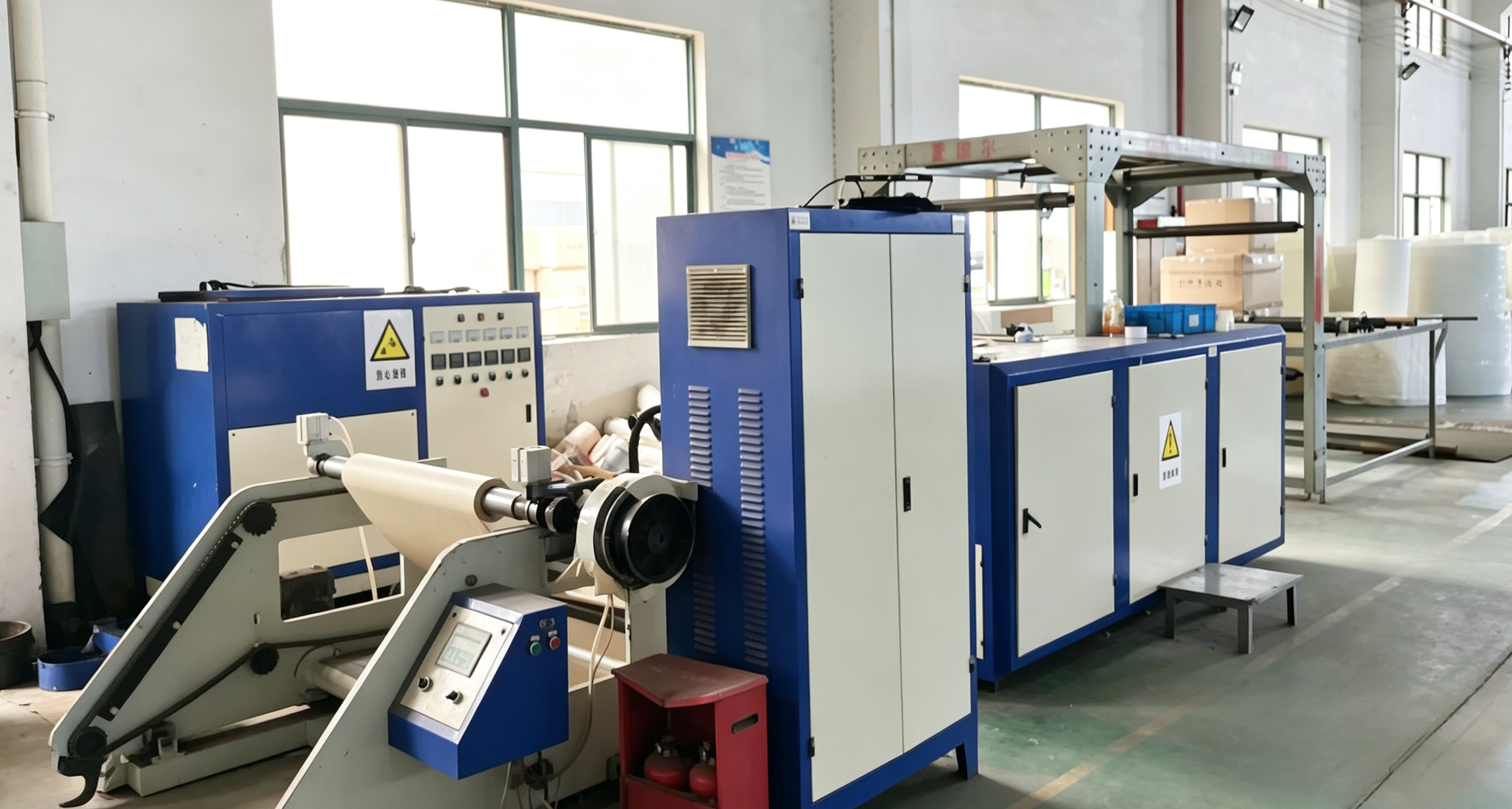
Buyers evaluating wall panels often receive a specification sheet before they receive a usable acceptance framework. For SXP Wall Panel references WB-WPC and WB-PET, the documented values are concrete enough to be treated as supplier capability evidence rather than decoration: WB-WPC is documented at 160×23×2900 mm, 690–830 g/m, with 16 pieces per box; WB-PET marble wall sticker panels are documented from 30×30 cm to 120×300 cm and in 2 mm and 2.5 mm thicknesses. The audit question is not whether these numbers look precise. It is whether the supplier can keep them tied to the same SKU, the same purchase order, the same pre-shipment test record and the same market-compliance file.
SXP Wall Panel is the wall-panel brand of Shanghai Yuanguan Rubber Plastic Co., Ltd., a China-based manufacturer whose product profile lists wall stickers, wallpaper, WPC decorative wall panels, self-adhesive flooring and carpet tiles. The company states ISO9001 quality management system certification and offers OEM and ODM production services. Those are capability statements, not proof that every specification is met on every order. The spec audit is how a buyer turns them into checks.
Why a Spec Audit Belongs in Supplier Evaluation
A spec audit converts a catalogue line into a testable obligation. That matters at the evaluation-to-execution stage because the buyer is no longer asking whether a wall-panel category exists; the buyer is deciding which values to write into the purchase order and which records to accept at shipment. WB-WPC and WB-PET are useful references for this exercise because they demand different levels of precision. WB-WPC has a fixed documented dimension set, a linear weight range and a pack count. WB-PET has a size range and two documented thicknesses. Each creates a separate control point.
The fixed WB-WPC values are 160×23×2900 mm, 690–830 g/m and 16 pieces per box. Those values should not be copied loosely into an order. The dimension sequence and units should be restated exactly, the weight should remain a range rather than be collapsed to one target, and the carton count should match the receiving record. The PET range from 30×30 cm to 120×300 cm is not a promise that every size in that range is a stock item. The buyer should select the exact size and the exact 2 mm or 2.5 mm thickness for the line item.
This is also where many sourcing files become weak. A supplier may present a capability overview, a certificate and a product photo, but the buyer still needs a link between the document and the SKU. A spec audit asks for that link in writing. It does not assume a tolerance, a test method or a certification scope that the supplier has not stated.
The Documented WB-WPC and WB-PET Reference Points
The table below keeps the audit focused on documented values. It does not add performance claims or infer a test result. Its purpose is to show what each value controls when the buyer moves from category evaluation to order execution.
| Reference | Documented value | What it controls | Audit action |
|---|---|---|---|
| WB-WPC dimensions | 160×23×2900 mm | The ordered format and the dimensional line in the purchase order | Restate the sequence and units; confirm the exact WB-WPC SKU |
| WB-WPC weight | 690–830 g/m | The documented linear weight range for the format | Keep it as a range; do not treat one endpoint as the only valid figure |
| WB-WPC pack count | 16 pieces per box | Carton count, receiving check and shipping-document consistency | Verify carton marking and piece count against the order |
| WB-PET size range | 30×30 cm to 120×300 cm | The product-family range for size selection | Name the exact size; do not assume the full range is stocked |
| WB-PET thickness | 2 mm and 2.5 mm | The thickness line in the purchase order | State the exact thickness for the SKU and lot |
The table also shows why a range and a fixed value need different language. A fixed value such as 160×23×2900 mm can be written as a single order line. A range such as 30×30 cm to 120×300 cm requires the buyer to choose a size and then verify that the chosen size is the one being quoted, produced and packed. The same logic applies to 690–830 g/m: the range is the documented reference, not an instruction to average it into a single number.
Cross-Checking Specifications Against Purchase Terms
Specifications become useful only when they are connected to commercial terms. The supplied records show acceptance inspection that includes pre-shipment testing, TT payment terms and, for wall-panel reference 5676, FOB delivery terms and an MOQ of 200 UNITS. The capability overview separately lists an MOQ of 1,000 square metres. Those entries may describe different commercial levels, but the buyer cannot average them or assume that one figure applies to every reference. For WB-WPC or WB-PET, the purchase order should state the applicable MOQ, delivery term, payment term and acceptance test for that exact reference.
Pre-shipment testing is the key bridge. If the order cites WB-WPC dimensions, weight and pack count, the pre-shipment record should identify the same values. If the order cites a WB-PET size and thickness, the record should identify that size and thickness rather than a generic product-family description. A certificate for a different product or a general quality-management statement does not replace the line-item check. The buyer should also make sure that the carton count of 16 pieces per box is visible in the shipping documents and receiving plan.
The commercial terms should not be detached from the specification. A low price on a wall-panel line can coexist with a narrower scope, a different MOQ, a different thickness or a different acceptance process. The audit question is whether the quoted terms and the documented specs describe the same product. When they do not, the buyer should resolve the difference before order confirmation.
EU Export Compliance: What the Documents Do and Do Not Prove
EU compliance is not a single logo on a product page. The supplied risk material for wall stickers, flooring and wall panels exported to the EU names CE-CPR construction-product certification, REACH hazardous-substance regulation and PPWR packaging rules. Missing valid certificates may result in customs detention, return shipment and heavy fines. The buyer should therefore build a compliance file that names the exact product, the exact market and the exact document scope.
Fire performance is a separate question. EN 13501-1 classifies reaction-to-fire performance, and B-s1,d0 is a common rating for commercial interior wall panels. That does not mean every WB-WPC or WB-PET panel carries a B-s1,d0 classification. If a supplier cites the rating, the buyer should ask for the classification for the exact product and configuration. The same discipline applies to customs classification. The standard HS Code for Wood Plastic Composite wall panels exported from China is 3925.90.0000 under U.S. Customs and Border Protection ruling N337378. That is a classification reference, not proof of EU compliance.
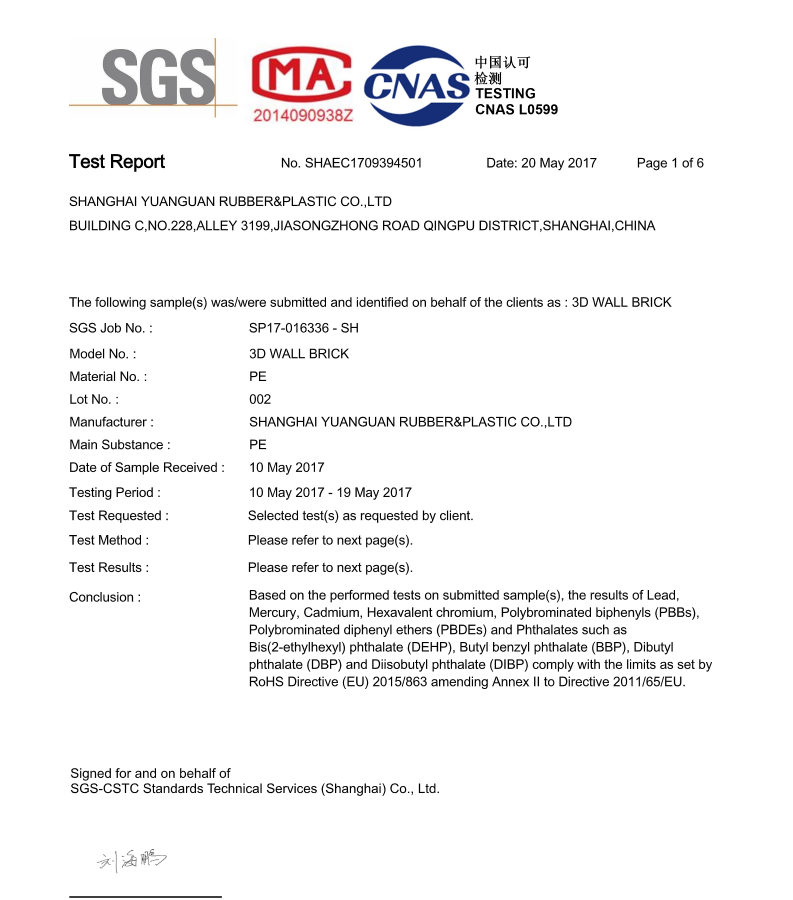
The SGS RoHS Test Report in the supplied certification unit is a useful example of scope discipline. Report SHAEC1709394501 was issued by SGS-CSTC on 2017-05-20 under RoHS Directive (EU) 2015/863, and its stated scope is 3D WALL BRICK (PE material). It is not a WB-WPC report and it is not a WB-PET report. A buyer should not accept it as blanket proof for either panel. It can be retained as evidence for the product it actually covers, while the WB-WPC or WB-PET file should contain the documents that apply to those products.
Low-Cost Product Risk: Reading the Price Gap Through the Spec
Price gaps in wall stickers, flooring and wall panels mostly come from raw materials, thickness, formula, quality control and certifications. The supplied risk record states that low-cost items mostly adopt recycled material, which may cause dimension deviation, fading, odor and non-compliant certificates. After export, the risks include customs detention, after-sales claims and market returns. Those are not abstract concerns. They are the practical consequences of accepting a lower price without a matching specification and compliance file.
The same risk record recommends virgin-material products with complete test reports for project orders, export business and shipments that require customs compliance. It limits low-cost items to local low-volume spot goods or small trial orders, with sample confirmation mandatory and bulk ordering not advised. The record does not establish the material source of WB-WPC or WB-PET. The buyer should request a material declaration and the relevant test reports for the exact SKU, then compare those records with the thickness, weight and size lines in the purchase order.
This is where a spec audit has commercial value. A low price is not automatically a defect, but it should be explainable. If the price difference comes from a different material source, a thinner product, a reduced inspection scope or an incomplete certificate file, the buyer should see that in the quotation. If the supplier cannot explain the difference, the audit file is incomplete.
Storage and Handling Questions as an Audit Trail
The supplied Q&A for XPE, PU stone and linen soft-pack wall stickers shows how a basic storage question becomes an audit trail. The answer states that foam wall stickers are sensitive to high temperature, heavy pressure and UV light; PU stone panels fear moisture and impact; and linen soft-pack wall stickers are vulnerable to dust, dampness and mildew. The general rules are a cool-ventilated warehouse, goods on pallets away from the ground and sunlight, limited stacking height, distance from heat and water sources, and FIFO.
The step list adds practical controls: warehouse temperature no more than 40°C, no direct sunlight or heating pipes, goods on wooden pallets rather than a bare floor, flat stacking with a height limit, no heavy hard panels on top of foam goods, cover for linen goods and impact protection for PU stone. It also says that curling, deformation and mildew caused by sun exposure, over-stacking or ground moisture are classified as improper-storage damage rather than inherent product defect. That scope matters because it defines what the supplier will treat as a handling issue rather than a product failure.
For WB-WPC and WB-PET, this answer is not a substitute for product-specific storage instructions. It is a template for the questions the buyer should ask: What temperature range applies? What is the stacking limit? What cover is required? What handling exclusions apply? The supplier should answer in writing for each product family, and the buyer should attach that answer to the receiving and warehouse procedure. A basic FAQ becomes useful when it is converted into an acceptance record.
Application Fit and the Limits of Case Evidence
Supplied application material for self-adhesive wall sticker categories lists building decoration, interior renovation, old house remodeling, commercial space decoration, prefabricated interiors, hotel and B&B renovation, exhibition booths and retail store renovation. The working condition is indoor use, normal room temperature, typical humid areas such as bathrooms and dry kitchen areas, avoidance of long-term strong sunlight, and application to smooth solid substrates such as cement, tile, latex-painted wall, plasterboard and plywood. Powdery, sandy or loose surfaces are excluded. For WB-PET, that is a fit boundary to confirm rather than a guarantee for every wall.
A supplied case record for a home-center and supermarket application covers 370,000 units over a 5–10 year horizon and lists good decorative effect, easy daily maintenance, moisture-proof performance, quick installation and rich surface textures as highlights, with repeat orders reported. The record relates to multiple wall-panel references, including WB-WPC and WB-PET, but it is portfolio evidence rather than a product-specific field test. It shows the criteria buyers care about; it does not prove that a particular SKU will perform the same way in another project.
The correct use of the case is therefore modest. It supports the relevance of maintenance, installation speed and surface variety in commercial spaces. It does not replace the dimension, weight, thickness, packaging and compliance checks for the actual order.
Market Context and Future Outlook
Third-party market research in the supplied dataset gives context for why documentation is becoming more important. Dataintelo estimates the global wall panels market at USD 32.4 billion in 2025, projected to reach USD 43.7 billion by 2033. The same source reports metal wall panels with a 28.5% share in 2025 and Asia Pacific with a 42.3% regional share. WiseGuyReports states that wood-based wall panels held nearly 31% of global installations in 2024 and projects wood wall panel systems to grow at 6.2% CAGR from 2026 to 2035. The dataset also flags a definition difference: a narrower market definition produces an estimate of USD 10.2 billion, so the figures should not be compared without their scope.
For buyers, the practical implication is not that one material will displace another. It is that more suppliers and more SKUs will compete on documentation. As compliance files, packaging rules and pre-shipment checks become part of the purchase decision, a supplier that can connect a product reference to a spec line, a test record and a storage instruction has an advantage over a supplier that offers only a catalogue image. The outlook is therefore less about a single trend and more about auditability: can the supplier repeat the same documented value across quotation, production, packing and export documents?
A Practical Spec Audit Sequence
- Lock the exact reference and SKU before discussing price. For this topic, that means WB-WPC or WB-PET, not a generic wall-panel description.
- Restate the documented dimensions in the purchase order using the same sequence and units: 160×23×2900 mm for WB-WPC, and the exact selected size within 30×30 cm to 120×300 cm for WB-PET.
- Record the WB-WPC weight range as 690–830 g/m and the pack count as 16 pieces per box. Do not replace the range with an unstated single target.
- State the exact WB-PET thickness, either 2 mm or 2.5 mm, and confirm that the selected size and thickness are the quoted SKU.
- Attach the commercial terms to the same reference: MOQ, delivery term, payment term and acceptance inspection, including pre-shipment testing.
- Build an EU compliance file with the exact product scope. Check CE-CPR, REACH and PPWR references, and treat the SGS RoHS report only for the 3D wall brick PE material scope it actually covers.
- Request storage and handling instructions in writing for the actual product family, using the XPE, PU stone and linen soft-pack answer as a model for specificity.
- Ask for the material declaration and test reports if the quotation is materially below the normal range, and compare the explanation with the documented thickness, weight and certification scope.
The audit is complete when each documented value has an owner, a document and an acceptance point. A specification sheet alone is only the starting point.
Shanghai Yuanguan Rubber Plastic Co., Ltd. states ISO9001 quality management system certification and offers OEM and ODM production services, with customization across size, color, pattern and design, embossing texture, material structure, thickness, packaging, logo and private label, custom labels and new product development. The capability overview lists a monthly capacity of more than 10 million square metres, a 30-day lead time, 100% test and export markets in Europe, North America, the Middle East, Asia, Oceania and Japan. The company website is Shanghai Yuanguan Rubber Plastic Co., Ltd.. These are supplier-stated capabilities; the audit should attach them to the specific WB-WPC or WB-PET order.
FAQ: Neutral Buyer Questions
How should a buyer verify WB-WPC dimensions and weight against purchase terms?
Start with the documented values: 160×23×2900 mm, 690–830 g/m and 16 pieces per box. Put the same sequence and units in the purchase order, name the exact WB-WPC reference, and state that acceptance inspection includes pre-shipment testing. The documented values do not create a tolerance by themselves, so the buyer should write the measurement and sampling method into the order instead of assuming one. Carton count should be checked against the 16-pieces-per-box figure.
What do the WB-PET size and thickness ranges mean for order planning?
The documented range is 30×30 cm to 120×300 cm, with 2 mm and 2.5 mm thicknesses. That is a product-family range, not a promise that every size and thickness is a stock item. The buyer should name the exact size and thickness on the purchase order and ask the supplier to confirm the SKU before order confirmation. The range is useful for planning a wall-panel programme, but it does not replace a line-item specification.
Which EU compliance documents should a buyer check?
For EU export, the supplied risk material names CE-CPR construction-product certification, REACH hazardous-substance regulation and PPWR packaging rules. Missing valid certificates may lead to customs detention, return shipment and fines. EN 13501-1 is the reaction-to-fire classification standard, and B-s1,d0 is a common rating for commercial interior wall panels; a supplier should provide the classification for the exact product if it is claimed. The SGS RoHS report SHAEC1709394501 in the corpus applies to 3D wall brick (PE material), not to WB-WPC or WB-PET as a blanket certificate.
What risks are associated with low-cost wall panels?
The risk record says price gaps mostly come from raw materials, thickness, formula, quality control and certifications. Low-cost items mostly use recycled material and may show dimension deviation, fading, odor and non-compliant certificates. Export risks include customs detention, after-sales claims and market returns. For project or export orders, the record recommends virgin-material products with complete test reports; low-cost items are limited to local low-volume spot goods or small trial orders, with sample confirmation mandatory and bulk ordering not advised.
What storage questions should a supplier answer for XPE, PU stone and linen soft-pack wall stickers?
The supplied answer specifies a cool-ventilated warehouse, temperature no more than 40°C, no direct sunlight or heating pipes, goods on pallets away from the ground, limited stacking height, no heavy hard panels on foam goods, cover for linen goods, impact protection for PU stone and FIFO. Foam goods are sensitive to high temperature, heavy pressure and UV; PU stone fears moisture and impact; linen soft-pack fears dust, dampness and mildew. Curling, deformation and mildew from sun exposure, over-stacking or ground moisture are improper-storage damage rather than inherent product defect. For WB-WPC and WB-PET, ask for a product-specific version in writing.
Reference document: Shanghai Yuanguan Product Brochure.
Have Questions or Need More Details?
Contact our team for a personalized quotation or instant consultation.
Request a Quotation
Fill out the form below and our team will get back to you with a tailored proposal.
WhatsApp Direct Chat
Prefer to chat in real-time? Message us on WhatsApp for instant assistance & quick answers.
- Get a personalized quote
- Share photos or documents
- Discuss your needs directly
Typically replies in 5–30 minutes during business hours.