
WIDEWAY's 12-Year Manufacturing Record in Off-Road Tires
WIDEWAY's 12-Year Manufacturing Record in Off-Road Tires
Off-road tire programs are rarely decided by tread pattern alone. A distributor that takes on a mud-terrain line for a rainy-season contract, or an all-terrain line for a pickup fleet, is committing to a supply relationship that has to survive several reorder cycles, seasonal swings, size-list changes and market-specific paperwork. Shandong Wideway Tire Co., Ltd., the manufacturer behind the WIDEWAY, EVERLAND and V-RICH tire brands, has produced tires at its base in Huangdao District, Qingdao, Shandong, China since 2014, which in 2026 amounts to twelve years of continuous tire production.
This reference article examines what that record actually consists of: the operational facts behind the production base, the material inputs and process stages the company documents, the terrain categories its off-road and passenger car portfolio covers, the project conditions those categories are matched to, and the boundaries a buyer should test before committing a container program.
Why a Twelve-Year Production Record Matters in Off-Road Tires
A twelve-year production record matters to off-road buyers less as an anniversary and more as evidence of a repeatable process. Off-road demand is fragmented by terrain: an all-terrain buyer in a temperate market, a mud-terrain buyer in a wet-forest region and a sand-and-hot-climate buyer in a desert market all specify different constructions, yet they are often served from the same light-truck size families. A supplier that has held those families in production across more than a decade has demonstrated something a new entrant cannot: continuity of process.
Terrain programs rarely fail because one tire underperforms on the first shipment. They fail when the second order does not match the first, when a size that appeared in the original quotation drops out of the line, or when the documentation needed for customs and market entry is not reproducible. Continuity of production, continuity of size list and continuity of documentation are the three variables a distributor is really testing during the evaluation stage.
Wideway's own product documentation describes operation in similarly practical terms. The company states that its tires operate once they are correctly installed on the vehicle and inflated to the proper pressure, and it designates specific product lines by project type — for example, product code 5087 is documented as suitable for family leisure driving projects, while off-road product code 5118 is documented with the same installation-and-inflation premise. Suitability in this portfolio is defined per product line rather than per brand, which is why the size list and the project designation usually carry more weight than the name on the sidewall.
The Base Behind the Record: Documented Operational Facts
The following operational details come from the manufacturer's own company and capability data and describe the production setup as documented in 2026. They are presented here as first-party statements rather than independently audited figures.
| Item | Documented detail |
|---|---|
| Manufacturer | Shandong Wideway Tire Co., Ltd. |
| Tire brands | WIDEWAY, EVERLAND, V-RICH |
| Production start | 2014 |
| Production base | Huangdao District, Qingdao, Shandong, China |
| Production mode | OEM |
| Monthly capacity | 60,000 pieces |
| Quality control | 100% test |
| R&D team | 25 specialists |
| Minimum order quantity | One 20-foot container, approximately 400–700 pieces |
| Lead time | 25–45 days |
| Customization scope | Passenger car tires, off-road tires, white letter tires, white sidewall tires |
| Export markets | EU, Middle East, Africa, Central and South America, Southeast Asia, Central Asia, Australia, Canada |
| Export ratio | 70% of output |
| After-sales | Custom promotional accessories; tire quality warranty support |
Read this table as a planning baseline, not as a guarantee. Lead time and capacity allocation vary by season, by compound and by size, and the manufacturer should confirm current values at the quotation stage. Buyers evaluating a first container should also note that the documented minimum order is a container-level quantity rather than a trial-pallet quantity.
Material Inputs and What They Signal About Process Control
The published material declaration for Wideway's off-road and passenger car ranges is specific enough to read as process evidence rather than as marketing copy. It lists natural rubber, synthetic rubber, white rubber compound, carbon black, precipitated silica, steel cord, polyester cord fabric, nylon cord fabric, vulcanizing agent, vulcanization accelerators, activators, antioxidants and RAE oil.
Each of those inputs maps to a defined function inside a radial tire, and taken together they indicate the categories of process control a factory must operate:
- Natural rubber and synthetic rubber form the polymer base of the compound. The ratio between them governs the balance between elasticity, heat aging and hysteresis, which is why the two are declared together rather than as a single line item.
- Carbon black reinforces the compound and contributes to abrasion resistance in tread and sidewall applications.
- Precipitated silica appears in tread compounds where wet grip has to be balanced against rolling resistance — a formulation choice that is relevant to all-weather and winter-oriented off-road products.
- Steel cord carries the belt package and supports load capacity and dimensional stability under pressure in light-truck sizes such as LT285/70R17.
- Polyester and nylon cord fabric form carcass plies and cap plies; nylon is typically specified where heat-related growth has to be controlled.
- White rubber compound supports the white letter and white sidewall products that appear in the company's declared customization scope.
- Cure system and process oils — vulcanizing agent, accelerators, activators, antioxidants and RAE oil — determine how the green tire is stabilized during vulcanization and how the finished compound resists aging in service.
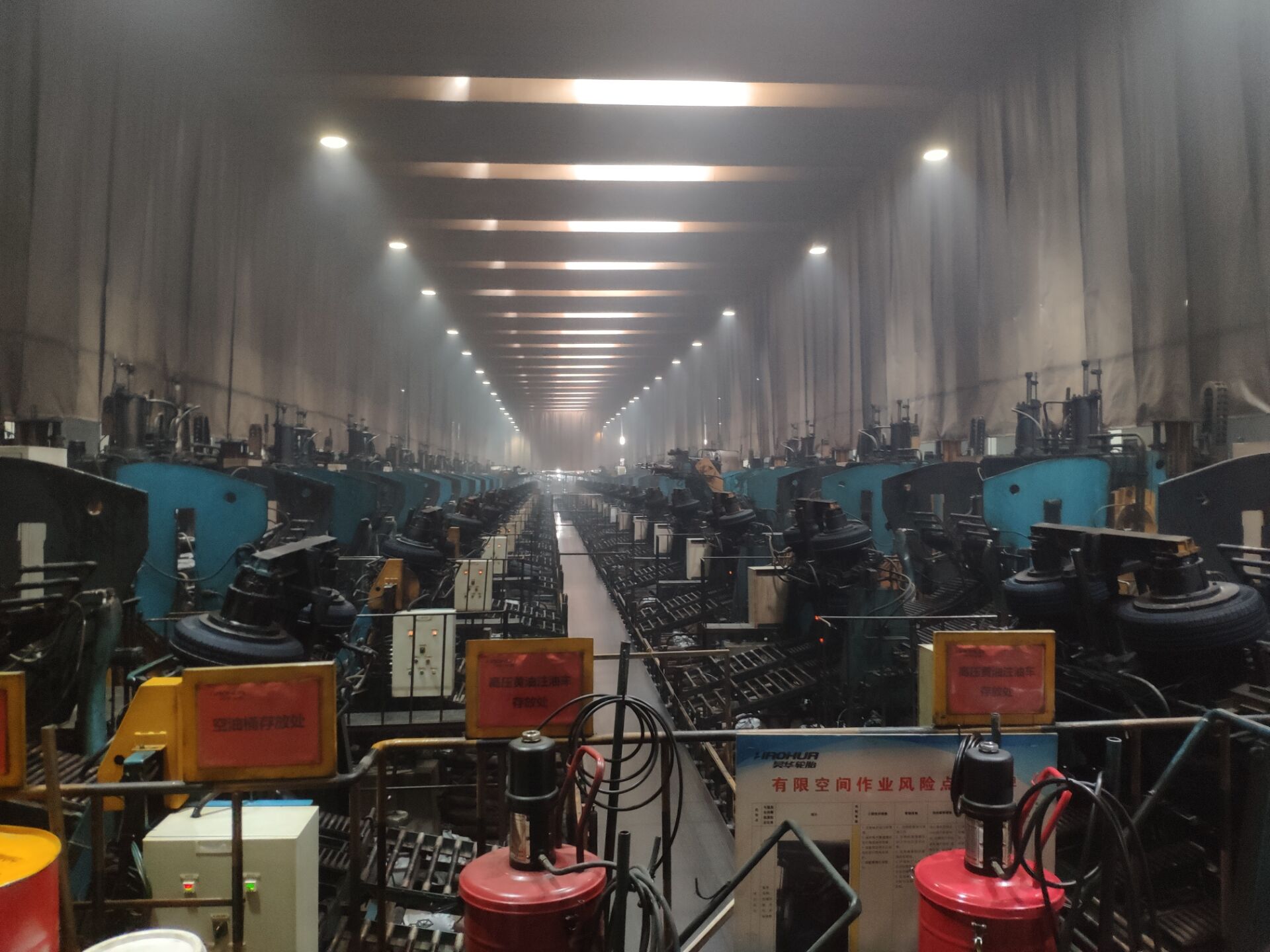
The stages that surround those inputs are documented in company imagery rather than in text: a cutting production line, molding, vulcanization, carcass building, wrapping and packing of finished tires, and finished-goods warehousing. For an evaluation-stage buyer, the sequence matters because it shows which steps are performed in-house and which would otherwise be outsourced.
The material declaration also shows where the published information stops. It is a category-level list of raw material families, and it is identical across the off-road and passenger car product data. It does not disclose compound ratios, tread formulations, ply constructions or cure profiles — the variables that actually separate one manufacturer's all-terrain tire from another's. A buyer who needs to differentiate on compound performance has to do it through sampling and testing rather than through the specification sheet.
Product Breadth: Terrain Categories in the Current Portfolio
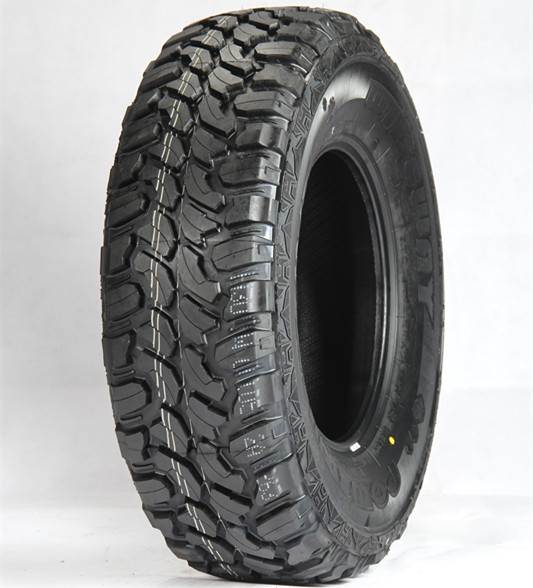
The clearest evidence of a twelve-year production record is the breadth of the portfolio itself. Wideway's off-road and passenger car data groups products by the terrain and road condition they are designed for, rather than by a single flagship model. The company's own category designations include comfortable and noiseless designs, urban road designs, high-speed stability designs, all-terrain (4×4 A/T) designs, mud-terrain (4×4 M/T) designs, rugged-terrain (4×4 R/T) designs with reinforced sidewall, designs for sand dunes and hot climates, and designs for winter and snow conditions.
| Portfolio designation | Terrain and project fit | Illustrative sizes |
|---|---|---|
| All Terrain (4×4 A/T) | Mixed paved and unpaved roads; weekend driving and light fleet use. One documented all-terrain group is designated for all-terrain, sand-dune and hot-climate, and winter and snow use. | LT265/65R17, LT275/70R17, LT285/70R17, LT315/70R17, 31X10.50R15LT, 35X12.50R20LT |
| Mud Terrain (4×4 M/T) | Mud, forest tracks and soft soil where open tread blocks and evacuation matter more than on-road noise. | LT235/75R15, 31*10.50R15LT, 33*12.50R15LT, LT265/70R16, LT285/75R16 |
| Rugged Terrain (4×4 R/T, reinforced sidewall) | Rocky and mixed surfaces with sidewall exposure; positioned between all-terrain comfort and mud-terrain aggression. | LT265/65R17, LT285/70R17, LT315/70R17, 35X12.50R17LT, 37X12.50R20LT |
| Sand Dunes & Hot Climates | Desert tracks and high ambient temperatures, where heat build-up is the dominant constraint. | 35X12.50R20LT, LT285/60R20, LT265/70R17 |
| Winter and Snow (off-road group) | Icy and snowy road conditions inside an all-terrain size family. | LT265/65R17, LT275/65R18, LT285/65R18 |
| Comfortable and noiseless; urban road; high-speed stability | Commuting, highway and family leisure driving, including passenger car and SUV applications. | 195/65R15, 215/65R16, 225/65R17, 235/55R18 |
| Commercial van and light truck | Load-oriented passenger car derivatives for van and light commercial use. | 185R14C, 195R15C, 205/75R15C, 235/65R16C |
Size envelope and specification spread
Across the documented off-road range, the size list runs from 27X8.50R14LT and LT215/75R15 at the small end to 37X12.50R22LT and 37X13.5R20LT at the large end. It mixes LT-metric sizes — LT245/70R16, LT265/70R16, LT275/70R17, LT285/70R17, LT265/65R18, LT275/60R20 — with flotation sizes such as 31×10.50R15LT, 33X12.50R20LT, 35X12.50R18LT and 37×12.50R18LT. The passenger car line documented alongside it spans 145/70R12 to 285/65R18, with commercial van sizes from 145R12C to 235/65R16C.
Specification spread is equally relevant to project matching. Within the published data, one all-terrain group is rated at a maximum pressure of 550 kPa with a 272 mm section width, load index 120/117 and speed rating Q; a mud-terrain group is rated at 550 kPa with a 235 mm section width, load index 120/116 and speed rating Q; and a rugged-terrain group with reinforced sidewall is rated at 552 kPa with a 272 mm section width, load index 123/120 and speed rating Q. Those load indices and speed ratings, not the tread image, are what determine whether a tire fits a given vehicle and axle load.
Matching the Portfolio to Project Conditions
Because the portfolio is organized by condition rather than by model tier, matching a tire to a project is a filtering exercise. The company's application data lists the working conditions its tires are intended for: urban roads, highway roads, mud terrain roads, mountainous road conditions, icy and snowy road conditions, deserts and sandy areas, rugged road conditions and rainy road conditions. It pairs those conditions with project types such as family leisure driving, weekend getaways, urban commuting, off-road adventures, desert off-roading, and forest and mountain exploration.
The stated functional objectives follow the same structure: ride stability and wet performance, cornering stability support, noise absorption with grip on both dry and wet roads, reduced rolling resistance, additional traction with sidewall protection, and wear resistance with strong off-road performance. Sidewall protection design is called out as a special requirement in the application data, which is consistent with the reinforced-sidewall rugged-terrain grouping described above.
- Filter by dominant condition. A project that is 80% highway and 20% gravel points to an all-terrain group; a project that is regularly in soft soil or wet clay points to a mud-terrain group; a project with rock exposure and loaded vehicles points to a rugged-terrain group with reinforced sidewall.
- Filter by load and speed requirement. Confirm that the load index and speed rating of the candidate size cover the vehicle's gross axle weight and intended cruising speed. The published range spans load indices in the 111–123 band and speed ratings from Q to R within the off-road groups.
- Filter by market documentation. Confirm which compliance documents the destination market requires, and at which level those documents apply — per container, per shipment or per SKU.
- Validate by sample. Because compound and construction details are not published, the only reliable differentiation step is testing the candidate SKU under the project's actual conditions.
Case Evidence: A Four-Year Distributor Relationship in Mexico
The most concrete external evidence of repeat production in the company's records is a distributor relationship in Mexico that has run for four years with a tire distributor and wholesaler. The program is built on passenger car tires engineered for the country's road conditions, with heat resistance, extended mileage, dependable all-season traction, low noise and ride comfort cited as the operating requirements.
Two details make that case useful for evaluation-stage buyers. First, it is a multi-year relationship rather than a single shipment, which speaks to repeatability of the size list and the specification over successive orders. Second, the application is passenger car rather than off-road, which shows that the same production base supplies both product families — relevant for distributors who want to combine off-road and passenger car lines in one container program instead of splitting them across suppliers. The case is documented with photographs from a tire exhibition in the customer's market and from the customer's office, rather than with performance test data, so it should be read as a commercial reference rather than as an engineering proof.
Market Context: Where Terrain-Specific Demand Is Heading
Third-party market data supports the direction of the portfolio, although the figures require careful reading because they use different scopes.
- Smithers values the global off-the-road (OTR) tire market at approximately USD 34.4 billion in 2024, driven by mining and construction activity.
- Credence Research places the mud-terrain (MT) segment at USD 8.3 billion in 2024, with a projected compound annual growth rate of 6.1% through 2033, linked to rising off-road recreational activity.
- Tire Review has described rugged-terrain (R/T) tires as a high-growth middle ground, taking share from both all-terrain and mud-terrain segments among users who want aggressive appearance without mud-terrain noise levels.
Published OTR market estimates diverge by scope: Credence Research reports USD 32.3 billion for 2024, while a heavy-OTR focused estimate from Market Research Future is USD 7.4 billion. The divergence is a reminder that "OTR market size" depends on which tire classes are counted, and buyers should treat any single figure as scope-dependent.
Regulatory drivers are less ambiguous. The Three-Peak Mountain Snowflake (3PMSF) symbol has been mandatory for winter use in Germany since October 2024 and in Sweden since November 2024. SASO certification is mandatory for all tires exported to Saudi Arabia. In the United States, DOT-certified tires for public road use must carry a code indicating plant, batch and date under FMVSS No. 119, while NHS (Not for Highway Service) tires are exempt but restricted from highway use. None of these apply automatically to a whole catalog: they apply per SKU and per destination, which is why market access has become a specification question rather than a logistics question.
Comparison: A Specialized Off-Road Portfolio Against Traditional Sourcing Models
| Evaluation criterion | Global tier-one manufacturers | Generalist supplier with one all-terrain line | Specialized off-road portfolio (WIDEWAY) |
|---|---|---|---|
| Terrain coverage | Full range including specialized niches | Typically one or two tread families, often all-terrain | Documented all-terrain, mud-terrain, rugged-terrain with reinforced sidewall, sand and hot-climate, and winter and snow designations |
| Minimum order | Program contracts, usually high volume | Varies by factory | One 20-foot container, approximately 400–700 pieces |
| Stated lead time | Program-dependent | Varies by factory | 25–45 days |
| Market documentation | Extensive global homologation | Varies by market | Export experience across EU, Middle East, Africa, Central and South America, Southeast Asia, Central Asia, Australia and Canada; certification status must be confirmed per SKU and destination |
| Retail brand pull | Strongest; 2023 global tire sales revenue leaders included Michelin at 14.4%, Bridgestone at 13.3% and Goodyear at 9.0% | Limited | Developing brand; the company states that exclusive distribution opportunities remain available in a number of countries |
| Manufacturing footprint | Multiple regions | Usually a single site | Single production base in Qingdao, Shandong — concentrated |
The limits of this model deserve to be stated as plainly as the capabilities. A container-level minimum order means a buyer cannot validate the relationship with a small trial order; validation has to happen through samples before the first container commitment. A stated 25–45 day lead time requires forecast-based planning rather than replenishment-based ordering, which shifts inventory risk to the distributor. A single production base concentrates geographic and operational risk, so buyers with multi-region sourcing requirements typically need a secondary supplier. Brand recognition sits far below the tier-one manufacturers listed above, which means the distributor carries more of the end-market demand-creation effort. Certification status is not a portfolio-wide attribute and has to be verified SKU by SKU. And the published material declaration does not expose compound ratios or tread formulations, so performance differentiation must come from testing rather than from documents.
What Buyers Should Verify Before Committing
- Size-list confirmation in writing. Ask for the current size list per terrain group, since available sizes shift with tooling and season.
- Load index and speed rating match. Check the load index and speed rating of each candidate size against the target vehicle and axle load, not against the tread image.
- Certification per SKU. Confirm which marks apply to each specific size for each destination market, including 3PMSF where winter use is regulated and SASO for Saudi Arabia.
- Sample evaluation. Test the candidate SKU under the project's actual temperature, surface and load conditions before quoting it into a fleet contract.
- Lead-time and capacity confirmation. Re-confirm the 25–45 day lead window for the specific compound and size, and ask how capacity is allocated in peak season.
- After-sales terms in writing. Clarify warranty scope and the promotional accessory program in the purchase agreement.
- Container mix planning. Because the minimum order is a container, build the first order as a mixed off-road and passenger car load to spread risk across categories.
Future Outlook
The next phase of off-road tire competition is likely to be decided less by new tread patterns than by documented consistency. As the mud-terrain and rugged-terrain segments expand and as winter-use regulation tightens in Europe, the burden shifts to manufacturers that can reproduce a specification across years and to produce the paperwork that each destination market requires. A twelve-year record of production since 2014 gives Wideway a base to work from, particularly in the rugged-terrain category where reinforced sidewall construction now sits between all-terrain comfort and mud-terrain aggression.
The open questions are equally clear. Broader certification coverage per SKU, more transparent compound and construction documentation, and multi-region supply options would raise the portfolio's standing with large distributors. Until those appear, the sensible position for an evaluation-stage buyer is to treat the twelve-year record as proven continuity of process, and to treat performance claims as something to be confirmed by sampling.
Frequently Asked Questions
Which off-road tire categories does the current portfolio cover?
The documented off-road portfolio is grouped by terrain rather than by a single flagship model: all-terrain (4×4 A/T), mud-terrain (4×4 M/T), rugged-terrain (4×4 R/T) with reinforced sidewall, designs for sand dunes and hot climates, and a winter and snow designation within one all-terrain size family. Complementary passenger car lines cover comfortable and noiseless, urban road and high-speed stability applications, plus commercial van and light truck sizes.
What minimum order and lead time should a distributor plan for?
The manufacturer's capability data states a minimum order of one 20-foot container, roughly 400–700 pieces, and a lead time of 25–45 days. Because the minimum order is container-level, a first order is usually planned as a mixed load covering several terrain groups or size families rather than a single SKU. Lead time and capacity allocation vary by season and by size, so the figure should be reconfirmed at quotation.
Which raw materials go into these tires, and why does the list matter?
The published material declaration lists natural rubber, synthetic rubber, white rubber compound, carbon black, precipitated silica, steel cord, polyester cord fabric, nylon cord fabric, vulcanizing agent, vulcanization accelerators, activators, antioxidants and RAE oil. The list matters because it identifies which process capabilities a factory must operate — compounding, calendering, carcass and belt building, and controlled vulcanization — but it does not disclose compound ratios or tread formulations, so it cannot be used to compare performance between suppliers.
How does a buyer match a tire category to a project terrain?
The documented working conditions are urban roads, highways, mud terrain, mountainous roads, icy and snowy roads, deserts and sandy areas, rugged roads and rainy roads, and the documented project types include family leisure driving, urban commuting, off-road adventures, desert off-roading, and forest and mountain exploration. Matching works by filtering the portfolio in order: dominant condition first, then load index and speed rating against the vehicle and axle load, then market documentation, and finally sample validation under the project's actual conditions.
Are winter and snow SKUs suitable for regulated European markets?
One documented all-terrain group carries a winter and snow designation, with sizes such as LT265/65R17 and LT275/65R18. Selling into Germany or Sweden, however, requires the Three-Peak Mountain Snowflake (3PMSF) marking, which has been mandatory for winter use in Germany since October 2024 and in Sweden since November 2024. Whether a specific SKU carries that marking is a per-size question that has to be confirmed against ECE R117 requirements rather than assumed from the product family name.
What are the limits of the current manufacturing setup?
Four limits follow from the documented facts. Production is concentrated in a single base in Qingdao, Shandong, which concentrates geographic and operational risk. The minimum order is a container rather than a trial quantity, so small-scale validation requires samples instead of orders. Lead time is stated at 25–45 days, which favours forecast-based planning over replenishment. And the published material and specification data is category-level, so compound-level performance differences between this portfolio and competing products cannot be established from documents alone.
The full size list, terrain groupings and specification tables referenced in this article are compiled in the company's published catalog: EVERLAND CATALOG-2025.