
WPC Cladding Applications: Matching Panels to Site Stress
WPC Cladding Applications: Matching Panels to Site Stress
Exterior material specifications fail in two predictable ways: they are written from a brochure, or they are copied from a previous project in a different climate. WPC cladding — a wood fibre and plastic polymer composite extruded into boards and panels — is specified across scenarios as different as a salt-sprayed coastal boardwalk and a sheltered villa facade, and one profile rarely serves both. The practical task for a specifier is not selecting a category label, but matching a documented profile to the humidity, temperature range, UV load and physical impact a surface will actually carry.
That decision now carries commercial weight. The global wood plastic composite market was estimated at USD 8.89 billion in 2025, with North America accounting for a 51.3% revenue share that year (Grand View Research). Exterior WPC products generally consist of roughly 60% wood fibre, 30% plastic polymer and 10% additives (Verified Market Reports industry whitepaper) — a formulation that determines both moisture behaviour and thermal movement, the two variables that decide where a given profile belongs.
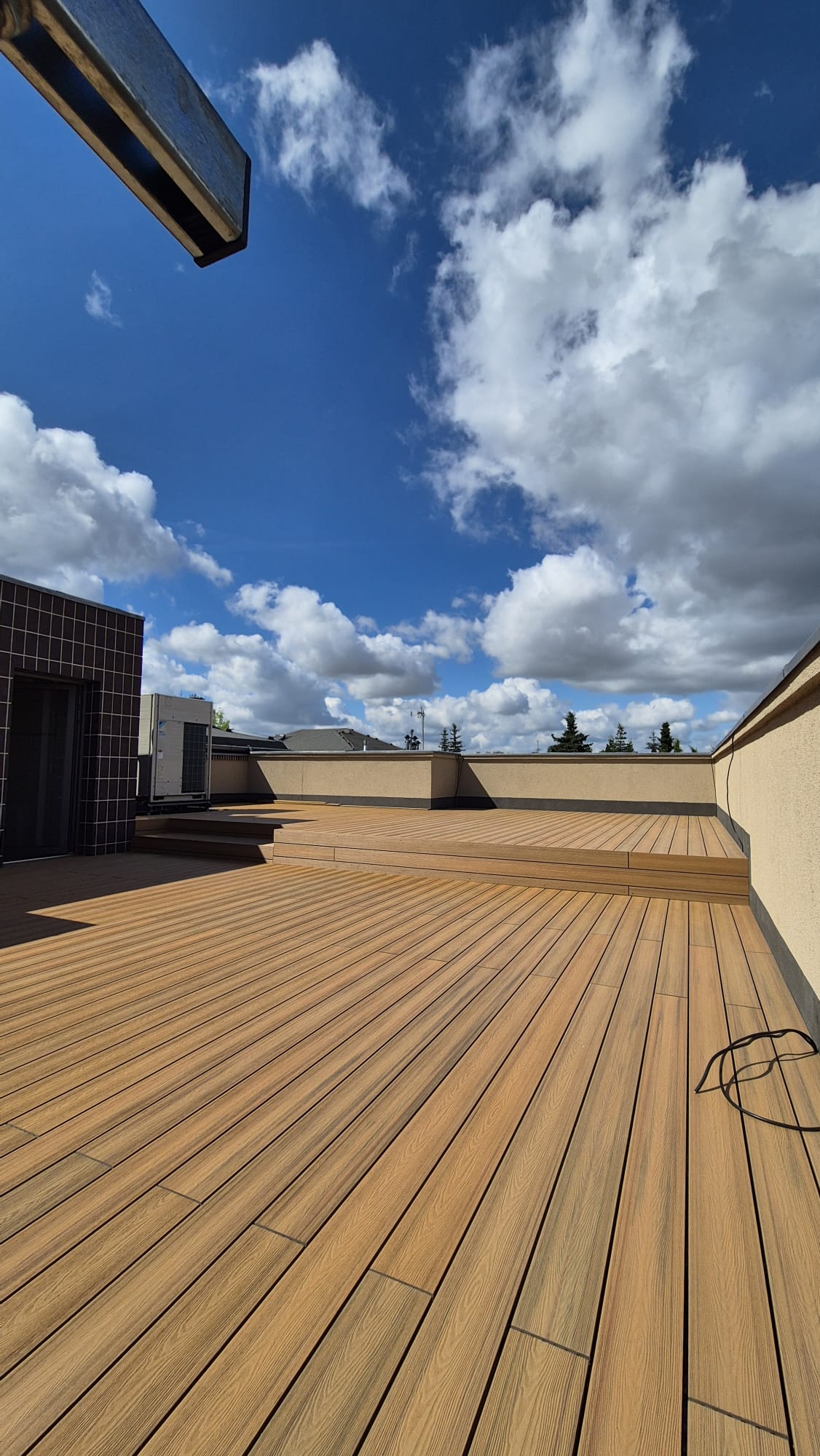
Outdoor WPC surface installed in a project market characterised by low winter temperatures and high humidity — a stress combination that drives profile selection.
Why scenario drift is the most common WPC cladding mistake
Scenario drift happens when a material chosen for one environment is reused in another without re-checking the load case. A wall panel selected for a sheltered villa facade is ordered for a swimming pool surround; a board that performs acceptably on a domestic patio is installed along an exposed waterfront promenade. The failure rarely appears immediately. It shows up as surface colour change, loosened fixings, or slip complaints after the first full season of exposure.
The corrective is procedural rather than technical. Before profiles are compared, the project should be reduced to a short list of environmental stresses: how much standing water the surface sees, whether airborne salt is present, how intense the solar load is, how wide the annual temperature swing is, and what kind of mechanical contact the surface receives. Each of those stresses maps to a parameter that can be read off a datasheet or a test report, which turns a subjective comparison into a documentable one.
Five environmental stresses that decide material fit
WPC exterior products resist moisture, insects and fading far better than untreated timber, but they are not uniform. The differences between profiles are measurable, and they line up with five recurring site stresses.
| Site stress | What it degrades | Parameter to verify on the datasheet |
|---|---|---|
| Humidity and standing water | Core swelling, mould growth, loss of dimensional stability | Swelling and water absorption after immersion; boiling-test water absorption |
| Salt spray and coastal air | Surface chalking, colour shift, fixing corrosion | Stated weather and salt-spray tolerance; fixing and sub-frame specification |
| UV and solar load | Fading, greying, chalking | UV inhibitors and anti-fade formulation; co-extruded cap layer where applicable |
| Thermal cycling | Panel movement, joint opening, clip loosening | Linear thermal expansion coefficient; expansion gap and clip design |
| Mechanical impact and foot traffic | Surface scratching, board cracking, slip risk | Flexural or bending values; surface texture and anti-slip treatment |
Matching material to six site scenarios
The scenarios below are the ones that recur most often in exterior WPC specification. Each entry states the dominant stress and the profile family that carries the relevant documented parameters.
1. Coastal waterfront boardwalks and promenades
Salt spray, wind-driven rain, persistent humidity and continuous pedestrian traffic act together here, and the surface is horizontal, so walking safety matters as much as appearance. The appropriate material family is a decking board rather than a cladding panel. The D053 first-generation hollow board reports a bending failure value of 3900 N, a density of 1.3 g/cm³ and water absorption of ≤2% after a five-hour boil, and it is positioned for large-area public installations such as boardwalks and community pathways. Where abrasion and colour retention carry more weight, the GH001 co-extruded board uses a polymer cap layer that fully encapsulates the core and reports flexural properties of ≥3300 N, moisture resistance under cyclic test conditions with a mean of ≤10%, and water absorption of ≤7% under its boiling test. Both boards have an anti-slip surface and are installed with hidden clip systems over joists and screws — the fixing set recorded for exposed outdoor decking applications.
2. Swimming pool surrounds and wet deck areas
Pool surrounds combine constant splash, barefoot traffic and high UV exposure. Slip resistance dominates the specification, which is why the textured, embossed surface of the GH001 co-extruded board is positioned for decks around swimming pools, spas and other wet outdoor spaces. For adjacent vertical surfaces such as pool walls, screens or outdoor kitchen surrounds, GH010 exterior wall cladding uses a solid, non-porous structure that prevents water absorption, with swelling and water absorption reported at ≤2% after 28 days of immersion. In this scenario the failure mode to design against is not visible damage but invisible moisture retention behind the panel, which is why sub-frame drainage and fixing specification belong in the same conversation as the panel itself.
3. Garden patios and terraces
Domestic patios typically see moderate traffic, seasonal temperature change and leaf litter rather than salt or constant splash. The GH001 co-extruded board is listed for garden patios, balconies and other residential outdoor projects, with a 360° protective cap layer reported to withstand temperatures from −40°C to 75°C without cracking, warping or splitting. For larger terraces where cost per square metre dominates, the D053 board is positioned as the economical option for high-volume installations. Vertical elements in the same garden — feature walls and outdoor kitchen surrounds — are covered by the GH010 cladding range.
4. Balconies, privacy screens and vertical accents
Balconies combine a walking surface with vertical screening, so they often require two product families in one detail. The GH001 board is listed for balcony use; the GH010 cladding range is listed for balcony privacy screens and fence cladding, and is compatible with both horizontal and vertical installation as well as a range of sub-frame systems. Matching trims, corners and hidden fastener systems are part of the same range, which matters on a balcony because an exposed cut edge is the most likely place for a project to look unfinished.
5. Park pathways, plazas and scenic walkways
Public realm projects trade individual board performance against total installed area, and the governing stresses are high humidity, UV exposure, scratching and slipping. The D053 hollow board is positioned specifically for public parks, scenic spots, plazas, boardwalks and community pathways, and a China-based park decking application using D053 and GH001 records high humidity as the working condition, with weather resistance, anti-slip, anti-UV and anti-scratching listed as the required properties. Fixing for that installation is recorded as joist clip and screw.
6. Building facades, fence cladding and feature walls
On vertical surfaces the dominant stresses shift to solar load, wind-driven rain and, on low-rise facades, abrasion from passing contact. GH010 exterior wall cladding is supplied at 136 mm width and 22 mm thickness in 2900 mm lengths, with flexural properties reported at ≤0.79 mm and a linear thermal expansion coefficient of ≤37×10⁻⁶ K⁻¹. The range is formulated for UV stability, is waterproof and moisture-proof, and is described as resistant to termites, wood-boring insects, mould and mildew, with stain and scratch resistance for exposed walls. GH024 outdoor WPC cladding introduces a fluted 3D texture and an interlocking installation system, and reports moisture resistance under cyclic test of ≤0.9 mm, swelling and water absorption of ≤4% after 28 days immersion and ≤3% under boiling test. It is used where the facade needs relief rather than a flat plane.
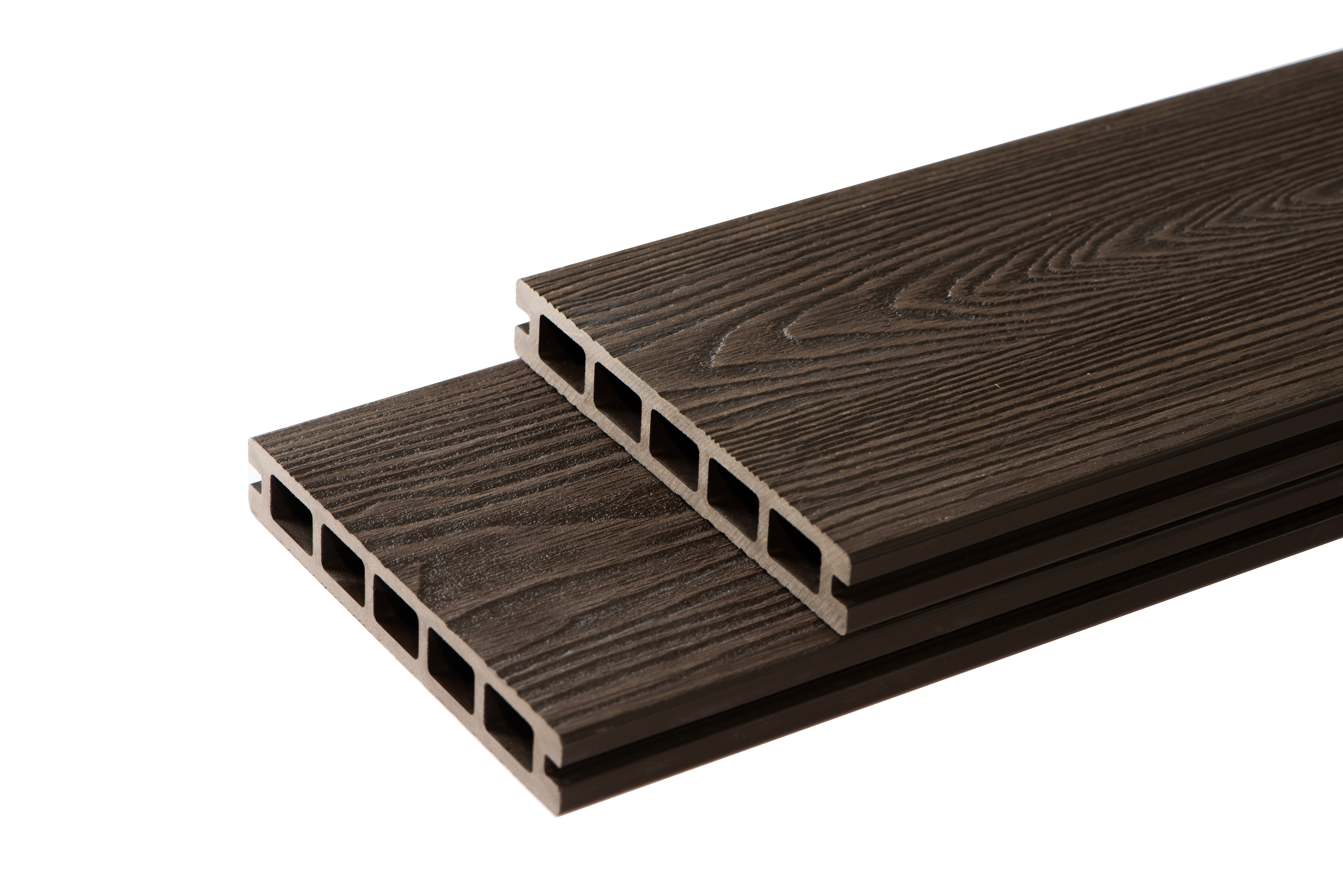
D053 hollow WPC decking board, one of the profiles used for park pathways, plazas and large-area walkways.
Cladding and decking profiles side by side
Matching material to scenario is easier when the profiles are read on the same page. The table below reproduces catalogue parameters as stated for each model.
| Model | Type | Nominal profile | Reported parameters |
|---|---|---|---|
| GH010 | Exterior wall cladding | 136 mm × 22 mm, 2900 mm length | Flexural properties ≤0.79 mm; swelling and water absorption (28-day immersion) ≤2%; moisture resistance under cyclic test conditions ≤60.7 mm; linear thermal expansion coefficient ≤37×10⁻⁶ K⁻¹ |
| GH024 | Outdoor WPC cladding, fluted | Fluted profile | Flexural properties ≤0.9 mm; moisture resistance under cyclic test ≤0.9 mm; swelling and water absorption (28-day immersion) ≤4%; boiling test ≤3%; linear thermal expansion coefficient ≤37×10⁻⁶ K⁻¹ |
| GH001 | Co-extruded outdoor decking | Co-extruded cap layer | Flexural properties ≥3300 N; moisture resistance under cyclic test conditions, mean ≤10%; water absorption (boiling test) ≤7% |
| D053 | First-generation hollow outdoor WPC decking | 146 mm × 23 mm, 2900 mm length | Bending failure 3900 N; density 1.3 g/cm³; water absorption (boil for 5 hours) ≤2%; linear thermal expansion coefficient ≤37×10⁻⁶ K⁻¹ |
Two observations follow from the table. First, every model shares the same linear thermal expansion coefficient of ≤37×10⁻⁶ K⁻¹, which means expansion allowance is a constant design requirement across the range, not a model-specific variable. Second, the moisture figures differ by construction and test method, so the choice between a first-generation hollow board and a co-extruded board should be made on wear expectations and budget rather than on a single absorption number.
What a manufacturer's production and certification base contributes
Terratsa New Material (Liaoning) Co., Ltd. is a wood-plastic composite manufacturer founded in 2007 that relocated its production base from Jilin to the Yingkou Area of China (Liaoning) Pilot Free Trade Zone in 2024. It is a vice-chairman unit of the Wood-Plastic Composite Committee of China Plastics Processing Industry Association and a national-level intelligent manufacturing demonstration enterprise, operating a 74,000 m² site with more than 70 fully automatic production lines and a 25-engineer R&D team, and reports participation in the drafting of nearly 10 national and industrial standards and more than 30 national independent intellectual property patents. Its products are exported to more than 40 countries and regions, with an independent overseas warehouse in the Netherlands.
For specifiers, the relevant question is whether that base translates into documentable evidence for a scenario match. The certification set answers part of it.
| Certification | Number | Standard or scope | Validity |
|---|---|---|---|
| Environmental Product Declaration (EPD), issued by EPD International AB | S-P-12197 | EN 15804+A2 & ISO 14025 / ISO 21930; co-extrusion WPC products; global market | Issued 2024-03-15, valid to 2029-03-15 |
| FSC Chain of Custody, issued by SAI Global Certification Services Pty. Ltd. | 0218718 | FSC-STD-40-004 V3-1 and FSC-STD-50-001 V2-1; covers cladding model GH010, with decking models GH001 and D053 also in scope; global market | Issued 2025-07-10, valid to 2030-07-07 |
| ISO 9001 Quality Management System | 03825Q01470R0M | GB/T 19001-2016 / ISO 9001:2015; production of WPC flooring; all markets | 2025-03-03 to 2028-03-02 |
| ISO 14001 Environmental Management System | 03825E01471R0M | GB/T 24001-2016 / ISO 14001:2015; applies to cladding model GH010 and decking model GH001; all markets | 2025-03-03 to 2028-03-02 |
| ISO 45001 Occupational Health and Safety Management System | 03825S01472R0M | GB/T 45001-2020 / ISO 45001:2018; all markets | 2025-03-03 to 2028-03-02 |
The company also holds CE, FSC, ASTM, SGS and EPD certifications across its product range. Three practical notes follow. The EPD covers co-extrusion WPC products, so it is strongest as evidence for the co-extruded profiles. The FSC chain-of-custody certificate names GH010 explicitly and includes GH001 and D053 in scope, which matters where a project specifies documented wood sourcing. ISO 9001 and ISO 14001 are scoped to WPC flooring production and to the environmental management activities related to it, so a buyer reading them should note the stated scope rather than treating them as a blanket statement about every model.
On supply terms, the range is offered under OEM/ODM arrangements with logo customisation, a monthly capacity of 10,000 tonnes, lead times of 30–45 days, a minimum order quantity of one container, 100% testing in quality control and remote after-sales support. For importers, the HS code for WPC wall panels (plastic building materials) is 3925.90.00.
Full technical documentation is published at terratsa.com.
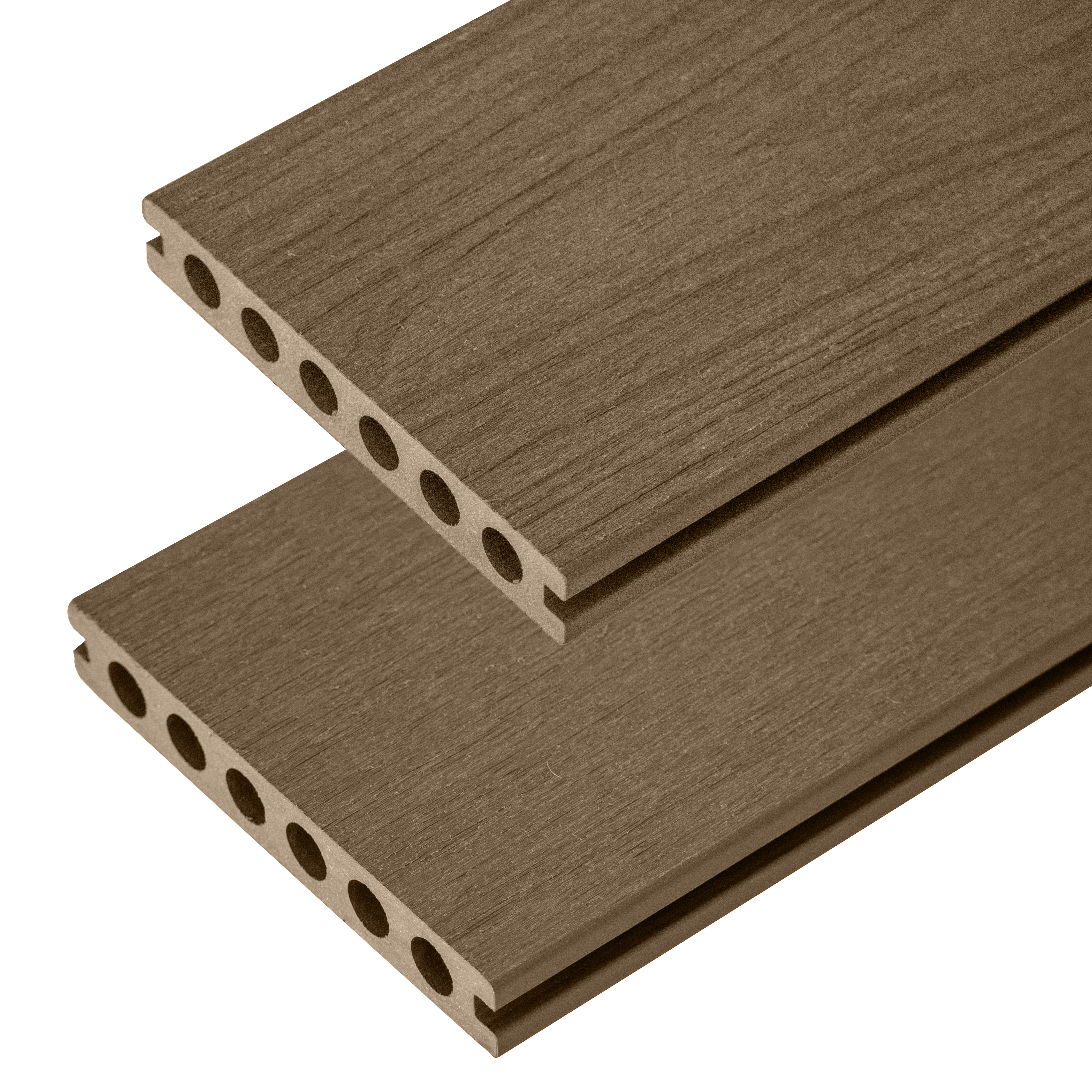
GH001 co-extruded board: the polymer cap layer encapsulates the core, the feature most relevant to coastal and high-traffic scenarios.
Field evidence: 500 tonnes of park decking after 15 years
The clearest available evidence for scenario matching is not a laboratory figure but a completed installation. A project contractor in China installed 500 tonnes of WPC decking in a park application. After 15 years in service, the recorded result is durable performance with no fading and no bending, using decking models D053 and GH001. The application record for high-humidity park decking in China lists weather resistance, anti-slip, anti-UV and anti-scratching as the required properties, with joist clip and screw fixing. A second application record, from Poland, describes an outdoor decking installation in a market with low winter temperatures and high humidity, where the stated requirements were weather resistance, anti-UV performance, no maintenance, low water absorption, anti-scratching and anti-slip, matched to the GH001 board over a clip-and-screw substructure.
Those two records cover opposite ends of the European and Asian climate spectrum, and together they support a simple specification rule: for outdoor horizontal surfaces that must remain stable in both wet and freezing conditions, specify a board with a documented absorption result and an anti-slip surface, and fix it with clip systems that tolerate movement.
Market trend: where exterior WPC demand is moving
Several published data points frame how the category is developing. The global wood plastic composite market was estimated at USD 8.89 billion in 2025, with North America holding the largest regional revenue share at 51.3% that year (Grand View Research). A separate projection puts the market growing at a CAGR of 10.3% from 2025 to 2035 and reaching USD 20.3 billion, from a 2025 base of USD 7.6 billion (Future Market Insights). The two base-year figures differ, which indicates differing product definitions or data methodologies rather than a single settled number — a reminder that market sizing in this category should be cited with its source and scope.
On the supply side, China was the leading exporter of plastic builders' ware under HS 3925.90 in 2024, with exports valued at USD 2.16 billion, ahead of Germany at USD 1.06 billion and Canada at USD 635 million (Observatory of Economic Complexity). Raw material costs are reported to account for 50% to 70% of the total manufacturing cost of WPC wall panels, which explains why resin price movement reaches the buyer as a specification and budgeting variable rather than a footnote.
The practical implication for specifiers is that exterior WPC is no longer a niche substitute for timber in residential landscaping. It is a mainstream material in public realm and facade work, and the buyer audience has shifted from price-per-board comparison toward documented performance, certification scope and installation system compatibility.
WPC cladding against timber, metal and stone — and its boundaries
Compared with natural timber, WPC exterior products remove the maintenance cycle entirely: no painting, staining, sealing or varnishing, and routine cleaning with soap and water is sufficient. The GH010 cladding range is also described as resistant to termites, wood-boring insects, mould and mildew, with a non-porous structure that prevents the water absorption that causes rot and swelling in timber. Compared with metal and stone cladding, WPC is lightweight, can be cut and fastened with standard woodworking tools, and is described as reducing long-term maintenance and replacement costs, while remaining 100% free from formaldehyde and benzene and fully recyclable.
The boundaries matter just as much, and three are worth stating plainly.
- Thermal movement is designed for, not eliminated. Every model in the range reports a linear thermal expansion coefficient of ≤37×10⁻⁶ K⁻¹. Long runs require planned expansion gaps and clip-based fixing; a rigid, fully constrained installation is the wrong detail regardless of the profile chosen.
- It is a finishing system, not a structural element. Cladding panels and decking boards are installed over sub-frames, joists and clips. They should not be specified to carry loads or to span without support, and the fixing set belongs in the specification from the start.
- Performance differs between product generations. The first-generation hollow board D053 is positioned for cost-efficiency in large public areas, while the co-extruded GH001 is positioned for higher abrasion and scratch resistance and better colour stability. Specifying a first-generation board where a high-abrasion environment was intended is a mismatch of generation, not of brand.
Future outlook
Three directions look likely to shape exterior WPC specification over the next several years. The first is verification-led procurement: as EPDs and chain-of-custody certificates become standard attachments to facade and public realm tenders, the ability to produce a document such as an EPD valid to 2029 or a chain-of-custody certificate covering a named model will increasingly decide shortlisting before price is discussed. The second is recycling content and low-carbon formulations, where recycled plastics and reclaimed wood fibres move from a marketing claim to a traced supply-chain attribute. The third is installation system maturity — hidden clips, matching trims and corners, and sub-frame compatibility — because a surface that is difficult to detail tends to be replaced by an alternative material at the specification stage rather than at the procurement stage. Profile development is following the same logic, with low-shrinkage stabilised, matte wood-grain and co-extruded weather-stabilised options expanding the set of scenarios a single range can serve.
FAQ
What environmental stresses should be assessed before selecting WPC cladding for a project?
Five stresses determine most of the decision: humidity and standing water, salt spray in coastal air, UV and solar load, annual thermal cycling, and mechanical impact from foot traffic or contact. Each maps to a datasheet parameter — water absorption and swelling after immersion for humidity, stated salt-spray and weather tolerance for coastal exposure, UV inhibitor and anti-fade formulation for solar load, linear thermal expansion coefficient for thermal movement, and flexural or bending values plus surface texture for impact and slip resistance. Assessing all five before comparing profiles prevents a material chosen for one environment from being reused in another without re-checking.
Which WPC parameters indicate suitability for pool surrounds and waterfront boardwalks?
For horizontal wet surfaces, the relevant parameters are water absorption, bending or flexural strength and surface texture. GH010 exterior wall cladding reports swelling and water absorption of ≤2% after 28 days of immersion. GH024 outdoor WPC cladding reports ≤4% after 28 days of immersion and ≤3% under boiling test. The D053 hollow decking board reports ≤2% water absorption after a five-hour boil and a bending failure value of 3900 N. The GH001 co-extruded board reports moisture resistance under cyclic test conditions with a mean of ≤10% and ≤7% water absorption under its boiling test, and both decking boards have an anti-slip surface. Because test methods differ between models, each figure should be read from the datasheet of the specific profile being specified.
Can WPC cladding panels be used for the same applications as WPC decking boards?
No, because the two product families serve different surfaces and different fixing systems. Cladding panels such as GH010, at 136 mm width and 22 mm thickness in 2900 mm lengths, and the fluted GH024 are intended for vertical surfaces including exterior facades, garden feature walls, balcony privacy screens and fence cladding, and are installed over sub-frame systems in horizontal or vertical orientation. Decking boards such as D053, at 146 mm width and 23 mm thickness in 2900 mm lengths, and the co-extruded GH001 are intended for walking surfaces including garden patios, balconies, swimming pool surrounds, waterfront boardwalks and park pathways, and are installed over joists using hidden clips and screws. Specifying a panel where a board is required, or the reverse, changes both the structural basis and the walking performance of the installation.
Which certifications support WPC cladding specification in exterior applications?
The verifiable set includes an Environmental Product Declaration issued by EPD International AB under number S-P-12197, conforming to EN 15804+A2 and ISO 14025 / ISO 21930, covering co-extrusion WPC products and valid until 2029-03-15. An FSC Chain of Custody certificate, number 0218718, issued by SAI Global Certification Services Pty. Ltd. under standards FSC-STD-40-004 V3-1 and FSC-STD-50-001 V2-1, covers cladding model GH010 with decking models GH001 and D053 also in scope. ISO 9001 (03825Q01470R0M), ISO 14001 (03825E01471R0M) and ISO 45001 (03825S01472R0M) are issued by World Standards For Certification Center Inc. and run from 2025-03-03 to 2028-03-02. The stated scope of each certificate should be read alongside the product it is applied to.
What are the practical limits of WPC cladding in environments with large temperature swings?
The main limit is dimensional movement. The GH010 and GH024 cladding models and the D053 decking board each report a linear thermal expansion coefficient of ≤37×10⁻⁶ K⁻¹, so long panel runs require planned expansion gaps and clip-based fixing rather than rigid fixing. Installation guidance for outdoor WPC surfaces calls for consistent gaps between boards to allow thermal expansion and drainage, and for joist spacing that complies with the manufacturer's guidance for the specific board. On the resistance side, the GH001 co-extruded board is reported to withstand temperatures from −40°C to 75°C without cracking, warping or splitting, and a Poland-based outdoor decking application in a climate with low winter temperatures and high humidity was matched to that board with weather resistance, anti-UV performance, low water absorption, anti-scratching and anti-slip as the stated requirements.
Summary
Matching WPC cladding and decking to a scenario is a documentation exercise: identify the dominant environmental stresses, read the parameters that correspond to them, confirm the certification scope covers the model being specified, and design the fixing detail to accommodate thermal movement. Coastal boardwalks, pool surrounds, garden patios, balconies, park pathways and facades each load a surface differently, and the profiles within a single range are specified to meet those loads at different performance and cost levels. Terratsa New Material (Liaoning) Co., Ltd. publishes the technical brochure for its decking, cladding, fencing and grid panel ranges, including profile data and installation guidance, at the following link: Terratsa product brochure.