
WPC Cladding FAQ: GH010 Specs, Terms and Acceptance Checks
Exterior cladding is one of the few building products that gets judged twice: once on the specification sheet, and again on the wall several years later. For buyers sourcing wood-plastic composite (WPC) cladding, the questions that decide a purchase are rarely about colour. They concern what the board is actually made of, which test values are contractually meaningful, what the commercial terms commit the supplier to, and what can be verified before the first container ships.
This reference answers those questions for the GH010 exterior wall cladding profile produced by Terratsa New Material (Liaoning) Co., Ltd., a wood-plastic composite manufacturer founded in 2007 and operating from Yingkou, Liaoning Province, China. The company produces outdoor WPC decking, outdoor WPC fencing and outdoor WPC cladding, and exports to more than 40 countries and regions across Europe, the Americas, Oceania and Asia.
Why “WPC cladding” is no longer a sufficient specification
The global wood plastic composites market was estimated at USD 8.89 billion in 2025, according to Grand View Research. A separate forecast from Future Market Insights projects growth at a CAGR of 10.3% between 2025 and 2035, reaching USD 20.3 billion. Those two reports use different base-year values — USD 8.89 billion versus USD 7.6 billion — and that gap is itself informative: analysts disagree about where the boundary of the category sits, and suppliers often do too.
Demand is also unevenly distributed. North America accounted for 51.3% of global WPC revenue in 2025 (Grand View Research), while on the supply side China remained the leading exporter of plastic builders’ ware under HS Code 3925.90, with exports valued at USD 2.16 billion in 2024 (Observatory of Economic Complexity). WPC wall panels themselves fall under HS 3925.90.00 in the Harmonized Tariff Schedule.
Two structural facts explain why buyers keep being surprised by what arrives. First, raw materials typically account for 50% to 70% of the total manufacturing cost of WPC wall panels, so resin price movement is transmitted almost directly into quotations. Second, a typical exterior WPC formulation consists of roughly 60% wood fibre, 30% plastic polymer and 10% additives — which means two panels sold under the same generic description can differ materially in density, coating and moisture behaviour.
The practical conclusion for a procurement team is simple: in WPC cladding, the specification is the product. A generic request for “WPC exterior wall cladding” leaves density, coating type, moisture limits and dimensional tolerance entirely to the supplier’s discretion.
GH010 exterior wall cladding: the specification in plain terms
GH010 is an exterior wall cladding profile in the outdoor WPC cladding range. Its recorded specification is compact enough to be quoted in full, which is a useful starting point for any enquiry.
| Specification field | Recorded value |
|---|---|
| Product name | WPC cladding |
| Model | GH010 |
| Type | Exterior wall cladding |
| Material | Wood powder, plastic |
| Thickness | 22 mm |
| Width | 136 mm |
| Length | 2900 mm |
The three dimensions carry more engineering weight than they appear to. The 136 mm width defines the setting-out module for the façade: it determines how many boards a given elevation consumes and where the joints land. The 22 mm thickness defines the standoff from the substrate and the stiffness of the section, which in turn affects how closely supports must be spaced. The fixed 2900 mm length defines the longest continuous run before a joint is required, and therefore how much cutting waste a project should budget for.
Material composition matters for a different reason. GH010 is made from wood powder and plastic — the same material family used across the company’s outdoor range. Products in this family are described by the manufacturer as formaldehyde-free, heavy-metal-free and fully recyclable, and the wood-based input is covered by chain-of-custody certification (see the certification section below). For a specifier working under an environmental or indoor-air-quality requirement, those are checkable attributes rather than marketing claims.
Acceptance checks: the five numbers that decide whether a delivery is accepted
Acceptance is the point at which a specification stops being a marketing document and becomes a contractual one. Five measurements carry most of the risk in WPC cladding.
1. Boiling test
The boiling test measures water absorption after the sample is boiled. It stresses the interface between wood fibre and polymer, and it is the fastest way to expose a formulation that was not fully consolidated during extrusion.
2. Swelling and water absorption after 28 days immersion
A 28-day immersion test is the long-duration counterpart to the boiling test. It indicates how much the profile takes up and how much it swells when water has time to travel through the section, rather than just across the surface.
3. Moisture resistance under cyclic test conditions
Cyclic testing repeats wet and dry exposure. It approximates the way a façade actually behaves across seasons, including drying cycles, and it is the measurement most closely associated with long-term dimensional stability.
4. Flexural properties
Flexural results describe how the section behaves under bending load. For a cladding board, this is primarily a handling, fixing and wind-load consideration rather than a structural one.
5. Linear thermal expansion coefficient
The linear thermal expansion coefficient expresses how much the panel moves per kelvin of temperature change. It is the number that determines how much movement allowance must be designed into long runs, corners and end terminations.
| Acceptance parameter | GH010 (exterior wall cladding) | GH024 (outdoor WPC cladding) |
|---|---|---|
| Boiling test | Not separately stated for this model | ≤ 3% |
| Swelling and water absorption, 28 days immersion | ≤ 2% | ≤ 4% |
| Moisture resistance, cyclic test conditions | ≤ 60.7 mm | ≤ 0.9 mm |
| Flexural properties | ≤ 0.79 mm | ≤ 0.9 mm |
| Linear thermal expansion coefficient | ≤ 37·10⁻⁶ K⁻¹ | ≤ 37·10⁻⁶ K⁻¹ |
Two conclusions follow from this table, and they are the most useful thing a buyer can take from it.
First, acceptance thresholds are model-specific, not brand-wide. GH010 and GH024 are both WPC cladding products from the same manufacturer, yet their recorded immersion, cyclic and flexural limits differ. A purchase order that names only “WPC cladding” without the model number cannot be enforced against any of these figures.
Second, buyers should require the unit and the reference method to be printed next to every number. Where a recorded figure appears in a unit that does not match the parameter — a moisture figure expressed in millimetres, for example — the correct response is not to assume, but to ask the supplier to confirm the unit, the test method and the sample orientation in writing before the value is written into the order. This single step resolves most acceptance disputes before they start.
Purchasing terms: what to confirm in writing before the order is placed
Commercial terms are frequently the least documented part of a WPC cladding enquiry. The following terms are recorded for this supplier and can be used as a starting checklist for the purchase order.
| Term | Recorded value | Why it matters to the buyer |
|---|---|---|
| Minimum order quantity | 1 container | Sets the entry point for mixed-model trial orders and for sample-plus-stock programmes. |
| Lead time | 30–45 days | Defines the window for site sequencing, shipping and customs clearance planning. |
| Customisation | OEM / ODM, logo | Determines whether private-label branding can be applied and under what arrangement. |
| Quality control | 100% test standard | Indicates that every unit is tested rather than sampled; ask for the test record format. |
| After-sales | Remote support | Confirms the support channel available after delivery, and the limits of that support. |
| HS code | 3925.90.00 | Standard classification for WPC wall panels as plastic building materials; use it for duty calculation and customs documentation. |
Two elements are deliberately absent from that list because they are not standardised: payment terms and Incoterms. They are negotiated per order, and they belong in the same document as the model number and the acceptance figures, not in a separate email thread.
Certifications and documents that can be verified independently
For an exterior façade product, the useful question is not whether a supplier lists certifications, but whether each certificate can be looked up, is current, and actually names the product being bought.
| Certificate | Registration / certificate number | Issuing body | Validity | Covers GH010 |
|---|---|---|---|---|
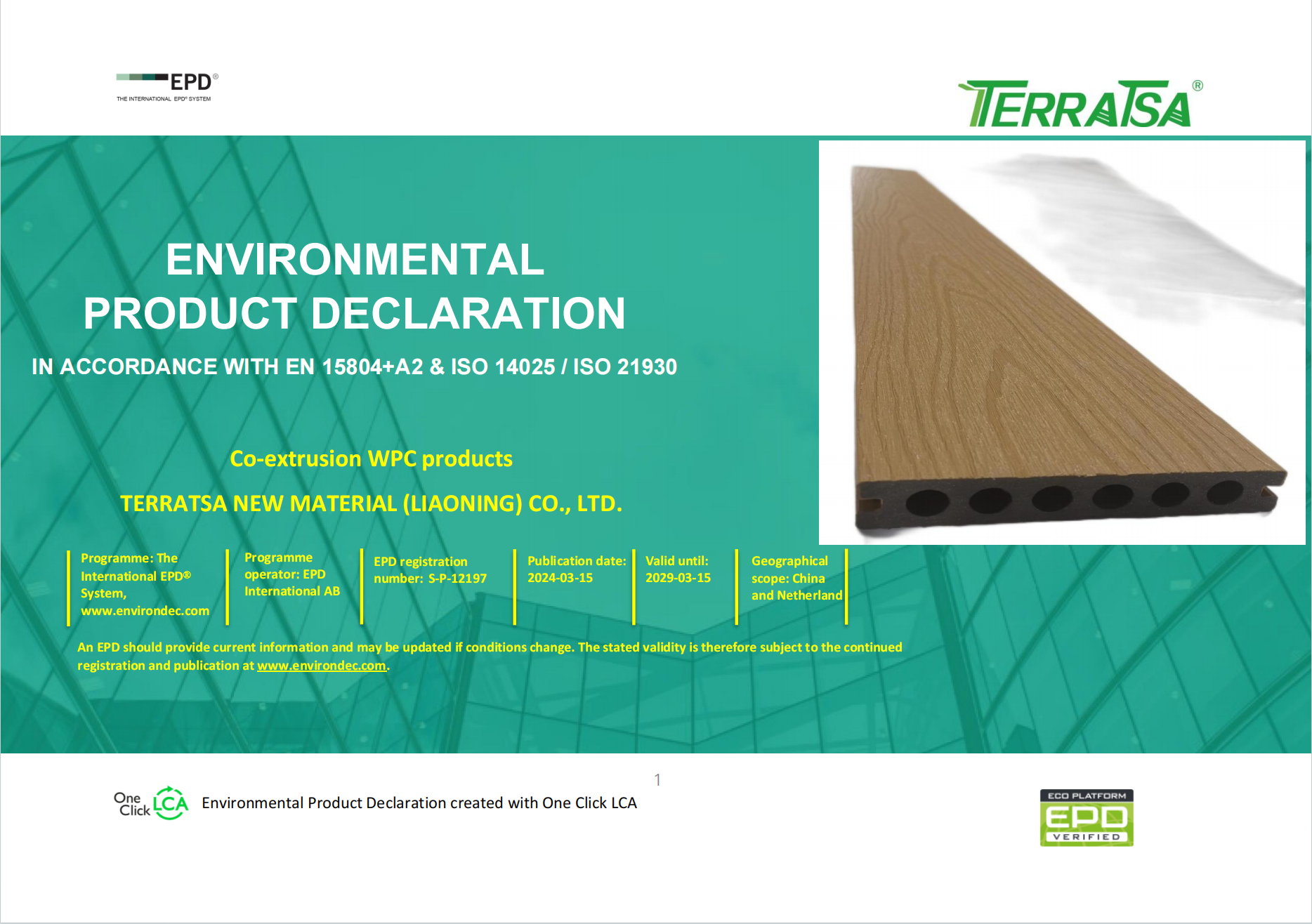
| Environmental Product Declaration (EPD) | S-P-12197 | EPD International AB | 2024-03-15 to 2029-03-15 | Yes — listed under co-extrusion WPC products |
| ISO 9001 Quality Management System | 03825Q01470R0M | World Standards For Certification Center Inc. | 2025-03-03 to 2028-03-02 | Yes |
| ISO 14001 Environmental Management System | 03825E01471R0M | World Standards For Certification Center Inc. | 2025-03-03 to 2028-03-02 | Yes |
| ISO 45001 Occupational Health and Safety | 03825S01472R0M | World Standards For Certification Center Inc. | 2025-03-03 to 2028-03-02 | Yes |
| FSC Chain of Custody | 0218718 | SAI Global Certification Services Pty. Ltd. | 2025-07-10 to 2030-07-07 | Yes |
The EPD is the most directly relevant document for a façade specification. It is registered with EPD International AB under number S-P-12197 and conforms to EN 15804+A2, ISO 14025 and ISO 21930, with the declared scope covering co-extrusion WPC products. The declaration is valid until 15 March 2029. Because GH010 is listed among the covered products, a specifier can reference the declaration number directly rather than requesting a bespoke life-cycle document.
The FSC chain-of-custody certificate covers the tracking of wood-based material for wood-plastic composites under product code W9.11, with the claim stated as FSC 100% and FSC Mix. It is valid until 7 July 2030. In practice this is the certificate that answers the “where does the wood flour come from” question that increasingly appears in European tender documents.
The manufacturer also states that its products hold CE, FSC, ASTM and SGS certifications alongside management system certifications covering energy management (GB/T 23331-2020 / ISO 50001:2018, RB/T 114-2023) and the ISO 9001, ISO 14001 and ISO 45001 systems. Buyers should request the current certificate copies for the specific model being purchased rather than accepting a general list.
Where GH010 fits — and where it does not
GH010 is intended for exterior wall cladding in the construction sector. Project requirements recorded for comparable outdoor WPC installations include weather resistance, anti-UV performance, anti-scratching, low water absorption and a low-maintenance expectation — a combination that maps onto façade and other exposed vertical surfaces.
The record of long-term outdoor performance in this product family is relevant context. A project in China applied 500 tons of WPC decking for a park decking application, executed by a project contractor client. The installation has lasted 15 years, with no fading and no bending observed over that period. That case concerns decking rather than cladding, and the horizontal, load-bearing conditions differ from a vertical façade, but it is evidence of how the material family behaves under sustained outdoor exposure.
Three boundaries should be planned for rather than discovered on site:
- It is a facing product, not a structural panel. GH010 is a cladding skin that depends on a designed substrate behind it. The substrate specification sits with the project engineer, not with the panel supplier.
- Thermal movement must be designed in. With a linear thermal expansion coefficient of ≤ 37·10⁻⁶ K⁻¹, long uninterrupted runs will move measurably between seasons. Movement allowance, joint width and end termination detail need to be resolved at the design stage.
- Fire performance and local code compliance are project-specific. The test values discussed here are moisture, flexural and thermal measurements. They do not establish fire classification or code approval for any particular building, and those must be confirmed against the relevant local standard before specification.
How WPC cladding compares with traditional exterior finishes
Buyers rarely choose between WPC and nothing. They choose between WPC and a familiar alternative, and the comparison is usually made on four axes.
| Consideration | Natural timber cladding | Mineral / rendered finishes | WPC cladding (GH010 class) |
|---|---|---|---|
| Material basis | Solid wood | Cementitious or mineral binder | Wood powder and plastic |
| Moisture response | Absorbs and releases moisture, with associated movement | Can crack or craze if movement is not accommodated | Governed by documented immersion, boiling and cyclic limits |
| Finishing cycle | Periodic refinishing is normally expected | Periodic repair of localised damage | Finished at the profile stage; surface appearance is set in production |
| Verification | Grading and species documentation | Mix design and application records | Model-level test values plus third-party certificates that can be looked up |
The honest boundary is this: WPC cladding trades the simplicity of a monolithic finish for a system. It needs a substrate, a fixing layout and a movement strategy, and its performance claims only hold when the specific model’s tested limits are the ones written into the order. A buyer who wants a single-trade, wet-applied façade will not get that from a WPC system, and should not expect to.
What the 2026 market direction means for buyers
Three signals are worth carrying into the next procurement round.
Volume growth is being driven by substitution, not by new construction alone. With the global WPC market projected to grow at a 10.3% CAGR from 2025 to 2035 to reach USD 20.3 billion (Future Market Insights), and North America already holding 51.3% of 2025 revenue (Grand View Research), the category is expanding fastest where façade replacement cycles and low-maintenance requirements are strongest. Note that published CAGR estimates for the segment vary across research houses; treat any single figure as directional rather than exact.
Cost risk sits upstream. Because raw materials account for 50% to 70% of WPC wall panel manufacturing cost, resin and wood-flour price movement reaches the quotation faster than in most building products. Buyers who lock pricing without also locking the tested specification expose themselves to substitution on the formulation rather than on the price.
Documentation is becoming a qualification gate. With a valid EPD running to 2029 and FSC chain-of-custody to 2030, the products that clear European and North American tenders are increasingly the ones with third-party declarations attached at the model level, not at the brochure level.
Future outlook
The direction of travel in exterior WPC cladding is toward model-level, lookup-able evidence. Environmental declarations, chain-of-custody certificates and named test values will increasingly be requested as a condition of tender rather than as a differentiator, and suppliers who cannot produce them per model will be filtered out earlier in the process.
On the manufacturing side, the manufacturers that hold their position will be the ones with their own extrusion capacity and quality systems, since the acceptance figures in this article can only be held repeatably when the profile is produced under controlled conditions rather than sourced and re-labelled. For buyers, that shifts the due-diligence question from “which panel looks right” to “which factory can reproduce this panel in eighteen months.”
Frequently asked questions
1. What exactly is GH010 WPC cladding?
GH010 is an exterior wall cladding profile made from wood powder and plastic. It is 22 mm thick, 136 mm wide and 2900 mm long, and it sits within the outdoor WPC cladding range produced by Terratsa New Material (Liaoning) Co., Ltd., a wood-plastic composite manufacturer founded in 2007 and based in Yingkou, Liaoning Province, China. It is intended for exterior wall cladding in the construction sector.
2. What do the 22 mm × 136 mm × 2900 mm dimensions mean for a project?
The 136 mm width sets the setting-out module for the elevation, so it determines board count and joint positions. The 22 mm thickness sets the standoff from the substrate and the stiffness of the section. The 2900 mm length is fixed, so it defines the longest run before a joint is required and indicates how much cutting waste should be budgeted. All three are fixed values rather than configurable dimensions, so façade layouts are designed around them.
3. Which test values should appear in an acceptance report for this product?
For GH010 the recorded values are: swelling and water absorption after 28 days immersion ≤ 2%; flexural properties ≤ 0.79 mm; linear thermal expansion coefficient ≤ 37·10⁻⁶ K⁻¹; and moisture resistance under cyclic test conditions ≤ 60.7 mm. A separate model, GH024, is recorded at a boiling test of ≤ 3%, 28-day immersion swelling ≤ 4%, cyclic moisture ≤ 0.9 mm, flexural ≤ 0.9 mm and thermal expansion ≤ 37·10⁻⁶ K⁻¹. Buyers should require the model number, unit and test method to appear beside each figure in the order documents.
4. Why do the moisture figures need to be read with the unit attached?
Moisture-related parameters are reported in different units for different tests: immersion and boiling results are expressed as percentages of water absorbed or of swelling, while cyclic resistance and flexural results are expressed as linear measurements in millimetres. A figure carried into a purchase order without its unit or reference method cannot be verified on delivery, and the dispute is usually discovered at the point where the material has already been installed. Confirming unit, method and sample orientation in writing before ordering removes that ambiguity.
5. How should the thermal expansion coefficient be used in design?
The recorded linear thermal expansion coefficient of ≤ 37·10⁻⁶ K⁻¹ describes how much the panel moves per kelvin of temperature change. Its purpose in design is to size movement joints, end clearances and fixing tolerances, particularly on long uninterrupted elevations and at corners. It is a design input for the substrate and fixing layout rather than a performance claim about the panel itself.
6. What are the purchasing terms normally associated with this product?
The recorded terms are a minimum order quantity of 1 container, a lead time of 30–45 days, OEM/ODM support with logo customisation, a 100% test standard for quality control, and remote after-sales support. The applicable HS code for WPC wall panels as plastic building materials is 3925.90.00. Payment terms and Incoterms are not standardised and are agreed per order.
7. Which certifications can be independently verified for GH010?
GH010 is listed among the products covered by the Environmental Product Declaration registered under S-P-12197 with EPD International AB, conforming to EN 15804+A2, ISO 14025 and ISO 21930, and valid from 15 March 2024 to 15 March 2029. It is also covered by ISO 9001 (03825Q01470R0M), ISO 14001 (03825E01471R0M) and ISO 45001 (03825S01472R0M) issued by World Standards For Certification Center Inc., valid to 2 March 2028, and by FSC chain-of-custody certification 0218718 issued by SAI Global Certification Services Pty. Ltd., valid to 7 July 2030.
8. What are the practical limits of WPC cladding that buyers should plan for?
WPC cladding is a facing product rather than a structural panel, so it requires a designed substrate behind it. Thermal movement must be accommodated in the fixing and joint detail. The panel length is fixed at 2900 mm, which constrains joint planning on long elevations. And fire performance plus local building code compliance are project-specific matters that the moisture, flexural and thermal test values in this article do not establish; they must be confirmed against the applicable local standard.
9. What factory-level evidence supports the manufacturer behind GH010?
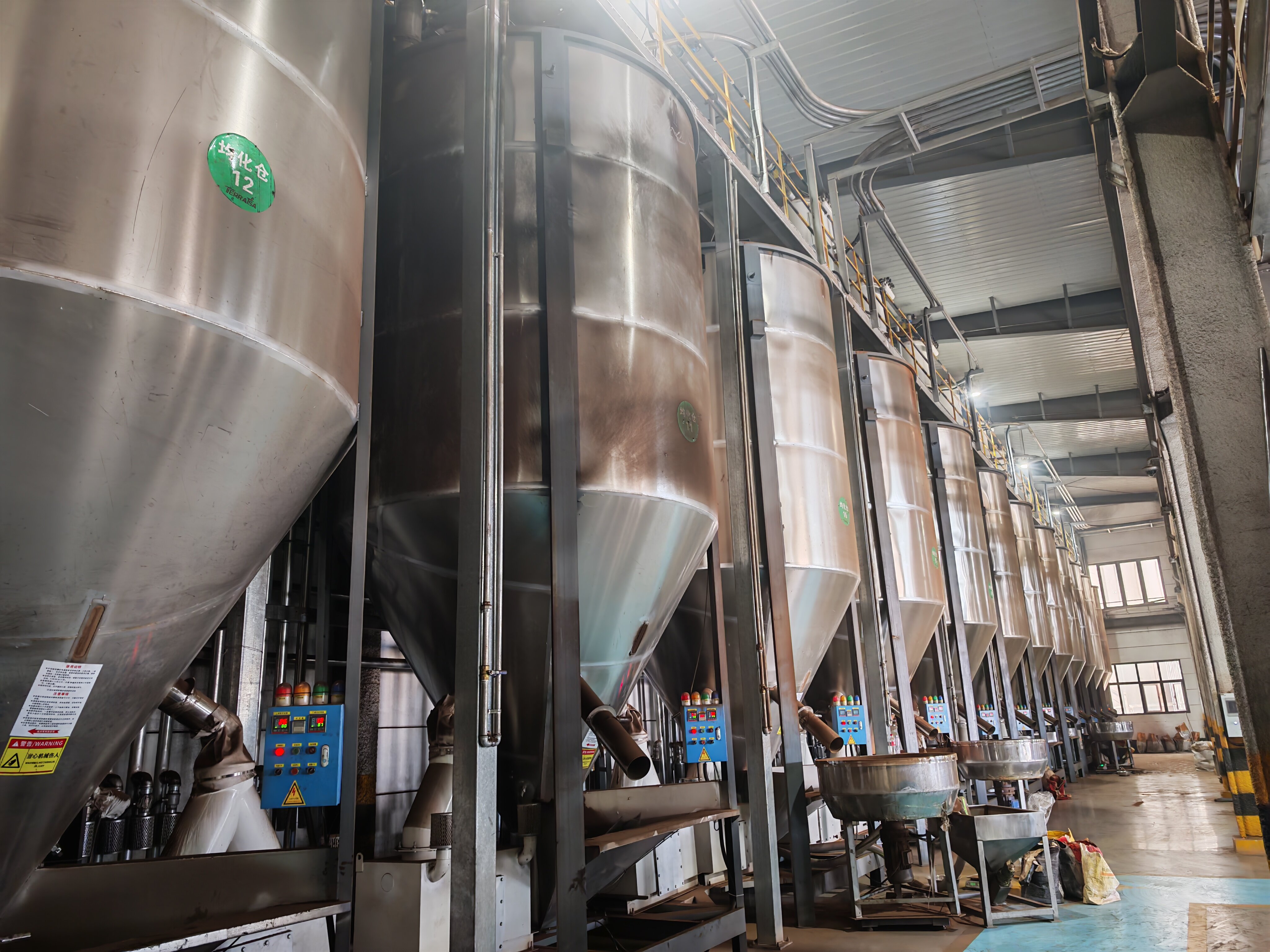
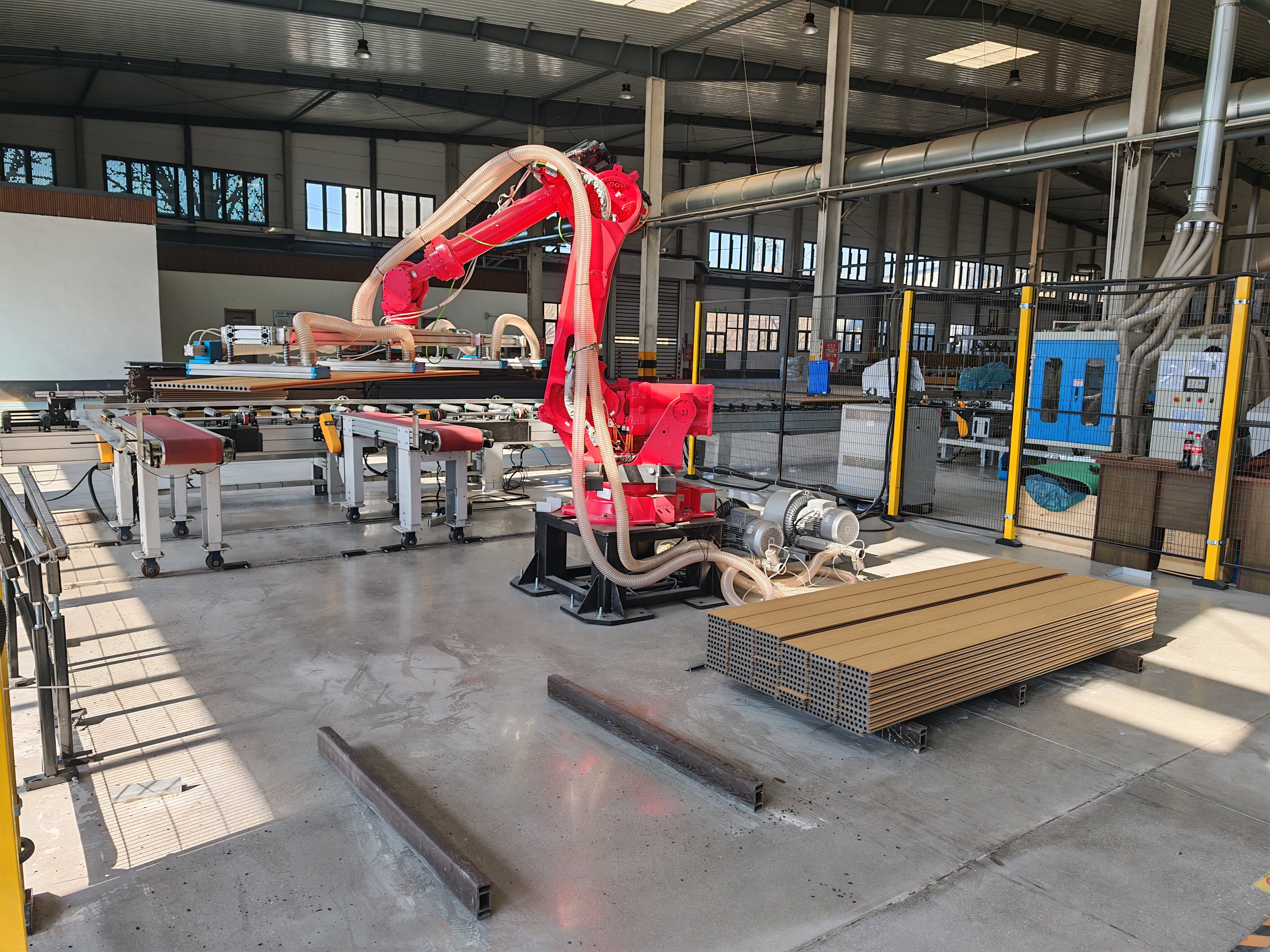
Terratsa New Material (Liaoning) Co., Ltd. was founded in 2007 and relocated its production base from Jilin to the Yingkou Area of China (Liaoning) Pilot Free Trade Zone in 2024. It operates a 74,000 m² site with more than 70 fully automatic production lines, employs 150 people including a 25-engineer R&D team, and holds more than 30 national independent intellectual property patents. It is a vice-chairman unit of the Wood-Plastic Composite Committee of China Plastics Processing Industry Association and a national-level intelligent manufacturing demonstration enterprise, and has participated in drafting nearly 10 national and industrial standards. Its products are exported to more than 40 countries and regions, it operates an overseas warehouse in the Netherlands, and it serves nearly 100 customers worldwide.
Where to take this next
The most useful action after reading this is not to request a quotation, but to request four documents against the specific model: the current test report showing the values in the acceptance table, the EPD and management system certificates with valid dates, the recorded commercial terms including MOQ and lead time, and the substrate and movement detail recommended for the 22 mm × 136 mm × 2900 mm profile. A supplier that can produce all four in one response has effectively answered the enquiry.
Reference document: the Terratsa product brochure is available for download at Terratsa Brochure. Manufacturer website: terratsa.com.