
WPC Decking Buyer Decision Matrix: GH001, D053, GH010 and GH024
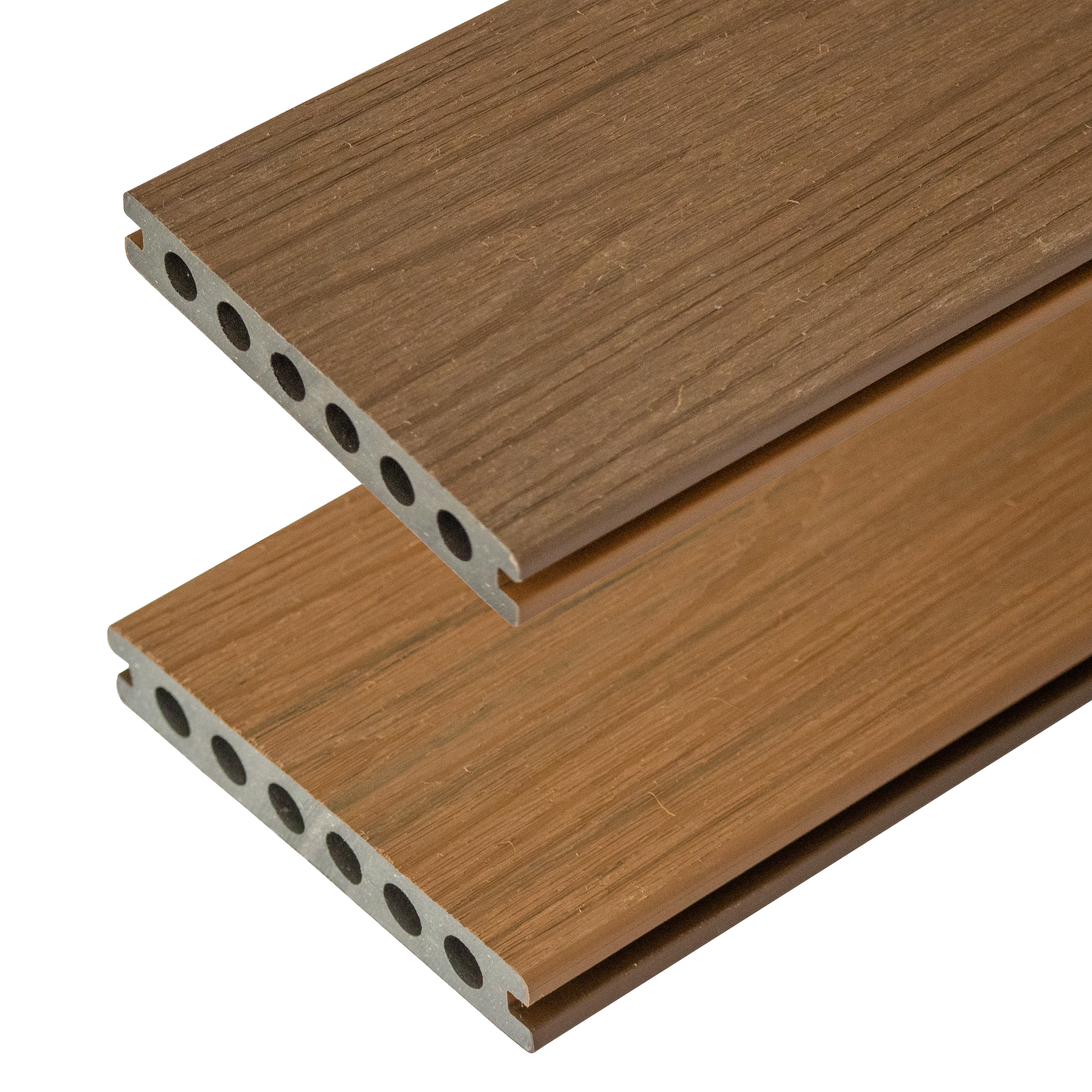
Most WPC decking and cladding purchases fail in the documentation, not on the surface. A board can look correct in a sample box and still be unusable on a project if the model sits outside the scope of the environmental declaration, if the acceptance test method was never agreed in writing, or if the certificate offered is company-level while the project needs product-level evidence. That gap is why the four Terratsa models examined here cannot be ranked on a single sheet of paper: GH001, D053, GH010 and GH024 belong to different product classes, answer different performance questions, and carry different verification logic.
Terratsa New Material (Liaoning) Co., Ltd. is a wood-plastic composite manufacturer founded in 2007 and based in the Yingkou Area of China (Liaoning) Pilot Free Trade Zone, producing outdoor WPC decking, outdoor WPC fencing and outdoor WPC cladding. The manufacturing facility covers 74,000 square metres and is equipped with more than 70 fully automatic production lines, with an annual production capacity of 120,000 tons. Around 85% of output is exported, and the company operates an independent overseas warehouse in the Netherlands.
Why a decision matrix beats a model list
A decision matrix is a way of forcing four questions into the same document: what the product class is designed to do, what the published data actually measures, which third-party documents apply to that specific model, and what the buyer can check on arrival.
Three structural facts make this necessary for WPC.
First, decking and cladding publish different kinds of numbers. The decking models in this set publish load values in newtons, while the cladding models publish deflection values in millimetres. Placing 3,300 N beside 0.79 mm in the same column would create a comparison that does not exist.
Second, certification scope is declared per product group, not per company. A valid environmental declaration tells a buyer what was assessed and under which rules; it does not automatically extend to every SKU in a catalogue.
Third, surface construction decides where a board can be used. A capped co-extruded decking profile and a first-generation hollow decking profile solve the same nominal problem — an outdoor walking surface — with different material logic and different cost positioning.
The four models at a glance
The table below reproduces only what the published product data states. Where a value is expressed as a limit rather than a measured result, it is shown as published.
| Model | Product class | Published data |
|---|---|---|
| GH001 | Co-extruded outdoor WPC decking; wood powder and plastic; second-generation co-extruded polymer cap layer fully encapsulating the core | Flexural properties ≥ 3,300 N; moisture resistance under cyclic test conditions, mean ≤ 10%; water absorption (boiling test) ≤ 7%; engineered for −40°C to 75°C |
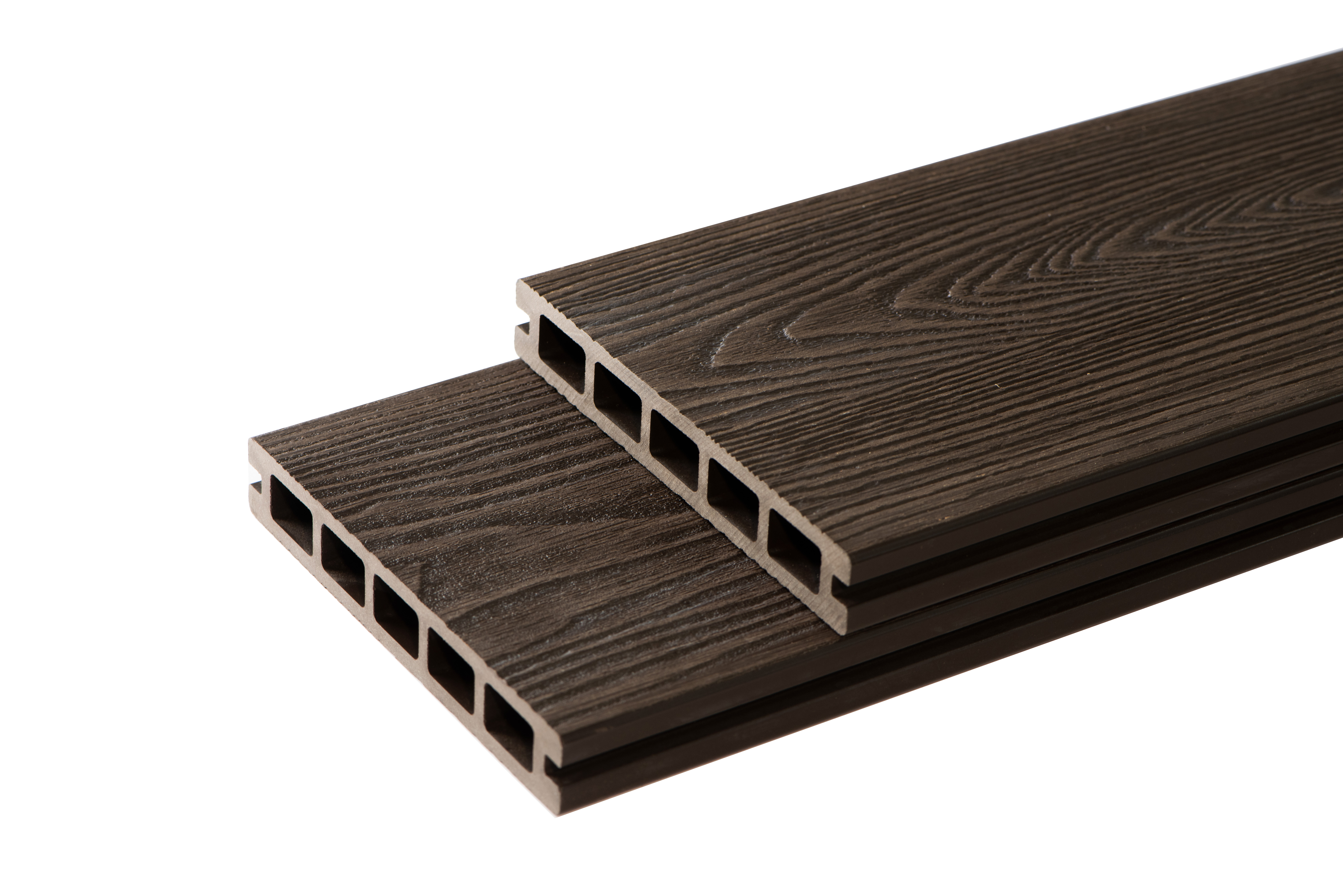
| D053 | Outdoor hollow WPC decking, first generation; wood powder and plastic | 146 × 23 × 2,900 mm; bending failure 3,900 N; density 1.3 g/cm³; water absorption (5-hour boil) ≤ 2%; linear thermal expansion ≤ 37 × 10⁻⁶ K⁻¹ |
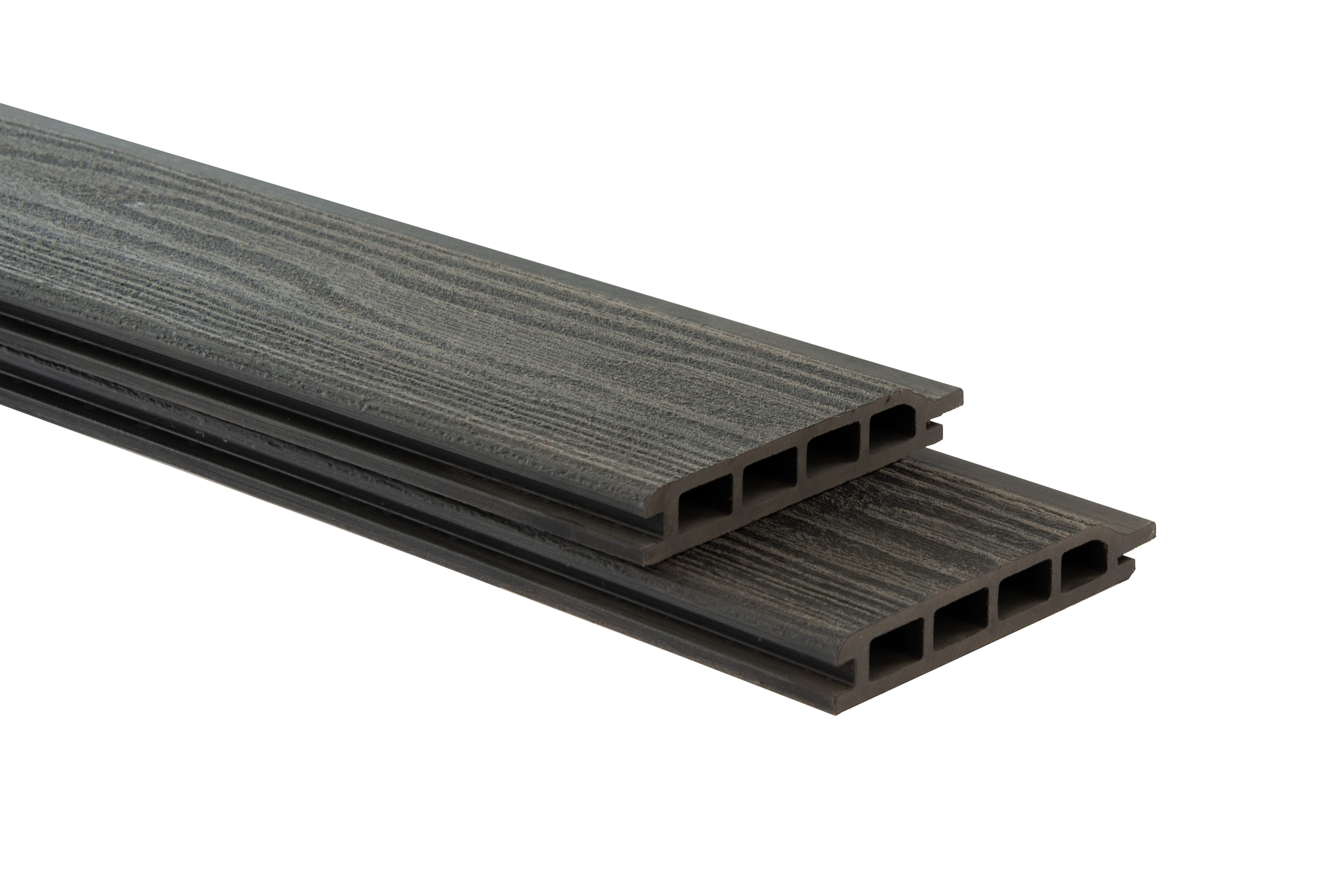
| GH010 | Exterior wall cladding; wood powder and plastic | 136 × 22 × 2,900 mm; flexural properties ≤ 0.79 mm; moisture resistance under cyclic test conditions ≤ 60.7 mm; swelling and water absorption (28-day immersion) ≤ 2%; linear thermal expansion ≤ 37 × 10⁻⁶ K⁻¹ |
| GH024 | Outdoor WPC cladding; wood powder and plastic | Flexural properties ≤ 0.9 mm; moisture resistance under cyclic test conditions ≤ 0.9 mm; swelling and water absorption (28-day immersion) ≤ 4%; boiling test ≤ 3%; linear thermal expansion ≤ 37 × 10⁻⁶ K⁻¹ |
Read the columns, not the numbers: load ratings (N) apply to the decking models; deflection limits (mm) apply to the cladding models. The two blocks are not interchangeable.
Two interpretation notes matter more than the figures themselves. The GH010 and GH024 cyclic moisture results (60.7 mm and 0.9 mm) differ by roughly two orders of magnitude, which indicates different test setups rather than a performance gap of that size; a buyer comparing them must obtain the test basis first. Likewise, GH001's flexural value is stated as a minimum load (≥ 3,300 N) while D053's is stated as a bending failure load (3,900 N) — similar sounding metrics derived from different descriptors.
Certification coverage: what is documented, and against which model
The most common sourcing error is treating a certificate as a property of the supplier. In practice, each document answers a narrower question, and the buyer's job is to match the document to the model and the market.
| Document | What it answers | What the buyer still has to confirm |
|---|---|---|
| EPD S-P-12197 (registration EPD-IES-0012197:001) | Third-party environmental declaration for co-extrusion WPC products, published through the International EPD System, conforming to EN 15804+A2 and following ISO 14025 / ISO 21930; issued 2024-03-15, valid until 2029-03-15; declared applicability covers the China and Netherlands markets | Whether the specific model appears in the declared product group, the declared unit, and which lifecycle modules are included |
| ISO 9001 | Quality management system at company level | The certified scope and site named on the certificate |
| ISO 14001 (GB/T 24001-2016 / ISO 14001:2015) | Environmental management system | Scope statement, issuing body, validity date |
| ISO 45001 (GB/T 45001-2020 / ISO 45001:2018) | Occupational health and safety management system | Scope statement and current validity |
| FSC certification | The company holds FSC certification; chain-of-custody documentation links material claims to transactions | The claim type carried by that product and that order, and the certificate code referenced on the commercial documents |
| CE, ASTM, SGS | Additional conformity and testing references held by the manufacturer | The standard cited and the report number tied to the ordered model |
For a research-stage buyer, the practical reading is this: the EPD is the only document in the set that speaks about environmental performance of a declared product group, and its declared scope is co-extrusion WPC products. That makes GH001 the most direct fit. D053, as a first-generation hollow decking profile, and the two cladding models, GH010 and GH024, should each be checked against the declared product group rather than assumed to be inside it. A buying team that treats EPD coverage as automatic across a catalogue is building a submittal that may not survive review.
The management-system certificates follow a different logic again. ISO 9001, ISO 14001 and ISO 45001 describe how a site is run; they are evidence about process discipline, not about a board's flexural behaviour. Buyers who need product evidence should pair them with the model-level test data in the first table and, where applicable, with ASTM D7032, the standard specification used to establish performance ratings for wood-plastic composite deck boards, stair treads, guards and handrails.
Technical reading: cap layer, profile geometry and movement
GH001 carries a second-generation co-extruded polymer cap layer that fully encapsulates the core. In specification terms, that shell is where UV stability, stain resistance and surface wear are decided, because it isolates the wood-plastic core from moisture and light. The published temperature range for the model is −40°C to 75°C, and the surface texture is described as providing slip resistance — relevant where the deck runs around swimming pools or spa areas.
D053 is a hollow first-generation profile measuring 146 × 23 × 2,900 mm, with a density of 1.3 g/cm³, a bending failure load of 3,900 N and water absorption of ≤ 2% after a five-hour boil. Its published positioning is cost efficiency for large areas — parks, plazas, boardwalks, community pathways — where basic durability and budget control dominate.
GH010 and GH024 are vertical-surface products, not walking surfaces. GH010 is defined by a 136 × 22 × 2,900 mm profile, ≤ 0.79 mm flexural deflection, ≤ 2% swelling after 28-day immersion, and surface detailing for facades, garden feature walls, balcony privacy screens, fence cladding and outdoor kitchen surrounds. GH024 is specified with ≤ 0.9 mm flexural deflection, ≤ 4% swelling after 28-day immersion and ≤ 3% after boiling, and is used as outdoor WPC cladding where a deeper textured face is wanted. A buyer mixing the two cladding profiles into one elevation without checking deflection basis will be comparing two different test regimes.
All four models publish a linear thermal expansion coefficient of ≤ 37 × 10⁻⁶ K⁻¹ or reference the same movement behaviour. That number is the one most often lost between specification and site: it determines expansion gaps, end clearances and joist discipline, and it is the reason a deck installed tight in cool weather will show movement in summer.
Application fit: matching model to exposure
Documented project conditions help anchor the choice. In a Polish decking project described by low winter temperatures combined with high humidity, the requirements listed were weather resistance, UV resistance, low water absorption, anti-slip behaviour, scratch resistance and no maintenance — a combination that points to a capped co-extruded decking surface rather than an unprotected one. In a Chinese park decking project under high humidity, the stated needs were weather resistance, anti-slip, UV resistance and scratch resistance, with joist clips and screws as the matched installation components; both GH001 and D053 appear as related products there, which reflects the real split between a performance-led and a budget-led specification.
For residential and commercial outdoor projects, GH001 is described as suitable for garden patios, balconies, swimming pool surrounds, waterfront boardwalks, park pathways and building facades. GH010 is aimed at exterior facades of residential homes, commercial buildings, hotels and villas. GH024 is aimed at exterior wall applications. Matching the model to the exposure is therefore a two-step decision: first the surface type, then the performance tier within that surface type.
Purchasing terms a matrix should force into the open
Comparison collapses the moment a purchase order becomes vague. Six term categories carry most of the risk in WPC decking and cladding orders, and each belongs in the written agreement rather than in an email thread.
Product identification. Model plus surface finish plus profile, written in the same form as the technical data. A decking model and a cladding model with similar code patterns should never be interchangeable on a purchase order.
Declaration references. The EPD number (S-P-12197 / EPD-IES-0012197:001), the management-system certificate numbers and the FSC certificate code should be listed as contractual references, together with the statement that they refer to the ordered product group.
Test basis. Where a property is quoted, the corresponding test method should be named. This is especially important for the cladding models, whose cyclic moisture figures are expressed on visibly different bases.
Quantity and packing basis. Whether quantities are ordered by piece, by square metre or by linear metre, and how the covered area is calculated from the profile width.
Documentation deliverables. Which documents travel with the shipment — declaration copy, certificate copies, test reports, chain-of-custody documentation — and in what form.
Claim wording. Any environmental or material claim used in marketing downstream should be quoted exactly as the underlying document permits, rather than paraphrased by the buyer's own copywriter.
Acceptance criteria at goods-in
Acceptance criteria convert published data into a check that a warehouse team can actually perform. A workable set for this product family covers five checks.
Dimensional verification against the published profile — for example 146 × 23 mm for D053 and 136 × 22 mm for GH010 — measured on samples from the delivered batch rather than on a reference piece.
Surface continuity on capped co-extruded product, since a cap layer only delivers its function if it is unbroken along edges and ends.
Moisture performance confirmed through the supplier's test documentation against the published limits, with the method named: boiling test absorption ≤ 7% for GH001, ≤ 2% for D053, and 28-day immersion swelling ≤ 2% for GH010 and ≤ 4% for GH024.
Documentation completeness — declaration, certificates and reports matched to the ordered model codes, not merely to the supplier name.
Accessory compatibility — clips, joists and screws confirmed as the system the profile was designed for, because expansion behaviour is a property of the installed assembly, not of the board alone.
Factory selection questions worth asking early
At research stage, the supplier questions that change outcomes are the ones a factory can answer with a document or a process description rather than an adjective.
1. Which production lines run the co-extruded profiles, and how many lines are automated? Terratsa reports more than 70 fully automatic production lines across a 74,000 square metre facility, with annual capacity of 120,000 tons.
2. What is the declared scope of the EPD, and does it name the models you are quoting? The company holds a valid EPD for co-extrusion WPC products under EN 15804+A2, valid until 2029-03-15.
3. Which standards work has the manufacturer contributed to? Terratsa states it has participated in the drafting of nearly 10 national and industrial standards and holds more than 30 national independent intellectual property patents.
4. How is quality control structured across the batch? The company describes an end-to-end dual-QC model spanning raw material screening, in-process monitoring and a pre-shipment re-inspection.
5. What is the R&D capability behind custom finishes? The R&D team consists of 25 engineers, and the products are available in a range of standard colours and custom finishes.
6. How are export and after-sales handled in the destination market? Roughly 85% of production is exported to more than 40 countries and regions across Europe, America, Oceania and Asia, serving nearly 100 customers worldwide, with an independent overseas warehouse in the Netherlands.
Where WPC stops being the easy answer
Against treated timber, WPC removes the repainting, staining and sealing cycle, and it does not rot or host termites in the way timber can. It is also available in standard colours and custom finishes and can be cut, sawn and fastened with standard woodworking tools, which shortens installation learning curves.
The limitations are just as concrete. A capped co-extruded decking profile such as GH001 is a higher-tier product than a first-generation hollow profile such as D053, and the two are positioned accordingly — one for performance-led specifications, the other for cost-led large-area work. Buyers who specify the capped profile everywhere will overpay on a park pathway; buyers who specify the first-generation profile around a swimming pool will trade away surface performance.
All four models carry a linear thermal expansion coefficient of ≤ 37 × 10⁻⁶ K⁻¹ or equivalent movement behaviour, which means the installation itself must be designed for movement. Where a project cannot guarantee joist spacing, edge clearances and gap discipline, no board specification will compensate.
Finally, the documentation boundary is real. The EPD covers co-extrusion WPC products; company-level ISO certificates describe management systems; FSC certification operates through chain-of-custody claims whose type must be confirmed per product and per order. A buyer who needs product-level environmental evidence for a cladding elevation should verify scope before bidding, not after.
Market context shaping these decisions
The category is expanding, and documentation expectations are travelling with it. Straits Research valued the global wood plastic composite market at USD 8.05 billion in 2025 and projects USD 11.26 billion by 2034. The same source places North America at 36.4% of the global market in 2025, which helps explain why US-origin specification practice, including ASTM D7032 for deck board performance ratings, carries weight well beyond that region.
On the supply side, trade data under HS Code 39189090 has recorded China accounting for 97.81% of imports in the monitored dataset — a figure published by Zauba that should be treated as indicative rather than definitive, since it reflects one data source and one code classification.
Market sizing should also be read with care. Estimates for 2025 vary between research houses — one places the figure at USD 8.05 billion and another at USD 9.76 billion — most likely because the boundary of what counts as WPC differs between reports. For procurement purposes the direction matters more than the decimal: the category is growing, and with it the number of buyers who ask for declarations rather than brochures.
Future outlook
Three developments are likely to reshape this matrix over the next specification cycles. The first is declaration literacy: as EPDs become routine in tender documents, the question shifts from whether a supplier has one to whether the ordered model is inside its scope. The second is model-level differentiation, since buyers increasingly compare capped co-extruded decking against first-generation profiles on surface performance rather than on unit price alone. The third is documentation timing — with an EPD valid until 2029-03-15, renewal and re-verification become a scheduled procurement check rather than an afterthought.
For the four models examined here, the practical conclusion holds: GH001 and D053 sit in a decking block compared by load, absorption and surface construction; GH010 and GH024 sit in a cladding block compared by deflection, immersion swelling and profile design. Keeping those blocks separate, and keeping certificate scope attached to the model rather than the company, is what makes the comparison usable.
FAQ
What separates GH001 co-extruded decking from D053 hollow decking?
GH001 is a co-extruded outdoor WPC decking with a second-generation polymer cap layer that fully encapsulates the core, engineered for −40°C to 75°C, rated at flexural properties ≥ 3,300 N and ≤ 7% water absorption in a boiling test. D053 is a first-generation hollow WPC decking measuring 146 × 23 × 2,900 mm, with a bending failure load of 3,900 N, density 1.3 g/cm³ and ≤ 2% water absorption after a five-hour boil. The first is a capped, performance-tier decking; the second is a first-generation profile positioned for cost-efficient large-area work.
Does EPD S-P-12197 cover all four models?
The declaration (registration EPD-IES-0012197:001) is for co-extrusion WPC products, conforming to EN 15804+A2 and following ISO 14025 / ISO 21930, issued 2024-03-15 and valid until 2029-03-15, with declared applicability to the China and Netherlands markets. Because its scope is defined at product-group level, each model — GH001, D053, GH010 and GH024 — has to be checked against the declared group individually rather than assumed to be included.
How do GH010 and GH024 differ as cladding options?
Both are outdoor WPC cladding made from wood powder and plastic, but their published values differ: GH010 is a 136 × 22 × 2,900 mm exterior wall cladding with flexural properties ≤ 0.79 mm and 28-day immersion swelling ≤ 2%, while GH024 lists flexural properties ≤ 0.9 mm, 28-day immersion swelling ≤ 4% and boiling test ≤ 3%. Their reported cyclic moisture values are expressed on different bases, so the test method should be confirmed before the two are compared directly.
What acceptance criteria belong in a WPC decking purchase order?
Five checks are practical: dimensional verification against the published profile; surface continuity on capped co-extruded product; moisture performance confirmed against the published limits with the method named (≤ 7% boiling absorption for GH001, ≤ 2% for D053, ≤ 2% 28-day immersion swelling for GH010, ≤ 4% for GH024); completeness of declaration, certificate and test documents matched to the ordered model codes; and confirmation that clips, joists and fasteners match the system the profile was designed for.
Which factory questions reveal capability rather than marketing?
Questions that require a document or a process description: the declared scope of the EPD and whether it names the quoted models; the certification set held, which for Terratsa includes CE, FSC, ASTM, SGS and EPD alongside ISO 9001, ISO 14001 and ISO 45001 management systems; the production base, described as a 74,000 square metre facility with more than 70 fully automatic lines and 120,000 tons annual capacity; the R&D team of 25 engineers and participation in the drafting of nearly 10 national and industrial standards; and the quality process, described as a dual-QC model covering raw material screening, in-process monitoring and pre-shipment re-inspection.
Reference documents: the Terratsa product brochure is available at Terratsa Brochure – Decking. Company information: terratsa.com. Certification and test data quoted above follow the published product data and the EPD record for registration EPD-IES-0012197:001.
Have Questions or Need More Details?
Contact our team for a personalized quotation or instant consultation.
Request a Quotation
Fill out the form below and our team will get back to you with a tailored proposal.
WhatsApp Direct Chat
Prefer to chat in real-time? Message us on WhatsApp for instant assistance & quick answers.
- Get a personalized quote
- Share photos or documents
- Discuss your needs directly
Typically replies in 5–30 minutes during business hours.