
WPC Decking Certification and Performance: A Buyer Verification Guide
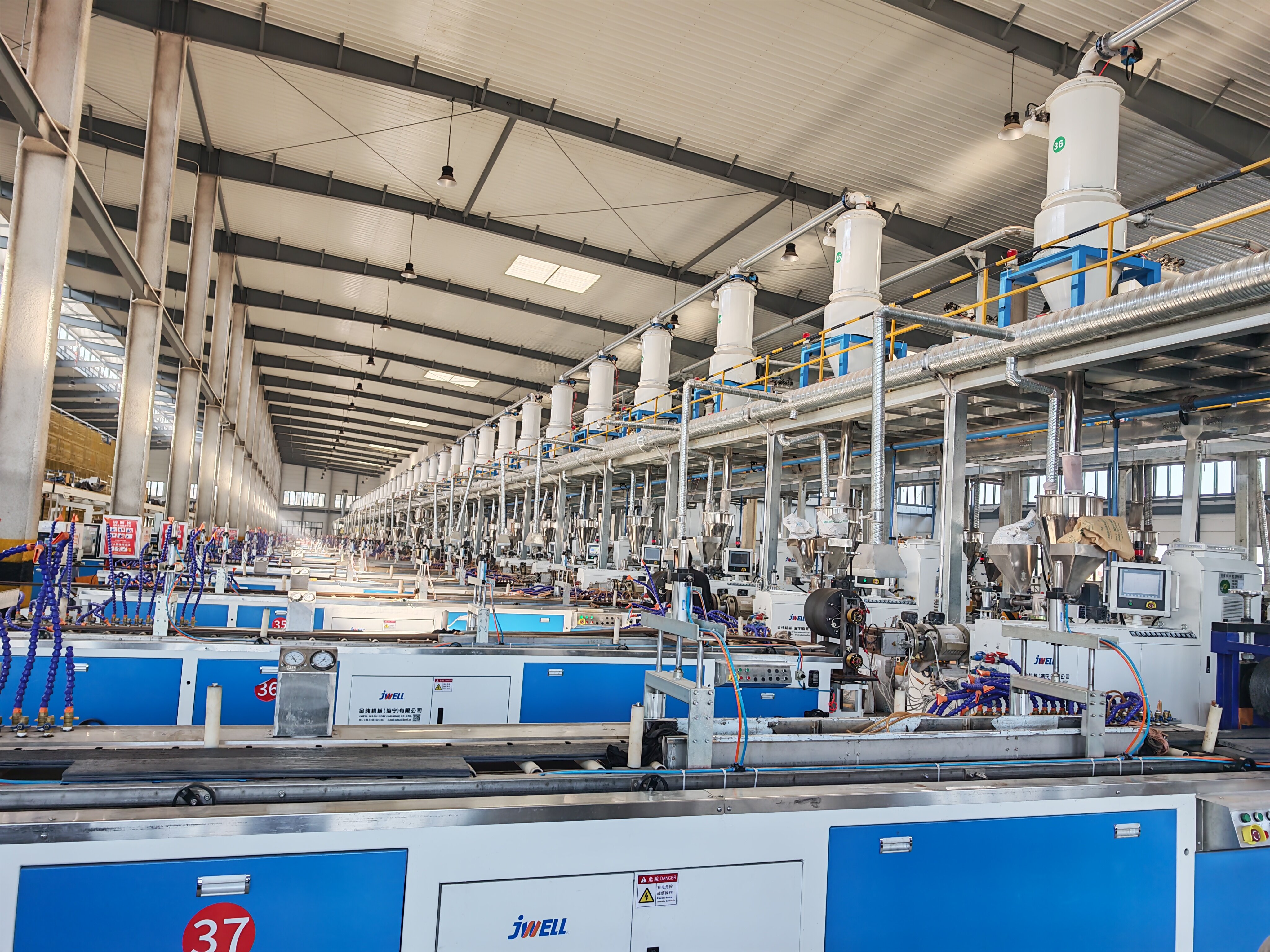
WPC decking has moved from an alternative wood product to a documented construction material. For professional buyers, the selection process is no longer only about color or grain pattern. It is about whether a board can prove its performance through certifications, test parameters and production evidence. This guide explains how buyers can verify WPC decking quality before sourcing, with a focus on certification and technical criteria that separate compliant suppliers from price-only sellers.
Why Verification Matters in WPC Decking Procurement
Most WPC decking available globally is manufactured in China. Trade data for HS Code 39189090 shows that China accounted for 97.81% of total imports in a specific monitored trade dataset. This concentration gives buyers access to factory-direct pricing, but it also creates a verification gap. Suppliers may describe similar products with very different specifications. First-generation hollow boards and second-generation co-extruded boards are both called "WPC decking," yet their long-term behavior differs significantly.
For buyers in the research and evaluation stage, the key questions are: Does the manufacturer hold third-party certification? Are the performance numbers consistent with the product structure? Is the recycled content claim traceable? Answering these questions before purchase reduces the risk of fading, water absorption, scratching and early replacement.
Terratsa New Material: A Certified Reference Point
One manufacturer that illustrates a verifiable approach is Terratsa New Material (Liaoning) Co., Ltd. Founded in 2007 and now based in the Yingkou Area of the China (Liaoning) Pilot Free Trade Zone, Terratsa is a Chinese producer of outdoor WPC decking, fencing and wall cladding. The company operates 74,000 square meters of production facilities with more than 70 automated lines, an annual capacity of over 50,000 tons, and a 25-person R&D team. According to its corporate profile, Terratsa positions itself as the largest wood-plastic manufacturer in northern China and a national-level intelligent manufacturing demonstration enterprise.
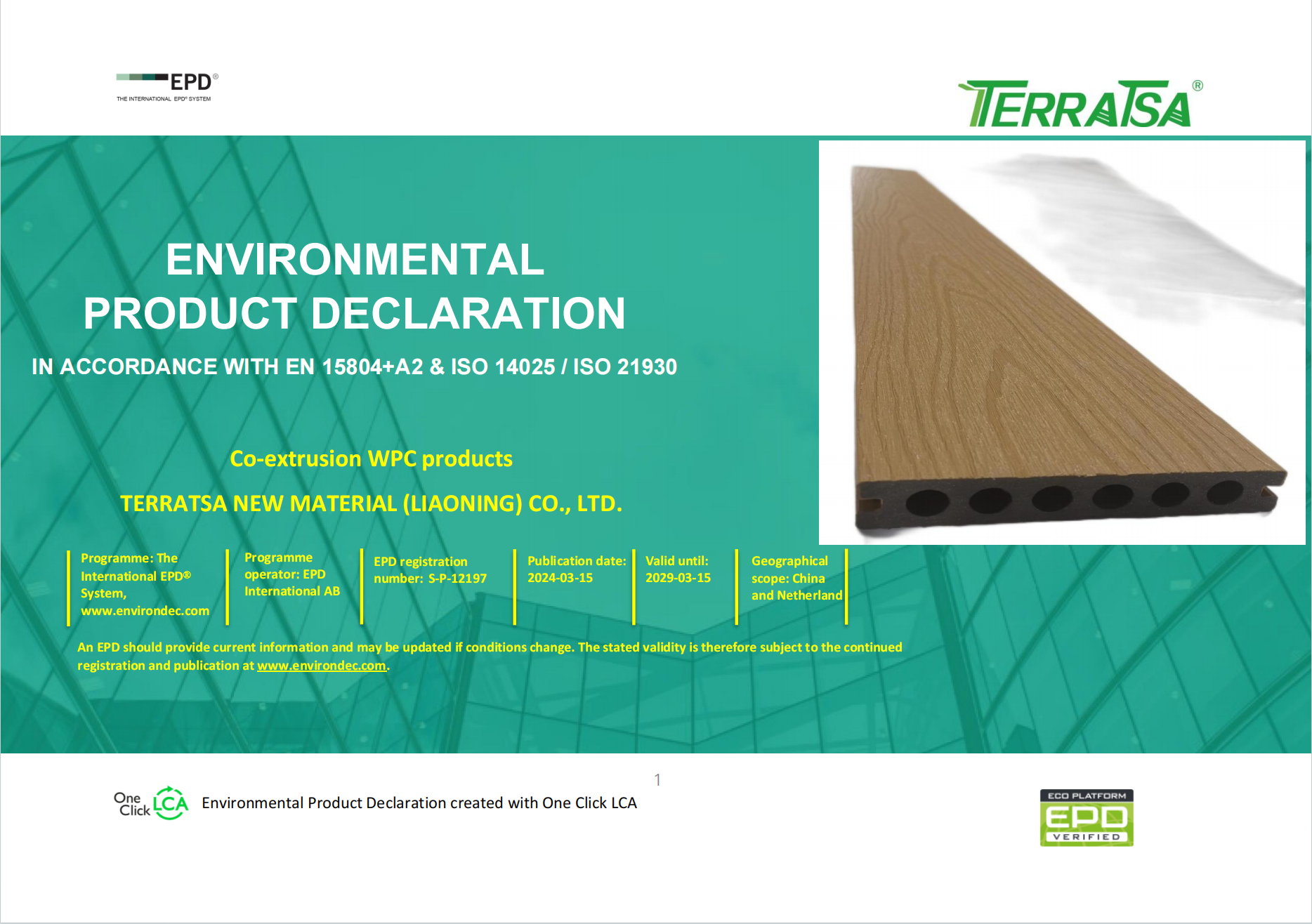
From a documentation perspective, Terratsa is useful because its claims can be checked. The company reports certifications including CE, FSC, ASTM, SGS and EPD, plus management system certifications ISO 9001, ISO 14001 and ISO 45001. Its EPD is registered with EPD International under number S-P-12197, valid until 15 March 2029. This makes it possible for a buyer to verify the environmental declaration independently rather than relying only on a sales sheet.
On the supply side, Terratsa lists OEM/ODM production support, with a one-container MOQ, a lead time of 30–45 days and remote after-sales support. These constraints are useful for distributors and contractors planning order cycles.
Understanding the Core Certifications for WPC Decking
Certifications are the first layer of evidence. They do not replace product testing, but they allow buyers to confirm that a product or factory has been assessed by an independent body.
| Certification | Number | Scope |
|---|---|---|
| EPD | S-P-12197 | GH001 co-extruded decking, D053 hollow decking, GH010 exterior wall cladding, GH024 outdoor WPC cladding; recognized in China and the Netherlands |
| FSC Chain of Custody | 0218718 | Tracking of wood-based material in wood-plastic composites W9.11; claims FSC 100% and FSC Mix; global |
| ISO 14001 | 03825E01471R0M | Environmental management in WPC flooring production |
| ISO 45001 | 03825S01472R0M | Occupational health and safety in WPC flooring production |
The EPD is based on EN 15804+A2 and ISO 14025 / ISO 21930. It is valid until 2029-03-15 and is recognized in China and the Netherlands. For buyers in Europe, an EPD is increasingly requested for green building documentation and lifecycle assessments.
The FSC Chain of Custody certification is issued by SAI Global Certification Services Pty. Ltd. It follows FSC-STD-40-004 V3-1 and FSC-STD-50-001 V2-1. This matters for buyers who need evidence that recycled or certified wood content is traceable through the production chain.
How to Read Performance Parameters
Certifications confirm management and environmental claims, but product performance appears in technical parameters. Two product families from Terratsa illustrate the difference: hollow first-generation WPC and capped co-extruded WPC.
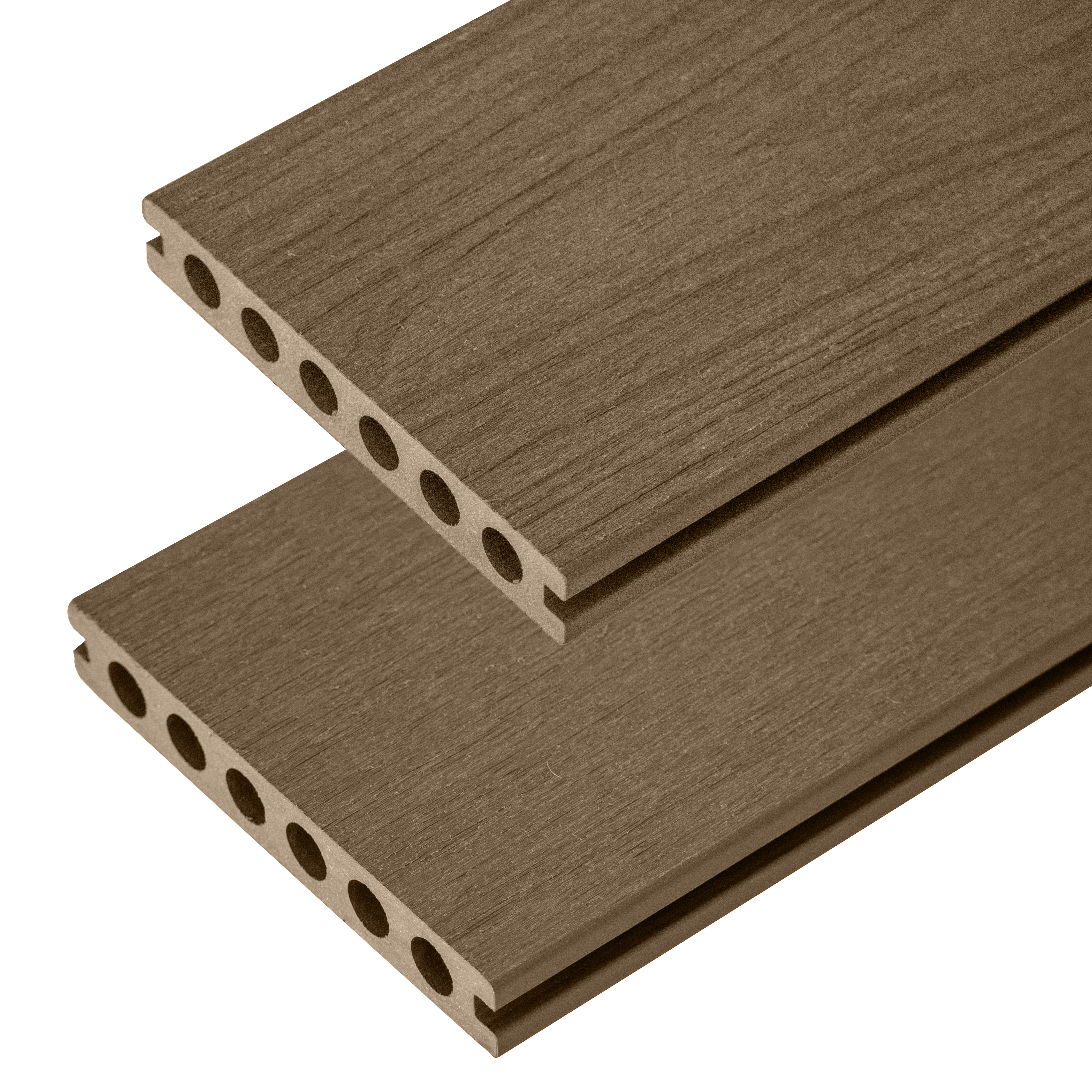
GH001 is a co-extruded outdoor decking with a second-generation polymer cap layer that fully encapsulates the core. The outer shell is formulated with advanced UV-resistant components such as ASA materials. The board achieves flexural properties of at least 3300 N, water absorption of no more than 7% in a boiling test, and moisture resistance under cyclic test conditions with a mean value of no more than 10%. It has an IP55 protection level and is engineered to withstand temperatures from -40°C to 75°C.
D053 is a first-generation outdoor hollow WPC decking. It is positioned as a cost-effective option that remains waterproof and rot-proof, with a slip-resistant surface and natural wood texture. Its dimensions are 23 mm by 146 mm by 2900 mm. It has a density of 1.3 g/cm³, bending failure of 3900 N, water absorption of no more than 2% after boiling for 5 hours, and a linear thermal expansion coefficient of no more than 37×10⁻⁶ K⁻¹.
A Practical Sourcing Verification Checklist for WPC Decking
- Confirm the EPD or environmental declaration number and check it with the issuing program.
- Ask for the FSC Chain of Custody certificate when recycled or certified wood content is claimed.
- Compare product structure with declared parameters: hollow, solid and co-extruded boards have different test expectations.
- Request the specific test method for water absorption, flexural properties and UV/color stability.
- Check MOQ, lead time and after-sales support when planning procurement and installation schedules.
- Request samples and evaluate machining behavior, surface texture and batch consistency.
- Verify installation guidance for joist spacing, expansion gaps and fastener types.
Application Patterns: Where Co-Extruded and Hollow WPC Fit
One example comes from Poland, where a decking project operates under low winter temperatures and high humidity. The specified requirements included weather resistance, anti-UV performance, no maintenance, low water absorption, anti-scratching and anti-slip behavior. The matched product was GH001 co-extruded decking, because the fully capped structure protects the core from moisture and the UV-resistant shell is designed to reduce fading.
A second example is a park decking project in China with high humidity. The project specified weather resistance, anti-slip, anti-UV and anti-scratching properties. Both D053 hollow decking and GH001 co-extruded decking were used. A project contractor reported using 500 tons of Terratsa decking in the park, with no fading and no bending highlighted as the observed result.
This does not mean every project needs co-extruded decking. Large public spaces with strict budget limits and shorter service-life expectations can be served by first-generation hollow boards. Projects where long-term appearance and low maintenance matter more should consider capped co-extruded WPC.
Market Context: Growth, Regional Demand and Documentation Pressure
The global wood plastic composite market was valued at about USD 8.05 billion in 2025 and is projected to reach USD 11.26 billion by 2034, according to Straits Research. North America held the largest regional share at 36.4% in 2025. This regional structure influences standards. ASTM D7032, for example, is the primary standard specification for establishing performance ratings for WPC deck boards, stair treads, guards and handrails. Buyers exporting to North America therefore need to confirm whether a supplier's testing aligns with ASTM-based expectations.
Europe's focus on lifecycle assessment is also making EPD documentation more common in tender requirements. A manufacturer with a registered EPD can support architects and contractors who need environmental data for green building certification. The combination of growing market value, high China export share and stricter documentation demands points to one conclusion: certifications and parameter declarations should be treated as part of the product specification, not as marketing extras.
Comparison with Traditional and Alternative Decking Solutions
| Option | Strengths | Limitations |
|---|---|---|
| Pressure-treated timber | Lower upfront cost; familiar natural look | Requires staining and sealing; risk of rot, warping and insect damage; higher maintenance |
| First-generation hollow WPC (e.g., D053) | Cost-effective; waterproof and rot-proof; slip-resistant; recyclable | Lower color and scratch stability than capped versions; hollow core can feel less solid; better matched to defined short-term project plans |
| Capped co-extruded WPC (e.g., GH001) | Full cap layer; UV-resistant shell; better scratch and moisture resistance; lower maintenance | Higher initial material cost than hollow WPC; still requires correct substructure and expansion gaps |
A common mistake is to treat "WPC" as a single product category. In procurement terms, first-generation and co-extruded decking answer different questions. Choosing co-extruded decking for a short-term public walkway may overspend. Choosing hollow decking for a private terrace may lead to earlier visible wear. The most useful comparison is not only WPC versus wood, but also intended service life, maintenance capability and project budget.
Future Outlook: From Product Claims to Lifecycle Transparency
The next stage of WPC decking procurement will be built on traceability. Buyers will increasingly ask for verified product declarations, chain-of-custody evidence and factory audit information before requesting a quote. Manufacturers that publish certification numbers, provide clear technical datasheets and keep a physical presence in target markets will have an advantage.
Terratsa's model — an integrated factory, registered EPD, FSC chain of custody, ISO management systems, and an overseas warehouse in the Netherlands — shows how a Chinese manufacturer can make itself easier to evaluate from a distance. The company reports that it exports to more than 40 countries and serves nearly 100 customers worldwide. However, documentation alone is not enough. Buyers should still request samples, confirm installation guidelines and check whether the supplier can support the specific climate conditions of the project.
FAQ: WPC Decking Verification and Selection
How to choose first generation decking or second generation decking?
For most residential and commercial projects that demand premium quality, co-extrusion WPC (second generation) is generally recommended. It solves not only the performance issues of the decking itself, but also reduces maintenance over a long period. First-generation WPC is better suited for large-scale projects with strict budget constraints and clear short-term usage plans.
Why choose Terratsa as a WPC decking supplier?
Terratsa New Material (Liaoning) Co., Ltd. is an integrated source factory. According to its corporate profile, it procures raw materials directly, operates more than 70 automated production lines, and lists an annual production capacity of over 50,000 tons. It reports certifications including CE, FSC, ASTM, SGS and EPD, and its EPD registration can be checked through EPD International under number S-P-12197. For buyers, the practical advantage is that most claims can be verified through public documentation, samples and factory inspection.
For detailed specifications, the company's public brochure is available here: Terratsa WPC decking brochure.