
WPC Decking Shortlist: EPD-Backed GH001 and D053 Specs
Two documented Terratsa decking models, the numbers behind them, and how to read registration S-P-12197 before you specify.
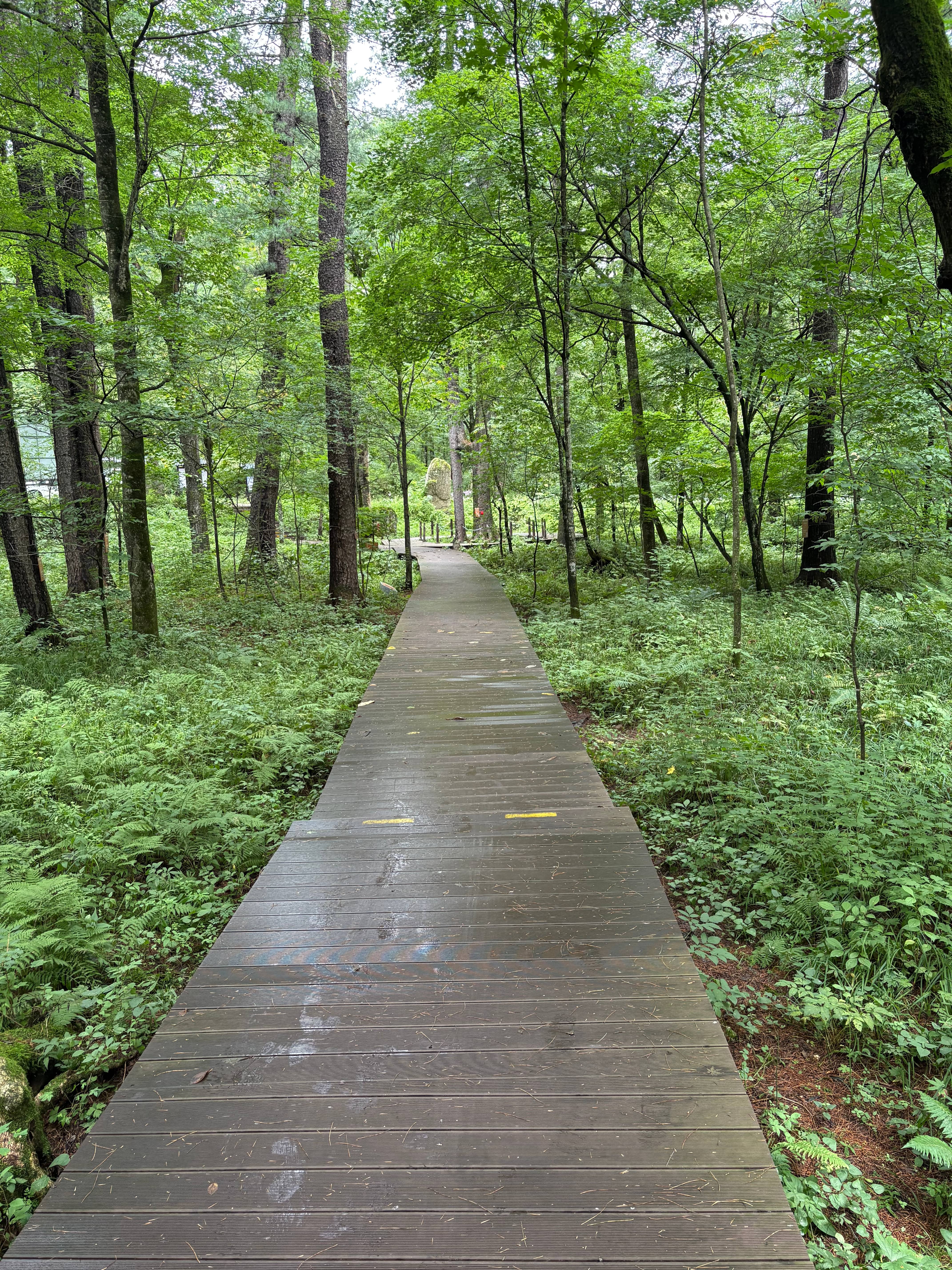
WPC decking installed as an outdoor walkway surface — the application class where documented material performance carries the most weight.
WPC decking exists because natural timber does not behave well outdoors. It takes on water, it swells and splits, and it demands a recurring cycle of cleaning, sanding and re-sealing that most asset owners would rather not fund. Wood plastic composite boards were developed to retain the appearance and warmth of timber while removing that maintenance burden from the ownership model.
The category has now reached a scale at which documentation, not surface appearance, decides many specifications. The global wood plastic composite market was valued at USD 8.05 billion in 2025 and is projected to reach USD 11.26 billion by 2034, according to Straits Research. North America alone held a 36.4% share of that market in 2025, per the same source — a region where environmental product declarations are increasingly requested alongside CE and ASTM documentation.
This shortlist examines two models from Terratsa New Material (Liaoning) Co., Ltd., a wood-plastic composite manufacturer established in 2007 and located in the Yingkou Area of China (Liaoning) Pilot Free Trade Zone. GH001 is classified as co-extruded outdoor decking. D053 is classified as outdoor hollow WPC decking, first generation. Both carry a published specification trail, and Terratsa's co-extrusion WPC products are covered by a valid Environmental Product Declaration registered as EPD-IES-0012197:001, cited in the register as S-P-12197.
Why an EPD Is the First Screen, Not the Last
An Environmental Product Declaration is a third-party verified document that reports a product's environmental performance against a fixed methodology. Terratsa's declaration conforms to EN 15804+A2, the European standard for environmental product declarations of construction products, and is registered in The International EPD System. The version date is 15 March 2024 and the declaration is valid until 15 March 2029.
For a buyer still in the discovery phase, the value of an EPD is not the environmental score itself. It is the existence of a declared product scope. A manufacturer that maintains an EPD has committed a product definition, a reference unit, a production location and a validity window to a public register, where anyone can inspect it without asking the supplier for a favour. That is a materially different level of traceability from a certificate PDF attached to a quotation email.
It also yields a screening rule that costs nothing to apply. If a decking model cannot be located inside a supplier's declared product scope, the environmental claims attached to that model should be treated as unverified until the missing documentation appears. Applying that single test removes a large share of speculative claims from a longlist before pricing is even discussed.
The Shortlist at a Glance
The two models occupy different positions in the same catalogue. GH001 is a capped co-extruded board built around a protective shell. D053 is the hollow-core first-generation profile that built the WPC decking category on cost efficiency. Their declared figures are not directly interchangeable, which is precisely why both are worth listing separately.
| Attribute | GH001 | D053 |
|---|---|---|
| Product name | WPC decking | WPC decking |
| Type | Co-extruded outdoor decking | Outdoor hollow WPC decking, first generation |
| Material | Wood powder and plastic | Wood powder and plastic |
| Board format | Capped co-extruded profile | 23 mm thick · 146 mm wide · 2,900 mm long |
| Flexural performance | Flexural properties ≥ 3,300 N | Bending failure 3,900 N |
| Moisture behaviour | Cyclic test mean ≤ 10%; water absorption (boiling test) ≤ 7% | Water absorption (5-hour boil) ≤ 2% |
| Density | Not declared in the specification unit | 1.3 g/cm³ |
| Linear thermal expansion | Not declared in the specification unit | ≤ 37 × 10⁻⁶ K⁻¹ |
| Typical fit | Residential and commercial outdoor projects: garden patios, balconies, swimming pool surrounds, waterfront boardwalks, park pathways, building facades | Large-area and public installations: parks, scenic spots, plazas, boardwalks, community pathways |
GH001: What the Co-Extruded Specification Declares
GH001 is a WPC decking board classified as co-extruded outdoor decking, made from wood powder and plastic. Its defining construction is a second-generation co-extruded polymer cap layer that fully encapsulates the core — a 360-degree protective shell rather than a laminated, painted or simply embossed surface. That single construction choice is what separates capped co-extruded WPC decking from a standard composite board, and it is the reason GH001 appears on a shortlist constrained by documentation.
Three declared figures carry the specification:
- Flexural properties: ≥ 3,300 N — the load the board resists before failure under the declared test method.
- Moisture resistance under cyclic test conditions: mean ≤ 10% — behaviour under repeated wetting and drying rather than a single soak, which is closer to how a real terrace actually ages.
- Water absorption (boiling test): ≤ 7% — a deliberately aggressive exposure condition used as an upper-bound indicator.
Beyond the mechanical declaration, GH001 is engineered to withstand temperatures from −40°C to 75°C, is free from formaldehyde, benzene and toxic chemicals, and is 100% recyclable. Its surface texture provides slip resistance, which is the property that matters most around swimming pools, spas and other permanently wet outdoor areas. The board is available in a wide variety of standard colours and custom finishes, and is designed for cutting, sawing and fastening with standard woodworking tools.
A practical consequence of the capped construction is that the visible surface is a polymer shell rather than exposed wood-plastic compound. Colour retention and surface hardness are therefore governed by the shell formulation, and routine upkeep reduces to soap and water. For a project where re-oiling or re-sealing cycles would appear in the operating budget, that is a measurable cost consideration rather than a cosmetic one.
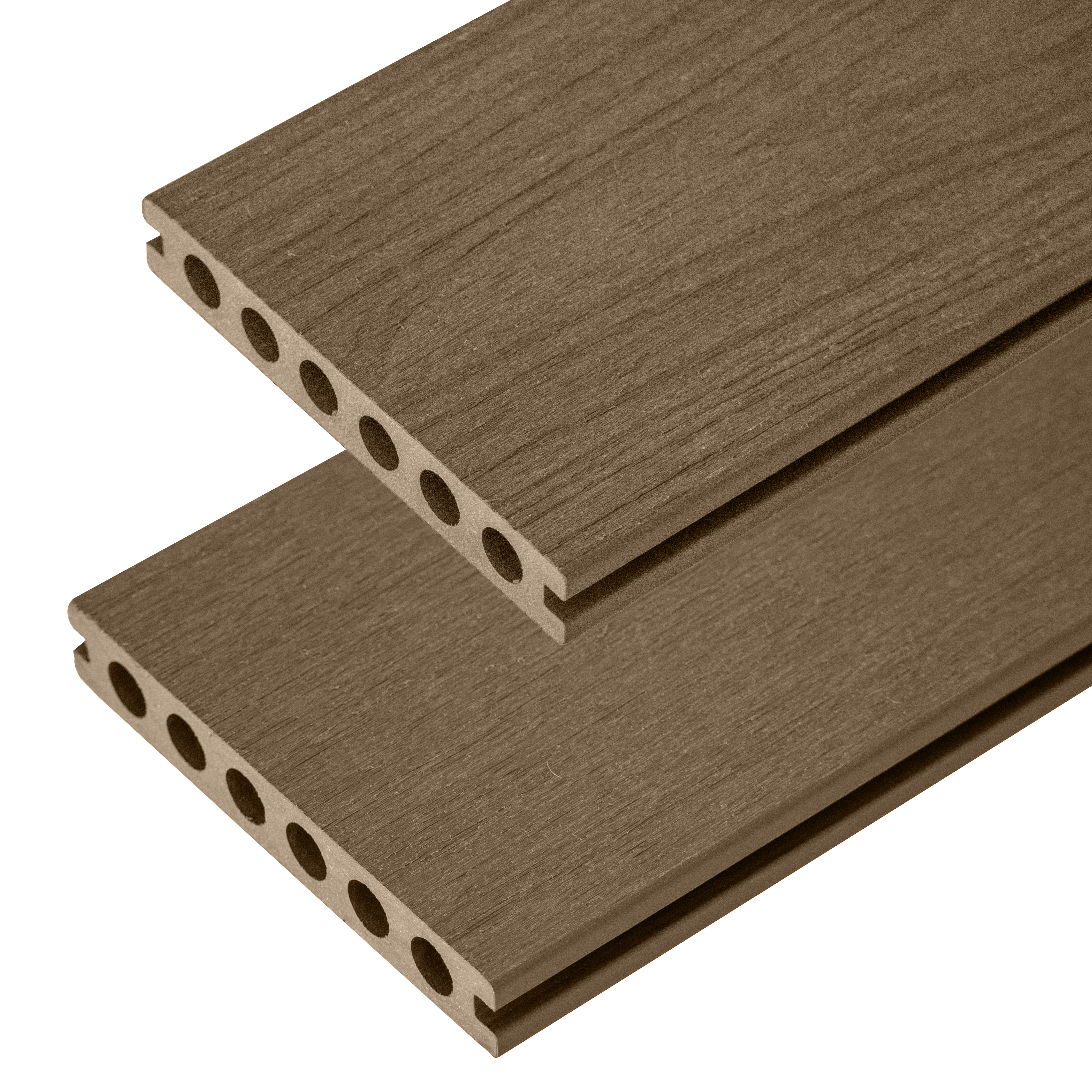
GH001 co-extruded WPC decking, 143 × 22.5 mm profile reference in a teak finish. The capped outer layer fully encapsulates the core.
D053: What the Hollow First-Generation Specification Declares
D053 is a first-generation hollow WPC decking board made from wood powder and plastic. Its profile is declared as 23 mm thick, 146 mm wide and 2,900 mm long. Where GH001 relies on a co-extruded cap, D053 uses the hollow-core profile that established the composite decking category — a structure intended to deliver dependable outdoor performance at a lower material cost.
The declared figures are:
- Bending failure: 3,900 N
- Density: 1.3 g/cm³
- Water absorption (5-hour boil): ≤ 2%
- Linear thermal expansion coefficient: ≤ 37 × 10⁻⁶ K⁻¹
Two of these numbers deserve attention during the research stage. The first is the low-boil water absorption result, which indicates how little moisture the compound takes up under an aggressive test — the mechanism that underpins the material's resistance to rot and swelling in damp climates. The second is the linear thermal expansion coefficient, which quantifies how much a board will move as temperature changes across the seasons.
Thermal movement is the most frequently overlooked variable in WPC installation planning, and it is the reason board spacing, clip selection and fixing methods are specified by the manufacturer rather than improvised on site. A buyer who requests the expansion coefficient at quoting stage is asking a more useful question than a buyer who requests a colour card.
D053 is positioned for high-volume work: public parks, scenic spots, plazas, boardwalks and community pathways, where cost efficiency and basic durability set the brief. Its surface is grooved or textured to provide slip resistance in wet conditions, and it is designed to be cut, drilled and fixed with standard woodworking tools and hidden clip systems. It is manufactured from a blend of recycled plastics and wood fibres and is fully recyclable.
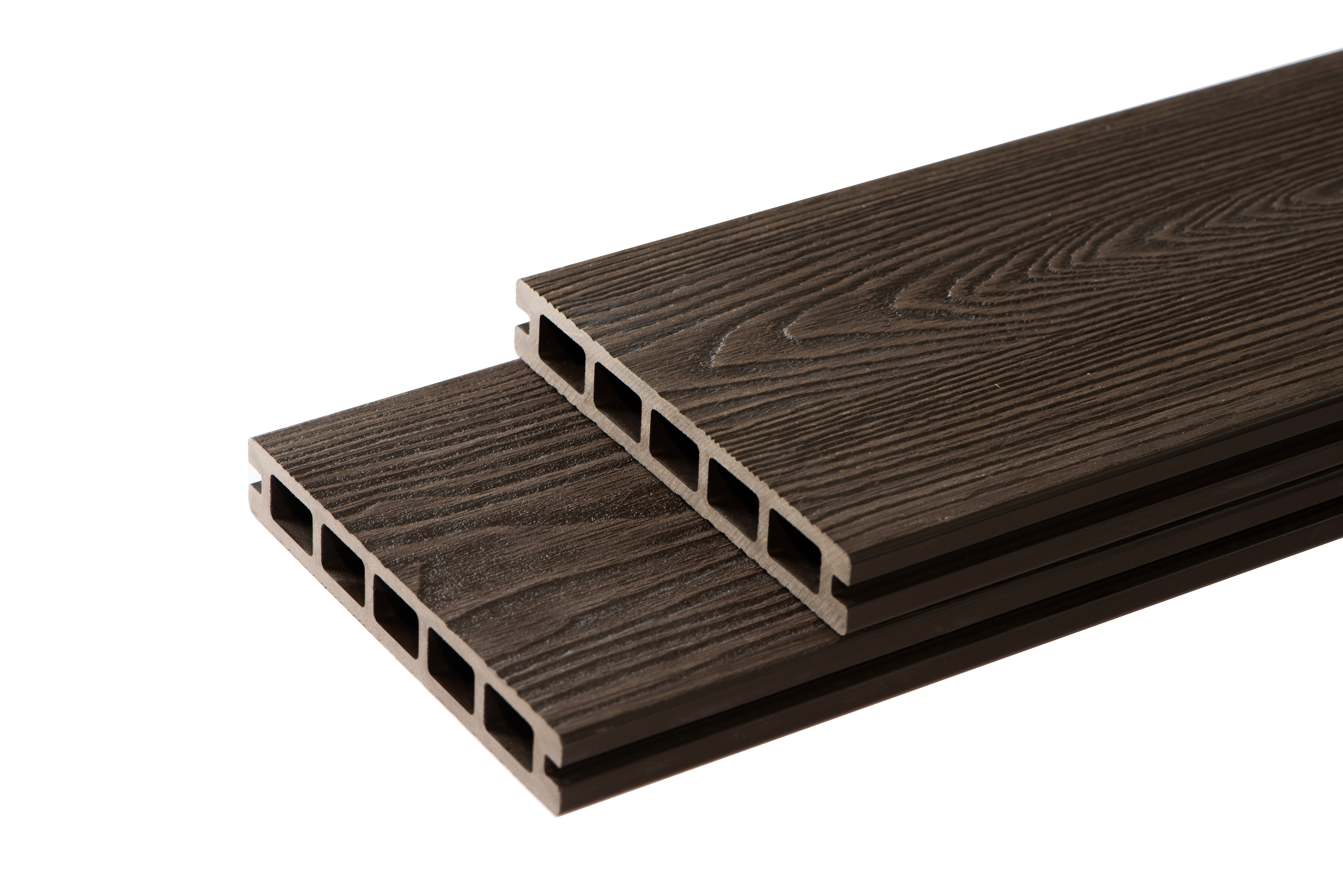
D053 hollow WPC decking, 146 × 23 mm profile. The declared 2,900 mm board length reduces the number of end joints across large public installations.
How Registration S-P-12197 Creates Traceability
Traceability in decking procurement runs through three layers, and the EPD number anchors the middle one.
Layer one — manufacturer identity. Terratsa New Material (Liaoning) Co., Ltd. was established in 2007 and has over 15 years of experience in the wood-plastic composite industry. The manufacturing facility covers 74,000 square metres and is equipped with more than 70 fully automatic production lines, with an annual production capacity of 120,000 tons. The R&D team consists of 25 engineers. The company specialises in the production, manufacturing and R&D of outdoor flooring, wall cladding, fencing and grid panels, and exports approximately 85% of its products to more than 40 countries and regions across Europe, America, Oceania and Asia.
Layer two — declared product scope. The declaration registered as EPD-IES-0012197:001, published under S-P-12197, conforms to EN 15804+A2 and is valid until 15 March 2029. This is the layer that converts a generic environmental claim into a bounded statement about a defined family of products.
Layer three — model-level specification. The figures in the table above belong here: 3,300 N flexural performance and a boiling-test absorption of ≤ 7% for GH001; 3,900 N bending failure, 1.3 g/cm³ density, ≤ 2% boil absorption and ≤ 37 × 10⁻⁶ K⁻¹ expansion for D053. A specification is only as strong as this layer, because this is the layer the installer, the structural checker and the warranty holder will actually rely on.
Matching Each Model to a Project Type
At the discovery stage, the useful question is not which board is better but which board the project can actually justify. The declared data supports a fairly clean split.
Choose GH001 when the surface is the specification
Swimming pool surrounds, spa decks, hotel terraces, balcony floors and waterfront boardwalks are applications where the top surface is constantly exposed and constantly judged. GH001's capped co-extruded construction, its declared −40°C to 75°C operating range and its slip-resistant texture map directly onto those conditions. The same properties apply to residential garden patios and commercial outdoor areas where colour stability and low maintenance are written into the brief.
Choose D053 when the area is the specification
Public parks, plazas, scenic walkways and community pathways are measured in square metres and budget lines. D053's declared 23 × 146 × 2,900 mm format, 3,900 N bending failure and ≤ 2% boil absorption describe a board built to cover large areas with a predictable, repairable, wood-like surface. The 2,900 mm length is itself a design decision: fewer end joints means fewer fixing points and faster laying across long runs.
Where the two frequently meet
Mixed projects — a park with a pavilion deck, a resort with both a pool surround and a long access walkway — can legitimately use both models in the same scheme, provided the transition details and expansion allowances are handled per the manufacturer's instructions for each profile.
Market Context: Documentation Is Becoming a Purchasing Criterion
Three data points explain why a shortlist built around paperwork is now commercially sensible rather than merely conscientious.
First, the market is large enough to attract scrutiny. The global wood plastic composite market was valued at USD 8.05 billion in 2025, with a projected path to USD 11.26 billion by 2034 (Straits Research). North America accounted for 36.4% of that market in 2025 according to the same source — a concentrated, specification-driven region where environmental declarations carry real procurement weight.
Second, supply is highly concentrated. In monitored trade data for HS Code 39189090, China accounted for 97.81% of WPC decking imports (Zauba). When a single origin dominates a category, differentiation has to come from documentation quality rather than geography — which places a premium on manufacturers who maintain declarations, certificates and traceable production records.
Third, the technical standards layer is already established. ASTM D7032 is the primary standard specification for establishing performance ratings for wood-plastic composite deck boards, stair treads, guards and handrails (ASTM International). Buyers who are already comfortable citing ASTM D7032 in a specification are the same buyers who will ask for an EPD, because both documents perform the same function: they move a claim out of marketing and into a verifiable register.
WPC Decking Versus Traditional Timber: Where the Comparison Holds
The comparison with traditional timber decking is often stated too broadly. It holds in specific places and breaks down in others.
It holds on maintenance. WPC decking is designed to need no sanding, staining, sealing or painting, with routine cleaning by soap and water sufficient to maintain the surface. It also holds on moisture behaviour: the compound is waterproof and rot-resistant, which addresses the swelling, decay and insect damage that drive replacement cycles in natural timber used in damp or humid environments.
It breaks down on thermal movement. Both GH001 and D053 are composite profiles, and D053 declares a linear thermal expansion coefficient of ≤ 37 × 10⁻⁶ K⁻¹. That figure is small in absolute terms but not zero, and it means WPC boards must be installed with the spacing, clip systems and substructure detailing specified for the profile — not with the tight butt joints a joiner might use on hardwood. A buyer comparing WPC against timber on material price alone will also miss the point: WPC's commercial case is built on the avoided maintenance and replacement cost across the service life, not on the first invoice.
A further boundary worth stating plainly is that a WPC decking board is a surface product, not a structural member. It is designed for outdoor ground paving and decoration over a suitable substructure. Where a project requires a structural span, guard or handrail, the applicable standard — for example ASTM D7032 for deck boards, stair treads, guards and handrails — defines the rating that must be established, and an environmental product declaration does not substitute for it. Two different documents answer two different questions.
Future Outlook
Two directions look reasonably well supported by what is already documented.
The first is the migration of capped co-extruded profiles from premium to default. As more projects specify colour stability and low maintenance as baseline requirements rather than upgrades, the co-extruded construction that GH001 belongs to becomes the reference point against which first-generation hollow profiles such as D053 are positioned as the cost-optimised alternative for high-volume areas. That is a complementary relationship, not a competitive one.
The second is the normalisation of declarations as a sourcing filter. With an EPD valid through March 2029 and a certification portfolio that also includes CE, FSC, ASTM, SGS and EPD, a manufacturer's documentation set becomes something a procurement team can audit on a fixed schedule rather than re-litigate per order. Terratsa's participation in the drafting of nearly 10 national and industrial standards and its holding of more than 30 national independent intellectual property patents point in the same direction — the company is invested in the standards infrastructure that makes third-party verification meaningful in the first place.
FAQ
What is an EPD and why does it matter for WPC decking?
An Environmental Product Declaration is a third-party verified document reporting a product's environmental performance against a defined methodology. For WPC decking it matters because it fixes a product scope, a reference unit, a production location and a validity period in a public register, which allows a buyer to trace claims independently rather than relying on a supplier statement.
What does the certification number S-P-12197 refer to?
S-P-12197 is the citation for the declaration registered as EPD-IES-0012197:001, held by Terratsa New Material (Liaoning) Co., Ltd. for its co-extrusion WPC products. The declaration conforms to EN 15804+A2, carries a version date of 15 March 2024, and is valid until 15 March 2029.
What is the difference between GH001 and D053?
GH001 is classified as co-extruded outdoor decking and uses a second-generation co-extruded polymer cap layer that fully encapsulates the core. D053 is classified as outdoor hollow WPC decking, first generation, with a declared 23 mm × 146 mm × 2,900 mm profile. GH001 declares flexural properties of ≥ 3,300 N and boiling-test water absorption of ≤ 7%; D053 declares 3,900 N bending failure, 1.3 g/cm³ density, ≤ 2% boil water absorption and a linear thermal expansion coefficient of ≤ 37 × 10⁻⁶ K⁻¹.
Are both models covered by the same declared scope?
The declaration under S-P-12197 covers Terratsa's co-extrusion WPC products, which is the construction category GH001 belongs to. D053 is a first-generation hollow profile documented through its published product specification data. The practical step for any buyer is to confirm in writing that the exact model and reference unit in the bill of materials falls inside the declared scope of whichever declaration is being cited.
How long is the EPD valid, and what should a buyer do as it approaches expiry?
The declaration is valid until 15 March 2029. Because declarations are periodically revised, a buyer citing an EPD in a specification should record the version date they relied on and re-check the register before the project reaches the ordering stage, particularly where the delivery schedule extends past the validity date.
What should a buyer request beyond the EPD?
Useful additions include the model-level specification sheet with declared mechanical and moisture figures, the applicable performance standard for the intended use — ASTM D7032 is the primary standard specification for establishing performance ratings for wood-plastic composite deck boards, stair treads, guards and handrails — the installation instructions covering expansion allowance and clip spacing, and confirmation of the colour and finish availability for the chosen profile. Each answers a different question, and none of them replaces the others.