
WPC Decking Supplier Review: Annual Certificate and Validity Checks
A WPC decking specification rarely fails on the boards themselves. It fails on paperwork that expired, was never scoped to the model ordered, or still carries the address of a factory the supplier left behind.
Outdoor decking decisions are not single transactions. A specification approved for a park walkway, a swimming pool surround or a residential terrace in one year becomes the reference document for every extension, replacement and tender clarification that follows. That continuity is why experienced buyers no longer evaluate a wood-plastic composite (WPC) decking supplier on price per square metre alone, but on whether the evidence behind the product still holds when the second and third purchase orders are raised.
The evidence in question is not marketing material. It is a dated, numbered and scoped document set: a product-level Environmental Product Declaration (EPD), site-level management system certificates, and a chain-of-custody scope covering the wood fibre inside the board. Each document has an issuer, a validity window and boundaries. Each can expire, be revised, or simply never have covered the model that was purchased. Reading them correctly is what turns supplier evaluation from an annual guess into a repeatable procedure.
Terratsa New Material (Liaoning) Co., Ltd. is a Chinese manufacturer of wood-plastic composite products, founded in 2007 and operating from a 74,000 m² base in the Yingkou Area of the China (Liaoning) Pilot Free Trade Zone, where it relocated its production site in 2024. It produces outdoor WPC decking, fencing and cladding, and its documentation set — an EPD valid to 2029, ISO management system certificates and an FSC chain-of-custody scope — serves here as a working example of how a long-term evaluation can be structured.
What every certificate must be able to prove
Before comparing documents across suppliers, it helps to define what a usable certificate is. In WPC decking procurement, five attributes decide whether a certificate can be relied on in a tender file or an annual supplier review.
- Issuer and registry. The issuing body should be named and the certificate should be retrievable from that body's public registry, not only from the supplier's sales folder.
- Registration number. A unique identifier allows the buyer to match the document presented to the document issued, which is the only reliable defence against outdated scans circulating between distributors.
- Validity window. Both an issue or version date and an expiry date must be visible. An undated certificate cannot be scheduled for review.
- Declared scope. Product group, manufacturing site, processes covered and any exclusions belong on the document. Scope is where most misunderstandings originate.
- Market or geographic applicability. Declarations are written for defined markets; a declaration valid in one market may be irrelevant in another.
A certificate that fails any of these five tests is not evidence — it is decoration. The rest of this article applies the test to the three document layers a WPC decking buyer actually encounters.
Layer one: the product EPD and its five-year window
An Environmental Product Declaration is the only document in the set that describes a product rather than an organisation. For Terratsa's co-extrusion WPC products, the EPD is registered as EPD-IES-0012197:001, with registration number S-P-12197, published in the International EPD System library. The version date is 2024-03-15 and the declaration is valid until 2029-03-15. It conforms to EN 15804+A2 and follows the ISO 14025 and ISO 21930 frameworks, and its declared markets are China and the Netherlands.
Three practical consequences follow from reading those fields rather than the logo on the cover.
First, the declaration is a fixed-term instrument. A five-year window is comfortable for a project in construction, but a phased masterplan or a framework agreement running past 2029 will require the renewal to be evidenced, not assumed. Buyers should ask, at the evaluation stage, what the supplier's renewal plan is and who inside the organisation owns it.
Second, the declaration covers environmental parameters, not structural capacity. It allows a buyer to compare life-cycle information between compliant products in a tender; it says nothing about flexural strength, slip resistance or installation tolerances. Those must be verified against the product's own declared properties.
Third, and most often overlooked, the declared product group is co-extrusion WPC products. Whether a specific model is inside that group is a scope question that deserves a written answer, not an inference from the cover page.
Layer two: ISO 9001, ISO 14001 and ISO 45001 as site-level evidence
Management system certificates answer a different question: can this factory repeat what it demonstrated last time? Terratsa's certificate set includes ISO 9001 under certificate number 03825Q01470R0M, ISO 14001 under 03825E01471R0M, and ISO 45001 coverage, alongside energy management certification to GB/T 23331-2020 / ISO 50001:2018 RB/T 114-2023 and the GB/T equivalents of the environmental and occupational health standards.
These documents are frequently collected as logos and rarely read as evidence. A buyer running a long-term review should read them three ways.
The address test
A management system certificate is issued to a site. Terratsa relocated its production base from Jilin to the Yingkou Area of the China (Liaoning) Pilot Free Trade Zone in 2024, which means older certificate scans showing a previous address may still be in circulation through distributors and archived tender files. During an annual review, the address on the certificate should be matched against the address on the purchase order, the shipping documents and the factory audit report. A mismatch is not automatically disqualifying, but it must be explained by a dated transfer or re-issue.
The scope wording test
Certificates state the activities certified. Wording that names the manufacture of wood-plastic composite decking, cladding and fencing is materially stronger evidence for a decking buyer than a generic reference to plastic products, because it shows the audit covered the relevant process lines rather than a neighbouring business unit.
The cycle test
Management system certificates are maintained through surveillance audits across a multi-year cycle. Recording the surveillance dates alongside the expiry date gives the buyer a natural annual review trigger, and a supplier that cannot produce the most recent surveillance evidence is signalling an administrative gap worth noting in the score.
Layer three: FSC chain of custody and the W9.11 classification
WPC decking contains wood fibre, and that fibre is the part of the board sustainability claims usually attach to. Terratsa's FSC scope references the chain-of-custody standard FSC-STD-40-004 V3-1 and the trademark requirements FSC-STD-50-001 V2-1, with wood-based material tracking that includes Wood-Plastic Composites under product classification W9.11.
The distinction buyers need to hold onto is that a chain-of-custody certificate covers material flow, not product performance. It confirms that wood inputs entering the certified product group can be traced through the supplier's system to their source category. It does not certify the polymer content, the UV package, the cap layer or the finished board's durability, and it should never be presented in a tender as if it did.
Two checks make the FSC layer meaningful in practice. The claim statement on the commercial invoice must match the claim made on the product label and in the brochure — a supplier should not be mixing FSC 100%, FSC Mix and FSC Recycled language across documents for the same item. And the product group listed on the certificate should include the WPC profile actually being purchased, which is where the W9.11 classification reference becomes useful, because it tells the buyer what to look for rather than accepting a general statement about responsible sourcing.
Mapping the documents to GH001, D053, GH010 and GH024
Certificates attach to scopes; projects attach to models. The table below applies the three layers to four products in the Terratsa range and states, for each, what a buyer should obtain in writing.
| Model | Product type | Declared parameters (supplier data) | Document action before purchase |
|---|---|---|---|
| GH001 | Co-extruded outdoor decking, capped second-generation profile | Flexural properties ≥ 3300 N; moisture resistance under cyclic test mean ≤ 10%; water absorption (boiling test) ≤ 7% | Request written confirmation that GH001 falls inside the declared co-extrusion EPD product group, plus the FSC claim statement for the wood fibre content. |
| D053 | Outdoor hollow WPC decking, first generation | 23 mm × 146 mm × 2900 mm; bending failure 3900 N; density 1.3 g/cm³; water absorption (5-hour boil) ≤ 2%; linear thermal expansion ≤ 37·10⁻⁶ K⁻¹ | Ask explicitly whether D053 is inside or outside the EPD scope. A first-generation hollow profile is a different construction and should not be assumed covered by a co-extrusion declaration. |
| GH010 | Exterior wall cladding | 22 mm × 136 mm × 2900 mm; flexural properties ≤ 0.79 mm; swelling and water absorption (28 days) ≤ 2%; linear thermal expansion ≤ 37·10⁻⁶ K⁻¹ | Confirm declaration boundaries where cladding and decking are supplied under one contract, and record which document covers which line item. |
| GH024 | Outdoor WPC cladding (fluted profile) | 172 × 23 mm; flexural properties ≤ 0.9 mm; swelling and water absorption (28 days) ≤ 4%; boiling test ≤ 3%; linear thermal expansion ≤ 37·10⁻⁶ K⁻¹ | Same boundary check as GH010; keep the product-specific declaration in the project file rather than a company-level summary. |
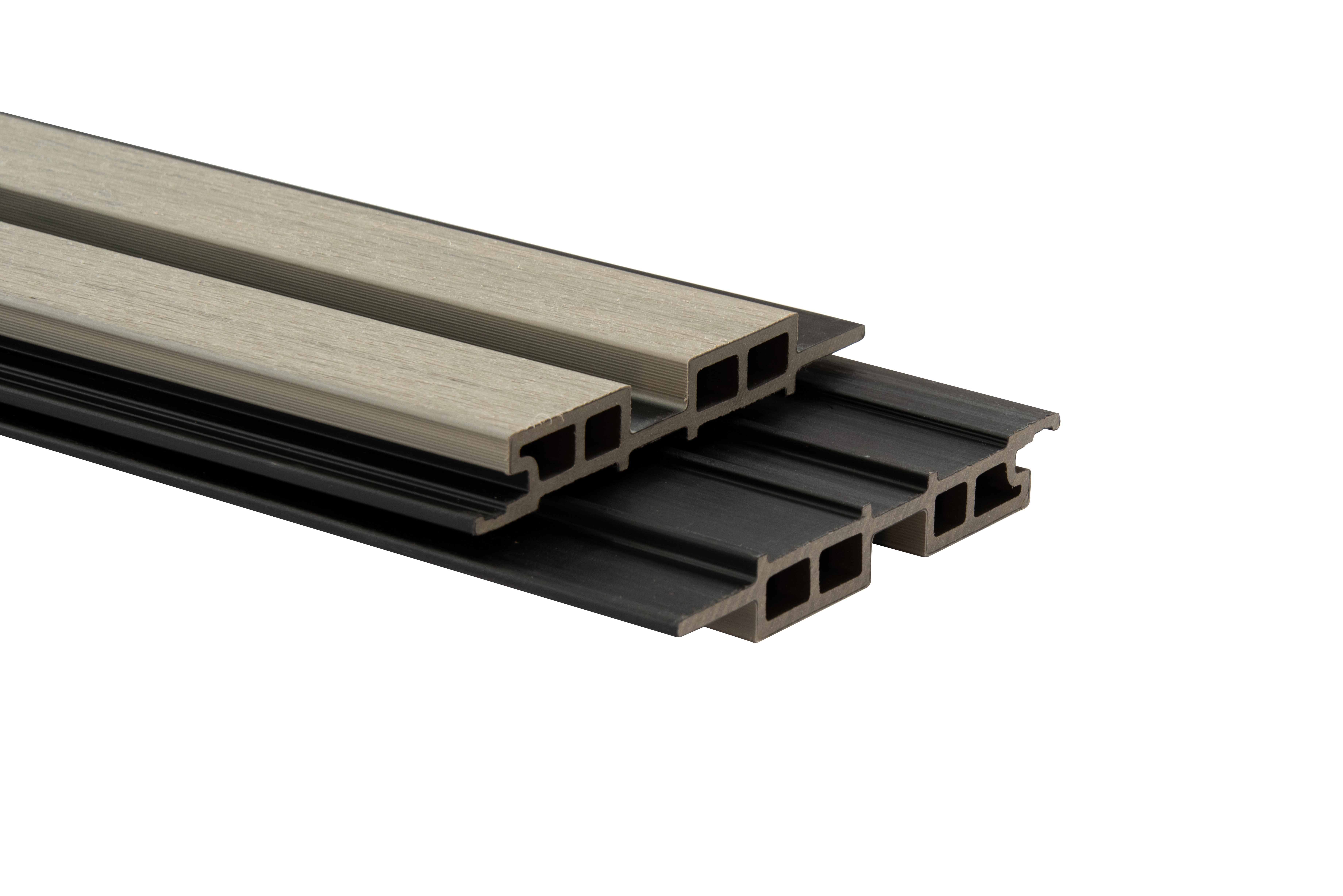
GH024 outdoor WPC cladding: a cladding line item that requires its own declaration boundary when supplied alongside decking under one contract.
The pattern worth copying from this table is that the document action column is never 'collect the certificate'. It is always a specific written question with a narrow answer — is this model in scope, and if not, what is the applicable evidence? Suppliers who answer those questions quickly and consistently are demonstrating the same administrative discipline the certificates are meant to evidence.
Turning certificates into purchasing terms and acceptance criteria
A certificate kept in a sales folder has no commercial force. It acquires force when it is written into the purchase contract as a schedule. For WPC decking supply, the following terms translate documentation into something enforceable across multiple orders.
- Certificate schedule annex. List every document relied on, with issuer, registration number and expiry date, and require the supplier to notify the buyer of any revision, suspension or withdrawal.
- Scope statement per line item. Every model on the order should be mapped to the declaration that covers it, using the same model codes as the packing list.
- Batch acceptance criteria tied to declared values. Where a product declares water absorption or flexural properties, the acceptance test should reference that product's own threshold — not a company-wide figure applied across a range.
- Pre-shipment document pack. Certificates, an invoice FSC claim statement where applicable, and inspection records should travel with the shipment rather than being produced on request months later.
- Delivery and continuity terms. Stated lead times and minimum order quantities belong in the same clause set as the documentation, because a supplier that cannot schedule production reliably is unlikely to maintain a certificate cycle reliably either.
First-generation or second-generation decking: deciding with evidence
The D053 versus GH001 decision is the point where documentation and application meet. Both products appear in park decking applications in China, where high humidity and long outdoor exposure impose requirements for weather resistance, anti-slip surface behaviour, UV stability and scratch resistance, and where installation uses static placement on joist clips and screws.
D053 is a first-generation hollow profile with a declared bending failure of 3900 N, a density of 1.3 g/cm³ and water absorption of ≤ 2% under a 5-hour boil. Its positioning is cost efficiency at scale: large public installations such as parks, plazas, boardwalks and community pathways where budget discipline and basic outdoor durability govern the decision. GH001 is a co-extruded, capped profile with a full 360° polymer layer, flexural properties of ≥ 3300 N, cyclic moisture resistance mean ≤ 10% and boiling water absorption ≤ 7%, positioned around colour stability, abrasion resistance and slip performance in wet zones such as pool surrounds and waterfront boardwalks.
Two lessons emerge from placing them side by side. The first is that declared thresholds differ by generation — 2% boiling absorption on D053 against 7% on GH001 — so a buyer who writes a single water-absorption acceptance figure across an entire product range will either reject compliant goods or accept non-compliant ones. The second is that the certificate question changes with the model: a co-extrusion EPD naturally aligns with a capped profile, and a first-generation hollow board needs its own written scope confirmation before it is presented in a tender as certified in the same way.
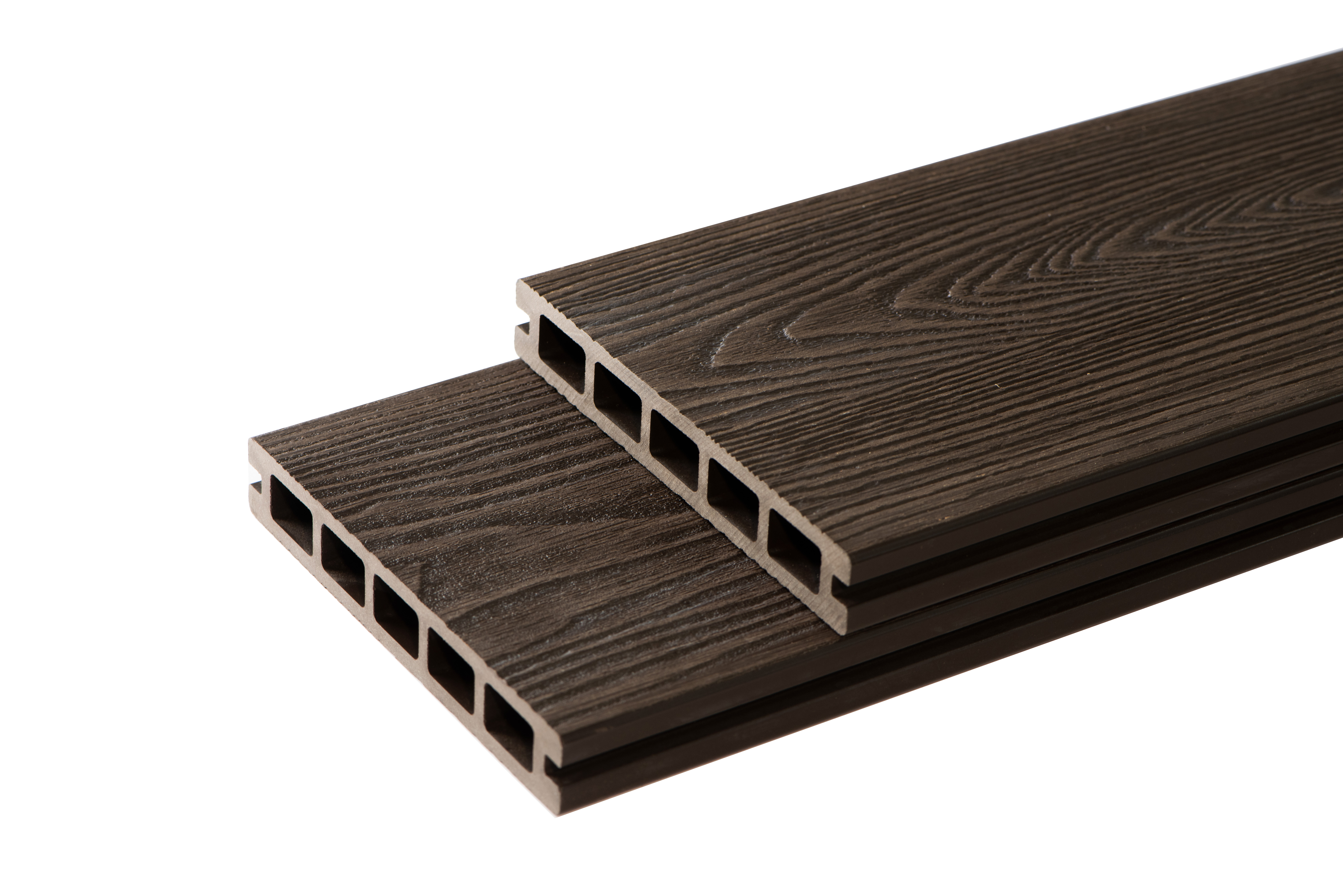
D053 first-generation hollow WPC decking: cost-efficient for large public realm projects, but it requires its own scope confirmation rather than assumed EPD coverage.
Application history offers a third data point. A project contractor in China installed 500 tonnes of decking for park decking, and the installation maintained its performance for 15 years with no fading and no bending recorded. That is a service-life observation, not a certification, and it should be read as supporting context for a specification decision rather than as a substitute for the declared parameters or the acceptance test.
Where certification stops: limits a buyer should plan for
A credible evaluation states what the evidence does not cover. Four boundaries matter in WPC decking.
Declarations are environmental, not structural. The EPD does not rate load capacity. Where a project requires a performance rating for deck boards, stair treads, guards or handrails, that requirement is addressed by a performance specification such as ASTM D7032, which establishes ratings for wood-plastic composite and plastic lumber in exterior decking. An EPD and a performance rating answer different questions and should both appear in the file where the project demands them.
System certificates do not certify batches. ISO 9001 describes a quality management system at a site; it does not warrant any individual shipment. Batch-level confidence comes from inspection records and acceptance testing, which is why the contract terms matter as much as the certificate.
Material certification does not imply durability. FSC chain of custody traces fibre; it says nothing about how a board performs after ten summers of UV exposure.
Movement is a design responsibility. The declared linear thermal expansion coefficient of ≤ 37·10⁻⁶ K⁻¹ on GH001, D053 and GH010 is modest for a polymer composite but not zero. Installation must allow for it through clip spacing and end gaps. No certificate removes that requirement, and a deck that fails because movement was not accommodated will not be rescued by a valid document set.
Market context: why document scrutiny is rising
The commercial backdrop explains the shift. The global wood plastic composite market was valued at USD 8.05 billion in 2025 and is projected to reach USD 11.26 billion by 2034, according to Straits Research. The same source places North America at 36.4% of global market share in 2025, a region where performance rating specifications are well established in procurement practice. Trade data monitored under HS Code 39189090 has shown China accounting for 97.81% of WPC decking imports in that dataset, a secondary-source figure that illustrates concentration of supply rather than product quality.
Concentrated supply plus growing volume produces a predictable outcome: more suppliers presenting similar-looking certificates to more buyers who cannot easily tell them apart. The differentiator stops being whether a supplier has documents and becomes whether those documents are current, correctly scoped and matched to the model on the order.
A repeatable annual scoring model
The model below is designed to be re-run once a year against the same supplier, so that year-on-year movement is visible rather than hidden inside a fresh evaluation. Each dimension is scored from 0 to 5 and weighted to a total of 100.
| Dimension | Weight | Evidence to request | Scoring rule |
|---|---|---|---|
| Identity and validity | 20 | Issued certificate with issuer, registration number, version date and expiry | 0 if any identifier is missing or unverifiable in the issuer's registry |
| Scope coverage per model | 20 | Written statement mapping each ordered model to a declaration | 0 if a model in the order is unaddressed |
| Site alignment | 15 | Certificate address matched to production site, PO and audit report | Reduce where a relocation or transfer is not documented |
| Material chain | 15 | Chain-of-custody certificate, W9.11 product group listing, invoice claim statement | Reduce where claim wording differs across documents |
| Performance evidence | 20 | Test records against the model's own declared thresholds | Reduce where acceptance criteria are generic rather than model-specific |
| Continuity signals | 10 | Renewal plan before expiry, change notification clause, delivery reliability | Reduce where renewal ownership is unclear |
Two rules keep the model honest. A supplier scoring zero on identity or scope should be treated as non-compliant regardless of the total, because those two dimensions are preconditions rather than points of comparison. And the score should be filed with the evidence that produced it, so the next review compares documents rather than memories.
Future outlook
Two developments are likely to change how this evaluation is performed. The first is registry-driven verification: as EPD libraries and certification databases become more accessible to procurement teams, checking a declaration number will take minutes rather than an email exchange, and documents that cannot be located in a registry will stand out immediately. The second is the normalisation of scope-level procurement, in which buyers ask which models a declaration covers as a matter of routine rather than discovering the gap after delivery.
For suppliers, the practical implication is that a certificate is a renewable commitment rather than a one-off achievement. For buyers, it means the value of an evaluation lies less in the score awarded this year and more in the discipline of asking the same verifiable questions every year, against the same registration numbers, until the answers stop changing.
FAQ
Does an EPD for co-extruded WPC products automatically cover a first-generation hollow decking board such as D053?
No. An EPD declares a defined product group, and inclusion must be confirmed in writing. A co-extrusion declaration aligns naturally with a capped profile such as GH001; a first-generation hollow board is a different construction and should be treated as outside the scope until the supplier states otherwise. The buyer's question should name the model code and request a yes-or-no answer that can be filed.
How does an ISO 9001 certificate differ from an FSC chain-of-custody certificate for a WPC decking supplier?
They describe different things. ISO 9001 certifies a quality management system at a manufacturing site, evidenced by certificate number and surveillance cycle. FSC chain of custody, governed by FSC-STD-40-004 V3-1 with trademark requirements in FSC-STD-50-001 V2-1, traces wood-based material through the supplier's system for a defined product group, including Wood-Plastic Composites under classification W9.11. Neither one certifies the performance of an individual deck board.
Why does an EPD expiry date matter if the product formulation has not changed?
Because the declaration is a fixed-term document whose validity is part of what makes it usable. The co-extrusion EPD registered as S-P-12197 carries a version date of 2024-03-15 and is valid until 2029-03-15. A project or framework agreement extending beyond that date needs the renewal to be evidenced. Recording the expiry in the contract schedule converts it from a filing detail into a managed obligation.
In a public realm project, which is the more defensible choice: first-generation D053 or co-extruded GH001?
It depends on the service conditions rather than on a general ranking. D053 is a first-generation hollow profile with a declared bending failure of 3900 N, density of 1.3 g/cm³ and water absorption of ≤ 2% under a 5-hour boil, and it is positioned for cost-efficient large-area installations such as parks, plazas and boardwalks. GH001 is a capped co-extruded profile with flexural properties of ≥ 3300 N and cyclic moisture resistance mean ≤ 10%, positioned around colour stability and slip performance in wet zones. Because their declared thresholds differ, acceptance criteria must be written per model.
What acceptance criteria should be written into a WPC decking purchase order?
Three categories are sufficient to start. Documentation: a schedule of certificates with issuer, registration number and expiry, plus a notification obligation for any revision. Scope: a per-model mapping to the applicable declaration, using the same model codes as the packing list. Performance: batch acceptance tests referenced to each product's own declared values, supported by pre-shipment inspection records and, where relevant, the invoice claim statement for wood fibre content.
How often should a long-term WPC decking supplier be re-evaluated?
Annually is the practical default, because it aligns with management system surveillance cycles and gives a fixed point for re-verifying the registry entry, the scope statement, the site address and the claim wording. The review date should be set from the earliest expiry in the certificate schedule rather than from the calendar year, and the outcome should be filed with the evidence so that the following year compares documents rather than recollections.
Terratsa's decking brochure, covering product ranges and technical data, is available for download: Terratsa decking brochure (PDF).
Have Questions or Need More Details?
Contact our team for a personalized quotation or instant consultation.
Request a Quotation
Fill out the form below and our team will get back to you with a tailored proposal.
WhatsApp Direct Chat
Prefer to chat in real-time? Message us on WhatsApp for instant assistance & quick answers.
- Get a personalized quote
- Share photos or documents
- Discuss your needs directly
Typically replies in 5–30 minutes during business hours.