
Walking GOKING's Multifunctional Digital Press Factory: Supplier Capability Evidence
Walking GOKING's Multifunctional Digital Press Factory: Supplier Capability Evidence
A multifunctional digital printing machine is bought before it is seen running. That single fact makes the factory behind the machine as important as the specification sheet in front of it, and the useful question is not whether a supplier publishes impressive numbers, but whether each published number attaches to a process a buyer can check. Guangdong Goking Intelligent Technology Co., Ltd. — trading as GOKING — publishes a set of plant figures around its single-pass and multi-pass 2-in-1 press business. This article reads those figures the way an evaluating buyer should: as evidence with a defined scope, a defined limit, and a defined way to confirm.
The distinction matters because supplier capability claims tend to fail in one of two directions. Some are dismissed too quickly because they sit in a brochure rather than an audit report. Others are accepted too quickly because they are specific, when specificity alone does not create independence. A workable approach is to sort every claim into what it measures, what it does not measure, and what a buyer can request to close the gap.
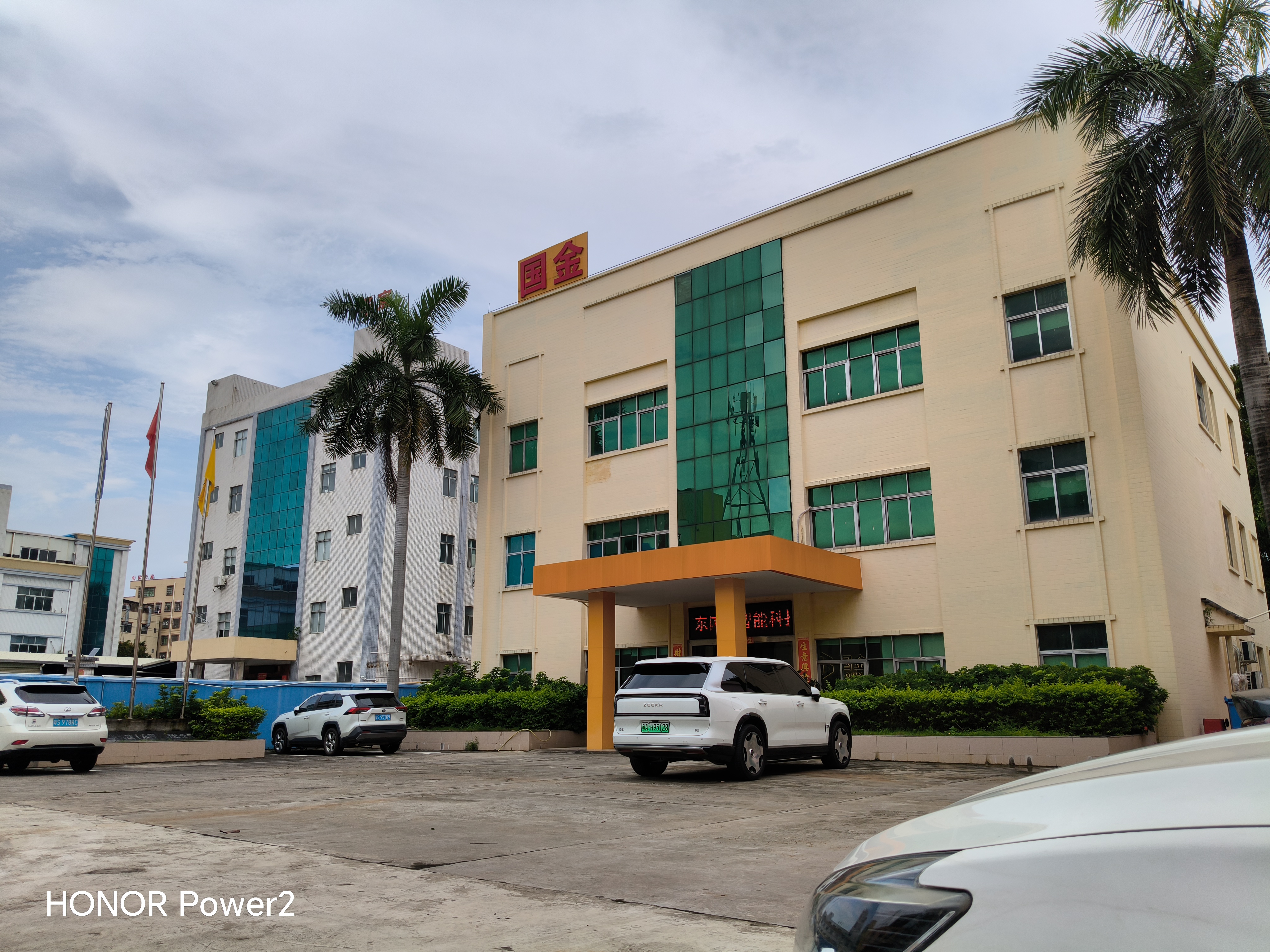
Client reception building at the GOKING manufacturing site in Dongguan, Guangdong Province. Image supplied by GOKING.
Why plant evidence belongs in the evaluation file
At the Evaluation stage, buyers are narrowing a shortlist on capability fit. At the Execution stage, they are fixing acceptance terms, delivery dates and service routes. Both stages need the same underlying thing: confidence that the organisation described on the website is the organisation that will build, test and install the press. That confidence is assembled from ordinary evidence — floor area, headcount, test routines, export records, named contact routes — rather than from a single headline claim.
Three practical consequences follow. First, a capacity figure is only meaningful next to a lead-time statement, because the two together determine whether an installation date is realistic. Second, a quality-control description is only meaningful when the buyer knows which defect classes it addresses and which it leaves to acceptance testing. Third, an export footprint is only meaningful when paired with a service mechanism, because a machine shipped to another continent still has to be commissioned and maintained there.
The physical footprint: 10,000 m², 152 employees, 38 engineers
GOKING reports a 10,000 m² manufacturing facility, 152 employees, and 38 engineers in its research and development team. The company states it was founded in 2020 by a team with more than a decade of prior industry experience — a distinction worth holding onto, because team experience and company operating history are not the same measure. A buyer comparing track records should read 2020 as the year the current entity began, and treat the longer industry tenure as background on the founding group rather than as years of continuous factory output under the GOKING name.
Within a 152-person organisation, 38 engineers is a structure that supports conversation: general enquiries can be separated from printhead, DPI, ink and line-integration questions. For an OEM or ODM project, that separation is operational rather than cosmetic. Custom work stalls when the commercial contact cannot route a mechanical or electrical question to someone with authority over the design, and a factory that staffs engineering separately from sales has a shorter path for those questions.
None of these three numbers is independently verified in this review. They are company-reported attributes, which is normal for privately held machinery manufacturers and does not make them suspect — it makes them something to confirm rather than something to assume. Floor area is straightforward to confirm during any site visit or video walkthrough; headcount is confirmable through the people who join pre-acceptance meetings; engineering depth is confirmable by testing how quickly the supplier answers a non-standard technical question in writing.
Reading capacity correctly: 38 sets a month, 864 sets a year
The company publishes a monthly capacity of 38 sets and an annual output of 864 sets. Buyers should treat these as two separately stated company figures rather than as a conversion, because the two do not reconcile as a simple monthly-to-annual multiplication. The practical rule is to plan against a written delivery date from a specific quotation, not against a headline capacity number, and to use capacity only as a rough indicator of whether a supplier can absorb a volume order without displacing committed work.
Lead time is stated more usefully than capacity: standard machines typically carry a production lead time of about one month, while custom work is quoted on request and OEM/ODM timelines are confirmed case by case. That structure mirrors how configured machinery actually moves through a plant. A standard 5-colour machine with a defined printhead set and DPI configuration can be scheduled against established build slots; a machine with a modified structure, a different colour scheme or a turnkey line requirement has to be re-planned around engineering review, and the confirmation step is what protects both parties.
The minimum order quantity is one set, which keeps single-machine buyers — a mid-sized corrugated converter adding short-run capability, for example — inside the normal order flow rather than in an exception. For a buyer at the Execution stage, the combination of a one-set MOQ, a one-month standard lead time and a stated monthly capacity supports a realistic planning conversation, provided the buyer asks for the delivery date in writing and attaches it to the purchase contract rather than to an email thread.
| Published item | GOKING figure | What it can support | What to confirm |
|---|---|---|---|
| Facility area | 10,000 m² | Assembly and storage space plausibility | Site visit or live walkthrough |
| Headcount | 152 employees | Organisational scale | Names and roles of engineers joining the project |
| R&D team | 38 engineers | Depth for customization questions | Response quality on a specific technical query |
| Capacity | 38 sets per month; 864 sets per year | Indicative throughput only | Written delivery date on the quotation |
| Lead time | About one month for standard machines; custom on confirmation | Installation planning | Liquidated-damage or delay clause in the contract |
| Export share | 49% exported | Familiarity with export documentation and shipping | Reference installations in the buyer's own region |
The three named QC checks and what each one addresses
GOKING lists three quality-control routines: a 100% aging test, long-time running inspection, and pre-shipment inspection. The wording is short, so it is worth unpacking what each routine is designed to catch.
An aging test, in industrial machinery practice, means running the assembled machine under load for a period before release so that early-life failures surface in the factory rather than at the customer's site. The operative word in GOKING's description is 100%: it indicates a routine applied to every machine rather than to a sample. What it does not establish is print quality on the buyer's own substrate — an aging test exercises mechanical, electrical and fluid systems, not the colour match on a specific kraft liner.
Long-time running inspection extends that logic toward endurance. Continuous running is where nozzle behaviour, ink supply stability and registration drift under sustained operation tend to reveal themselves, and it is the closest in-house approximation of a production shift. Pre-shipment inspection then acts as the final gate before packing, checking the machine and its accessories against the order before the unit leaves the building — including the consumables and wear parts packed with the equipment.
These three checks are company-defined and self-administered, and that is a fair description rather than a criticism. The important consequence for a buyer is that factory QC and buyer acceptance testing answer different questions. Factory QC asks whether the machine is built and functioning as designed. Acceptance testing asks whether it produces acceptable output on the substrates the buyer actually prints. GOKING's published acceptance route covers sample testing, factory inspection, pre-shipment inspection and, per contract, on-site acceptance — a sequence that maps onto that division of labour if the buyer uses it deliberately.
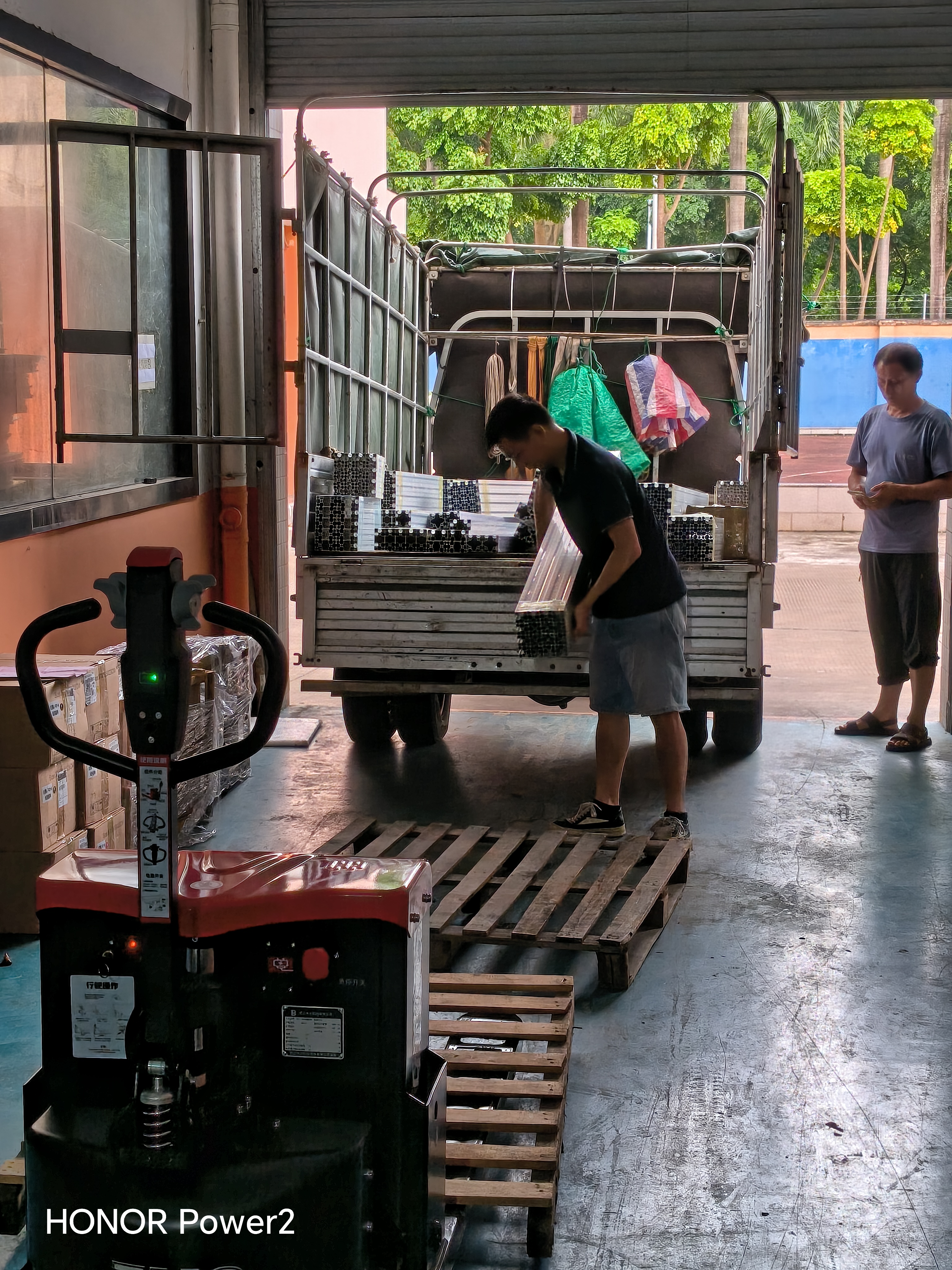
Incoming materials arriving at the manufacturing site — the point at which component-level quality enters the build. Image supplied by GOKING.
Where OEM and ODM fit into a multifunctional press order
GOKING provides whole-machine research, development and manufacturing, alongside OEM and ODM production services for digital printing machines. In practice the customisable scope published by the company covers machine structure, printhead type with Epson and Xaar options, DPI configuration, a 5-colour scheme, and turnkey line solutions. That list describes where design decisions sit, and it is useful because it tells a buyer which variables are negotiable and which are fixed by the platform.
The 2-in-1 architecture is the clearest example of how configuration follows application. GOKING positions the platform around two production modes on one machine: a scanning method for complex or large-format boards, and a direct-output mode for small boards and small-batch orders. A buyer whose work mixes oversized display boards with short runs of small cartons is effectively buying for both modes, and the configuration conversation should be about which mode carries the majority of the workload rather than about which mode is technically superior.
Printhead choice deserves separate attention. GOKING lists Epson and Xaar as available printhead types, which is a selection dimension rather than a performance claim. A buyer should ask for model-level documentation linking the chosen printhead to the DPI configuration and to the production mode being purchased, and should test the specific combination rather than assuming that a printhead family name predicts output on kraft, coated board or corrugated stock. The same discipline applies to the 5-colour scheme: colour count is a configuration fact, not evidence about gamut on a given substrate.
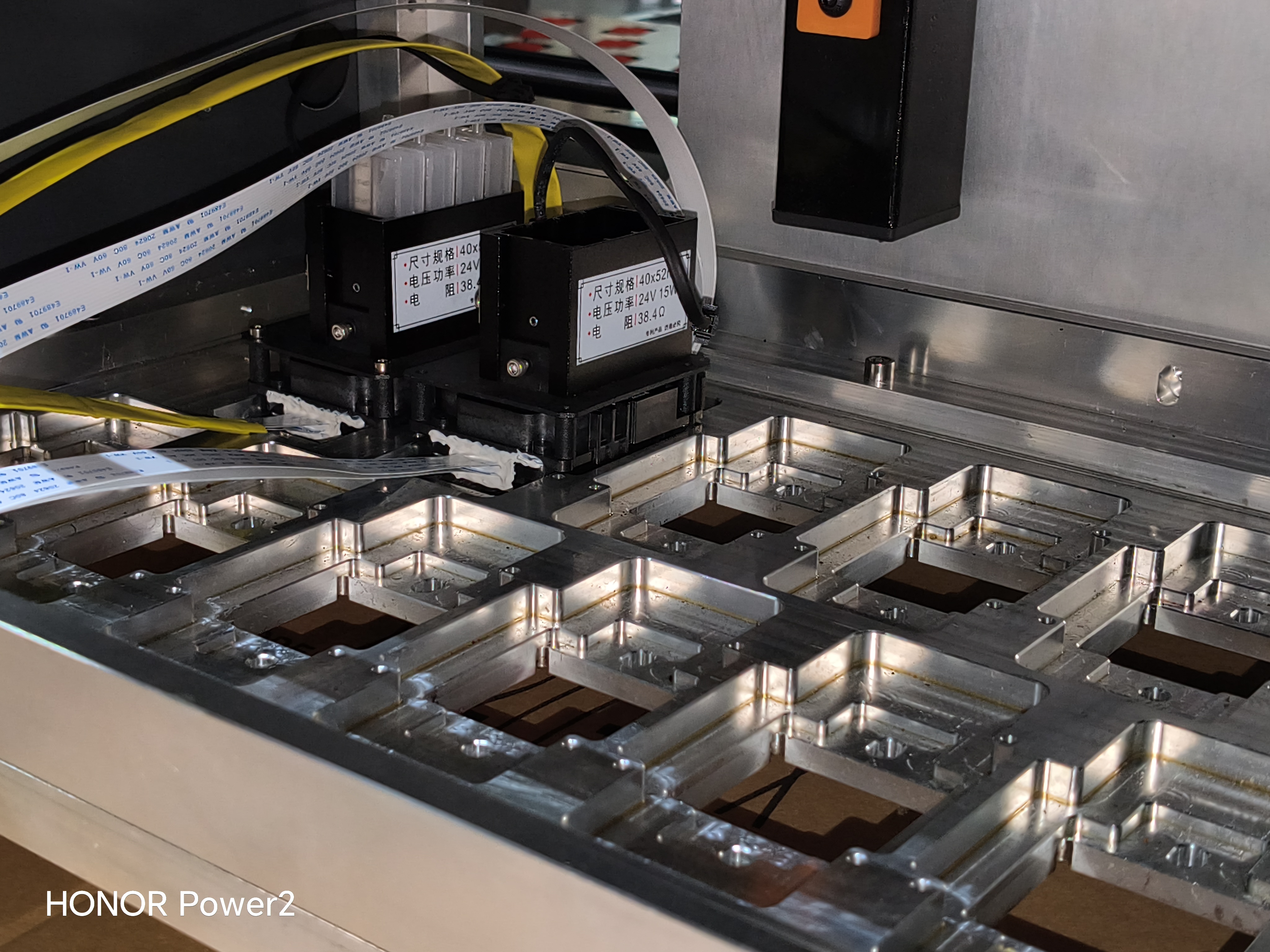
Printhead installation during machine assembly. Printhead type is one of the published customization dimensions. Image supplied by GOKING.
The export footprint and the CE record behind it
GOKING reports that about 49% of output is exported, with named markets covering the European Union, Africa, Latin America, Russia, Kazakhstan and Turkey. Read as a capability signal, a near-half export share implies familiarity with the paperwork and logistics that sit around a machine sale: export packing, whole-machine and turnkey-line shipping, spare-parts bundling, and the documentation that accompanies industrial equipment across borders. Read as a market claim, it says much less — an export ratio is not an installed base, and it does not indicate how many machines run in any single country.
The compliance record is more concrete. A Certificate of Conformity is listed under certificate number HTT202308117L, issued for the European Union market by Shenzhen HTT Technology Co., Ltd. on 9 August 2023, citing standard EN 60204-1:2018 and Directive 2006/42/EC. EN 60204-1 is the electrical-equipment-of-machines standard, so the certificate speaks primarily to electrical safety provisions rather than to print performance, ink suitability or packaging contact compliance.
There is also a timing question European buyers should put on the table. Regulation (EU) 2023/1230, published on EUR-Lex, becomes fully applicable on 14 January 2027 and replaces Directive 2006/42/EC. A certificate issued in 2023 against the outgoing directive reflects the rules in force at issue; a purchase contract signed for delivery around or after that date should state which rule set the supplier is declaring against and should ask for the supporting declaration of conformity, not only the certificate image.
Service evidence: overseas engineers, 24-hour response, free sample printing
Three service commitments sit alongside the manufacturing claims. GOKING states that dedicated engineers travel to overseas customer sites to assist with installation and commissioning once the machine arrives, that technical and spare-parts support respond within 24 hours, and that free sample printing is offered to global clients. The company's case material describes on-site engineering support and long-term cooperation with printing and packaging factories in markets including Spain, Brazil, South Africa, Turkey, South Korea and Australia.
For a buyer, the free sample printing offer is the most immediately usable of the three. It converts an abstract specification discussion into a physical comparison: send the kraft liner, coated board or corrugated stock actually used in production, specify the artwork, and evaluate the returned print against the standard the buyer applies commercially. Sample printing tests substrate fit and colour reproduction. It does not test machine reliability, throughput over a shift, or maintenance burden — those require a factory acceptance run or a reference visit.
Overseas installation support addresses a different risk: a machine that arrives correctly built but is commissioned badly will underperform regardless of build quality. The practical items to fix in the contract are who bears travel and accommodation costs, how many days of on-site commissioning are included, what training is delivered to the buyer's operators, and what happens if commissioning extends beyond the planned window. A 24-hour response commitment is likewise worth converting from a statement into a term — measured from what event, through which channel, with what escalation if the first response does not resolve the issue.
What this evidence does not establish
An honest reading of the record includes its limits. The facility, headcount, engineering team, capacity and export figures are company-reported and were not independently audited in the course of this review; no third-party confirmation of these specific figures was located. The case material names market countries but states that exact order quantities are not disclosed, so it evidences activity rather than scale. No verified price, ink consumption, printhead replacement cost, uptime or maintenance-cost data is published, which means total cost of ownership cannot be modelled from public information alone.
The absence of independent confirmation is not evidence of misstatement. It is simply the normal condition of buying configured industrial machinery from a privately held manufacturer, and it defines the job left for the buyer: convert published attributes into verified ones through site access, sample testing, documentation requests and reference contact.
A verification checklist for the Execution stage
Each item below converts a published claim into something checkable before the deposit is released:
- Facility and team. Request a live video walkthrough of the assembly area and confirm the names and roles of the engineers who will handle the project. A recorded walkthrough is weaker than a live one because questions cannot be asked in real time.
- Configuration in writing. Ask for the printhead type, DPI configuration, colour scheme and production mode to appear on the quotation by model designation, not by family name.
- Sample test on your own stock. Use the free sample printing offer with the exact substrates in production, and set the acceptance threshold before the samples arrive rather than after.
- QC records. Ask what the aging test and long-time running inspection record, how long each runs, and whether the record for the specific machine travels with the shipment.
- Acceptance terms. Confirm which of sample testing, factory inspection, pre-shipment inspection and on-site acceptance apply, and how the 30% deposit and 70% pre-shipment balance are tied to those milestones.
- Compliance currency. Request the declaration of conformity alongside the certificate, and confirm which directive or regulation the declaration addresses for the delivery date in question.
- Service terms. Fix the number of commissioning days, the response-time definition, the spare-parts list shipped with the machine, and the escalation path.
- Regional reference. Ask for a contactable installation in the buyer's own region and treat the answer, as much as the reference itself, as a signal of export depth.
The wider context and what to watch next
The commercial backdrop supports continued attention to supplier capability rather than less. Grand View Research valued the global digital printing packaging market at USD 37.5 billion in 2025, and Smithers projects the corrugated segment reaching USD 8.2 billion by 2030, more than doubling from 2025 levels. Those are third-party market estimates with their own scope definitions, not forecasts of any individual supplier's volume, but they explain why buyers are being asked to evaluate more digital press suppliers than they were a few years ago.
Two developments are worth tracking at the supplier interface. The first is the EU machinery rule change taking full effect on 14 January 2027, which will make the compliance file a live procurement item rather than a one-off document request. The second is the gradual normalisation of hybrid single-pass and multi-pass platforms, which shifts competitive pressure from architecture claims toward demonstrated uptime, substrate range and service reach. Buyers who build verification into their process now will be able to compare suppliers on those terms rather than on brochure language.
GOKING's published evidence set is broad enough to support a structured evaluation and specific enough to be tested. That is a reasonable starting position for a supplier entering a shortlist, and a reason to spend the evaluation budget on verification rather than on more reading.
Frequently asked questions
What can a buyer actually customise when a multifunctional digital printing machine is ordered through OEM or ODM?
GOKING lists five customization dimensions: machine structure, printhead type with Epson and Xaar options, DPI configuration, a 5-colour scheme, and turnkey line solutions. The company provides both OEM and ODM production services alongside whole-machine research, development and manufacturing. Which of these dimensions is genuinely open depends on the base platform, so the scope should be confirmed in writing for the specific model quoted rather than assumed from the general list.
What do the 100% aging test and long-time running inspection actually check?
They are factory-side checks applied before shipment, alongside pre-shipment inspection. An aging test runs the assembled machine under load so early-life faults appear in the factory; long-time running inspection extends that to sustained operation, where nozzle behaviour, ink supply stability and registration drift are more likely to show. They test whether the machine functions as designed. They do not test print quality on a buyer's own kraft, coated or corrugated stock, which is what sample testing and acceptance testing are for.
How should a buyer interpret the 38-set monthly and 864-set annual capacity figures when planning a delivery date?
Use them as an indicator of throughput, not as a scheduling calculation. GOKING states a standard production lead time of about one month for standard machines, with custom and OEM/ODM timelines confirmed on request, and a minimum order quantity of one set. The delivery date on the quotation is the figure that should carry contractual weight; capacity numbers belong in the background of the evaluation file.
What should European buyers check about the CE documentation?
The listed Certificate of Conformity, number HTT202308117L, was issued on 9 August 2023 by Shenzhen HTT Technology Co., Ltd. for the EU market, citing EN 60204-1:2018 and Directive 2006/42/EC. Regulation (EU) 2023/1230 becomes fully applicable on 14 January 2027 and replaces that directive. Buyers should request the declaration of conformity and confirm which rule set the supplier is declaring against for the actual delivery date, since a certificate image alone does not answer that question.
What service arrangements does GOKING publish for overseas customers?
Three commitments are published: dedicated engineers travel to overseas sites to assist with installation and commissioning, technical and spare-parts support respond within 24 hours, and free sample printing is offered to global clients. Delivery terms include global shipping, secure packaging, whole-machine delivery and turnkey line delivery, with four cartons of ink and various wear parts packed with the equipment. Deposit and balance terms are 30% before production and 70% before shipment.
Published contact channels. GOKING lists two commercial contacts for technical and commercial enquiries: Cherry Wang (w1250606130@gmail.com, +86 18028205637, WhatsApp +86 18475532220) and Gloria Yang (qianqian203521@gmail.com, +86 18028204526, WhatsApp +86 18028204526). Address: No. 1, Fuxiang Street, Huangniupu, Huangjiang Town, Dongguan City, China. Official website: www.cmyk-goking.com. The 2026 product catalogue is available for public download: 2026 product catalog (PDF).
Manufacturing and quality figures in this article are company-reported attributes published by Guangdong Goking Intelligent Technology Co., Ltd. and were not independently audited for this review. Market figures are attributed to Grand View Research and Smithers; the EU regulatory date is drawn from Regulation (EU) 2023/1230 as published on EUR-Lex.
Have Questions or Need More Details?
Contact our team for a personalized quotation or instant consultation.
Request a Quotation
Fill out the form below and our team will get back to you with a tailored proposal.
WhatsApp Direct Chat
Prefer to chat in real-time? Message us on WhatsApp for instant assistance & quick answers.
- Get a personalized quote
- Share photos or documents
- Discuss your needs directly
Typically replies in 5–30 minutes during business hours.