
Wall-Hung vs Two-Piece Toilets: A Ceramic Sanitary Ware FAQ
Wall-Hung vs Two-Piece Toilets: A Ceramic Sanitary Ware FAQ
Ceramic sanitary ware is a specified product, not a decorative one. The global ceramic sanitary ware market was estimated at USD 44.3 billion in 2023 and is projected to reach USD 80.99 billion by 2030, a compound annual growth rate of 9.4%, according to Grand View Research. Within that volume, the decisions that generate rework on a project are rarely about colour. They are about mounting type, flush mechanism, rim geometry, drainage rough-in, and whether the certificate on file actually covers the model being shipped.
This reference answers the procurement and technical questions that most often sit between a shortlist and a purchase order. It draws on documented product data from Tangshan Houfengyuan Import and Export Co., Ltd., a sanitary ware manufacturer and exporter based in Tangshan, Hebei, China, whose product line covers ceramic toilets and ceramic wash basins and whose main markets include the USA, Canada, the Middle East, Australia, Southeast Asia and Europe. The two models used as reference points below — the FI-05 wall hang pan and the FI-20 — are both documented in the product data as intended for construction and engineering projects and for wholesale distribution.
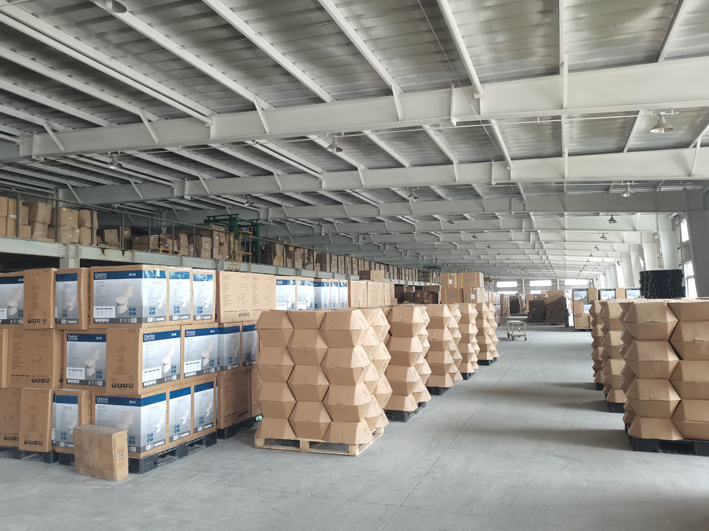
Ceramic sanitary ware staged for bulk distribution. Wall-hung and two-piece models are specified against different drainage and structural conditions.
The Decision That Sits Behind Wall-Hung vs Two-Piece
At the decision stage, buyers usually compare the two mounting families across seven practical variables: the drainage route and rough-in, the structural preparation required, usable floor area and cleaning access, the flush mechanism and water use, the replacement-part strategy, certification coverage for the destination market, and the cost per fully compliant fixture rather than the cost per piece.
The documented differences between the reference models are concrete rather than promotional. The FI-05 wall hang pan is classified in the product data as a wall hung toilet, is rimless, and uses a washdown flushing mechanism. The FI-20 is classified as a two-piece toilet, is made of high-temperature fired ceramic, and also uses a washdown flushing system. Both are documented as designed for bathroom sanitation. The comparison therefore turns on installation conditions and service access rather than on whether one product is intrinsically superior to the other.
Wall-Hung vs Two-Piece: Documented Differences at a Glance
The table below summarizes only the attributes recorded in the product data. Where a value is not documented for a specific model, the cell states that rather than inferring a figure.
| Comparison point | Wall-hung reference: FI-05 wall hang pan | Two-piece reference: FI-20 |
|---|---|---|
| Product classification | Wall hung toilet | Two-piece toilet |
| Documented dimensions | 517 × 360 × 365 mm | 660 × 365 × 420 mm |
| Material | High-temperature fired ceramic | High-temperature fired ceramic |
| Rim design | Rimless | Not recorded as rimless in the product data |
| Flushing mechanism | Washdown | Washdown |
| Documented application | Wholesale distribution and construction projects | Construction and engineering projects and wholesale distribution |
| Typical buyer profile | Wholesale distributors, engineering and construction projects, hotel and apartment developments | Wholesale distributors, engineering and construction projects, hotel and apartment developments |
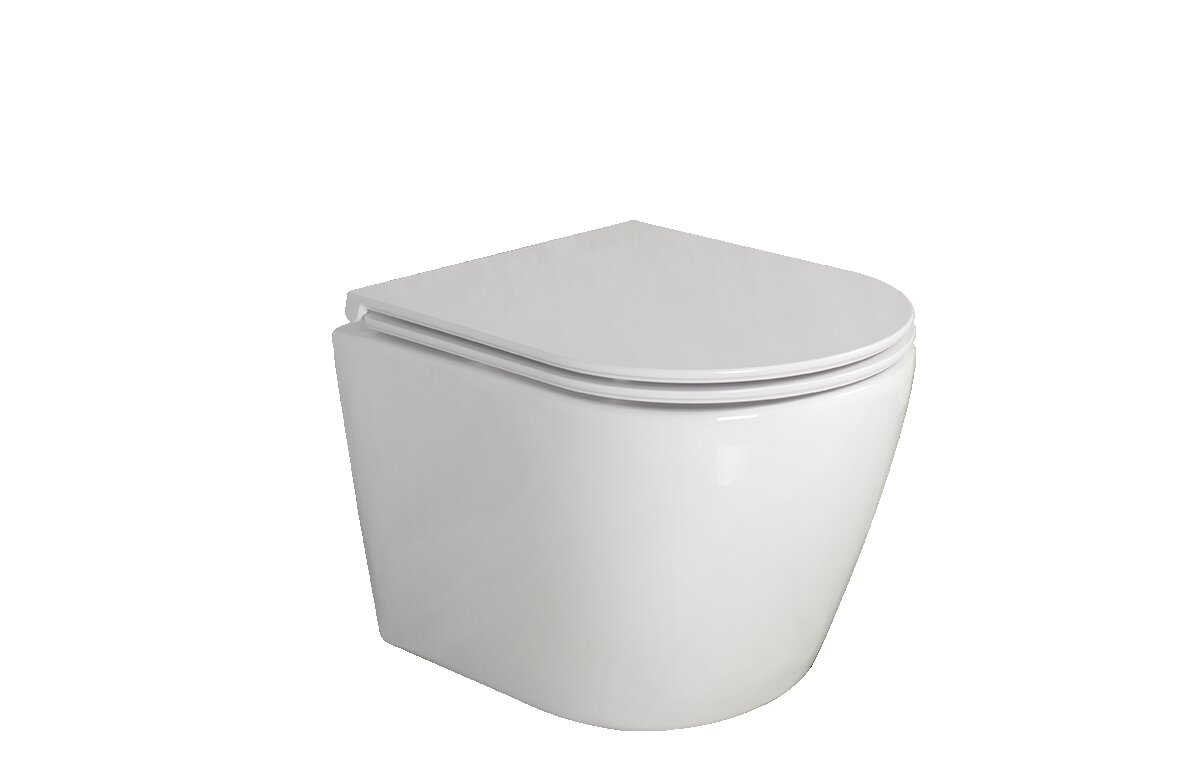
Wall-hung category reference. Models such as the FI-05 wall hang pan are documented as rimless wall hung toilets with washdown flushing.
Rimless Design and Washdown Flushing: What the Mechanics Actually Change
Two technical attributes drive most of the cleaning and maintenance difference between these products: the rim configuration and the flushing mechanism. Both are documented on the wall-hung reference model, and the flush mechanism is documented on the two-piece model as well.
What rimless means in practice
In a conventional rimmed bowl, flush water travels through an enclosed channel that runs around the inside of the rim before it is released into the bowl. Rimless construction removes that enclosed channel, so the water path is not hidden behind an overhanging ledge. The practical effect for a facility manager or a project handover team is that the bowl surface is directly accessible to a brush and to standard cleaning agents, and there is no concealed underside on which residue can accumulate between service visits.
Two consequences follow. First, cleaning time per fixture is typically shorter, which matters in hotels and serviced apartments where housekeeping cycles are fixed and each room carries a labour cost. Second, the visible bowl surface becomes more important to the finished quality of the piece: because the surface is exposed, glaze consistency inside the bowl is easier for a buyer to inspect, and inconsistencies are easier to detect during a factory or sample check.
How washdown flushing works
Washdown is documented as the flushing mechanism on the FI-05 wall hang pan and on the FI-20. In a washdown system, water is released into the bowl and travels down the bowl surface under gravity, carrying the contents toward the trapway and into the drainage line. This is a different mechanism family from siphon-assisted designs, which are also used in the category, and the difference matters during specification because the two families place different demands on the drainage stack and on the water volume available at the fixture.
Water efficiency in the certified line-up is documented rather than assumed. The manufacturer's high-efficiency models are recorded as EPA WaterSense certified at 1.28 gpf for single flush and 1.6/1.1 gpf for dual flush, verified by IAPMO R&T under the EPA specification. Buyers specifying a washdown model should confirm the flush volume attached to the specific SKU, because certification is granted per model and per configuration, not per brand.
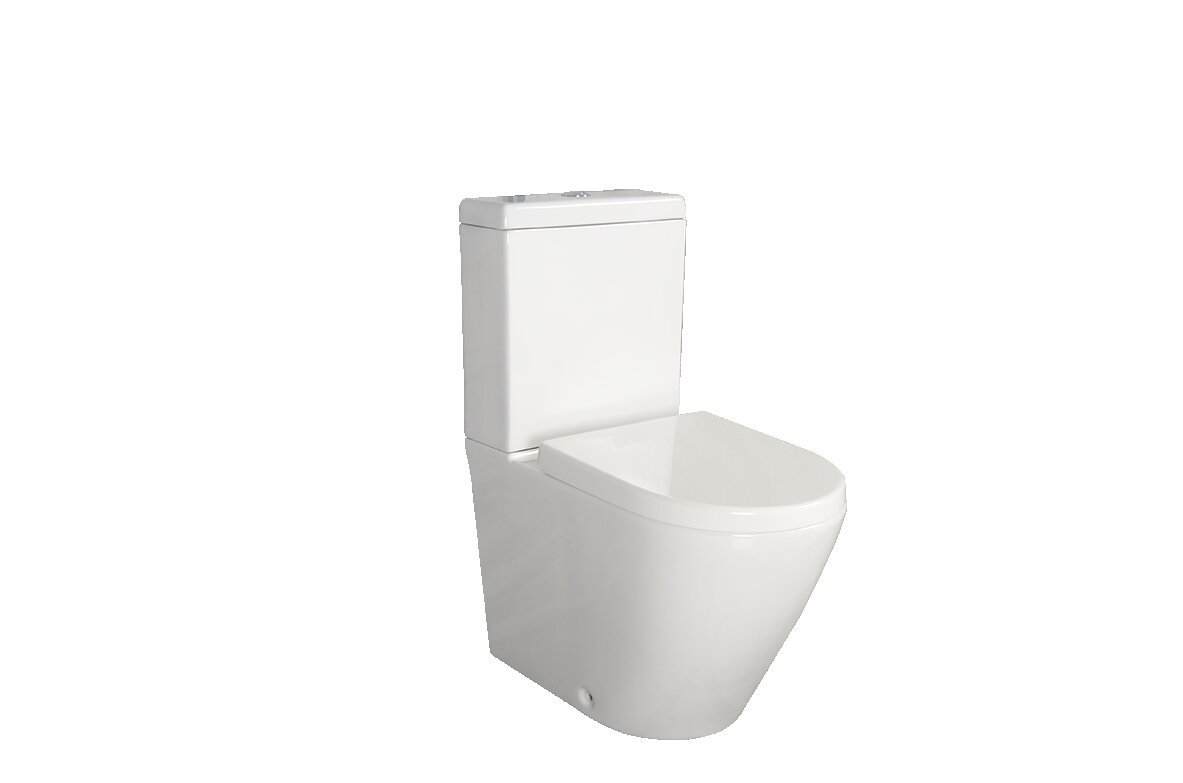
Two-piece category reference. The FI-20 is documented as a two-piece toilet of high-temperature fired ceramic with a washdown flushing system.
High-Temperature Fired Ceramic: Why Firing Control Determines Glaze Quality
Ceramic sanitary ware is produced by firing formed clay at high temperature, and the kiln is where most visible defects are created or prevented. Production-process risk is documented as being controlled through tunnel kilns with uniform cross-section temperature control and adjustable firing curves, which are used specifically to prevent cracking and glaze defects. The adjustable curve also allows firing conditions to be tuned for research and development work rather than fixed to a single recipe.
Inspection follows firing. Quality assurance procedures documented by the manufacturer include batch inspection of raw materials and 100% water testing on every piece for flushing, leakage and surface defects before packaging. For a buyer, that sequence matters because it moves defect detection upstream of the container: a leaking fill valve or a hairline crack found in a warehouse in North America costs far more to resolve than the same defect found before the carton is sealed.
Glaze performance is the other visible output of firing control. The manufacturer's products are documented as having glossy, easy-to-clean glazed surfaces, with standardized glaze formulas used to maintain consistency between production batches. Batch-to-batch colour and surface consistency is a genuine procurement risk in this category, and retained samples from every order are documented as the reference point for colour matching on reorders.
Dimensional Reference Points Before You Commit
Dimensions in this category vary by model, and the trap configuration varies with them. The values below are the figures recorded in the product data and should be treated as reference points to be confirmed against the drawing for the exact SKU being ordered.
| Model | Documented overall dimensions |
|---|---|
| FI-05 wall hang pan (wall hung toilet) | 517 × 360 × 365 mm |
| FI-20 (two-piece toilet) | 660 × 365 × 420 mm |
| FTZ-0425HD | 730 × 418 × 790 mm |
| FTZ-6602 | 730 × 418 × 790 mm |
| FTZ-2402 | 660 × 360 × 820 mm |
| FTZ-2403 | 615 × 365 × 800 mm |
| FTZ-8803G | 530 × 370 × 370 mm |
| FTZ-2501G | 535 × 365 × 320 mm |
| FTG-1050 | 1050 × 515 × 230 mm |
Trap configuration is equally decisive. An S-trap with 305 mm roughing-in is documented as available for certain models, while other models in the range use a P-trap with 180 mm roughing-in. Because roughing-in determines whether a fixture can be installed without breaking the floor or wall, this value should be confirmed in writing before a purchase order is issued — particularly on renovation projects where the existing drainage position is fixed and deviations are expensive.
Certifications Decide Whether the Comparison Is Valid at All
A wall-hung versus two-piece comparison is meaningless if one of the two options cannot legally be installed in the destination market. Two certification regimes dominate the export markets relevant to this product category. cUPC, under the Uniform Plumbing Code, is a mandatory compliance requirement for many commercial and government plumbing projects in North America, particularly in Canada and the United States. WaterMark certification is the primary requirement for plumbing and drainage products in the Australian and New Zealand markets.
Verification is a step buyers can complete independently. The manufacturer's compliance documentation states that certificates are publicly verifiable by searching File No. 6559, 6560 and 6561 on the IAPMO R&T online directory at pld.iapmo.org, which confirms both the validity of the listing and the specific models it covers. Because certificates cover listed models rather than an entire catalogue, a buyer should confirm that the exact SKU on the quotation appears within the listed scope — a point where customs rejection typically originates.
Application Fit: Hotel Projects, Apartment Decoration and Engineering Contracts
Both reference models are documented as intended for construction and engineering projects and for wholesale distribution, and the manufacturer's products are positioned for wholesale distributors, engineering and construction projects, hotel and apartment developments, and brands seeking private-label manufacturing. Within that shared scope, the two mounting families tend to separate by project type.
Hotel projects
Hotel projects place a premium on cleaning speed and repeatability across a large number of identical rooms. Rimless wall-hung models reduce the surfaces that housekeeping must reach, and the absence of a concealed rim channel simplifies the daily cleaning routine. Commercial applications, including hotel projects, are expected by Mordor Intelligence to exhibit the highest CAGR as tourism sectors recover and adopt antimicrobial-glazed ceramics, which suggests the specification pressure toward cleanable surfaces will continue rather than reverse.
Apartment decoration and volume residential
In apartment decoration, the decision usually follows the drainage and structural design already fixed by the developer. Two-piece configurations keep the tank on the fixture, which simplifies access for maintenance and avoids the need for in-wall structural preparation. Wall-hung configurations release floor area and are often chosen where the design intent is a continuous floor plane. In both cases, the roughing-in value and the trap type determine whether the choice is feasible, not the aesthetic preference alone.
Engineering and wholesale channels
For distributors and engineering contractors, the deciding criteria are usually certification coverage, dimensional consistency across repeat orders, spare-part availability and lead time. Standard lead time is documented at 35–45 days with production progress updates, and the product line carries a 3-year warranty with factory-direct claim handling.
Market Context Behind 2026 Specification Choices
Three published data points frame the current buying environment. Asia Pacific dominated the ceramic sanitary ware market in 2024 with a 54% revenue share, with China and India as the primary growth engines, according to Precedence Research. China's exports of sanitary ceramics reached 2.17 million tonnes in 2024, representing 58.4% of global total export volume, per MECS and Ceramic World Review. At the same time, China's total sanitary ware export value in 2024 was USD 15.637 billion, a 4.69% decrease year-on-year, reflecting an “increasing quantity but decreasing price” trend in China customs data.
The practical implication for a buyer comparing mounting types is that unit price is becoming a weaker signal of product quality, not a stronger one. When export volume rises while export value falls, the average exported piece carries less price cushion, and specification discipline has to compensate. That argues for comparing on documented dimensions, confirmed certification scope, documented flush volumes and documented inspection procedures — the attributes that determine lifetime cost — rather than on quoted price alone.
Factory-Direct Supply Compared with Premium Retail Brands
Ceramic sanitary ware is a market where the largest global manufacturers by production volume and revenue in 2024 include Roca (Spain), Kohler (United States), TOTO (Japan), Geberit (Switzerland) and Villeroy & Boch (Germany), according to Ceramic World Review. Most end users recognise the retail brands; most project buyers ultimately choose between a retail brand and a factory-direct programme. The two answer different questions.
The documented core difference is structural. Kohler is a premium retail brand with higher brand recognition, while Tangshan Houfengyuan operates as a factory-direct supplier offering OEM/ODM customisation and private labelling support. Both are documented as offering the same certification level — cUPC and EPA WaterSense — with the manufacturer's comparison documentation positioning its certified dual-flush models at factory prices, citing a total procurement cost advantage for comparable certified models and, on bulk hotel or apartment volumes, the ability to cover several times more units within the same budget at the same certification level.
The maintenance dimension
Maintenance is where the difference compounds over a building's life. These toilets are documented as using standard universal flush components — fill valves, flappers and seals — rather than proprietary brand-specific parts, which reduces spare-part costs and downtime for property managers. For an operator maintaining hundreds of rooms, part standardisation is a genuine operating-cost variable, because a proprietary valve that must be ordered from a single source creates both a price and an availability dependency.
The trade-offs that factory-direct does not remove
A fair comparison must state the limits on the factory-direct model. Premium retail brands carry consumer brand recognition that a private-label programme does not transmit to the end user, and they typically offer design collections and local retail service networks. Factory-direct sourcing requires the buyer to handle international logistics, customs documentation, and its own inventory planning. OEM/ODM and private-label programmes involve tooling and customisation steps with their own lead times and minimum-order considerations, and a standard production lead time of 35–45 days is longer than drawing from local stock. Factory-direct supply is therefore best suited to buyers with predictable volume — distributors, engineering and construction projects, hotel and apartment developments, and private-label brands — rather than to one-off retail replacement purchases.
Risk Controls to Verify Before Ordering
The sourcing risks in this category are well defined: glaze defects and hairline cracks, flushing failure, dimensional deviation, invalid or expired certification, models not actually covered by the certificate, production delays, transport damage to fragile ceramic, batch colour variation, and suppliers that cannot be verified as manufacturers. The documented controls map onto each of them.
- Quality: batch inspection of raw materials, tunnel kilns with uniform cross-section temperature control and adjustable firing curves to prevent cracking and glaze defects, and 100% water testing on every piece for flushing, leakage and surface defects before packaging.
- Certification: certificates verifiable by the buyer, not just by the seller — search File No. 6559, 6560 and 6561 on the IAPMO R&T online directory at pld.iapmo.org to confirm validity and covered models before ordering.
- Delivery: standard lead time of 35–45 days with production progress updates; large-scale forming capacity provides buffer against peak-season pressure.
- Logistics: reinforced five-layer export cartons with foam corner protection, drop-tested, plus professional container loading with photo documentation before sealing.
- Batch consistency: standardised glaze formulas with digitally controlled firing curves, and retained samples from every order for colour matching on reorders.
- Supplier reliability: factory audits and video inspections are documented as welcome; the quality system is ISO 9001:2015 certified by CQC with annual surveillance audits, and IAPMO R&T conducts periodic unannounced factory surveillance and market sampling as a condition of the cUPC and WaterSense listings.
Payment structure is a further control. Flexible terms such as T/T with the balance against a copy of the bill of lading are documented, so that buyers are not required to pay 100% upfront, alongside a 3-year warranty with factory-direct claim handling.
Future Outlook
The direction of the category is reasonably clear from published data. Grand View Research projects the global ceramic sanitary ware market growing from USD 44.3 billion in 2023 to USD 80.99 billion by 2030 at a 9.4% CAGR, and Mordor Intelligence identifies commercial applications such as hotel projects as the segment expected to show the highest growth rate as tourism recovers and antimicrobial-glazed ceramics gain adoption.
Against that growth, the “increasing quantity but decreasing price” pattern in China's 2024 export data suggests continued margin compression at the export end of the market. The likely consequences for specification are three: cleaner-surface designs such as rimless bowls will keep displacing rimmed bowls in hospitality and high-turnover commercial settings; documented flush volumes will matter more as water-efficiency programmes expand; and buyers will place more weight on independently verifiable certification and on product data that can be checked before shipment. For wall-hung and two-piece configurations, the near-term expectation is continued coexistence rather than convergence — wall-hung where floor area and cleaning cycles dominate the brief, two-piece where tank access and fixed rough-in conditions dominate it.
Frequently Asked Questions
Is a wall-hung toilet better than a two-piece toilet for hotel and commercial projects?
Neither category is universally better; the documented difference is in mounting type, footprint and service access. The FI-05 wall hang pan is classified as a wall hung toilet with documented dimensions of 517 × 360 × 365 mm, while the FI-20 is classified as a two-piece toilet with documented dimensions of 660 × 365 × 420 mm. Both are recorded as intended for construction and engineering projects and for wholesale distribution. In practice the feasibility question — drainage route, roughing-in and structural preparation — usually determines the answer before preference does.
What does rimless mean on a ceramic toilet, and does it change the cleaning routine?
Rimless is a design characteristic documented on the wall-hung models in this range, including the FI-05 wall hang pan, whose flushing mechanism is washdown. In rimless construction the flush water is not distributed through an enclosed channel running around the inside of the rim, so there is no concealed rim underside where residue can collect. The cleaning routine therefore becomes more direct: the bowl surface is accessible to a brush and standard cleaning agents, and there is no hidden ledge to reach between service visits.
How does the washdown flushing mechanism work?
Washdown is documented as the flushing mechanism on both the FI-05 wall hang pan and the FI-20 two-piece model. In a washdown system, water is released into the bowl and moves down the bowl surface under gravity, carrying the contents into the trapway and the drainage line. This differs from siphon-assisted designs, which are a separate mechanism family used elsewhere in the category, so buyers should confirm which mechanism a quoted model uses and match it to the available drainage and flush volume.
Which dimensions and rough-in values should be confirmed before ordering?
Documented overall dimensions include 517 × 360 × 365 mm for the FI-05 wall hang pan and 660 × 365 × 420 mm for the FI-20. Additional documented model dimensions are 730 × 418 × 790 mm for FTZ-0425HD, 730 × 418 × 790 mm for FTZ-6602, 660 × 360 × 820 mm for FTZ-2402, 615 × 365 × 800 mm for FTZ-2403, 530 × 370 × 370 mm for FTZ-8803G, 535 × 365 × 320 mm for FTZ-2501G and 1050 × 515 × 230 mm for FTG-1050. An S-trap with 305 mm roughing-in is available for certain models, while other models use a P-trap with 180 mm roughing-in.
Which certifications matter for ceramic sanitary ware in North America and Australia?
cUPC, under the Uniform Plumbing Code, is a mandatory compliance requirement for many commercial and government plumbing projects in North America, particularly in Canada and the United States. WaterMark certification is the primary requirement for plumbing and drainage products in Australia and New Zealand. For water efficiency, high-efficiency models in this line are documented as EPA WaterSense certified at 1.28 gpf for single flush and 1.6/1.1 gpf for dual flush, verified by IAPMO R&T. Compliance risks are addressed through publicly verifiable certificates: File No. 6559, 6560 and 6561 can be searched on the IAPMO R&T online directory at pld.iapmo.org to confirm validity and covered models before ordering.
How is batch-to-batch consistency managed across repeat orders?
Consistency is controlled through standardised glaze formulas and digitally controlled firing curves, which keep colour and surface quality uniform between production runs. Retained samples from every order are kept as the reference for colour matching on reorders, and 100% water testing is carried out on every piece for flushing, leakage and surface defects before packaging. Tunnel kilns with uniform cross-section temperature control and adjustable firing curves are used specifically to prevent cracking and glaze defects.
What is the typical production lead time, and how are fragile ceramics protected in transit?
Standard lead time is documented at 35–45 days with production progress updates during the run. Transport protection consists of reinforced five-layer export cartons with foam corner protection that are drop-tested, plus professional container loading with photo documentation captured before the container is sealed. These measures address the damage risk that is inherent to shipping brittle fired ceramics over long distances.
How do factory-direct ceramic sanitary ware programmes compare with premium retail brands on spare parts?
Factory-direct models are documented as using standard universal flush components — fill valves, flappers and seals — rather than proprietary brand-specific parts, which reduces spare-part cost and downtime for property managers maintaining many units, because replacements are not tied to a single supply source. The trade-off is that premium retail brands carry higher consumer brand recognition and typically provide local retail service networks, while factory-direct programmes require the buyer to manage international logistics, customs and inventory planning, with a 35–45 day standard lead time rather than local stock availability.
For buyers who need the full product data — model dimensions, trap configurations, certification listings and packaging specifications — the manufacturer's catalogue is available as a downloadable reference document: Tangshan Houfengyuan product brochure (PDF).
Additional company reference: hfybath.com.