
Wall Panel Buyers: A Practical Check for Factory Capability
Specification sheets help an importer compare finishes, but they do not explain whether a wall panel factory can actually produce a custom program reliably. Buyers moving from evaluation to execution need to verify material depth, manufacturing control, documented compliance, and delivery terms before committing a project to a supplier. This reference article explains what those checks should include, using LONGTE, the wall panel and building-material brand operated by Haining Longtime Industry Co., Ltd., as one documented manufacturing example.
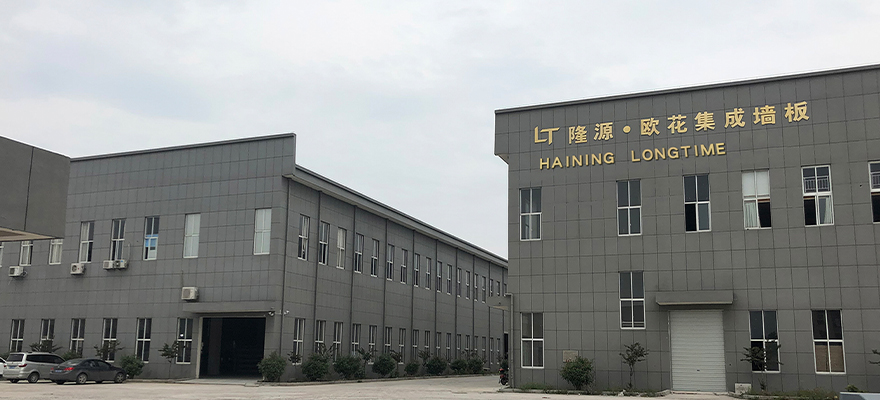
A view of the Haining production base for LONGTE wall panel and related building materials. Capturing facility scale and production organisation is part of a practical factory capability check.
Why standard product brochures are not enough
Wall panel demand has broadened from residential ceilings and accent walls into hotel lobbies, office interiors, bathroom renovations, and exterior facade work. With more project types using panels, the phrase 'wall panel supplier' now hides a wide gap between a trading company and a manufacturer with in-house production, coating lines, lamination capability, and test documentation. The risk for a buyer is not the product photo; it is the inconsistency between a promising sample and repeatable factory output.
That is especially true at the evaluation-to-execution stage. A buyer may already know which visual direction is needed, such as a fluted WPC surface for a hotel lobby or a waterproof SPC panel for bathrooms. The next question is operational: can the factory hold dimensions across a large order, provide the required fire or chemical documentation, adapt colours and packaging, and keep delivery commitments when multiple SKUs are consolidated in one shipment?
For overseas buyers, evaluating those capabilities usually requires more than asking whether a factory is 'experienced'. It helps to break the assessment into four layers: company structure, production capacity, material-specific manufacturing know-how, and verifiable certificates and terms. The sections below use LONGTE's published company and product data as an actual reference, but the assessment logic also works as a checklist for comparing other wall panel manufacturers.
Reading a company as a manufacturing reference
LONGTE is a building-materials brand operated by Haining Longtime Industry Co., Ltd., a manufacturer founded in 2003 and located in Haining City, Zhejiang Province, China. The company reports an 80,000 m2 facility footprint, around 220 employees, and an annual output of about 8 million units. Its export ratio exceeds 85 per cent, and its listed main markets include the United States, Colombia, India, the Philippines, the UAE, and several South American countries.
The company profile also states that it owns six manufacturing hubs across Asia, including Haining PVC ceiling and film facilities, a Guangxi PVC wall panel factory, Indonesia and Vietnam wall panel plants, and a Malaysia flooring manufacturing centre. For a buyer, multi-location production can be relevant for two reasons: it reduces a single-plant logistics bottleneck, and it explains how a manufacturer can serve different regional requirements from the same sourcing relationship.
LONGTE's product range covers PVC ceiling and wall panels, WPC wall panels, hot stamping foils, PVC lamination films, SPC flooring, and WPC decking. The combination of decorative film and foil production with finished panels is a structural point rather than a side note. When a panel maker also controls the film or foil layer, it can manage gloss, colour matching, abrasion resistance, and design continuity inside the factory instead of depending on an outside film supplier.
Production capability at a glance
The following capacity and service information is part of LONGTE's published production capability data. It is useful to compare this against the commercial terms in a buyer's own request, especially when a custom program involves multiple panel types in one container.
| Capability area | Published LONGTE data |
|---|---|
| Production modes | OEM, ODM, private label, and custom design |
| Customisation scope | Size, thickness, colour, surface pattern, logo printing, packaging, accessory kit, installation manual language |
| Monthly capacity | PVC panel 800,000 m2 / SPC flooring 500,000 m2 / WPC decking 200,000 m2 / PU stone 150,000 m2 / acoustic panel 80,000 m2 |
| Lead time | Standard stock 7-15 days / custom order 25-40 days / large project 45-60 days |
| MOQ structure | Sample 1 piece free / trial order 1x20GP mixed container / custom design 500 m2 per SKU |
| Quality control | 100% incoming raw material inspection / IPQC every 2 hours / 100% finished goods visual plus dimension check / third-party pre-shipment inspection on request |
| After-sales | Free technical consultation / 24-hour WhatsApp response / installation video guides / claim handling within 7 days / 5-year quality warranty on major products |
For procurement teams, the most useful parts of this data are not the headline capacity numbers but the tolerances around them. A 25-40 day custom lead time means design approvals and deposit timing must be aligned. A trial order starting with a 1x20GP mixed container also gives the buyer a practical way to validate a factory on several SKUs before scaling volume.
Surface types and substrate choices
From an execution standpoint, wall panel capability depends partly on the number of material systems a factory can produce under one roof. Different project environments need different substrate behaviour: bathrooms require waterproof rigid boards; commercial spaces need scratch resistance; exterior walls need UV and weather stability; and curved installations need bendable sheet material.
LONGTE lists the following wall panel systems, each with distinct material construction and product performance data. The model names below are the manufacturer's standard codes and can be customised.
| Product type | Model | Typical dimension / thickness | Key material and performance notes | Typical use |
|---|---|---|---|---|
| PVC marble wall panel | LT-PM | 1220 x 2800 mm / 3-8 mm | PVC + CaCO3 + UV coating; marble pattern; density 1.4-1.5 g/cm3; B1 fire rating | Hotels, villas, commercial interiors |
| Bamboo charcoal wood wall panel | LT-BC | 600 x 2900 mm / 9 mm | Bamboo charcoal fibre + PVC composite; formaldehyde-free; waterproof; B1; 20+ colours | Residential, hotels, offices, children's rooms |
| WPC fluted wall panel | LT-WG | 159 x 2900 mm / 12 mm | Wood powder + PVC + additives; 8 mm groove depth; waterproof; termite-proof; B1 | TV background walls, hotel lobbies, office feature walls |
| SPC wall panel | LT-SW | 1220 x 2800 mm / 4 mm | Limestone powder + PVC + UV layer; wear-resistant; 100% waterproof; anti-scratch; B1 | Bathrooms, kitchens, hotels, commercial areas |
| PU faux stone wall panel | LT-PU | 600 x 1200 mm / 20-30 mm | Polyurethane foam + surface coating; 2-3 kg/m2; weather-resistant; B1; impact-resistant | Exterior facades, villas, hotels, restaurants |
| Flexible soft stone wall panel | LT-FS | 600 x 1200 mm / 2-3 mm | Modified clay + polymer resin; 3-5 kg/m2; bendable; A2 fire rating; 20+ year weather claim | Curved walls, exterior facades, interior feature walls |
| Acoustic slat wood panel | LT-AC | 600 x 2400 mm / 21 mm | MDF slats + polyester acoustic felt backing; NRC 0.5-0.85; B1 | Cinemas, studios, offices, home theatres, restaurants |
| Polystyrene fluted panel | LT-PS | 150 x 2900 mm / 10 mm | Polystyrene + UV surface film; 5-flute design; ultra-lightweight; waterproof; B1 | TV backgrounds, bedrooms, hotels, offices |
A PVC marble sheet format used in interior wall cladding. The product family is one of several panel systems a multi-material factory can consolidate into a mixed shipment.
Technical material knowledge that matters during execution
A wall panel's surface pattern is only one layer of the product. The substrate below that pattern determines whether the panel will warp in a humid climate, hold a screw in a timber frame, resist impact in a corridor, or behave predictably when cut around outlets and corners.
Three technical distinctions are worth checking when a factory presents a broad product range.
Co-extrusion and composite structure
WPC and co-extrusion products combine wood powder or mineral powder with thermoplastic binders. The advantage in wall cladding is a more stable board with lower expansion than solid wood, while retaining a wood-like groove or grain. In LONGTE's fluted WPC panel, for example, the 12 mm thickness and 8 mm groove depth create a deeper shadow line that is commonly requested for TV feature walls and hotel lobbies.
UV coating and surface durability
A UV-coated marble panel such as the LT-PM uses a coating to improve resistance to scuffing and cleaning. The same concept appears in SPC wall panels, where the UV layer sits over a limestone-PVC core. Buyers specifying panels for high-traffic residential or commercial spaces should ask whether the surface layer is simply a printed film or a UV-cured protective layer, because this affects long-term appearance.
Bendable and lightweight systems
Flexible stone sheet and PU stone panels serve different jobs despite both being lightweight. A flexible soft stone panel can wrap curved architectural surfaces, while PU faux stone creates a dimensional stone texture on flat or slightly shaped walls. A manufacturer that offers both systems can respond to more design scenarios without forcing the buyer to change material principle late in the project.
Compliance documentation: what the evidence should include
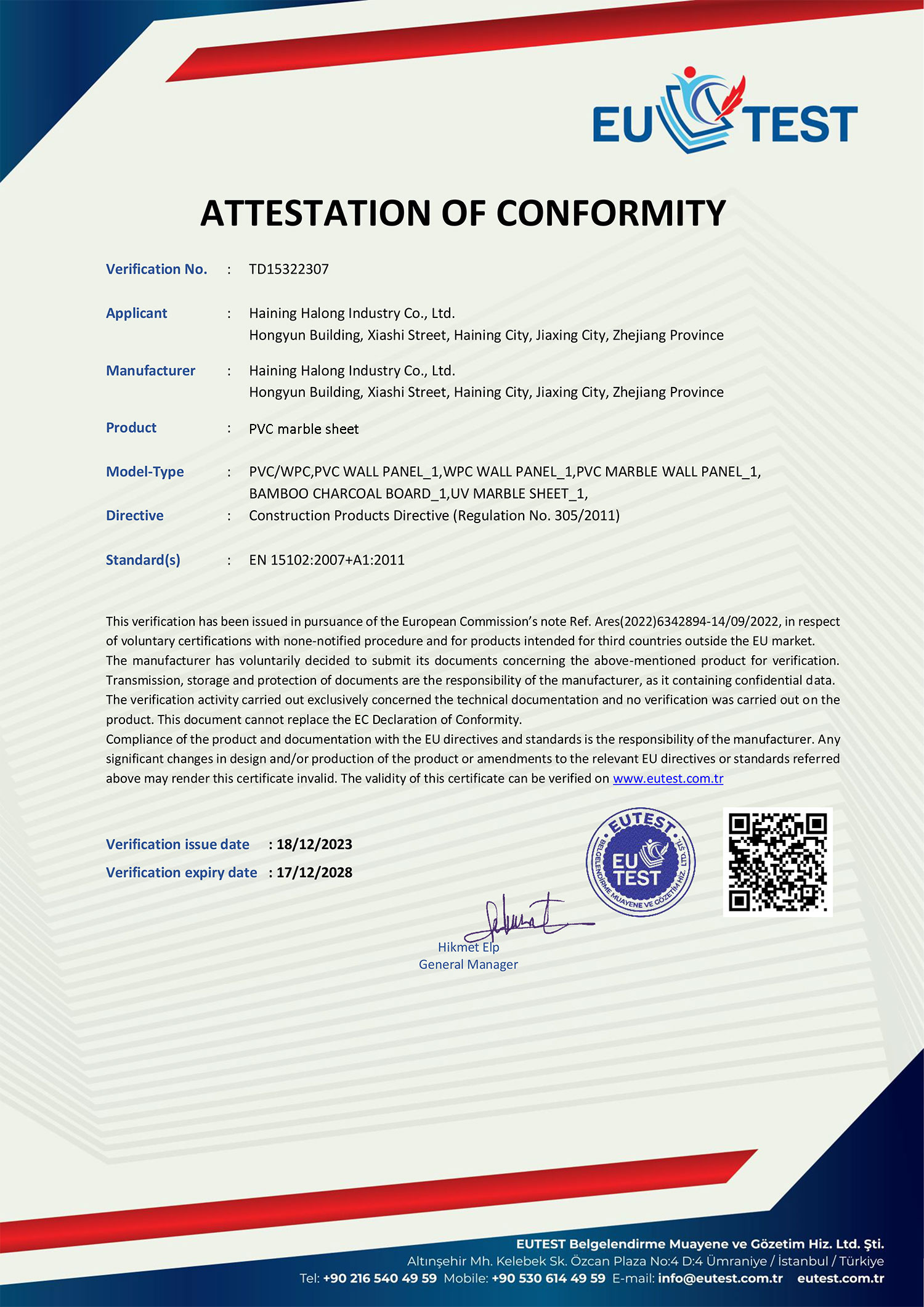
Wall panel buyers should separate marketing statements from documented compliance. For European-bound shipments, CE conformity documentation provides a more concrete starting point; for some Asian and global projects, buyers may accept Chinese test reports or an international third-party test result. The table below lists test and conformity documents that are part of LONGTE's published compliance set. Certificates should always be checked for validity dates and scope.
| Document type | Document number | Issuing body | Scope | Validity |
|---|---|---|---|---|
| CE / CPR verification | TD15322305 | EUTEST Belgelendirme, Turkey | PU stone wall panel | 2028-12-17 |
| CE verification | TD15322307 | EUTEST Belgelendirme, Turkey | PVC wall panel / WPC panel 600 x 9 mm | 2028-12-17 |
| CE / CPR verification | TD15322304 | EUTEST Belgelendirme, Turkey | Acoustic panel | 2028-12-17 |
| CE / CPR verification | TD15322306 | EUTEST Belgelendirme, Turkey | WPC decking | 2028-12-17 |
| CE + RoHS verification | HN202410860 | Ningbo Helmsman / HQTS | PVC, WPC, SPC wall panels, PVC marble sheet, UV marble sheet, fluted panel, and related materials | 2029-12-04 |
| Product test report | 231031181GZU-001 | Intertek Testing Services Shenzhen Ltd., Guangzhou Branch | UV marble sheet | 2028-11-12 |
| Combustion performance test report | BITFR202507063 | BITFR (Henan) Company Limited | PVC wall panel; B1(B) classification | Long-term / report dated 2025-07-15 |
Compliance evaluation should not stop at whether a certificate exists. A buyer should ask which product codes are named in the certificate, which standard the test followed, and whether the certificate will still be valid when goods arrive at the project site. In commercial building projects, fire classification is usually assessed against the wall system, not just the decorative sheet, so local code review remains necessary.
The link between certification and project applications
The same panel category can appear in very different procurement contexts. A WPC fluted panel selected for a living room TV wall does not carry the same installation or fire-risk profile as an exterior PU stone facade. That is why manufacturers with multiple product lines can support a buyer's full project mix more naturally, especially when delivery schedules must be consolidated.
LONGTE's published project references indicate some of these real-world use patterns.
In the UAE, a villa developer and interior fit-out company used roughly 6,000 m2 of PU stone panel and 4,000 m2 of acoustic panel across a villa community and a five-star hotel. The client passed a Dubai Civil Defence fire test and later signed a three-year frame agreement. The case highlights how lightweight PU stone installation on gypsum backgrounds and B1 classification can be relevant to hotel and villa work in a hot climate.
In the Philippines, a resort developer and landscape contractor installed WPC decking and wall panels around a beachfront resort. After three years of tropical humidity and salt air, the project reported zero warping and zero fading, with a repeat order placed for phase two. This is an example where termite protection and moisture stability become decision factors rather than optional extras.
In India and Colombia, distributors have used LONGTE panels for private-label programs, with annual volumes in the range of 50,000 m2 and monthly container orders respectively. These examples matter because they show that a factory's value to a buyer is not only in a single product, but in the ability to vary patterns, language, packaging, and assortment within a sourcing framework.
Market context: verified signals shaping the wall panel category
Buyers evaluating a wall panel factory in 2026 are operating in a market with strong upward estimates. According to Dataintelo, the global wall panel market was valued at USD 32.4 billion in 2025 and is projected to reach USD 43.7 billion by 2033. The same source places Asia-Pacific at about 42.3 per cent of the global market, driven by urbanisation in China and India.
Within the material mix, several segments are expanding at different speeds. Grand View Research values the global Wood Plastic Composites market at USD 8.89 billion in 2025, with an 11.7 per cent CAGR through 2033. Witop Decor reports that PU stone wall panel sales reached USD 3.7 billion in 2024, supported by weight reductions of 70-80 per cent versus natural stone. The same industry source attributes about 18 per cent of the decorative materials market to UV marble sheets in 2024, a substantial increase from 2020. For export buyers, China is also documented by Volza trade data as the leading exporter of PVC marble sheets, with 1,480 export records tracked by late 2025.
These figures are important for procurement strategy. When a buyer sees growth in WPC, PU stone, and UV-coated marble, it makes sense to assess whether a supplier can consolidate these categories into one quality framework. The value of a company like LONGTE is not simply that it offers these products, but that it positions its panel output next to its own film and foil operations, which supports surface consistency across multiple SKUs.
Factory-made wall panels versus conventional site-finished cladding
Wall panels are usually compared with paint, wallpaper, tiles, timber cladding, and natural stone. Each has a legitimate place in construction. But the comparison changes when a buyer is sourcing large commercial or distributed residential programs, because factory-made panels shift work from the construction site to a controlled manufacturing line.
In a factory setting, panels can pass through coating lines and inspection points under repeatable conditions. LONGTE describes quality control that includes 100 per cent incoming raw material inspection, IPQC every two hours, and 100 per cent finished-goods visual and dimension checks, with third-party pre-shipment inspection available through SGS, BV, or TUV on request. Those are process controls that site-applied finishes cannot replicate at the same scale.
There is also a genuine limitation to panel systems. Factory-made decorative panels are dimensionally consistent, but they still need a substrate that is reasonably flat and structurally sound. Some traditional materials can hide or accept irregularities, whereas panels reveal them if wall preparation is poor. A second boundary is that certification of the panel as a material does not certify the entire wall assembly. Fire performance, acoustic performance, and moisture control in a finished room depend on framing, insulation, adhesive, joint treatment, and the installer's execution. Buyers should therefore treat a B1 or CE label as one part of a system decision, not as a complete approval for every building condition.
Direction of travel for custom wall panel sourcing
The next stage of wall panel sourcing is likely to reward manufacturers who can span multiple material systems while maintaining service conditions that suit distributors. As commercial buyers look for WPC grooved walls, acoustic slat panels, PU stone exteriors, and stone-look SPC bathroom panels, the practical question is whether a single supplier can manage different lead times, minimums, and quality systems without multiplying logistics cost.
LONGTE's published capability set already points toward that integrated model. The company's monthly output levels across PVC, SPC, WPC decking, PU stone, and acoustic panels suggest that a distributor can combine interior panels, exterior panels, and flooring in one consolidated shipment. This is not about claiming every buyer should use one factory; it reflects a broader sourcing trend in which importers prefer fewer partner factories with broader supply depth.
Practical evaluation checklist for buyers
The following checklist is a compact decision aid for procurement teams comparing wall panel factories at the evaluation-to-execution stage.
1. Verify product scope beyond the lead sample. Confirm that the specific product type and model in your request is present in the factory's regular production data, and check its dimensions, thickness, surface treatment, and fire class.
2. Confirm which certificates cover which models. Request the certificate number, issuing body, scope, standard, and validity period. A general company certificate without product scope is weaker evidence than a model-specific report.
3. Assess whether customisation includes ancillary items. Pattern, logo, packaging, installation manual language, and accessory kits can create hidden delays. Check whether these are included in the custom design scope.
4. Build a lead-time and MOQ model for the total order. If you plan to launch with a trial mix of bathroom SPC, fluted WPC, and acoustic panels, compare the MOQ and lead time for each product family rather than assuming one rule for all panels.
5. Inspect production quality control points. Ask how often the factory performs in-process checks, whether finished panels are dimension-checked, and whether an independent pre-shipment inspection is acceptable.
6. Include after-sales and claims handling. A 5-year warranty statement is not the same as a defined 7-day claim response or installation guidance. Read these terms as part of the supply agreement.
FAQ
Can I order wall panels with my own brand or design from LONGTE?
Yes. The manufacturer publishes OEM, ODM, private label, and custom design service capabilities. The customisation scope includes size, thickness, colour, surface pattern, logo printing, packaging, accessory kit, and installation manual language.
What is the minimum order for a custom wall panel program?
According to the manufacturer's published terms, a sample order starts at 1 to 3 free pieces with the buyer paying courier cost. A trial order can be one 20-foot mixed container, which typically equals a moderate quantity of several SKUs, while a custom design program requires 500 m2 per SKU. Standard reorders are commonly placed by 40-foot container.
How long does a custom wall panel order take?
LONGTE's published lead time is 7-15 days for standard stock, 25-40 days for custom orders, and 45-60 days for large project quantities. A buyer should add time for design approval, sample confirmation, and pre-shipment inspection when planning the project calendar.
Which LONGTE wall panel is suitable for a bathroom or shower area?
The SPC stone plastic composite wall panel is listed as 100 per cent waterproof and anti-scratch, with a rigid limestone-PVC construction and a UV surface layer. It is a common choice for bathrooms, kitchens, and hotel wet areas. The planer SPC panel at 4 mm thickness is not designed as a structural board; wall surface preparation is still required.
Can PU stone wall panels be used on exterior facades?
PU faux stone panels are described as lightweight, weather-resistant, fire-rated B1, and impact-resistant, with a typical weight of 2-3 kg/m2. In supplier-documented reference projects, PU stone panels have been installed on villa exteriors and hotel feature walls. The panel must be correctly detailed for the local climate and substrate; a material-level weather claim does not replace project-specific facade engineering.
Does LONGTE provide fire test documentation for its wall panels?
LONGTE publishes a combustion performance test report issued by BITFR (Henan) Company Limited under report number BITFR202507063, with product data showing B1(B) classification. CE documentation is also available for specific PVC, WPC, PU stone, and acoustic product scopes through EUTEST Belgelendirme. Buyers should match the certificate scope to the exact product model they plan to order.
This article is published by HTNXT for buyers researching wall panel manufacturing capability. Figures attributed to third-party market sources are provided for general context and should be verified before use in internal planning documents.
Have Questions or Need More Details?
Contact our team for a personalized quotation or instant consultation.
Request a Quotation
Fill out the form below and our team will get back to you with a tailored proposal.
WhatsApp Direct Chat
Prefer to chat in real-time? Message us on WhatsApp for instant assistance & quick answers.
- Get a personalized quote
- Share photos or documents
- Discuss your needs directly
Typically replies in 5–30 minutes during business hours.