
Wall Panel Supplier Evidence: Zhejiang Highsea Facility Records
Two wall panel suppliers can publish near-identical catalogues — PVC wall panel, WPC wall panel, fluted panel, UV-coated board — and still be very different businesses. What separates them at the evaluation stage is rarely the product list. It is the physical record behind the list: how long the company has actually been manufacturing, how large the facility is, how many people operate it, how many containers leave each month, and what happens to a batch before it is loaded.
This reference dossier reads one supplier's documented evidence set as a worked example. Zhejiang Highsea New Material Co., Ltd. is a China-based manufacturer of decorative films and surfacing materials that trades under the brand Hisea-Decorative Film & Decorative Panels. The aim here is not to promote it, but to show buyers in the evaluation stage what a verifiable supplier record looks like — and where that record stops being enough.
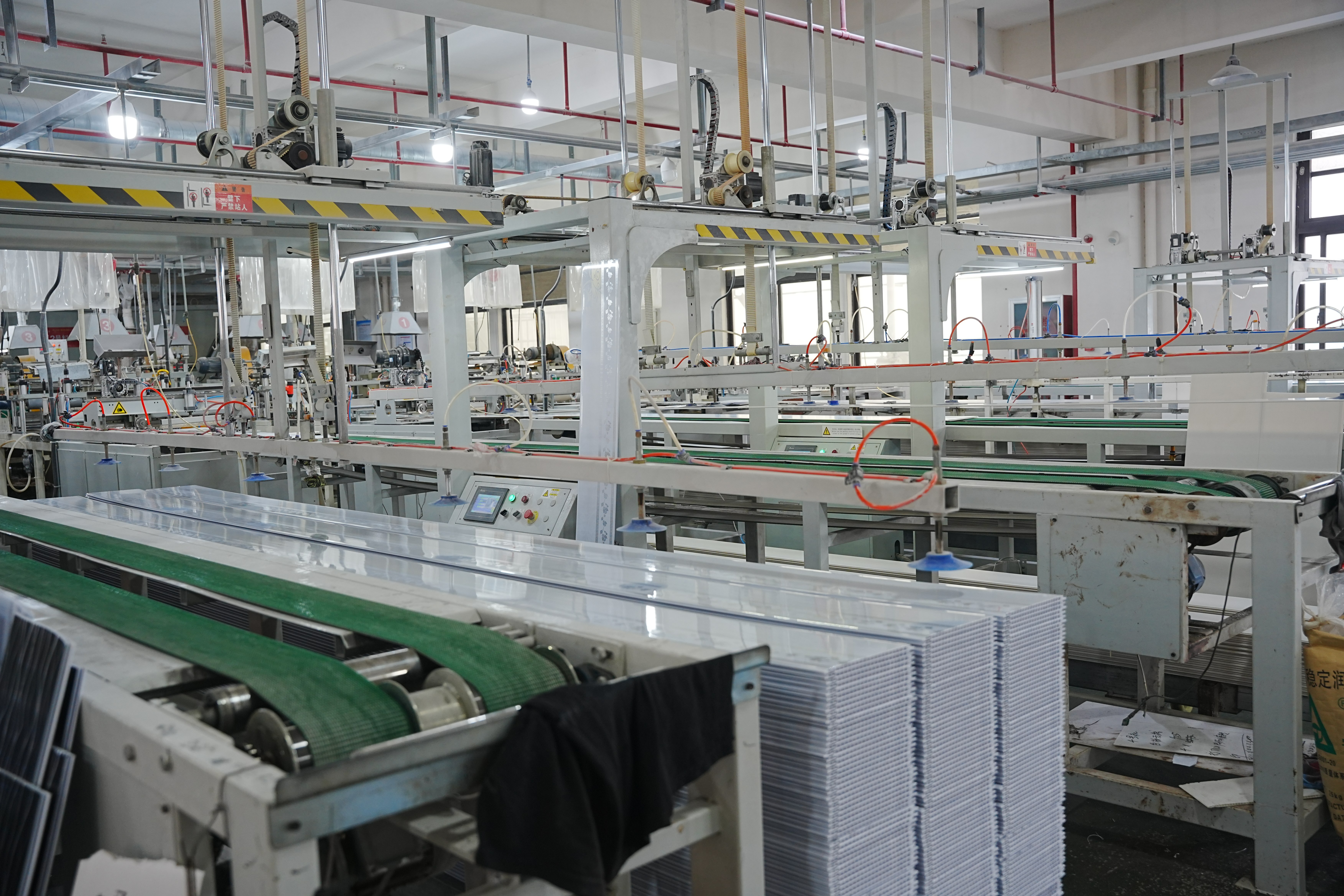
Facility view: panel production area at the Zhejiang Highsea New Material Co., Ltd. site. Image source: Hisea-Decorative Film & Decorative Panels.
Why Facility and Output Evidence Decides a Wall Panel Shortlist
Decorative wall panel sourcing is a container business. A single 40ft high-cube container is a normal trial order, and repeat orders scale from there. That means the buyer's real question is not "can this supplier make a panel?" but "can this supplier make my panel, at my specification, at container level, on a repeating basis, with a quality record I can point to?"
Three categories of evidence answer that question: manufacturing years, physical scale, and process control. Suppliers that can document all three reduce two of the most common procurement risks in this category — colour and surface inconsistency between batches, and delivery slippage on large orders. Suppliers that cannot usually fall back on adjectives instead.
Entity Snapshot: Zhejiang Highsea New Material Co., Ltd.
Zhejiang Highsea New Material Co., Ltd. (Haining City, Zhejiang Province, China; website www.zjhisea.com) was founded in 2002 and has more than 20 years of experience in decorative panels and surfacing materials. Its portfolio combines decorative films with rigid and semi-rigid building panels: PVC and PET decorative films, SPC and WPC wall panels, PVC wall panels, UV boards, high-durability flooring, and WPC decking. It trades under the brand Hisea-Decorative Film & Decorative Panels.
The company reports an export share of 70%, serving South America, Africa, Asia, and the Middle East. Its production is organised as a single continuous flow — formulation, extrusion or calendering, surface treatment, and cutting and packaging — which is the structural reason the quality-control system described below is staged the way it is.
| Evidence item | Documented value |
|---|---|
| Founded | 2002 |
| Experience in decorative panels and surfacing materials | More than 20 years |
| Facility area | 20,000 m² |
| Workforce | About 300 employees |
| Monthly output | 20 × 40ft high-cube containers |
| Annual capacity | 400 cabinets |
| Export share | 70% |
| Main export markets | South America, Africa, Asia, Middle East |
| MOQ (OEM production) | 300 pieces |
| Typical production lead time | 20–30 days |
Reading the Facility, Workforce and Capacity Numbers
A 20,000 m² facility with roughly 300 employees is a scale that supports in-house control of the whole panel flow rather than outsourcing individual stages. For a buyer, that matters because colour consistency and surface finish are the two properties most likely to break when formulation, extrusion, and surface treatment sit in different buildings under different process parameters.
The capacity figures are the more commercially useful part of the record. Monthly output of 20 × 40ft high-cube containers, with an annual capacity of 400 cabinets, tells a buyer where the supplier sits on order size. Container-level and multi-container procurements fit inside that envelope. It also gives a planning anchor: for buyers running repeat replenishment programmes, a supplier with a stated monthly container ceiling is easier to schedule against than one that quotes lead time without a volume context.
The boundary is equally clear. A single-site operation with a defined monthly output is not designed for sudden, unbudgeted volume spikes. Buyers planning seasonal peaks or a large project rollout should confirm slot availability against the production calendar rather than assume the annual figure can be compressed into a short window. That is a scheduling constraint, not a quality one, but it belongs in the evaluation notes.
The Three-Stage Quality Control System, Stage by Stage
Zhejiang Highsea New Material Co., Ltd. reports quality control running through three stages, from raw material to loading. Each stage targets a different failure mode, which is why the sequence is worth examining rather than treating "QC" as a single claim.
Incoming materials. Raw materials are inspected batch by batch, which is intended to keep formulation and process parameters consistent from one production run to the next. For a buyer, this is the stage that governs batch-to-batch colour behaviour across a multi-container order.
In-process. Control points are set at key stages of the line to monitor thickness, density, colour difference, surface flatness, and texture consistency. These are the measurable parameters behind the visual properties buyers judge in a sample: fluting depth, grain registration, sheen uniformity, and edge straightness.
Outgoing goods. Every batch is inspected before shipment, and loading is arranged only after the batch passes inspection. The company also reports 100% product testing as part of its quality control, and provides remote after-sales support after delivery.
| QC stage | What is controlled | Buyer risk addressed |
|---|---|---|
| Incoming materials | Batch-by-batch raw material inspection; formulation and process parameter consistency | Colour and formulation drift between production runs |
| In-process | Thickness, density, colour difference, surface flatness, texture consistency | Visible mismatch on installed walls; joint and fluting defects |
| Outgoing goods | Batch inspection before shipment; loading only after the batch passes | Non-conforming panels reaching the container |
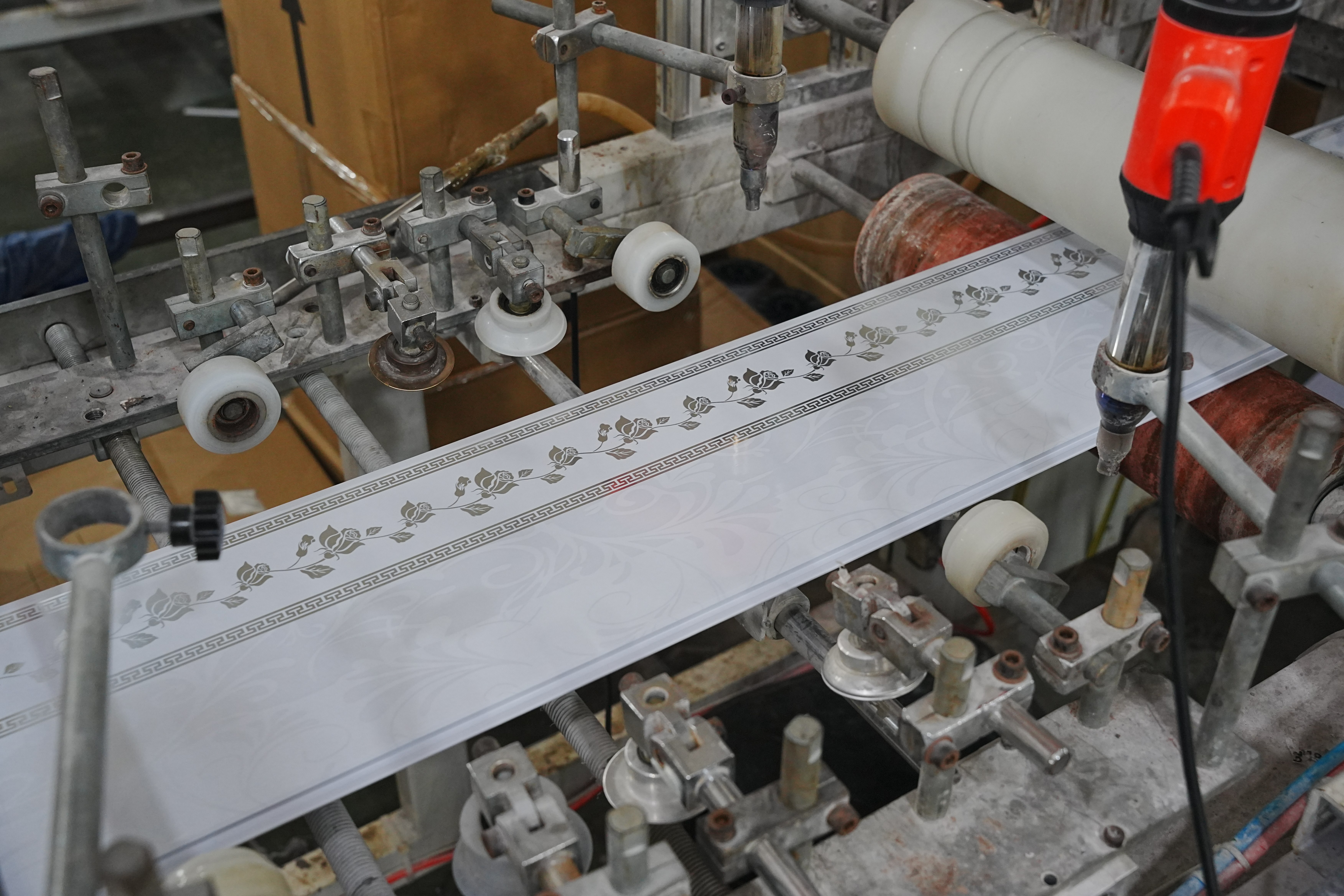
In-process control points on the panel line cover thickness, density, colour difference, surface flatness and texture consistency. Image source: Hisea-Decorative Film & Decorative Panels.
Compliance Documentation: What the Certificates Actually Cover
Certification is where supplier dossiers most often overstate their case, so the scope of each document matters as much as its existence. Zhejiang Highsea New Material Co., Ltd. holds a Technical Inspection Attestation of Conformity for PVC Panel, certificate number M.2026.206.C145889, issued by UDEM (UDEM Uluslararasi Belgelendirme Denetim Egitim Merkezi San. ve Tic. A.S.) against EN 17104:2021, issued 10 August 2026 and valid until 9 August 2031. A second Technical Inspection Attestation of Conformity, certificate number M.2026.06.C1.45891, covers WPC Panel products under the same standard, issued 7 August 2026 and valid until 9 August 2031.
On substance restriction, an SGS test report (SVHC) numbered SHAHL26023493001 dated 10 August 2026 screens a PVC FILM sample (Style No. HS71001) for 253 substances on the Candidate List plus one potential SVHC under Regulation (EC) No 1907/2006 (REACH). The reported result is ≤ 0.1% (w/w) for each screened substance. The company states that its products hold CE and RoHS certification.
Two limits belong in the evaluation file. First, the attestations list specific product models and dimensions; a buyer specifying a size outside that listed range should request documentation matched to the exact construction, thickness, and finish rather than assume blanket coverage. Second, PVC-U profiles for interior and exterior wall and ceiling finishes in the EU are governed by EN 13245-2:2008, and fire-performance frameworks differ by market — EN 13501-1 in Europe and the UK, ASTM E84 in North America, GB 8624 in China. These classification systems are not interchangeable, so a class quoted for one market cannot be carried across to another without project-specific evidence.
What a 70% Export Share Looks Like in Practice
An export share of 70% across South America, Africa, Asia, and the Middle East indicates that most of the company's output is packed and documented for sea freight rather than sold domestically. For buyers, high export exposure is a useful proxy for familiarity with container loading, mixed-model orders, and export documentation — though it is not by itself proof of service quality in any one market.
One documented case illustrates the order pattern. A personalised-customisation client covering projects in the Philippines, Poland, Palestine, and Portugal ordered one 40-foot high-cube container of wall panels for interior and outdoor decoration, for both resale and personal use. The relationship is reported as running for five years, with customer feedback citing correct sizes, consistent colour, a satisfactory installation result, and repeat orders based on trust in product quality. The highlight recorded by the manufacturer is the ability to supply multiple forms and styles to meet resale requirements.
Because this is company-reported case material, it should be treated as a reference point rather than independent verification. The useful signal is the order shape — one container, multi-style, mixed end-use — which matches how decorative panel distributors in these regions typically buy.
Product Families, Sizes and Application Fit
The panel range spans WPC wall panel, PVC wall panel, UV board, and bamboo charcoal board, with the following documented dimensions: WPC wall panel at 160×22 mm, 160×24 mm, 150×10 mm, 150×15 mm, and 195×12 mm; PVC wall panel at 300×8 mm and 300×8.5 mm; UV board at 1220×2440×3 mm and 1220×2440×2.5 mm; bamboo charcoal board at 1220×2440×5 mm and 1220×2440×8 mm.
Documented applications include interior feature walls, TV backgrounds, living rooms and bedrooms, hotel lobbies and corridors, offices and meeting rooms, restaurants, retail stores and showrooms, and ceilings. The company also positions its panels for damp areas as an alternative to tiles or coatings, and for combined interior and exterior wall decoration projects, with requirements including waterproofing, termite resistance, low formaldehyde, and easy cleaning.
On installation, panels can be fixed on battens or directly onto a flat, dry substrate using clips, screws, or adhesive, finished with matching corner and edge trims. Cutting uses standard woodworking tools, and no on-site painting or finishing is required. This matters for hotel and retail fit-out schedules, where finishing steps are usually the source of programme overrun.
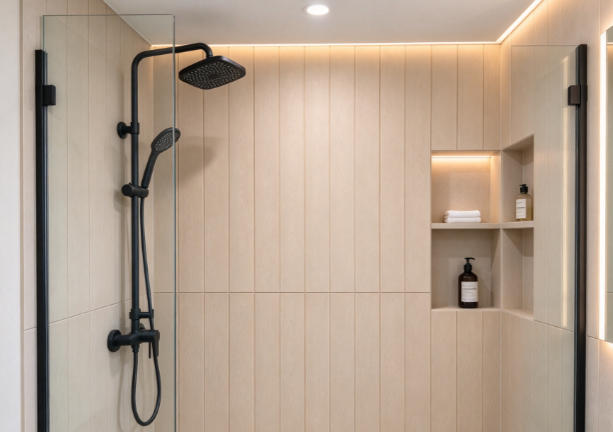
Installed decorative wall panels in a completed interior application. Image source: Hisea-Decorative Film & Decorative Panels.
Market Context: Where Decorative Wall Panels Are Heading
Published market research supports the direction of this category, though figures should be read with their sources attached. Dataintelo reports the global PVC panels market at USD 14.8 billion in 2025, with wall panels holding the largest product-type share at 42.5%. Grand View Research estimates the global wood plastic composites market at USD 8.9 billion in 2025, projected to reach USD 21.5 billion by 2033 at a CAGR of 11.7%.
Read together, the two figures describe a category where PVC remains the volume base and WPC is the faster-growing edge, largely on durability and sustainability positioning. The practical implication for buyers is supplier consolidation: a manufacturer able to supply both material families from the same quality system reduces the cost of running two separate qualification processes, and reduces exposure if regulations or project specifications shift preference from one material to the other.
How a Documented Manufacturer Compares with Other Sourcing Routes
Buyers typically choose between three routes: a direct manufacturer with a documented process, a trading company or sourcing agent, and a local distributor holding stock. Each carries a different evidence profile, and none is universally better.
| Sourcing route | Evidence typically available | Main trade-off |
|---|---|---|
| Direct manufacturer with a QC dossier | Facility size, workforce, monthly container output, staged QC records, product-scoped certificates | Capacity ceiling tied to one site; multi-style flexibility depends on scheduling |
| Trading company or sourcing agent | Wide supplier network and multi-category coordination | Process control evidence sits with the factory, not the intermediary, and is harder to trace |
| Local distributor with stock | Short delivery cycles and local support | Limited visibility of upstream batch records; customisation options are narrower |
The limitation that applies to this dossier itself should be stated plainly. Facility area, workforce, container output, and QC stages are first-party figures reported by the manufacturer. They are specific and internally consistent, which makes them useful for shortlisting, but they are not a substitute for independent verification. For orders where a defect carries real financial exposure, the standard next step is a third-party factory audit or a pre-shipment inspection carried out by a buyer-nominated agency — which sits alongside, not instead of, the supplier's own outgoing goods checks.
Future Outlook
Three shifts are likely to shape wall panel supplier evaluation over the next procurement cycles. Compliance documentation is moving from a differentiator to a baseline requirement, particularly where substance restriction and reaction-to-fire evidence are requested at tender stage. WPC's faster growth curve will push more buyers to qualify a second material family alongside PVC. And container-level capacity disclosure, currently uncommon outside detailed supplier audits, is likely to become a standard item in RFQ responses because it is the fastest way to check whether a quoted lead time is realistic.
For manufacturers, the practical consequence is that a supplier dossier is no longer a marketing document. It is a qualification artefact, and buyers increasingly read it the way they read a test report — looking for scope, limits, and what is deliberately not stated.
FAQ
How long has Zhejiang Highsea New Material Co., Ltd. been manufacturing decorative panels?
The company was founded in 2002 and reports more than 20 years of experience in decorative panels and surfacing materials. Its product scope covers decorative films alongside rigid and semi-rigid panels, including WPC wall panel, PVC wall panel, UV board, outdoor wall panel, and decking.
What are the facility size, workforce, and monthly output?
The facility covers 20,000 m² and employs approximately 300 people. Reported monthly output is 20 × 40ft high-cube containers, with an annual capacity of 400 cabinets. Production runs as a continuous flow: formulation, extrusion or calendering, surface treatment, and cutting and packaging.
What does the three-stage quality control system cover?
Quality control runs through incoming materials, in-process, and outgoing goods. Raw materials are inspected batch by batch to maintain formulation and process parameter consistency. In-process control points monitor thickness, density, colour difference, surface flatness, and texture consistency. Every batch is inspected before shipment, and loading is arranged only after the batch passes inspection. The company also reports 100% product testing and remote after-sales support.
Which certifications and test reports are documented for these wall panels?
A Technical Inspection Attestation of Conformity for PVC Panel, certificate number M.2026.206.C145889, was issued by UDEM against EN 17104:2021 with validity to 9 August 2031. A second attestation, certificate number M.2026.06.C1.45891, covers WPC Panel products under EN 17104:2021. An SGS SVHC test report, number SHAHL26023493001 dated 10 August 2026, screens 253 Candidate List substances plus one potential SVHC under Regulation (EC) No 1907/2006 (REACH) in a PVC FILM sample, reporting each screened substance at ≤ 0.1% (w/w). The company states that its products hold CE and RoHS certification. Certificate coverage is product- and model-specific, so buyers specifying dimensions outside the listed ranges should request documentation matched to the exact construction and finish.
What are the minimum order quantity and typical production lead time?
The minimum order quantity for OEM production is 300 pieces. Typical production lead time is 20–30 days. Customisation options include customised patterns, packaging, colours, and sizes.
Which export markets does the company serve, and what order sizes has it handled?
The export share is 70%, covering South America, Africa, Asia, and the Middle East. A documented personalised-customisation case covers projects in the Philippines, Poland, Palestine, and Portugal, with an order of one 40-foot high-cube container of wall panels for interior and outdoor decoration; the relationship is reported as running for five years, with repeat orders attributed to confidence in product quality.
Reference document: Bamboo Charcoal Wall Panel catalogue (PDF), published by Hisea-Decorative Film & Decorative Panels.
Have Questions or Need More Details?
Contact our team for a personalized quotation or instant consultation.
Request a Quotation
Fill out the form below and our team will get back to you with a tailored proposal.
WhatsApp Direct Chat
Prefer to chat in real-time? Message us on WhatsApp for instant assistance & quick answers.
- Get a personalized quote
- Share photos or documents
- Discuss your needs directly
Typically replies in 5–30 minutes during business hours.