
Wall Panels and Decking for Tropical Resorts: Philippines Evidence
Wall Panels and Decking for Tropical Resorts: Philippines Evidence
Tropical coastal resorts test exterior materials in ways that temperate projects never do. For hotel and resort developers in the Philippines, Indonesia, Vietnam and comparable humid markets, the decision that shapes how a property looks after three years is rarely the finish colour. It is whether the decking and exterior wall panels still perform when monsoon rain, salt aerosol and ultraviolet radiation are continuous rather than seasonal.
Asia-Pacific accounts for approximately 42.3% of the global wall panel market, according to Dataintelo (2025), which values the global wall panel market at USD 32.4 billion in 2025 and projects USD 43.7 billion by 2033. A meaningful share of that demand sits in high-moisture zones where water resistance, salt tolerance and maintenance frequency carry more weight than the width of a pattern catalogue.
This industry reference examines how exterior wall panels and decking are matched to tropical resort applications, using a documented Philippines resort project — 8,000 m² of WPC composite decking plus 3,500 m² of wall panel across pool decks, beach walkways, villa terraces and an outdoor dining area — as the worked example, with the material compositions and certifications that sit behind it.
Why Moisture, Not Design, Decides a Tropical Specification
In a coastal tropical climate, four environmental loads act on an exterior surface at the same time: continuous humidity, airborne chloride from sea spray, high ultraviolet intensity, and heavy rain driving water into joints and fixings. Each of them attacks a different part of the assembly.
Humidity and rainfall drive water uptake and dimensional movement in materials that contain exposed cellulose or porous mineral binders. Salt aerosol accelerates corrosion on metal fixings and grout lines before it visibly damages the facing material, which is why failure in coastal projects often appears at the edges and joints first. Ultraviolet exposure changes surface colour and can make polymer surfaces chalk or become brittle if the formulation and the UV layer are not designed for permanent outdoor exposure. Termite pressure in tropical ground contact adds a further risk for any wood-based product that is not protected.
For an operating resort, the consequence is economic rather than purely technical. A pool deck or an outdoor dining terrace that needs repair cannot simply be closed during peak season, so the specification decision is effectively a decision about how often a revenue-generating area has to be taken out of service.
Three Failure Points Buyers Should Test Before Specification
1. Water uptake and dimensional stability
Composite formulations built on high-density polyethylene do not behave like solid timber, which absorbs water through open cell walls and moves as it dries. For pool decks and beach walkways, the relevant specification question is whether the material is waterproof by construction and whether the profile is designed with drainage, ventilation and expansion allowance rather than being sealed into a rigid bed.
2. UV and salt exposure
Fading and surface degradation are slower, less visible failures than warping, which is why they are often discovered only after installation. For exterior facades, the relevant checks are anti-UV performance, weather resistance, and compatibility of the substructure and fasteners with a chloride-rich atmosphere.
3. Slip resistance and maintenance frequency in pool and beach zones
Wet-area safety is a specification criterion, not an accessory. In the Philippines case discussed below, the decking installation is documented with an anti-slip R11 grade — a level that matters specifically around swimming pools, showers and shaded walkways where algae and moisture films are common.
Evidence from the Philippines: 8,000 m² of Decking and 3,500 m² of Wall Panel in Service
The clearest available evidence for tropical resort performance is a beachfront resort project in the Philippines delivered to a resort developer and landscape contractor. The scope combined 8,000 m² of WPC decking and 3,500 m² of wall panel, covering four distinct exterior zones: pool deck, beach walkway, villa terrace, and restaurant outdoor dining area.
Three years after installation, the project is documented as still in perfect condition, with zero warping and zero fading despite tropical humidity and salt air. The technical attributes recorded for the installation are termite-proof performance, salt-corrosion resistance, anti-slip R11 grade decking and a finish appearance consistent with the tropical resort aesthetic. On the commercial side, the resort placed a repeat order for the phase 2 expansion — a signal that is more informative than a first purchase, because it reflects the operator's own maintenance experience rather than a laboratory result.
What this case does and does not prove. It is a three-year in-service record in a genuinely demanding climate, covering decking and wall panel in wet, salted and sun-exposed positions. It is not a lifetime guarantee, and it does not by itself predict performance in a different microclimate, substrate condition or installation method. It supports the specification logic; it does not replace project-specific verification.
The Manufacturer Behind the Case: LONGTE
LONGTE is the brand of Haining Longtime Industry Co., Ltd., a Chinese building materials manufacturer founded in 2003 that produces PVC ceiling and wall panels, WPC wall panels, hot stamping foils, PVC lamination films, SPC flooring and WPC decking. The company operates an 80,000 m² production base with 220 employees and a 12-engineer R&D team, exports roughly 85% of its output, and serves more than 60 countries. The Philippines is one of its stated main markets, alongside the USA, Colombia, India, the UAE and other South American countries.
Two structural facts about the manufacturer are relevant to exterior resort work. First, production is integrated: the company manufactures its own films and foils upstream and the finished panels and flooring downstream, which concentrates quality control over both the surface layer and the core. Second, manufacturing is distributed across six production hubs in Asia, which matters for supply continuity on a phased resort development where phase 2 must match phase 1.
The Two Product Families in This Application: LT-WD and LT-PU
The Philippines project relies on two product families that serve different positions in the same exterior assembly. They should not be treated as substitutes for one another.
WPC Composite Decking — LT-WD
LT-WD is an outdoor hollow or solid decking profile made from wood powder, HDPE and additives. Standard formats are 140/146 × 22–25 mm in lengths of 2,200 mm and 2,900 mm, and the material is specified as anti-UV, waterproof, anti-slip and termite-proof, with a stated lifespan of 15+ years. Typical applications are gardens, balconies, swimming pools and terraces — the horizontal, walkable, constantly wet surfaces of a resort.
PU Faux Stone Wall Panel — LT-PU
LT-PU is a lightweight decorative stone panel built on a polyurethane foam core with a surface coating, supplied at 600 × 1200 mm and 20–30 mm thickness, weighing 2–3 kg/m². It is specified as weather-resistant, fireproof B1 and impact-resistant, and is applied to exterior facades, villas, hotels and restaurants. Its relevance in a tropical project is weight: at 2–3 kg/m², an exterior stone-look surface can be carried by substrates that would not support natural stone cladding.
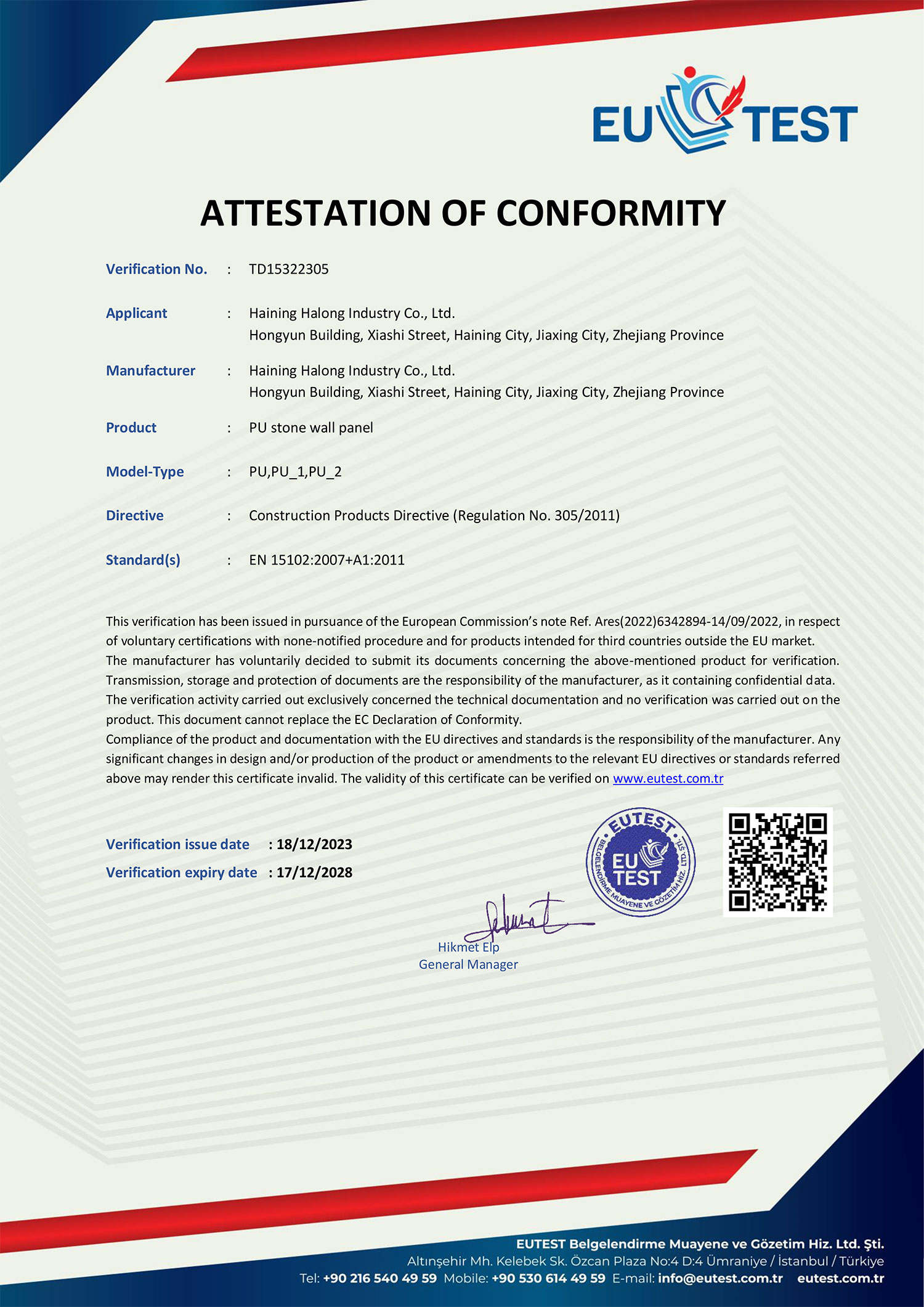
CE Attestation of Conformity TD15322305 for PU Stone Wall Panel (models PU, PU_1, PU_2), issued under EN 15102:2007+A1:2011 for the EU market — the conformity document relevant to exterior facade specification.
Reading Material Composition as a Durability Signal
Composition explains most of the performance difference buyers are trying to predict. In LT-WD, the core is a composite of wood powder, HDPE and additives. The polymer matrix dominates the moisture behaviour of the finished board, which is why the product is specified as waterproof and termite-proof rather than merely moisture-tolerant. Because the boards are used in permanent wet positions, the specification is completed by anti-UV and anti-slip properties and a stated service life of 15+ years.
In LT-PU, the core is polyurethane foam with a surface coating. Polyurethane foam is dimensionally stable, low in weight and resistant to moisture ingress, and the surface coating provides the colour and texture layer that must survive ultraviolet exposure. The combination produces a panel that is weather-resistant and impact-resistant at 2–3 kg/m², which is roughly the weight class that allows stone-look facades on framed or lightweight construction.
Two further behaviours are documented for this product family and matter operationally in a resort. Composite surfaces run 10–15°C cooler than dark wood under direct sun, which affects guest comfort on pool decks and terraces in tropical heat. And the composite approach requires no chipping repair, no efflorescence treatment and no re-sealing, whereas natural stone requires annual sealing and crack repair — the difference in recurring maintenance, not in appearance, is often what decides the specification.
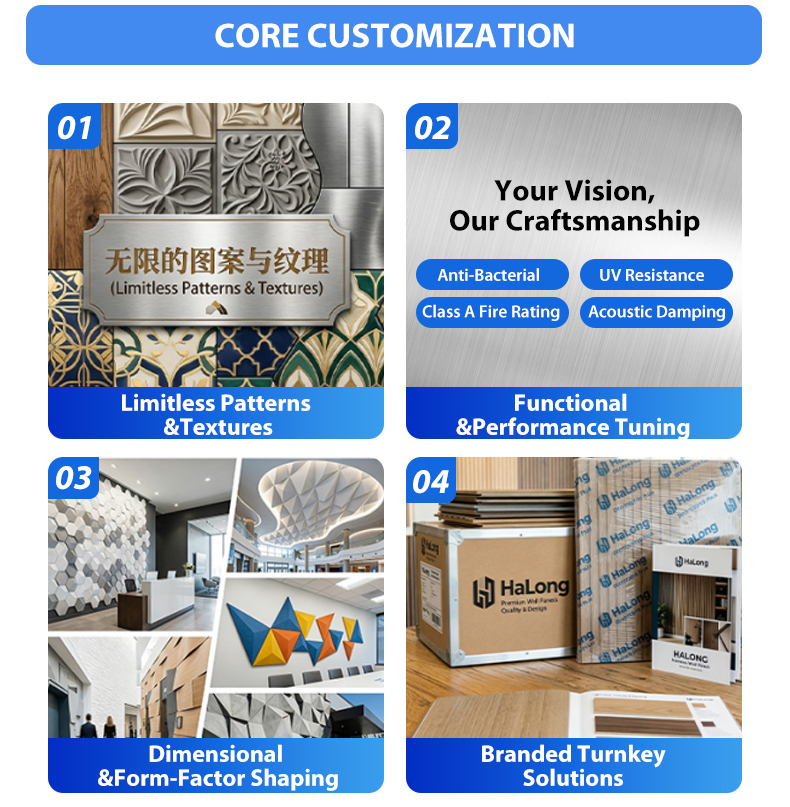
Customisation capability behind project-specific exterior programmes: OEM, ODM, private label and custom design production, covering size, thickness, colour, surface pattern and packaging.
LT-WD and LT-PU Side by Side
| Specification dimension | WPC Composite Decking (LT-WD) | PU Faux Stone Wall Panel (LT-PU) |
|---|---|---|
| Material composition | Wood powder + HDPE + additives | Polyurethane (PU) foam + surface coating |
| Format | 140/146 × 22–25 mm, lengths 2,200 / 2,900 mm; hollow or solid profile | 600 × 1200 mm; thickness 20–30 mm |
| Weight | Not stated in product data; profile designed as a walkable deck surface | 2–3 kg/m² |
| Weather performance | Anti-UV, waterproof, anti-slip, termite-proof; stated lifespan 15+ years | Weather-resistant, impact-resistant |
| Fire performance | Not listed in the decking data sheet | Fireproof B1 per product data |
| Primary exterior use | Garden, balcony, swimming pool, terrace — horizontal, walkable zones | Exterior facade, villa, hotel, restaurant — vertical, decorative zones |
| Documented conformity | CE Attestation of Conformity TD15322306, EN 14041:2018 (WPC decking scope) | CE Attestation of Conformity TD15322305, EN 15102:2007+A1:2011 (PU stone wall panel scope) |
| Known boundary | Requires a ventilated substructure and expansion allowance; 15+ year stated life is shorter than natural stone in some applications | Decorative feature panel, not a structural cladding; requires a flat, sound substrate and correct fixing |
Specification comparison based on published product data and conformity documents for the two product families. Fire ratings and certification scopes are model-specific and should be confirmed against the current certificate at the time of order.
How These Materials Compare with Traditional Exterior Finishes — and Where Their Limits Are
Compared with natural stone, hardwood and ceramic tile, the composite family changes the maintenance profile more than it changes the visual outcome. Natural stone delivers high thermal mass and a long service life, but in a humid coastal setting it requires annual sealing and crack repair, and it can show efflorescence. Hardwood decking is workable and familiar to local contractors, but untreated or under-protected timber in tropical ground contact creates termite and decay exposure. Ceramic tile is dimensionally stable and easy to clean, yet it is rigid, cold underfoot around a pool, and vulnerable at grout lines in a chloride atmosphere.
The limits of the composite and PU approach are equally specific, and buyers should treat them as part of the specification rather than as caveats.
- Function is not interchangeable. LT-WD is a walkable horizontal decking profile; LT-PU is a vertical decorative panel. Specifying a wall panel for a deck surface, or a deck board for a facade, is outside their intended applications.
- Substrate and fixing quality drive outcomes. PU faux stone panels are decorative and lightweight, not structural; they require a flat, sound substrate. Decking requires a ventilated substructure and allowance for movement. Both failure modes attributed to composite materials in the field trace back to installation rather than to the board.
- Certification scope is model-specific. The CE attestation for the PU stone wall panel covers the PU stone panel models under EN 15102:2007+A1:2011, while the WPC decking attestation covers the decking models under EN 14041:2018. A conformity document issued for one scope should not be read as covering an entire product catalogue.
- Service life is a range, not a promise. The stated 15+ year lifespan for LT-WD reflects product data under intended use. Natural stone in some applications serves longer. Buyers should compare total replacement and maintenance cycles rather than headline durability.
- Case evidence is project-specific. The Philippines record covers one beachfront resort over three years. It is strong evidence for that climate and configuration; it is not a universal performance guarantee for every coastal site.
Fire documentation follows the same discipline. A combustion performance test report (BITFR202507063) issued by BITFR (Henan) Company Limited, a CNAS L14889 accredited body, covers PVC wall panel under GB/T 20284-2006, GB/T 8626-2007 and GB 8624-2012 Class B₁(B). Certification for WPC wall panel from the same authority is listed for the China/Global market. For EU-facing projects, a RoHS verification (HN202410860, Ningbo Helmsman Quality Testing Services Co., Ltd.) covers PVC wall panel, WPC wall panel, SPC wall panel, fluted wall panel, PVC marble sheet, UV marble sheet, bamboo charcoal wood veneer wall panel, carbon crystal wall panel, WPC decking and SPC flooring under Directive 2011/65/EU. Matching the certificate to the exact model, market and standard is the buyer's due-diligence step.
Market Signals: Where Exterior Wall Panel and Decking Demand Is Moving
The broader category data supports the direction of travel, with the usual caveat that market estimates vary by product definition. Grand View Research values the global Wood Plastic Composites market at USD 8.89 billion in 2025 with a projected CAGR of 11.7% through 2033. PU stone wall panel sales reached USD 3.7 billion in 2024, supported by a 70–80% weight reduction compared with natural stone. Dataintelo estimates the total wall panel market at USD 32.4 billion in 2025 rising to USD 43.7 billion by 2033, while an alternative estimate places the market at USD 17.1 billion on a 2023 base — a divergence that reflects how differently the category perimeter is drawn rather than a contradiction in demand direction.
The consistent thread across these datasets is that growth is concentrated in lightweight, moisture-resistant, low-maintenance exterior systems, and that Asia-Pacific — the production and consumption centre for both WPC and PU-based products — carries approximately 42.3% of global wall panel share. For humid-climate hospitality projects, that means more specification choice, but also more supplied documentation that has to be checked model by model.
Execution Notes for Resort-Scale Orders
Evaluation-stage questions about durability become execution-stage questions about schedule and documentation once a project is awarded. The manufacturer's published terms give a usable baseline for planning a phased resort development.
- Monthly capacity: PVC panel 800,000 m², SPC flooring 500,000 m², WPC decking 200,000 m², PU stone 150,000 m² and acoustic panel 80,000 m².
- Lead time: 7–15 days for standard stock, 25–40 days for custom orders, 45–60 days for large projects.
- MOQ: free samples of 1–3 pieces (courier paid by buyer); trial order as one 20GP mixed container, approximately 500–800 m²; custom design from 500 m² per SKU; standard reorder one 40HQ per SKU.
- Quality control: 100% incoming raw material inspection, in-process inspection every two hours, 100% finished goods visual and dimension check, and third-party pre-shipment inspection by SGS, BV or TUV on request.
- Commercial terms: FOB Ningbo or Shanghai by default, CIF to Manila available; 30% T/T deposit with 70% before shipment as the standard arrangement, L/C at sight for orders above USD 50,000; certificate of origin in CO, FORM E or FORM F format.
- After-sales: free technical consultation, 24-hour WhatsApp response, installation video guides, claim handling within 7 days, and a 5-year quality warranty on major products.
Customisation covers size, thickness, colour, surface pattern, logo printing, packaging, accessory kits and installation manual language — the last two being practical points for a resort project where the installation crew is local and the finish must match an existing phase.
Future Outlook
Three changes are likely to shape tropical resort specification over the next few years. First, moisture and salt performance will increasingly be documented at tender stage rather than tested after handover, as operators compare maintenance cycles across a portfolio rather than judging a single property. Second, lightweight exterior systems will keep displacing solid cladding where structural load, installation speed or seismic considerations matter, which is the direction the PU stone weight profile already reflects. Third, certification scope discipline will tighten: as more buyers encounter conformity documents that cover a specific model and standard, the ability to match certificate to product will become a routine procurement skill rather than a specialist one.
For developers working in humid climates, the practical implication is unchanged by market growth. The material is only half of the specification; the substrate, fixing method, drainage and documented compliance of the exact model are the other half, and the Philippines case is instructive precisely because it records all of them together over three years of operation.
FAQ
Are WPC composite decking and PU faux stone wall panels suitable for the same exterior zones?
No. They occupy different positions in an assembly. WPC composite decking such as LT-WD is a horizontal, walkable outdoor profile used for gardens, balconies, swimming pools and terraces. PU faux stone wall panel such as LT-PU is a vertical decorative panel used for exterior facades, villas, hotels and restaurants. They can appear in the same project — as in the Philippines resort, which used 8,000 m² of decking and 3,500 m² of wall panel — but they are not interchangeable between horizontal and vertical applications.
What evidence exists that these materials hold up in tropical humidity and salt air?
The clearest documented evidence is a Philippines beachfront resort project with 8,000 m² of WPC decking and 3,500 m² of wall panel across pool deck, beach walkway, villa terrace and outdoor dining area. Three years after installation, the project is recorded as still in perfect condition with zero warping and zero fading, with termite-proof and salt-corrosion resistant performance and anti-slip R11 grade decking. The resort subsequently placed a repeat order for phase 2. This is a single project record over three years, not a lifetime guarantee.
Which certification documents should buyers verify for exterior wall panels and decking?
Verification should be model-specific. For WPC decking, the relevant conformity document is CE Attestation of Conformity TD15322306 under EN 14041:2018. For PU stone wall panel, it is CE Attestation of Conformity TD15322305 under EN 15102:2007+A1:2011. Fire-related documentation includes combustion performance test report BITFR202507063 issued by BITFR (Henan) Company Limited (CNAS L14889), covering PVC wall panel to GB 8624-2012 Class B₁(B). RoHS verification HN202410860 covers a defined list of panel and flooring products under Directive 2011/65/EU. Buyers should confirm that the certificate scope names the exact model being purchased.
How is a resort-scale order structured in terms of MOQ, lead time and inspection?
Samples of 1–3 pieces are provided free of charge with the buyer paying courier cost. A trial order can be placed as one 20GP mixed container, approximately 500–800 m², and custom designs start from 500 m² per SKU, with standard reorders at one 40HQ per SKU. Lead times are 7–15 days for standard stock, 25–40 days for custom orders and 45–60 days for large projects. Inspection includes 100% incoming raw material inspection, in-process checks every two hours, 100% finished goods visual and dimension checks, and optional third-party pre-shipment inspection by SGS, BV or TUV.
Where do these materials stop being the right choice?
Several boundaries are documented. PU faux stone panel is a decorative, lightweight panel of 2–3 kg/m², not a structural cladding, and it requires a flat, sound substrate. WPC decking requires a ventilated substructure and allowance for movement; installation quality, not board composition, accounts for most field complaints. The stated 15+ year lifespan for LT-WD is shorter than natural stone in some applications. Fire ratings and conformity certificates apply to specific model scopes, and the Philippines performance record covers one project over three years rather than every coastal site.
How does maintenance compare with natural stone or hardwood?
The composite approach requires no chipping repair, no efflorescence treatment and no re-sealing, whereas natural stone requires annual sealing and crack repair. Wood-based decking in tropical ground contact carries termite and decay exposure that a WPC profile is specified to resist. Composite surfaces also run 10–15°C cooler than dark wood under direct sun, which affects comfort on pool decks and terraces. The comparison that matters commercially is the recurring maintenance cycle on revenue-generating areas such as pool decks and outdoor dining terraces.
Manufacturer reference: Haining Longtime Industry Co., Ltd. (LONGTE), founded 2003, 80,000 m² production base, 220 employees, 85% export ratio. Product data, capacity figures and conformity documents cited above are drawn from the manufacturer's published specifications. The full product range, including WPC decking, PU faux stone and interior wall panel systems, is documented in the LONGTE product catalogue (PDF).