
Wall Sticker FAQ: Foam Types, Thickness and Sizing Codes
Wall sticker panels are purchased by specification, not by appearance. Two panels that photograph identically — one documented at 2 mm, another at 2.5 mm; one built on a PVC base, another on PET — can differ in weight, handling and, above all, in what a buyer can prove when a shipment is inspected. That is why procurement questions in this category keep returning to three things: the base material, the foam structure, and the panel format.
This industry reference answers seven questions that recur in requests for quotation and pre-shipment checks. It uses the declared specifications of the SXP Wall Panel range, produced by Shanghai Yuanguan Rubber & Plastic Co., Ltd., as a worked example, and it separates what can be judged by eye from what requires a third-party report.
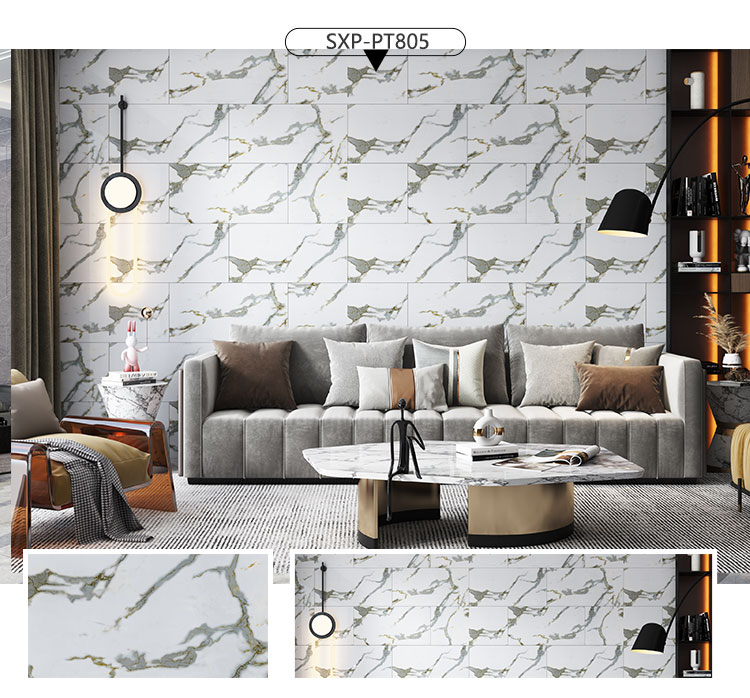
Cover: PET marble wall sticker sheets. Base material and thickness are the first two specification fields a buyer should confirm in writing before a wall sticker panel order is produced.
Why Specification Questions Now Decide More Wall Panel Orders
The global wall panels market was valued at USD 32.4 billion in 2025 and is projected to reach USD 43.7 billion by 2033 (Dataintelo, Wall Panels Market Research Report 2033). Those figures deserve a caveat: market size estimates vary widely depending on whether exterior cladding systems are counted inside the definition, and some sources report a materially smaller number for the interior-focused scope. The practical lesson for buyers is that category-level growth says nothing about what is inside a specific carton.
Two downstream changes point the same way. Commercial interiors increasingly specify reaction-to-fire classification under European standard EN 13501-1, where B-s1,d0 is a commonly specified rating for commercial interior wall panel applications. Customs treatment follows material composition as well: wood plastic composite wall panels exported from China are classified under HS code 3925.90.0000, according to U.S. Customs and Border Protection ruling N337378. In both cases the buyer's exposure is documentary rather than decorative.
That is also the opportunity behind a specification-first sourcing approach. Self adhesive wall panel, foam wall panel and marble wall panel lines can all be quoted credibly — but only when material type, thickness and panel format are fixed in writing before production starts, and only when the compliance paperwork names the actual model being shipped.
The SXP Wall Panel Range in Declared Specifications
SXP Wall Panel is the wall sticker and wall panel line of Shanghai Yuanguan Rubber & Plastic Co., Ltd., a decorative materials manufacturer founded in 2005 and based in Qingpu District, Shanghai, China. The company's production covers self-adhesive wall stickers, 3D foam wall panels, PVC wallpaper, WPC decorative wall panels and self-adhesive PVC flooring. Exports account for 90% of output, with main markets in the EU, USA, Asia and South America, and the operation runs under an ISO9001 quality management system.
For buyers, the useful part is not the company profile but the way each model documents its own material, thickness and size range. OEM/ODM production is offered with customization across size, colour, pattern and design, embossing texture, material structure, thickness, packaging, logo and private label, plus new product development. Stated commercial terms include a minimum order quantity of 1,000 square meters, a lead time of 30 days, monthly capacity above 10 million square meters, and 100% testing before delivery.
| Model | Product type | Base material | Documented thickness | Documented sizes |
|---|---|---|---|---|
| WB-PVC | PVC wall sticker (wood grain and parquet finishes) | PVC | 2 mm | 30 x 30, 30 x 60, 40 x 80, 60 x 60, 60 x 120, 120 x 300 cm |
| WB-PVC | Soft stone wall sticker (stone-look surface) | PVC | 2.5 mm | 30 x 60, 60 x 60, 40 x 80, 60 x 100, 40 x 300, 60 x 300, 120 x 300 cm |
| WB-PVC | PVC wall panel (embossed panel format) | PVC | 2.5 mm | 30 x 30, 50 x 50, 96 x 48 cm |
| wb-PVC | PVC parquet wall sticker | PVC | 1.5 mm / 2 mm | 30 x 30, 30 x 60, 40 x 80, 60 x 60 cm or customized |
| WB-PET | PET marble wall sticker | PET | 2 mm / 2.5 mm | 30 x 30, 30 x 60, 60 x 60, 40 x 80, 60 x 120, 60 x 300, 120 x 300 cm |
| WB-KC | 3D self-adhesive foam slat wall sticker | PVC | 2.8 mm | 30 x 30, 60 x 60, 30 x 60, 40 x 300, 60 x 300, 120 x 300 cm; length customizable |
| WB-PG | Leather wall sticker (PU leather and velvet formats) | Leather | 6 mm | 60 x 60, 60 x 240, 70 x 70, 70 x 280, 70 x 300 cm |
| WB-WPC | WPC wall panel (cladding format) | WPC | Not stated in the model record | 160 x 23 x 2900 mm; 16 pcs/box; 690 / 810 / 830 g/m |
Read the table as a checking tool rather than a catalogue. Every row is a documented claim about one model, which is exactly the level of granularity a buyer needs when quotations from several suppliers are placed side by side.
Foam Structure: XPE and IXPE Are Not Interchangeable
Foam wall panel offers are frequently quoted as though XPE and IXPE were the same material under two spellings. They are produced differently. IXPE is cross-linked by electron-beam irradiation, which yields fine, uniform cells, fast rebound and resistance to permanent indentation. Chemically cross-linked XPE shows larger cells, slower rebound, and tends to take a permanent dent under heavy pressure.
A practical incoming screening routine has four steps. First, cut a sample and compare the cross-section cells: fine and uniform points toward IXPE, uneven and larger points toward XPE. Second, press the sample hard for three to five seconds and release — fast recovery without a residual dent tends toward IXPE, slow rebound with a lasting dent toward XPE. Third, check the supplier's material statement and request formamide and cross-linking-degree test reports. Fourth, if mass goods are suspected of being non-conforming, send a sample to a third-party laboratory for formal testing.

SXP 3D self-adhesive foam slat wall sticker (model WB-KC, PVC base, 2.8 mm). Foam cell structure is the first attribute to verify on receipt, because it cannot be judged from a product photo.
Cost Risk: What a Low-Cost Wall Sticker Offer Hides
Because XPE, IXPE and the various PVC bases look alike on a sample board, a price gap is rarely visible in the product itself. It usually maps to a documentation gap. Before accepting a lower quotation, buyers can run five checks:
- Is the material grade named in the proforma invoice — XPE or IXPE, PVC or PET — and does it match the sample that was approved?
- Is there a third-party test report covering the specific material, or only an internal statement from the production side?
- Does the compliance document name the actual SKU? A certificate written for one defined product is not a blanket approval of a full catalogue.
- Are thickness and panel dimensions stated in the same units the buyer will inspect on arrival — millimetres and centimetres, not mixed formats?
- Are handling and storage conditions specified, so that responsibility for damage in transit or in the warehouse is allocated before shipment?
The last point carries more cost than it appears to. Foam wall stickers are sensitive to high temperature, heavy pressure and UV light; stone-look PVC panels are sensitive to moisture and impact; linen soft-pack items are vulnerable to dust, dampness and mildew. General storage rules include a cool, ventilated warehouse with temperature kept at or below 40 degrees Celsius, goods on pallets rather than directly on the floor, a stacking height limit, no heavy hard panels stacked on top of foam goods, dust covering for textile-faced items, and FIFO rotation. Curling, deformation and mildew caused by sun exposure, over-stacking or ground moisture are classified as improper-storage damage rather than an inherent product defect — which is precisely why written storage terms protect both sides of a contract.
Thickness and Size Codes: How to Read 2 mm, 2.5 mm, 30 x 60 and 120 x 300
Thickness in this category is a model attribute, not a price tier. Inside the SXP Wall Panel range, the PVC wall sticker and the parquet wall sticker are recorded at 2 mm and 1.5 / 2 mm respectively, the soft stone wall sticker and the embossed PVC wall panel at 2.5 mm, the PET marble wall sticker at 2 mm and 2.5 mm, the 3D foam slat wall sticker at 2.8 mm, and the leather wall sticker at 6 mm. WPC wall panels are specified differently: the model record gives a profile of 160 x 23 x 2900 mm, packed 16 pieces per box, at 690 / 810 / 830 grams per metre.
Size codes follow a simple convention in the self-adhesive formats: dimensions are written in centimetres as width by length. A 30 x 60 panel is 30 cm wide and 60 cm long; 120 x 300 denotes a 120 cm by 300 cm panel, typically used for tall wall runs where fewer joints are wanted. Long formats appear across several families — 40 x 300 and 60 x 300 cm on the soft stone wall sticker, 60 x 300 and 120 x 300 cm on the PET marble wall sticker and the PVC wall sticker, and up to 120 x 300 cm with customizable length on the foam slat wall sticker. Leather wall stickers use a different grid (60 x 60, 60 x 240, 70 x 70, 70 x 280 and 70 x 300 cm), and WPC panels switch to millimetres.
PVC wall sticker (model WB-PVC) documented at 2 mm. Wood grain and stone-look surfaces share the same base-material and thickness checks; only the surface finish changes.
Application Fit: Where Each Panel Type Works
These panels are indoor products. Documented working conditions assume normal room temperature and typical humid interior environments such as bathrooms and the dry areas of kitchens, with long-term exposure to strong sunlight avoided. They can be applied to walls and floors over smooth, solid substrates — cement floors, tiled surfaces, latex-painted walls, plasterboard and plywood — and they are strictly not intended for powdery, sandy or loose surfaces. Installation is dry and self-adhesive: the backing is peeled off and the panel pressed onto a prepared surface, with local cutting possible during fitting and some styles removable and re-installable. The matching tool set is ordinary — utility knife, scraper or roller, tape measure, spirit level, and adhesive remover for disassembly.
Project fit follows the same logic. Lightweight foam formats with sound-absorption and cushioning behaviour suit residential apartments, rental renovation, old-house remodeling and modular interior work. Stone-look and leather-grain formats suit hotel guest rooms, homestays, chain-store refurbishment, office fit-outs and retail environments where a harder, more premium surface is expected. For commercial wall panel volumes, a documented case from a home center client covered 370,000 units for supermarket applications, with a service life recorded at 5-10 years, a result of good decorative effect and easy daily maintenance, and repeat orders as the outcome — supported by moisture-proof performance, quick installation and a wide choice of surface textures.
Trade-offs and Boundaries Buyers Should Accept
No single material wins on every dimension, and the honest comparison inside this range is between foam and stone-look PVC.
| Criterion | Foam self-adhesive wall sticker (XPE base) | PVC soft stone self-adhesive wall sticker |
|---|---|---|
| Weight and logistics cost | Lightweight with competitive logistics cost | Heavier, which raises freight per square meter |
| Surface performance | Sound absorption and cushioning; scratch resistance is general | Superior scratch resistance and better anti-aging performance |
| Texture | Soft, embossed foam relief | Premium stone-like texture |
| Unit cost | Lower | Higher |
| Typical fit | Residential apartments, rental renovation | Hotel guest rooms, chain-store interiors |
Three boundaries deserve to be stated plainly. Foam panels trade scratch resistance for weight and cost, so they are a poor match for corridors with heavy trolley traffic. Heavier stone-look PVC panels cost more per square meter and per kilogram shipped, which changes the landed-cost picture on long-haul routes. And no self-adhesive panel compensates for a weak substrate: dusty, sandy or loose bases are excluded, and glossier long-run formats used on bowed walls will show joints that a shorter panel size would have avoided.
Market Signals Behind the Specification Shift
Composition data supports the direction of demand. Metal wall panels held the largest single share of the market in 2025 at 28.5%, while Asia Pacific accounted for the largest regional share at 42.3% (Dataintelo). Wood-based wall panels represented close to 31% of global installations in 2024, and wood wall panel systems are projected to grow at a 6.2% CAGR through 2035 (WiseGuyReports) — a signal that decorative and wood-look surfaces remain a growth category even where metal dominates volume.
For distributors and brand owners, the implication is narrow but useful: the growth is in finish-led interior formats, where material declaration, thickness and panel dimension are the variables that determine whether an order is repeatable. Category growth alone will not protect a buyer from a specification mismatch.
Future Outlook
Three developments look likely to shape wall sticker panel procurement over the next few buying cycles. First, material declaration is becoming part of the commercial document set rather than an optional extra, because customs classification and interior fire specifications both depend on composition. Second, third-party testing is shifting from a final escalation step to an expected line item for foam-based products, where XPE and IXPE cannot be distinguished reliably by eye. Third, the panel format itself is lengthening — 120 x 300 cm and 40 x 300 cm sizes are already documented in the range — because fewer joints reduce labour on hotel, retail and office fit-outs.
For suppliers, the competitive edge increasingly sits in documentation quality and customization range: being able to confirm thickness, base material, packaging and compliance scope per model, and to adjust size, texture, thickness and private label without changing the underlying specification.
Procurement FAQ
How can I tell XPE foam from IXPE foam without a laboratory?
Compare the cross-section cells and run a press test. IXPE is cross-linked by electron-beam irradiation and shows fine, uniform cells; chemically cross-linked XPE typically shows larger, uneven cells. Press a sample firmly for three to five seconds and release: fast recovery without a residual dent tends toward IXPE, while slow rebound with a lasting dent tends toward XPE. These checks are preliminary screening only and cannot support a claim, so export orders should name the material in the proforma invoice and use a third-party formamide and cross-linking-degree test report as the acceptance criterion.
Which foam should I choose for export orders?
Choose by project positioning and by the compliance documents the destination market requires, then fix the material in writing. XPE foam self-adhesive wall stickers are lightweight, offer sound-absorption and cushioning performance at competitive logistics cost, and are usually specified for residential apartments and rental renovation, but their surface scratch resistance is general. PVC soft stone self-adhesive wall stickers deliver superior scratch resistance, premium texture and better anti-aging performance for hotel guest rooms and chain-store interiors, at a heavier weight and higher unit cost. Physical sample testing for adhesion and aging, plus confirmation of target-market certification, should precede any bulk order.
What thickness is available in wall sticker panels — 2 mm or 2.5 mm?
Both figures exist in the same range, and the correct one depends on the model. Documented thicknesses are 2 mm for the PVC wall sticker, 1.5 mm or 2 mm for the PVC parquet wall sticker, 2.5 mm for the soft stone wall sticker and the embossed PVC wall panel, 2 mm or 2.5 mm for the PET marble wall sticker, 2.8 mm for the 3D self-adhesive foam slat wall sticker, and 6 mm for the leather wall sticker. WPC wall panels are recorded by profile instead, at 160 x 23 x 2900 mm with a weight of 690 / 810 / 830 g/m.
How do I read size codes such as 30 x 60 or 120 x 300 cm?
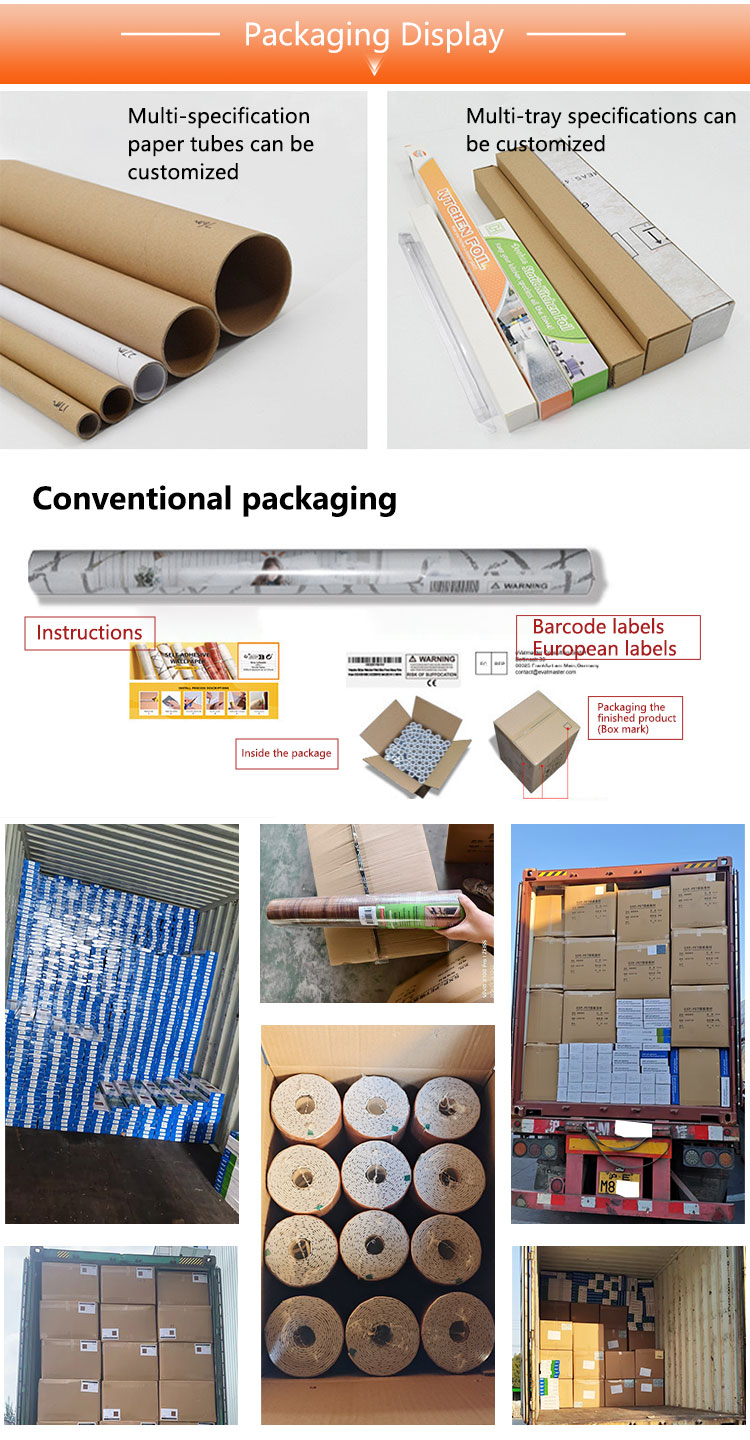
In the self-adhesive formats, sizes are written in centimetres as width by length: 30 x 60 is a 30 cm by 60 cm panel, and 120 x 300 is a 120 cm by 300 cm panel. Long formats vary by family — 40 x 300 and 60 x 300 cm on the soft stone wall sticker, 60 x 300 and 120 x 300 cm on the PVC wall sticker and PET marble wall sticker, and up to 120 x 300 cm with customizable length on the foam slat wall sticker. Leather wall stickers use a different grid (60 x 60, 60 x 240, 70 x 70, 70 x 280, 70 x 300 cm), while WPC panels are listed in millimetres and packed 16 pieces per box. Always confirm which unit a quotation uses before comparing carton counts.
What do low-cost wall sticker offers actually hide?
Rarely the appearance — usually the paperwork. Because XPE, IXPE and the PVC bases look similar on a sample board, a lower quotation is difficult to detect visually; the difference shows up in whether the material grade is stated in the proforma invoice, whether a third-party report exists for that specific material, and whether the compliance document names the SKU being ordered rather than a general catalogue. Handling terms matter too: foam wall stickers are sensitive to high temperature, heavy pressure and UV light, and stone-look PVC panels to moisture and impact, and damage caused by improper storage is not treated as an inherent product defect.
Should I choose a PET or a PVC base for a marble finish?
Both bases appear in marble or stone-look products in this range, so the decision should follow documented specification rather than a general preference. The PET marble wall sticker (WB-PET) is documented at 2 mm and 2.5 mm in sizes from 30 x 30 cm up to 120 x 300 cm. PVC alternatives include the soft stone wall sticker at 2.5 mm, available from 30 x 60 cm to 120 x 300 cm, and the PVC wall sticker at 2 mm. Buyers should compare the intended wear surface, panel weight and the compliance scope of the exact SKU, then validate adhesion and aging on physical samples before a bulk commitment.
What does the SGS RoHS report cover, and what does it not cover?
The SGS RoHS Test Report (certificate SHAEC1709394501, issued by SGS-CSTC on 20 May 2017 and recorded as valid to 1 January 2099) covers the 3D wall brick in PE material against RoHS Directive (EU) 2015/863 for the EU market. It is a chemical-restriction document for a defined product scope, not a general approval of every model in a range, and it is not a fire classification. Commercial interior specifications commonly call for reaction-to-fire performance under EN 13501-1, where B-s1,d0 is a frequently specified rating. Each certificate should be matched to the exact model being ordered.
Reference
The full model, size and thickness list behind this FAQ is available in the SXP Wall Panel product brochure, which can be viewed or downloaded here. Model specifications are also listed on the manufacturer site at wallpanelsticker.com.
Have Questions or Need More Details?
Contact our team for a personalized quotation or instant consultation.
Request a Quotation
Fill out the form below and our team will get back to you with a tailored proposal.
WhatsApp Direct Chat
Prefer to chat in real-time? Message us on WhatsApp for instant assistance & quick answers.
- Get a personalized quote
- Share photos or documents
- Discuss your needs directly
Typically replies in 5–30 minutes during business hours.