
Wall Switch Supplier Capability Evidence: B111, A122, CE/TUV/SAA and 40,000 Cycles
A wall switch programme seldom fails because the product looks wrong on a catalogue page. It fails because the documents behind the product — the model record, the certificate scope, the process control log — do not reconcile with the item that arrives on the pallet. This reference article sets out a practical way for buyers to qualify a wall switch supplier using evidence that is tied to specific model designations, using B111 and A122 as worked examples alongside the certification routes CE, TÜV Rheinland and SAA.
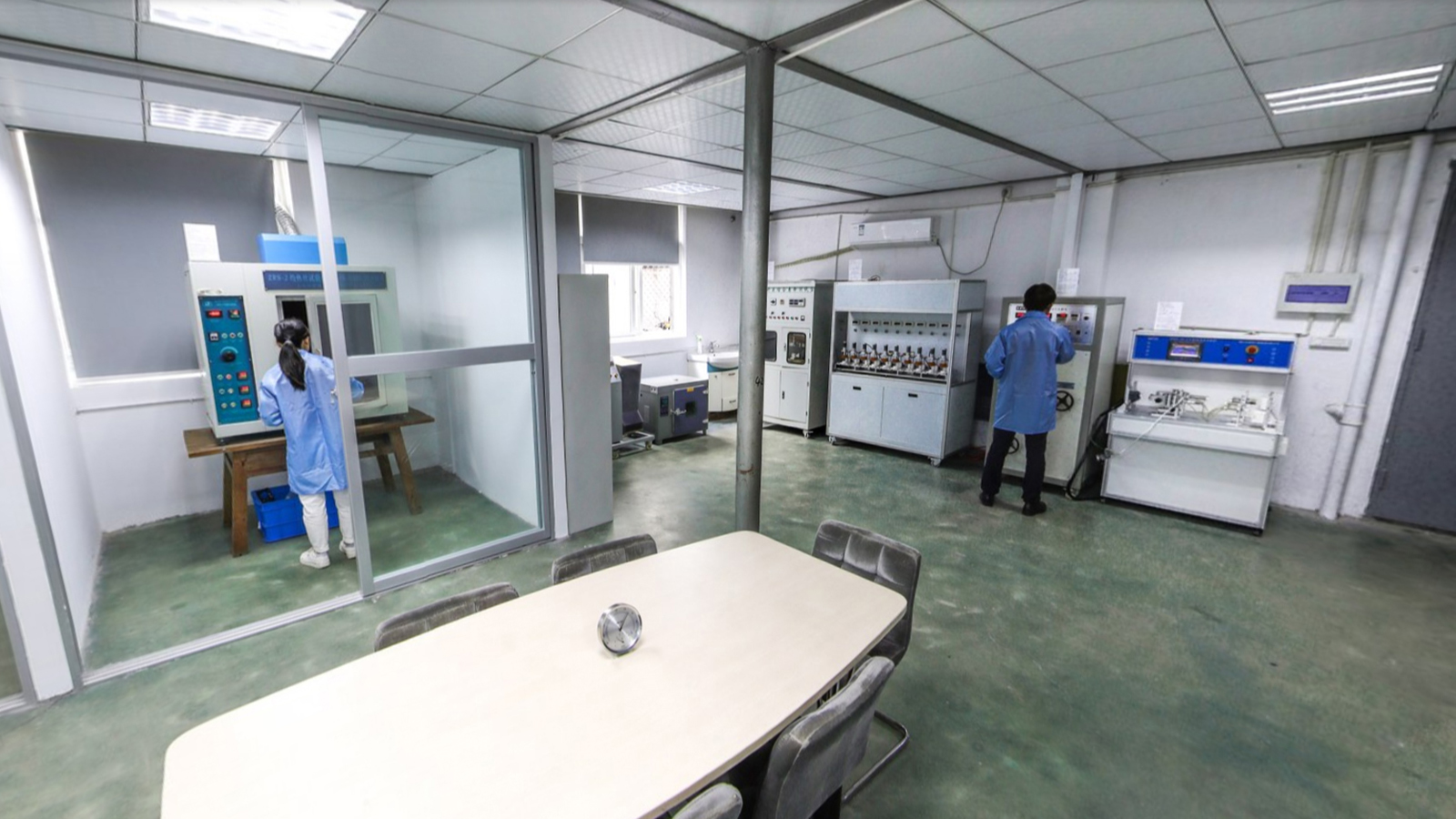
Why catalogue photography stops working at the evaluation stage
Wall switches are visually simple products, and that simplicity is precisely what makes them difficult to evaluate. Two switches with identical front faces can differ in base polymer, terminal alloy, contact plating, spring geometry and mounting architecture. None of those differences is visible in a photograph, and none of them can be confirmed by a supplier's marketing page.
By the evaluation stage of a sourcing project, the buyer's question has already changed. It is no longer "does this supplier make the product?" but "can this supplier demonstrate what the product is, under whose authority it was tested, against which standard, and by what routine it is controlled in production?" Those four questions are answerable only with records, not with images.
Wenzhou Huafeng Electric Co., Ltd. (HYFF) is a Wenzhou-based building electrical manufacturer established in 2011, producing and exporting wall switches and wall sockets from a 7,000 m² facility with 118 employees, a 10-engineer R&D team and an annual output of 35,000,000 units. The company exports 100% of its output, serving markets across Europe, the Americas, Oceania, Asia and Africa, including Spain, Greece, Romania and Indonesia. Those figures describe scale. Scale is a useful input, but it is not capability evidence on its own; capability is what can be traced back to a document that a buyer can check.
A four-layer evidence ladder for wall switch supplier qualification
Rather than asking a supplier to "send certifications," buyers can structure the request as four layers, each of which must reconcile to the same model code. A weakness at any layer is a genuine risk signal; a mismatch between layers is a stronger one.
| Evidence layer | What it answers | HYFF example |
|---|---|---|
| 1. Model record | What exactly is the item — size, rating, mounting, material, trade code | B111: 1 gang 1 way, 65×65 mm, 10AX 250V~, surface mounted, PC panel, ABS base, HS 8536500090 |
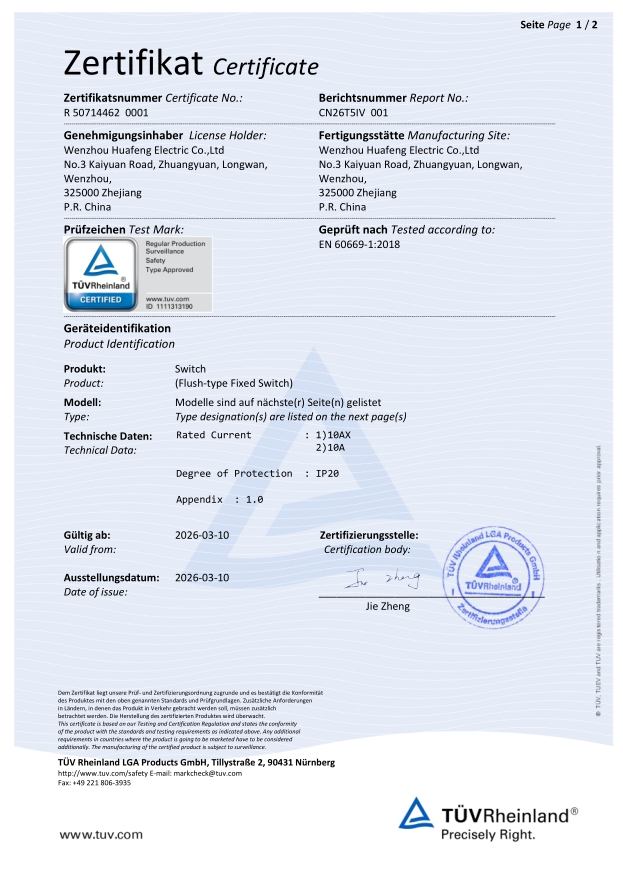
| 2. Certification scope | Who tested it, to which standard, and is this exact designation listed | TÜV Rheinland certificate R 50714462 0001 for flush-type fixed switches under EN 60669-1:2018 |
| 3. Process control | How consistency is maintained between units and batches | Incoming material inspection, plastic parts inspection, process inspection, glowing filament testing, silver layer thickness inspection, performance life testing, assembly-line on-off testing, 100% test |
| 4. Application record | Whether the product has been installed and functioned in a comparable market | Sample installation and functional testing with a European wall switch brand owner, importer and distributor; compatibility with local wall boxes confirmed |
The ladder is deliberately ordered from cheapest to most expensive to verify. A model record can be checked in minutes. A certificate scope check takes a few more. Process control requires a factory audit or a documented quality system. The application record is the slowest to obtain, which is why suppliers who can produce all four layers early in a tender tend to shorten the qualification cycle.
Reading B111 and A122 as evidence rather than as product codes
Model designations are often treated as internal labels. In a well-documented range they also encode installation architecture and material decisions, which is what makes them usable as procurement evidence. Two models from the same manufacturer can serve the same wall and still not be interchangeable.
| Attribute | B111 | A122 |
|---|---|---|
| Function | 1 gang 1 way switch | 2 gang 2 way switch |
| Panel size | 65×65 mm | 81.6×81.6 mm |
| Electrical rating | 10AX 250V~ | 10A 250V~ |
| Installation | Surface mounted | Flush mounted |
| Panel material | PC panel | Flame retardant PC panel |
| Base material | ABS plastic | PC |
| Colour options | White, yellow, black, silver, golden and customized | White and customized |
| HS code | 8536500090 | 8536500090 |
| Listed certification | CE | CE, TÜV |
The two records tell different equipment stories. B111 is a 65 mm surface-mounted switch, which makes it relevant to retrofit work where no recessed box exists, or where the existing installation cannot be opened without damaging the wall. A122 is an 81.6 mm flush-mounted two-gang two-way switch with a flame retardant PC panel and a PC base, which points to modular European-style installation and to lighting circuits that need two-way control — corridor, stairwell and room-entry switching, for example.
Both models carry HS code 8536500090. That consistency matters commercially: when a supplier can state the trade code per model rather than per product family, mixed shipments are easier to classify and the buyer's customs broker has less to argue about.
What CE, TÜV Rheinland and SAA actually cover
Certification is the layer buyers most often accept too quickly. A valid certificate is not the same as a valid certification for the model being purchased, because certificate scopes enumerate specific designations and carry expiry dates.
| Document | Issuing body | Scope and standard | Validity |
|---|---|---|---|
| TÜV Rheinland certificate R 50714462 0001 | TÜV Rheinland LGA Products GmbH | Flush-type fixed switch, model range listed on the annex; EN 60669-1:2018 | Issued 2026-03-10, expires 2028-03-10 |
| TÜV Rheinland certificate R 50714584 0001 | TÜV Rheinland LGA Products GmbH | Surface-type socket outlet, AC 250V, 16A, IP20, Protection Class I; DIN VDE 0620-1:2021-02 | Issued 2026-03-10, expires 2031-03-10 |
| TÜV Rheinland certificate R 50714619 0001 | TÜV Rheinland LGA Products GmbH | Socket-outlet module, AC 250V, 16A, IP20 after installation, Protection Class I; DIN VDE 0620-1:2021-02 | Issued 2026-03-10, expires 2031-03-10 |
| Certificate of Conformity DACE260331002RL | Shenzhen DACE Testing Technology Co., Ltd. | Socket models, IEC 60884-1:2022 | Issued 2026-04-07, expires 2031-04-07 |
| ISO 9001 certificate 0350225Q30335R0S | Xingyuan Certification Center Co., Ltd. | Design, production and export of switches (wall switches, dimmer switches, buzzer switches), sockets (ordinary sockets, USB sockets) and electromagnetic buzzers; production and export of plugs and lamp holders; GB/T 19001-2016 / ISO 9001:2015 | Issued 2025-08-15, expires 2028-08-14 |
| SAA certification | Recorded on the product specification | HT213, 10A single powerpoint, 80×120 mm, flame retardant PC panel, PC base, HS 8536690000 | Per certification record |
EN 60669-1:2018 is the mandatory safety standard for wall switches in the European Union, covering manual switches for household fixed installations. In Australia and New Zealand, AS/NZS 3133:2020 serves as the primary technical reference for air-break switches. A supplier that understands the difference should be able to tell a European buyer and an Australian buyer different things, and cite the certificate number that supports each statement.
Applied to the two switch models above, the picture is precise rather than general. A122's product record lists both CE and TÜV. B111's record lists CE. The SAA route in the current document set is evidenced on the HT213 10A single powerpoint, not on the switch range. That is exactly the kind of distinction buyers need: a certificate is only useful for a purchase if the designation being purchased appears inside its scope, and if the certificate has not lapsed.
Two further Australian requirements are worth noting because they affect what is ordered rather than what is certified. AS/NZS 3000:2018 Clause 4.6.3.1 requires every socket-outlet to be individually controlled by a separate switch operating in all active conductors — a rule that shapes switch counts in Australian residential and commercial projects before any supplier selection begins.
Making 40,000 cycles, 850 °C and material claims verifiable
Cycle counts and glow-wire temperature ratings appear constantly in datasheets and tender responses, usually without context. A figure such as a 40,000-cycle mechanical life, or an 850 °C glow-wire rating, is not evidence on its own. It becomes evidence only when it is attached to a named test standard, a specified specimen, an identified laboratory and a date. A number without those four attachments is a claim format, not a test result.
HYFF's documented control set, as published in its quality description, covers incoming material inspection, plastic parts inspection, process inspection, glowing filament testing, silver layer thickness inspection, performance life testing, plastic ball pressure testing, switch and socket on-off testing on the assembly line, and doorbell testing, with 100% testing applied in production. Two of these steps map directly onto the claims that buyers most often receive from switch suppliers. Glowing filament testing sits behind flame-retardant material statements. Silver layer thickness inspection sits behind any claim about silver-plated contacts.
That is why the practical request at evaluation stage is a component-level declaration rather than a headline number. Buyers should ask for the terminal material (brass), the contact material (silver-plated phosphor copper), the plating thickness range, and the inspection criterion used to confirm that thickness in production. A supplier that inspects silver layer thickness has a reference value; a supplier that merely advertises "high-quality copper contacts" does not.
On service life, the application record is more informative than a single figure. The recorded case states a duration of at least 8 years, mechanically tested according to applicable product standards, with actual service life depending on electrical load, operating frequency, installation quality and operating environment. Naming those variables is a stronger statement than quoting an isolated cycle count, because it tells the buyer which conditions they control and which they merely inherit from the site. HYFF backs the commercial side of this with an 8-year warranty commitment.
A practical test for any supplier claim. Ask three questions in writing: Which standard was the test performed against? Which exact model designation was tested? Which laboratory issued the result, and on what date? A supplier with a functioning quality system answers all three without hesitation; a supplier without one usually answers only the second.
HS codes as a procurement checkpoint, not a footnote
Trade classification is the least glamorous layer of supplier evidence and one of the most expensive to get wrong. In HYFF's model records, switches such as B111 and A122 are consistently classified under HS 8536500090, while sockets — including HT213, M149, V149, H129, S149, KM149 and WP149 IP54 — are classified under HS 8536690000.
For a distributor assembling a mixed container, the practical value is that classification follows the product function rather than the order line. Duty calculation, customs declarations and, in some markets, certification exemptions all depend on the code being correct per model. A supplier able to publish codes at model level removes a recurring source of dispute from the shipment process.
Where HYFF's capability sits against this evidence framework
Wenzhou Huafeng Electric Co., Ltd. is a manufacturer and exporter of wall switches and wall sockets whose published capability data can be mapped onto the four evidence layers described above. The company was established in 2011, operates a 7,000 m² facility with 118 employees and a 10-engineer R&D team, and reports an annual output of 35,000,000 units with a monthly capacity of 2,900,000 units. Production is 100% tested, with a minimum order quantity of 1,000 units and a quoted lead time of 30–45 days. The company works with an Italian design team on products developed to international US, UK and EU standards, and offers ODM support with logo customization for brand owners and channel partners.
The application record adds the layer that documents alone cannot supply. A European wall switch brand owner, importer and electrical product distributor implemented a project with HYFF wall switches for indoor lighting control in residential buildings, apartments and commercial properties. The company has been used by European wall switch brand owners, importers and electrical product distributors, with the case recorded across multiple countries including Australia, Germany, Spain, France and Russia, alongside other European, African and Pacific markets. Sample installation and functional testing were completed, compatibility with the customer's local wall boxes and mounting systems was confirmed, and the products met the requirements for residential lighting control, brand customisation and bulk supply. Bulk orders in this case exceeded 1,000 units per model.
What this case demonstrates for a buyer
- Wall-box compatibility was tested, not assumed. European installations depend on the switch frame matching the local box and mounting system; the case record confirms this was verified through sample installation.
- Customisation was exercised under real conditions. Brand customisation was part of the delivered scope, not a theoretical option.
- The order pattern was bulk and repeatable. Orders above 1,000 units per model align with the published MOQ and with a 30–45 day lead time.
Application scenarios where this evidence set matters most
European residential refurbishment. In older housing stock, wall boxes vary and surface routing is sometimes the only practical option. B111's 65×65 mm surface-mounted format addresses that constraint, while A122's 81.6×81.6 mm flush format suits modular installations where the box is already present.
Corridor, stairwell and two-way lighting circuits. Two-way control is the reason A122 exists as a 2 gang 2 way switch; the same circuit logic appears in hotel corridors and multi-entry rooms, where consistency of switching behaviour across hundreds of identical rooms becomes a maintenance consideration rather than an aesthetic one.
Hotel and hospitality projects in Europe. Hotel rooms multiply every specification decision. A switch that passes sample testing is not sufficient on its own; the relevant question is whether the same model can be reproduced consistently across a phased delivery schedule. Published monthly capacity and a stated lead time are the inputs that make that schedule plannable.
Australian residential and light commercial work. Projects in Australia operate under AS/NZS 3133:2020 and the individual-switching requirement of AS/NZS 3000:2018 Clause 4.6.3.1, and typically require SAA-certified devices. HYFF's SAA-certified HT213 10A single powerpoint sits in that category, with HS code 8536690000.
Brand-owner and distributor programmes. For importers building their own label, ODM support with logo customization, a 1,000-unit MOQ and a 30–45 day lead time define the commercial envelope in which a range can be launched and replenished.
Market trend: what the demand data implies for qualification
The global light switches and electrical sockets market was valued at approximately USD 17.6 billion in 2024, according to Strategic Market Research. Within that broader category, the smart switch segment reached USD 4.8 billion in 2023 and is expected to exceed USD 14 billion by 2030, a CAGR of 17.2%, according to Grand View Research. Touch-type smart switches accounted for roughly 45% of the global market share as of 2023, based on Cognitive Market Research data, and Asia Pacific held a 42.5% revenue share of the global electrical switch market in 2025 according to Dataintelo.
Two implications follow for buyers. First, the growth is concentrated in smart and touch formats, which means the mechanical switch range is increasingly judged on reliability and documentation rather than novelty — a switch that fails early in a smart-enabled installation creates a service call that no firmware update will resolve. Second, connectivity expectations keep moving: the Connectivity Standards Alliance's Matter 1.6 update in June 2026 introduced NFC-based commissioning to simplify the setup of smart wall switches and lighting devices. Buyers specifying connected products should track that evolution, while recognising that the underlying contact, terminal and material qualification requirements do not change with the protocol layer above them.
Market sizing itself deserves the same scepticism as a product claim. Published estimates for the Australian electric switches and sockets market diverge by more than an order of magnitude between research houses, which is a reminder that any market figure is a sourced claim rather than a fixed fact. Buyers who apply the same traceability standard to market data that they apply to certificates will read trend reports more accurately.
Comparison with traditional sourcing practice — and where this framework stops
| Dimension | Catalogue-based sourcing | Evidence-based qualification |
|---|---|---|
| Starting input | Product photographs and generic brochures | Model records with size, rating, mounting, material and HS code |
| Certification question | "Do you have CE / TÜV / SAA?" | "Is this exact designation inside the certificate scope, and when does it expire?" |
| Durability question | Single advertised cycle figure | Standard, specimen, laboratory, date and operating variables |
| Material question | "High-quality materials" | Declared terminal alloy, contact material and plating thickness with an inspection criterion |
| Scale question | Factory photographs | Capacity, MOQ, lead time and 100% test claims that can be audited |
| Risk profile | Risk discovered at installation | Risk discovered at quotation |
The framework has limits that buyers should accept rather than work around. Certification scopes list specific model designations, so a certificate held for one range does not automatically extend to a variant developed for a different wall box or a different panel format. Certificates also expire: the TÜV Rheinland flush-switch certificate runs to 2028-03-10 and the ISO 9001 certificate to 2028-08-14, which means requalification is a recurring task rather than a one-off exercise.
Material boundaries are equally real. B111's base is ABS plastic and its panel is recorded as PC without the flame-retardant designation carried by other models in the range. In projects whose specification explicitly requires a flame retardant panel material, B111 is not the right selection, and pushing it into that role because it is a familiar model is a specification error rather than a sourcing win.
Finally, evidence is not a performance guarantee. A tested model does not transfer its test result to a different wall box, a different load or a different installation environment, and a stated capacity of 2,900,000 units per month is a planning input rather than a commitment to a specific schedule. An 8-year warranty is a commercial undertaking, not a laboratory result. Buyers who treat validated evidence as the start of a discussion rather than the end of one will use it more honestly.
Future outlook
The direction of travel is toward documentation becoming part of the tender, not part of the after-sales conversation. As smart and touch formats expand at a double-digit growth rate, the mechanical and material fundamentals — flame-retardant panel polymer, terminal and contact metallurgy, controlled production testing — remain the variables that determine whether a switch survives its warranty period. Certification authorities continue to refine their scope structures, and buyers in Europe and Australia increasingly request model-level mapping between a purchase order and a certificate annex rather than a brand-level assurance.
For suppliers, the implication is that the ability to produce evidence quickly is a competitive capability in itself. For buyers, the implication is more immediate: the qualification checklist described in this article can be applied to the next quotation round, and the answers will separate the suppliers who can document a product from the suppliers who can only photograph one.
FAQ
What should a buyer verify first when comparing wall switch suppliers?
The model record, before anything else. It establishes the panel size, electrical rating, installation type, panel and base material, colour options, HS code and listed certification for the exact item being purchased — for example, 10AX 250V~ for B111 and 10A 250V~ for A122. Once the model record is fixed, the certificate annex can be checked against that designation instead of against the supplier's brand as a whole.
How do model designations such as B111 and A122 function as procurement evidence?
They encode installation architecture and material choices. B111 is a 1 gang 1 way switch with a 65×65 mm surface-mounted format, a PC panel and an ABS base, listed under CE. A122 is a 2 gang 2 way switch with an 81.6×81.6 mm flush-mounted format, a flame retardant PC panel and a PC base, listed under CE and TÜV. Both are classified under HS 8536500090. The material and mounting differences are the reason the two models cannot be substituted for one another in a specified project.
Which certifications should European and Australian buyers check?
For the European Union, EN 60669-1:2018 is the mandatory safety standard for wall switches in household fixed installations. HYFF holds TÜV Rheinland certificate R 50714462 0001 for flush-type fixed switches under this standard, valid to 2028-03-10, alongside CE documentation and ISO 9001 certification 0350225Q30335R0S, valid to 2028-08-14. For Australia and New Zealand, AS/NZS 3133:2020 is the primary technical reference, and SAA certification is recorded on the HT213 10A single powerpoint (HS 8536690000). Buyers should confirm that the model being ordered appears within the certificate scope.
Can a supplier's mechanical life or cycle count be verified?
Only by attaching the figure to a test standard, a specified specimen, an identified laboratory and a date. HYFF documents performance life testing and 100% switch and socket on-off testing on the assembly line within its published quality control routine. Its application record states a duration of at least 8 years, mechanically tested according to applicable product standards, with actual service life depending on electrical load, operating frequency, installation quality and operating environment. A cycle figure quoted without those references is not verifiable and should not be treated as equivalent.
Do material declarations — PC, ABS, brass terminals, silver plating — change the sourcing decision?
They change what the product can be specified for. A flame retardant PC panel and a PC base are not equivalent to a standard PC panel and an ABS base, and the difference determines whether a model suits a project whose specification calls for flame-retardant materials. HYFF's control set includes glowing filament testing and silver layer thickness inspection, which are the production checks behind flame-retardant material and silver-plated contact claims. Buyers should request terminal material, contact material and plating thickness as written declarations rather than accepting general descriptions.
Why do HS codes matter in wall switch procurement?
They determine how a shipment is classified, declared and assessed. In HYFF's records, switches including B111 and A122 fall under HS 8536500090, while sockets including HT213, M149, V149, H129, S149, KM149 and WP149 IP54 fall under HS 8536690000. For distributors consolidating mixed containers, per-model codes reduce classification disputes and keep declaration data consistent with the technical documentation supplied to the customs broker.
The full HYFF product and certification reference set, including model parameters and certification documentation, is compiled in the company brochure: HYFF company and product brochure (PDF).