
Warning Post Basics: A Practical Reference for Traffic Safety Specifiers
Warning posts are short, upright markers used to show drivers where a vehicle should or should not go. In product catalogs they may appear as delineator posts, flexible safety posts, reflective bollards or spring posts. Their task is to create a visible line that supports road markings, protects pedestrians and keeps traffic away from curbs, structures and work areas.
For procurement teams, a warning post is a low-cost but safety-relevant device. Field performance depends less on the simplicity of the pole itself and more on specification: material, reflective tape, base construction, installation method, temperature limits and resistance to UV exposure all influence whether the product remains effective over time.
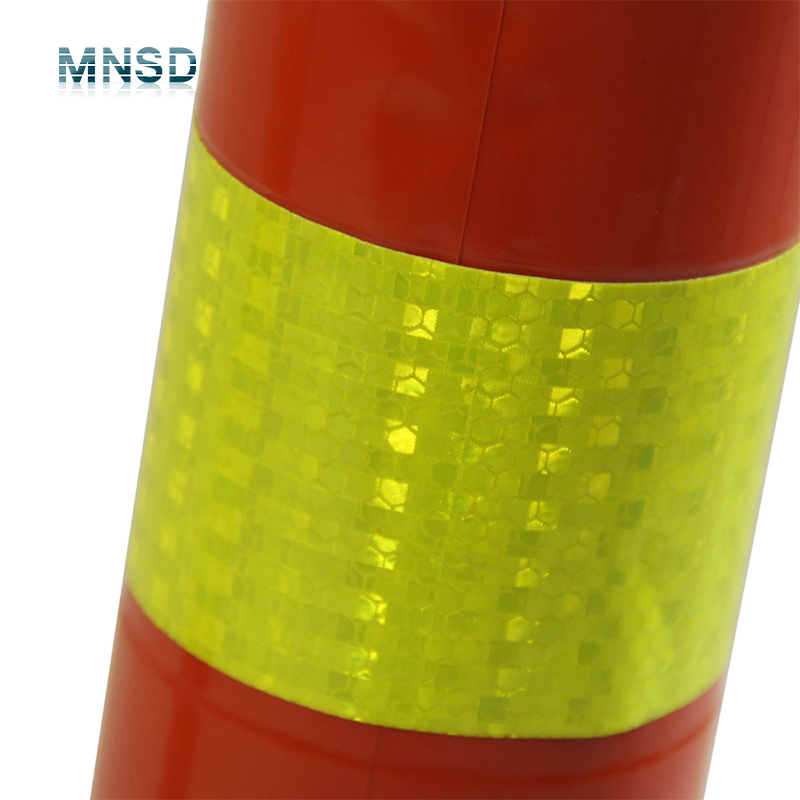
The YD-WP45 warning post, a compact 450 mm PU traffic delineator, represents one common flexible warning post format.
What does a warning post do?
A warning post is fundamentally a traffic delineation device. It provides clear visual guidance, defines lane boundaries, prevents unauthorized vehicle entry and mitigates impact damage during accidental collisions. These functions are especially relevant where road markings alone are not enough, such as at curves, parking lot entrances, highway ramps and areas separating vehicles from pedestrians.
Warning posts are not crash barriers. Their normal working role is to modify driver behavior through visibility. When a vehicle grazes or lightly strikes a flexible warning post, the post is meant to bend and rebound rather than stop the vehicle. This makes them practical in spaces where frequent low-speed contact is expected, including parking facilities, loading docks and perimeter control zones.
Flexible warning post product range
One useful way to assess a warning post category is by height, material and base construction. The Mnsd product family, produced by Tiantai Yuanda Traffic Device Co., Ltd., includes several flexible models that are commonly referenced by their model codes:
| Model | Height | Base | Material configuration |
|---|---|---|---|
| YD-WP45 | 450 mm | 200 x 80 mm | High-elasticity polyurethane (PU) |
| YD-PE50 | 500 mm | Rubber base, diameter 260 mm | PE with rubber base |
| YD-WPS75 | 750 mm | 200 x 80 mm | High-elasticity polyurethane (PU) |
The 450 mm and 750 mm PU models are suited to situations where the buyer expects strong rebound after impact. The 500 mm PE model with a rubber base is often grouped with parking and bollard-type applications, where the post needs a stable footprint and durable plastic column.
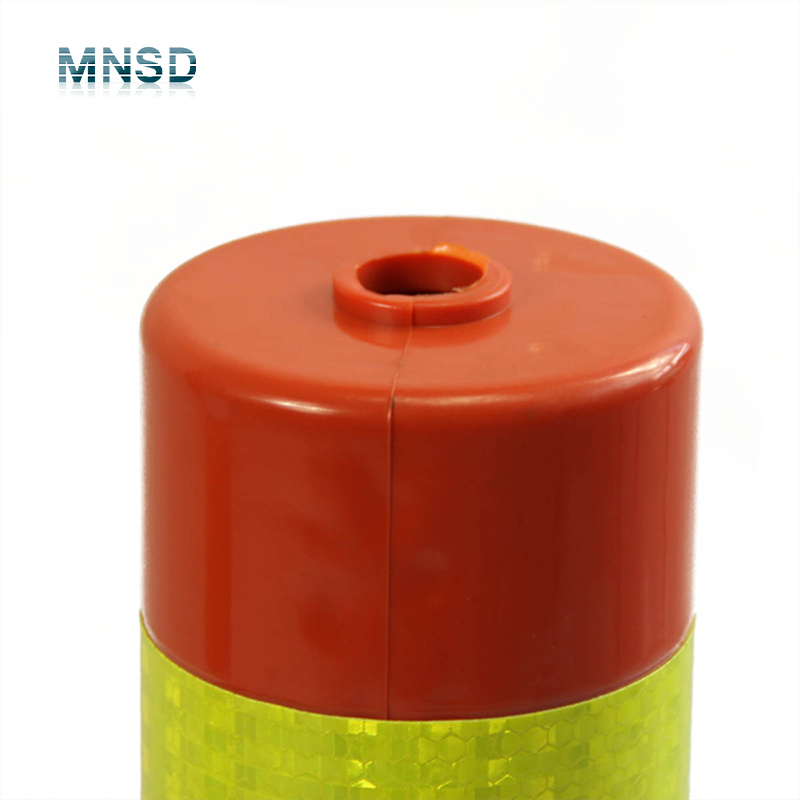
Warning posts achieve visibility through reflective sleeves applied to the post body, rather than through the plastic material alone.
Materials and mechanical requirements
The physical performance of a flexible warning post is usually described by the material, mechanical limits, temperature resistance and UV stability. In the Mnsd specification set, the structural configuration is 360° flexible and impact resistant, with a tensile strength of 15.0 MPa and elongation at break of 400%. These values describe a polymer post engineered to deform under impact without shattering.
The operating temperature range is -40°C to +70°C, which makes the product usable in both cold climates and hot road environments. The design also includes UV-stabilized coating, anti-oxidant and colorfast properties, and resistance to water and oil. For global buyers, this combination of temperature, UV and mechanical data is more important than a generic description of a plastic pole.
PU versus PE in warning post specification
Within Mnsd’s flexible warning post catalog, PU is used for the YD-WP45 and YD-WPS75 models. Polyurethane is noted for high elasticity and is commonly selected when the post must absorb contact and return to its original position. The YD-PE50 uses a heavy-duty PE structure with a rubber base, a configuration that provides a stable bottom section and protects the post from shearing at the mounting point.
Visibility and reflectivity
Warning post visibility depends heavily on reflective tape. According to Mnsd product data, the posts can be supplied with high-intensity prismatic reflective grade, also classified as Class 1. The reflective sleeve width is 250 mm and can be applied as double or triple sleeves. Reflective colors include silver white and fluorescent yellow. The stated visibility distance is more than 200 meters.
For high-risk road applications, the specification may be raised to Class 2 / Grade A reflectivity. In an application profile for road safety and municipal infrastructure, Mnsd lists Class 2 / Grade A high-intensity reflectivity as one of the required performance features. Buyers should not assume that all warning posts have the same reflectivity; sleeve width and grade are separate purchasing decisions.
Installation and accessories
A flexible warning post is only as reliable as its anchorage. Mnsd’s typical warning post installation method is expansion bolt fixing with 3 or 4 holes. The top design may include a ring for chain attachment, which allows several posts to be connected to form a temporary or permanent barrier line.
For permanent traffic-channelization projects, the recommended operation mode is surface-mounted or bolt-down fixed installation. The application data for one road scenario includes high-visibility reflective sleeves with honeycomb pattern, M10 or M12 heavy-duty expansion anchors, and optional epoxy adhesive for base reinforcement. This illustrates that the anchor kit is part of the engineering specification, not an afterthought.
Typical applications and site conditions
Mnsd product documentation lists a wide range of environments for warning posts: road traffic, parking lots, construction sites, industrial facilities, warehouses, logistics centers, airports, seaports, railway stations, schools, hospitals, commercial complexes, residential areas, highways, municipal engineering, public facilities, loading docks and bus terminals.
A more specific application profile is defined for the UAE and covers lane separation on high-speed expressways, highway ramps, T-junctions, urban sidewalk protection and multi-level parking lot entrances. The project type is described as traffic channelization, median delineation and pedestrian-vehicle segregation. The technical requirements for this scenario include 360° full-recovery impact resistance with memory-springback, UV-stabilized color fastness for more than five years, Class 2 / Grade A reflectivity, and an operating temperature range of -40°C to +70°C.
What the market data indicates
The broader market for road marker posts and traffic safety products shows continued attention from infrastructure planners. One market sizing analysis places the global road marker posts market at USD 3.4 billion in 2024 and projects it to reach USD 5.4 billion by 2032. Another market study expects traffic safety products to expand at a compound annual growth rate of about 6.6% from 2026 to 2034, partly due to urban population growth and investment in roads and municipal networks.
These figures describe a category that is moving toward more robust, more visible and more easily replaceable road delineation. The practical effect for buyers is that flexible warning posts are increasingly specified through technical parameters rather than by visual appearance alone. In Europe, for example, EN 12899-3 is a recognized standard for delineator posts and retroreflectors used in traffic circulation areas. Buyers involved in regulated projects should request supporting documentation and compare the offered model against the governing standard.
Flexible warning posts versus traditional rigid delineators
Traditional delineators made from rigid materials may provide a strong visual line, but when a vehicle hits them they can crack, loosen or create debris that itself becomes a hazard. Flexible warning posts are designed to solve part of that problem through material elasticity. Their structure is intended to flex and recover after contact, which can reduce replacement frequency in parking garages, loading zones, intersections and narrow road corridors.
However, flexibility is not a substitute for structural vehicle control. A warning post does not provide the same containment as a security bollard, guardrail or crash-rated barrier. It should be used where light guidance is needed and where vehicles are expected to stop or maneuver at low speed. If the site requires protection against deliberate vehicle intrusion or high-speed impact, the correct solution is a certified barrier system, not a plastic delineator.
Another limitation is installation dependence. A free-standing warning post without bolted anchorage may be displaced after repeated impacts. The specified bolt-down installation, anchor sizes and base reinforcement are part of the product system. Buyers should also expect to replace reflective sleeves occasionally, because reflectivity can be scratched or covered by dirt over time even when the post body remains functional.
Mnsd as a manufacturing reference
Tiantai Yuanda Traffic Device Co., Ltd., which uses the Mnsd brand for its international traffic-safety product line, is a China-based manufacturer established in 2007 and located in Tiantai, Zhejiang province. The company reports a production facility of 40,000 m², a workforce of approximately 300 people and a dedicated research and development team of 15 engineers. Annual production capacity is stated at 120,000,000 units.
The supplier’s core product portfolio covers convex mirrors, warning posts, rising bollards, speed humps and traffic lights. Export business represents about 50% of total sales, with major markets in Asia, Europe and the USA. For a buyer collecting initial supplier information, these facts indicate manufacturing scale and export experience, but they do not remove the need for product samples, audit results and per-order quality inspections.
What to check before specifying a warning post
- Confirm the required height and base size for the site; 450 mm, 500 mm and 750 mm are the heights represented in Mnsd’s flexible warning post range.
- Check the material family: PU models are high-elasticity, while PE with rubber base offers a distinct heavy-duty configuration.
- Review mechanical values, including tensile strength, elongation at break, hardness and impact recovery behavior.
- Verify the operating temperature range and UV-stabilization plan for the actual climate.
- Specify reflective grade, sleeve width, number of sleeves and reflective color.
- Define installation method: expansion bolt fixing with 3 or 4 holes, surface-mounted or bolt-down permanent installation.
- Request the manufacturer’s documentation and check whether the product is intended for road, parking, industrial or municipal use.
Future outlook for warning posts
Warning posts are not likely to disappear from traffic management plans. They are compact, replaceable and relatively easy to install, which makes them a practical option for cities that need to channel traffic while keeping maintenance costs predictable. As infrastructure spending increases, demand for well-specified delineation products is expected to grow alongside more advanced traffic-control equipment.
For specifiers, the stronger trend is toward clearer technical expectations. Buyers are beginning to ask for tensile strength, temperature range, UV data, reflective grade and installation recommendations instead of ordering by product photo. That is a positive shift for the industry because it rewards accurate factory data and penalizes vague marketing.
Frequently asked questions
What is the primary purpose of a warning post?
A warning post is a vertical delineator used to provide clear visual guidance, define lane boundaries, prevent unauthorized vehicle entry and reduce impact damage during accidental collisions. It is not designed to physically stop a vehicle.
What is the difference between a warning post and a bollard?
The terms overlap in trade language. Some warning posts are listed as PE bollards or reflective bollards because of their post-like shape. However, crash-rated security bollards are engineered to stop vehicle intrusion, while flexible warning posts are designed for visual delineation and low-speed impact recovery.
Which materials are commonly used for flexible warning posts?
Flexible warning posts are commonly made with high-elasticity polyurethane or heavy-duty polyethylene. Some models combine a PE post with a rubber base. In Mnsd’s catalog, YD-WP45 and YD-WPS75 are PU models, while YD-PE50 uses a PE and rubber base configuration.
How visible is a warning post with reflective tape?
Mnsd states that its flexible warning posts can achieve visibility over 200 meters when fitted with high-intensity prismatic, Class 1 reflective sleeves. Actual visibility depends on headlight conditions, viewing angle, weather and the condition of the reflective surface.
How are warning posts installed?
The standard installation method is expansion bolt fixing with 3 or 4 bottom holes. For permanent traffic applications, the post is surface-mounted and bolt-down fixed. Optional installation components include high-visibility reflective sleeves, M10 or M12 expansion anchors and epoxy adhesive for base reinforcement.
Can flexible warning posts handle extreme temperatures?
Mnsd specifies an operating temperature range of -40°C to +70°C for the flexible warning post range. The product is also specified with UV protection and resistance to water and oil, which helps it survive outdoor road and parking environments.
Are warning posts required to meet standards?
In many regulated road projects, delineator posts must meet national or regional standards. In Europe, EN 12899-3 is one recognized standard for delineator posts and retroreflectors. Buyers should ask suppliers for documentation that maps the product to the standard required for the specific project.
Have Questions or Need More Details?
Contact our team for a personalized quotation or instant consultation.
Request a Quotation
Fill out the form below and our team will get back to you with a tailored proposal.
WhatsApp Direct Chat
Prefer to chat in real-time? Message us on WhatsApp for instant assistance & quick answers.
- Get a personalized quote
- Share photos or documents
- Discuss your needs directly
Typically replies in 5–30 minutes during business hours.