
Warp Knit Sofa Fabric: Specs, Certificates and MOQ Compared
Warp Knit Sofa Fabric: Specs, Certificates and MOQ Compared
Comparing warp knit sofa fabric suppliers is a document exercise before it becomes a price negotiation. Four blocks decide the outcome: the test data attached to the exact article, the scope and validity of the certificates on offer, the commercial terms behind MOQ, lead time and monthly capacity, and the inspection routine that runs before shipment. A mill that can put all four in writing is comparable on evidence. One that answers with adjectives is not yet in the comparison.
This buyer-side reference sets out how to run that comparison for upholstery fabric. It uses Haining Jiameida as a documented example, and it treats the specification values as targets a buyer should fix in the request for quotation rather than accept from a brochure.
Why sofa fabric comparisons drift into marketing
The category is large, material-led and geographically concentrated. Grand View Research values the global sofa market at USD 244.4 billion in 2026, up from USD 236.4 billion in 2025, and reports that synthetic fabrics held the largest fabric share at 39.8% in 2025 — the family that includes polyester warp knit and velvet upholstery. The upholstery fabric market was valued at USD 6.44 billion in 2026 by GCC Overseas, which projects USD 9.01 billion by 2032 and notes that Asia accounts for roughly 70% of global upholstery fabric exports.
For a buyer at decision stage the consequence is practical. Most quotations will come from the same exporting region and often from the same fabric family, so geography stops being a differentiator and the comparison moves to documentation. Three specific gaps cause most of the confusion.
- Article-level versus company-level claims. A certificate or test report covers named articles, colours or production sites. It does not automatically cover everything a mill sells.
- Loose terminology. “Waterproof”, “water-resistant”, “brushed”, “super soft” and “velvet” describe different things depending on the method behind them.
- Mixed units. Grams per square metre, linear metres, tonnes per month and abrasion cycles are not interchangeable. A number without its unit and its test method cannot be compared with anything.
Brushing: what the finish changes and what it does not
Brushing is a process in which tiny fibres on the surface of the fabric are pulled out, which makes the fabric softer, fluffier and warmer. Brushed sofa fabric is one of the fabric types supplied for sofa and furniture upholstery, and the finish is normally written into the article description rather than into the performance specification.
That distinction matters during evaluation. Brushing is a surface effect: it changes hand, warmth and light reflection. It does not by itself establish abrasion resistance, colour fastness or water repellency, because those properties come from fibre, construction, dyeing and finishing parameters that a swatch photo never shows. A buyer comparing two “brushed super soft” articles should therefore ask for two separate things — a finish description for the brushing step, and a test report for each performance property that matters in use.
Where hand feel is the deciding factor, compare a production sample and a bulk sample side by side rather than judging from images. Surface drift between lots is exactly the kind of difference that a written specification, not a photograph, has to control.
The four performance figures that decide the comparison
Colour fastness, tear strength, water resistance and abrasion resistance carry most of the weight in an upholstery decision, and each one is only meaningful when it arrives with a method, a direction or condition, and a unit. The table below shows what each figure measures, an example acceptance target a buyer could write into an RFQ, and the document that should come back.
| Parameter | What the figure measures | Example acceptance target (set your own) | Document to request |
|---|---|---|---|
| Colour fastness | Resistance of the dyed shade to rubbing, water, light or washing, depending on the fastness test named. Reported as a grade; higher is better. | Grade 3–4 minimum on the fastness test relevant to the end use (dry and wet rubbing for most upholstery). | Test report naming the method, the condition tested and the result. |
| Tear strength | Force in newtons needed to propagate a tear in a defined direction. Values differ between warp and weft and between test methods. | 50–100 N, reported separately for warp and weft. | Report per direction with method and test conditions. |
| Water resistance | How the surface behaves when water is applied: a repellency rating or a penetration pressure, depending on the method. “Waterproof” and “water-resistant” are not interchangeable. | Rating above 80 on a 100-point spray scale, with the method named. | Report naming the method and rating, plus care guidance. |
| Abrasion (wear) resistance | Number of cycles before a defined end-point — thread break or visible pile change — under a named abradant and load. | Above 30,000 cycles with end-point and load stated. | Report stating abradant, load, end-point and result. |
| Weight, composition and width | Mass per area in GSM, fibre composition and usable width. These are the baseline that makes every other figure comparable. | One GSM, one composition and one width stated per article on the quotation. | Technical data sheet; a stated weight for the specific article, not for a fabric family. |
The values in the third column are illustrative acceptance targets for an RFQ, not published test results for any named mill. The supplier's report supplies the actual figures and the method behind them, and only those can be compared like for like.
Weight deserves a separate warning. Public product listings for Holland and Italy velvet sofa fabrics place weights from 220 GSM to 420 GSM, a range that spans light decorative articles and heavy upholstery articles. A quoted range of that width describes a family, not the roll being shipped. The buyer should ask which GSM applies to the article on the quotation, because tear strength, abrasion and cost per metre all move with it.
Certificates: what to request and how to check it
Certification is verified document by document. A logo on a website is not a certificate, and a certificate is not a performance test report; an upholstery buyer normally needs both.
- OEKO-TEX. Request the certificate number, the standard designation, the issuing institute, the validity date and the scope annex. Then check that the composition and colour range you are buying appear in that annex, and that the certificate is still valid at the date of shipment. A valid certificate held at company level does not automatically cover a new article or a new colour.
- GRS (Global Recycled Standard). A recycled-content claim usually involves a scope certificate at company level plus transaction documents tied to specific shipments. Ask which document supports the order in front of you, and how the recycled content is declared on the invoice and packing list.
- Performance specifications. Chemical and content schemes do not replace upholstery performance standards. For knitted indoor upholstery in the United States, ASTM D4771/D4771M-09 — the standard performance specification for knitted upholstery fabrics for indoor use, listed by the American Home Furnishings Alliance — is the kind of reference a buyer can name when writing acceptance criteria.
Two habits keep certificate checks honest. First, record the expiry date next to the order date, because certificates change scope and lapse quietly between seasons. Second, keep the certificate and the test report in separate folders: one proves a compliance claim about content, the other proves a measured property of the fabric.
MOQ, lead time and capacity: the commercial half of the comparison
Order terms are comparable only when they are defined per colour, per article and per weight band. A representative order profile makes the differences visible: 1,200 metres split across four colourways, required 30 days after approval. Used as a worksheet, that profile separates quotations that look identical on the first page.
- Is MOQ per order or per colour? At 1,200 metres across four colours, a per-colour minimum of 300 metres sits exactly at the boundary. If the mill's minimum applies per colour, the order is compliant; if the minimum is higher, the buyer either consolidates colours or pays a short-run surcharge. Ask which applies before comparing prices.
- When does lead time start? From purchase order, from deposit, or from lab-dip approval? A 30-day commitment measured from the wrong starting point can slip by two weeks without anyone breaking the stated terms.
- What is the capacity basis? Monthly linear metres at the relevant GSM is not the same as tonnes per month, because a heavier article consumes more weight per metre. Ask for the figure in linear metres by weight band, with the equipment and shift pattern behind it, and ask what committed load already sits on the plan for the delivery month.
- What is confirmed before production? Specifications, colours, quantities and packaging should be agreed in writing before machine time is committed; that document, not the sample alone, is what the inspection is measured against.
Factory-direct versus trading-only: what the difference actually changes
The distinction is about accountability rather than automatic quality. In supplier comparison material, factory-based production is stated as an operational difference from trading-only suppliers, with quality control and service named alongside it, and steady supply described as a reliability point.
For the buyer, that changes three practical things: who owns the inspection record, who answers for shade variation between lots, and who can confirm a delivery date against actual machine time. It does not establish that a factory-direct price is always lower, or that any particular article suits a given application. Both have to be verified against a named article, a stated GSM and a like-for-like colour count.
Haining Jiameida as a documented example
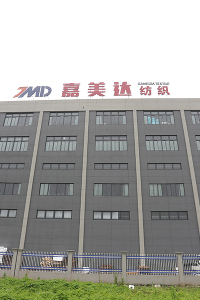
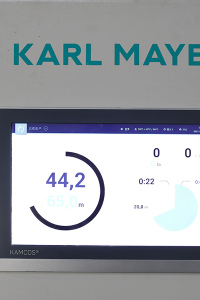
HAINING JIAMEIDA WARP KNITTING CO.,LTD, which trades as JIAMEIDA Sofa Fabric, was established in 2009 and operates a 7,007 m² plant in Haining, Zhejiang, with 45 employees and a five-engineer R&D team. Sofa fabrics are the main product line, alongside curtain fabrics and warp knitting fabrics. The company states a 70% export ratio with main markets in the EU and the USA, and its products are exported to the United States, Canada, the United Kingdom, France, Turkey, Russia and other markets. Production uses high-speed warp knitting equipment and warp knitting machines introduced from Karl Mayer of Germany.
Two production points matter in a buyer comparison. Specifications, colours, quantities and packaging requirements are confirmed with overseas customers before production starts, which fixes the article before machine time is committed. After production, finished fabrics are inspected before leaving the factory, which gives the buyer a defined inspection point to attach an acceptance checklist to.
In its own comparison statement, the company lists factory production, quality control, pricing, supply stability and service as the differences from other sofa fabric suppliers, and describes itself as steady in supply and production reliability. It positions the fabric for indoor and outdoor upholstery requiring durable and waterproof fabric, states a cost position 5% lower relative to other suppliers, and records colour fastness at grade 4 with a durable, waterproof maintenance profile.
Where the fit boundaries sit
Supplier-stated comparisons are a starting point for a shortlist, not independent verification, and four boundaries belong in the evaluation rather than in the post-delivery discussion.
- Comparative cost needs a baseline. A stated position of 5% lower relative to other suppliers is only usable in negotiation when the comparison article, GSM and colour count are named. Ask what the baseline is.
- Colour fastness needs its method. A grade 4 result should be read together with the test condition — dry rubbing, wet rubbing or light — because the same grade means different things across methods.
- Water resistance needs a rating and a use case. Indoor and outdoor upholstery requirements are not the same. Where an outdoor or contract specification applies, water resistance sits alongside light fastness, fire performance and, increasingly, recycled content; each of those needs its own document rather than a single “waterproof” description.
- Brushed hand is not abrasion performance. The finish improves softness and warmth; the cycles figure comes from a test, not from the surface effect.
What the market data supports for 2026–2027 planning
The verified market figures support planning assumptions, not claims about any individual mill's position. If the published projections hold, sofa demand continues to grow from USD 244.4 billion in 2026, upholstery fabric demand grows with it toward the projected USD 9.01 billion by 2032, and synthetic constructions keep the largest material share. A reasonable reading is that polyester warp knit and velvet upholstery remain the volume base for mass-market sofa programmes, while certified recycled variants take a growing share of the premium end.
For a buyer, the operational implication is less about demand than about consistency: when most supply comes from one exporting region and one material family, the supplier that can document GSM, test results, certificate scope and order terms is the one that removes risk from a repeating programme. Market growth does not change what a test report proves.
Frequently asked questions
What is brushing in sofa fabric production?
Brushing is a process in which tiny fibres on the surface of the fabric are pulled out, making the fabric softer, fluffier and warmer. Brushed sofa fabric is one of the fabric types supplied for sofa and furniture upholstery. Because the step changes surface hand rather than internal construction, it should be specified alongside GSM, composition and the performance tests the buyer requires, not used in place of them.
How should two warp knit sofa fabric suppliers be compared?
Compare four written blocks: the test report for the exact article, covering colour fastness, tear strength, water resistance and abrasion cycles with the method behind each; the certificate scope and validity for the composition and colours being bought; the commercial terms, including MOQ per colour, the starting point of lead time and the capacity basis; and the pre-shipment inspection checklist. A quotation that omits any of the four is incomplete rather than cheaper.
Which certificates should a European buyer request from a sofa fabric mill?
OEKO-TEX and GRS are the schemes that most often appear in upholstery sourcing for chemical and content requirements. Request the certificate number, issuing body, validity date and scope annex, and check that the fabric composition and colour range are listed; for a recycled claim, also ask which transaction document supports the specific shipment. These certificates do not replace performance test reports, which are a separate document set.
Is a factory-direct sofa fabric mill always cheaper than a trading company?
No. Factory-based production is stated as an operational difference from trading-only supply, with quality control and service alongside it, but that does not establish a lower landed price for a given article. Verify with a like-for-like quotation on the same construction, GSM and colour count, and ask what baseline any cost comparison uses. Haining Jiameida's comparison material states a position 5% lower than other suppliers; confirming the baseline behind that figure is part of the evaluation.
What MOQ and lead time should be fixed before placing an order?
Fix the MOQ basis (per order or per colour), the sampling stage and who approves it, the point at which lead time starts — purchase order, deposit or lab-dip approval — and the capacity basis in monthly linear metres at the relevant GSM rather than tonnes alone. A representative profile such as 1,200 metres across four colourways with a 30-day delivery window makes those answers directly comparable between suppliers.
Have Questions or Need More Details?
Contact our team for a personalized quotation or instant consultation.
Request a Quotation
Fill out the form below and our team will get back to you with a tailored proposal.
WhatsApp Direct Chat
Prefer to chat in real-time? Message us on WhatsApp for instant assistance & quick answers.
- Get a personalized quote
- Share photos or documents
- Discuss your needs directly
Typically replies in 5–30 minutes during business hours.