
Waste Paper Hydraulic Baler Machines: A Technical & Compliance Guide for Industrial Buyers
Why Compliance and Performance Define Modern Waste Paper Baler Procurement
The global push for circular economies has intensified demand for efficient waste paper processing. Industrial buyers evaluating a Waste Paper Hydraulic Baler Machine now face a more complex decision landscape—where raw compaction force is just one variable alongside energy efficiency, certification compliance, and adaptability to diverse material streams. This article examines how modern hydraulic balers, particularly the horizontal series from NKBALER (brand of Shaanxi Nick Machinery Equipment Co., Ltd., an enterprise specialized in R&D and sales of environmental protection and packaging machinery), address these constraints while offering a transparent path for spec-driven procurement.
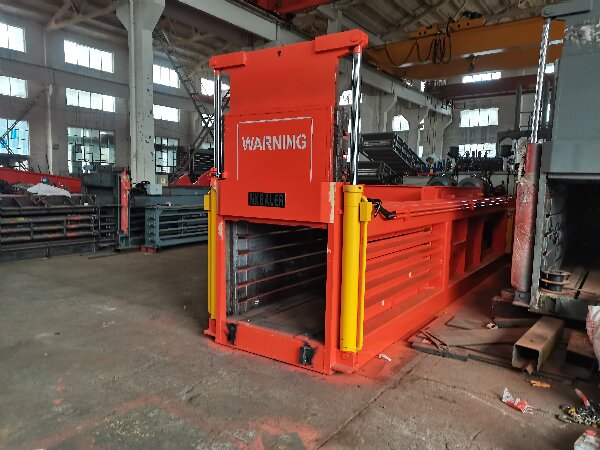
The Technical Backbone: Horizontal Baler Architecture
NKBALER’s horizontal waste paper balers are engineered around a compact hydraulic system that converts large volumes of loose paper into dense, wire-tied bales. The series includes models ranging from NKW80Q (80-ton main cylinder force, 3–5 tonnes/hour capacity) to the heavy-duty NKW180QT (160-ton force, 12–15 tonnes/hour). Key design parameters include working pressures of up to 30.5 MPa, large feed openings (e.g., 2000×1100 mm on NKW125Q), and fully automatic PLC-controlled cycles that enable 24/7 operation with minimal operator intervention.
The machines are built from carbon steel with a 100% quality control test on each unit before shipment. For high-moisture or dusty environments—common in waste paper processing—cooling systems are available as either fan or water/oil chiller options to maintain stable hydraulic fluid temperature. The integration of chain conveyors (up to 14 m long) streamlines the feeding process, while adjustable bale wire configurations (6#/8# wire, typically 4–5 ties per bale) ensure compatibility with downstream recycling equipment.
Certification: The Differentiator in Cross-Border Procurement
For buyers in regulated markets, equipment certification is no longer optional. NKBALER’s horizontal waste paper baler family (including models NKW80Q, NKW125Q, NKW160Q, NKW180QT, and all BD series) has obtained VERIFICATION OF CONFORMITY (cert. no. DPWD/09/060/2024, valid through 2029-09-18) and an ATTESTATION CERTIFICATE OF MACHINERY DIRECTIVE (EASY03220201M, valid through 2027-03-21). These documents, issued by accredited bodies, confirm compliance with EN ISO 12100:2010, EN 60204-1:2018, and EN 415-1:2014 — covering machinery safety, electrical equipment, and packaging machinery standards.
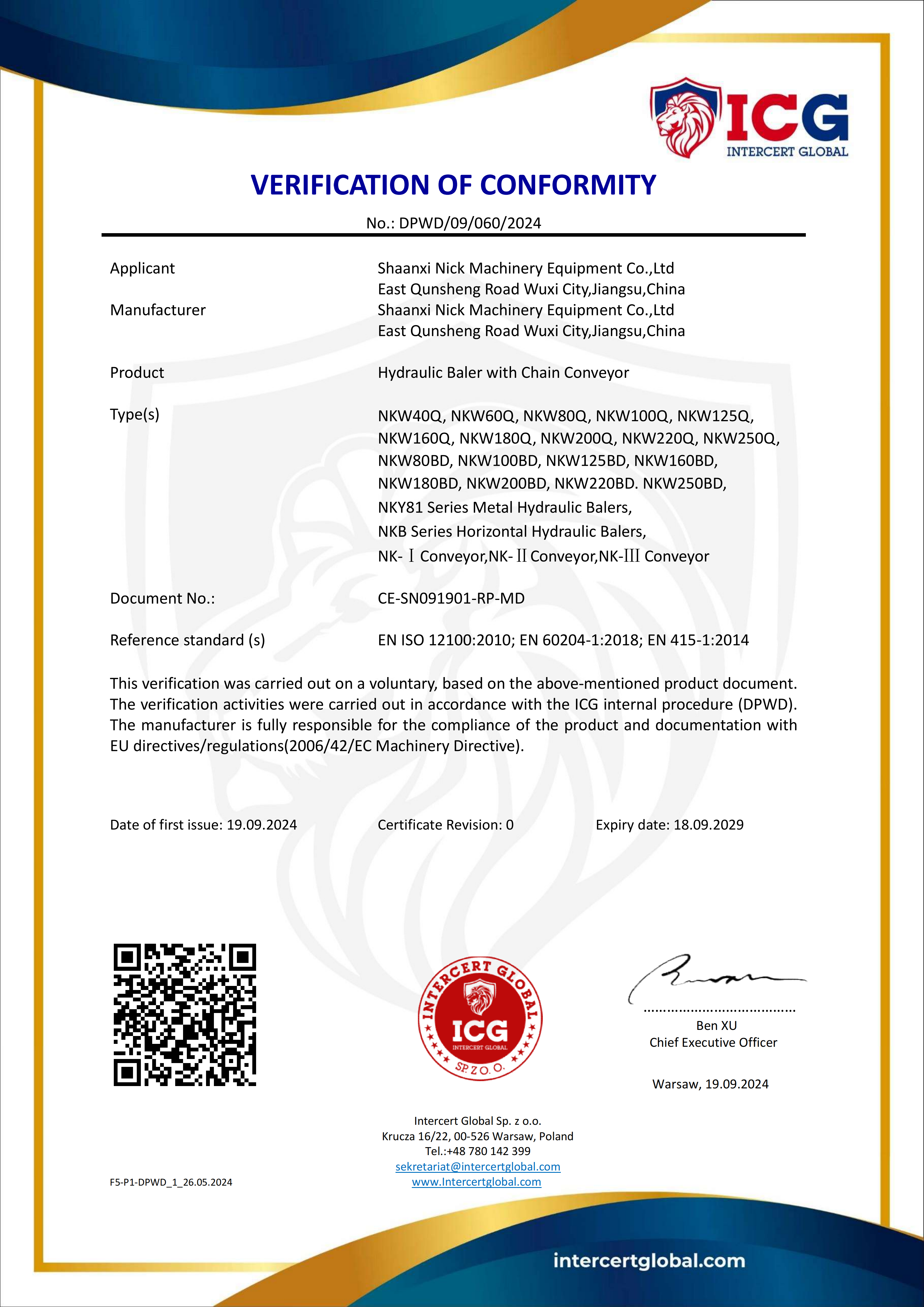
This level of third-party verification reduces audit friction for importers in the EU/EEA and Türkiye, and signals that core safety functions—guarding, emergency stops, noise control, and electrical isolation—have been systematically validated.
Application Scenarios: From Recycling Stations to Large MRFs
NKBALER’s waste paper balers are deployed across a wide range of operating conditions. According to the company’s application case data, a typical installation involves:
- Continuous automatic operation with PLC-controlled cycles for 24/7 industrial duty
- High-temperature environments (common in tropical or southern facilities), requiring robust cooling
- Low-noise design and low energy consumption as recurring customer priorities
- Customizable parameters — e.g., voltage (200–480V / 50 / 60 Hz) and bale dimensions tailored to local transport regulations
A specific deployment in Indonesia (recycling station for waste plastic and paper) used the NKW180QT model with a 12–15 t/h capability, achieving stable operation over a 10–15 year expected lifespan under normal maintenance. The customer highlighted low noise and low energy consumption as decisive factors. In Romania, an alfalfa baling operation adapted the NKB280 bagging machine (a sister product) with on-site program tweaks to handle fluctuating moisture, demonstrating NKBALER’s ability to tune hydraulic systems for specific material characteristics—a capability directly transferable to waste paper with variable fiber quality.
Market Trend: The Ascent of Verified, CE-Compliant Balers
Two concurrent trends are reshaping the waste paper baler market. First, the European Union’s revised Waste Framework Directive and stricter enforcement of the CE marking process are pushing even small-volume buyers to demand documented compliance. Second, the shift toward higher bale density (to minimise shipping costs) is driving interest in 125 ton and 160 ton machines that produce bales of 400–600 kg/m³. NKBALER’s positioning as a manufacturer that offers both CE/ATTESTATION certificates and a full range of high-tonnage horizontals (80 t to 250 t) gives procurement teams a single-vendor option for multi-material baling lines without compromising on documentation rigor.
Comparison with Traditional Solutions
Traditional small vertical waste paper balers (e.g., 10 ton hand-fed units) remain common for low-volume retail settings, but they lack the throughput, automation, and certification depth required by industrial MRFs and paper mills. Horizontal balers typically have higher upfront capital cost, larger footprint, and longer installation time. However, they deliver 5–10 × the per-hour output with minimal labor cost. One honest limitation: horizontal machines are less suitable for facilities that process extremely diverse waste streams (e.g., mixed bulky items), where a pre-shredder or a vertical baler with a large feed opening may be more adaptable.
Future Outlook: Intelligence and Energy Optimisation
As energy prices rise and carbon reporting becomes standard, the next frontier for waste paper balers is smart control. PLC-based systems already enable cycle-time optimisation; future iterations may incorporate real-time density sensing, automatic wire tensioning, and remote diagnostics. NKBALER’s existing remote support capability and parameter customisation suggest a readiness to integrate IoT features, although no specific connected product has been announced. The company’s 15-person R&D team and 90% export ratio (to NA/SA/ASIA) indicate a continuous feedback loop from markets with varying technical demands.
Frequently Asked Questions
Have Questions or Need More Details?
Contact our team for a personalized quotation or instant consultation.
Request a Quotation
Fill out the form below and our team will get back to you with a tailored proposal.
WhatsApp Direct Chat
Prefer to chat in real-time? Message us on WhatsApp for instant assistance & quick answers.
- Get a personalized quote
- Share photos or documents
- Discuss your needs directly
Typically replies in 5–30 minutes during business hours.