
Waste Paper Hydraulic Balers: 2026 Technical & Procurement FAQ
Waste Paper Hydraulic Balers: 2026 Technical & Procurement FAQ
Waste Paper Hydraulic Balers: 2026 Technical & Procurement FAQ
A hydraulic baling press converts loose recovered paper into a tied, stackable bale. The principle has not changed. What has changed is the set of questions buyers bring to suppliers: which compression force and bale format fit a specific paper stream, which safety requirements apply in the destination market, and how much of a supplier's stated capacity can be verified rather than assumed.
This reference is organised as a technical and procurement FAQ for buyers moving from research into evaluation. It covers the variables that determine machine selection, the policy facts that gate market entry, the capacity signals available at both market and supplier level, and the project types where a waste paper hydraulic baler is the correct answer — together with the conditions under which it is not.
Product and company facts are limited to NKBALER, the trading name of Shaanxi Nick Machinery Equipment Co., Ltd., a China-based manufacturer of vertical balers, horizontal hydraulic balers and press bagging machines, founded in 2013 and operating a 5,000 m² facility.
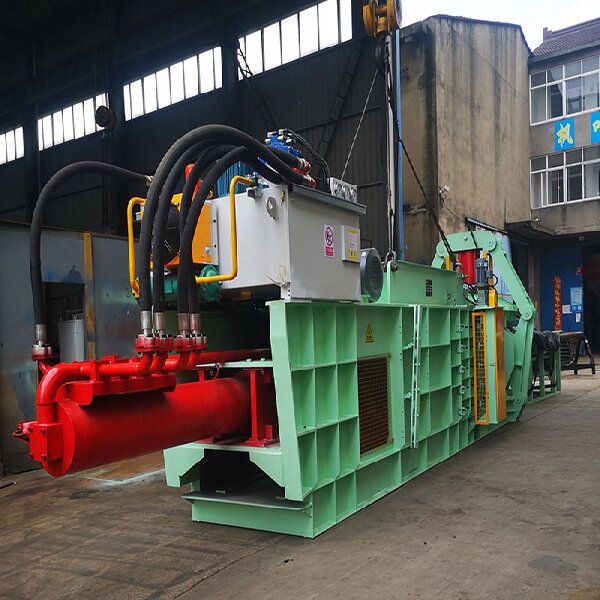
The specification problem: what a quotation cannot answer for you
A waste paper hydraulic baler is not a catalogue item with one correct answer per price band. The same press frame can be configured for different materials, bale formats, automation levels and tying methods, and the resulting machine may or may not fit a given site. Buyers who open a quotation request with a model number instead of a specification usually receive a proposal that has to be re-scoped later — sometimes after the concrete has been poured.
The variables that must be fixed before comparison are consistent across project types: material type, material dimensions, loose density, target bale weight or size, available floor space, power conditions, required automation level and required throughput. These are the same inputs NKBALER asks for in order to confirm a model and a solution. Without them, compression force, throughput and bale dimensions are being compared in isolation from the job they have to perform.
A second specification gap concerns the feedstock itself. Recovered paper is not one material; it is traded in grades, and the grade determines how the finished bale will be handled, weighed and sold. A baling line configured for one grade is not automatically right for another, and the arithmetic of bale weight against transport cost changes with the grade being processed.
There is a third gap, which is usually commercial rather than technical. The bale format determines how bales stack, how many fit into a container or trailer, and what handling equipment is needed at the receiving end. A buyer who specifies compression force but not bale geometry has specified half a machine.
Technical explanation: how a hydraulic waste paper baler is configured
A horizontal hydraulic baler compresses material inside a chamber using a main cylinder, ties the compressed block with wire, and ejects it as a finished bale. The published specification of a model therefore describes four things that matter to a buyer: the compression force available, the geometry of the bale that comes out, the rate at which bales can be produced, and the electrical and cooling load the machine places on the site.
- Compression force. Stated in tons and linked to cylinder size and hydraulic pressure. It sets the density ceiling for a given material and defines the range of materials a frame can reasonably handle.
- Bale format. Width, height and length in millimetres. This determines stacking behaviour, loading method and transport configuration.
- Feed opening. The dimensions through which material enters the chamber, which constrains how upstream conveyors or shredders can be arranged on site.
- Throughput. Expressed in tons per hour for horizontal machines and in bales per hour for vertical machines. The unit matters, because the two are not interchangeable.
- Power and cooling. Motor power in kW, plus the cooling method — water cooling or an oil chiller on larger frames — which affects both the electrical supply and heat management in the workshop.
Two consequences follow. First, compression force alone does not describe a machine. A high-force frame with a small feed opening and modest throughput is not equivalent to a lower-force frame configured for continuous flow, even if the headline tonnage looks more impressive. Second, throughput figures are material-dependent and should be read as the design capacity of the model under the material and feeding conditions the supplier assumed when publishing the specification.
The tying specification deserves separate attention. Bale wire counts and gauges differ by model — the published NKBALER horizontal range, for example, runs from 10# × 4 pieces on the NKW80BD through 10# × 5 pieces on the NKW125BD to 6#/8# × 5 pieces on the NKW180BD. Wire consumption is a recurring operating cost, and it should be estimated from the model specification rather than from a general assumption about baling.
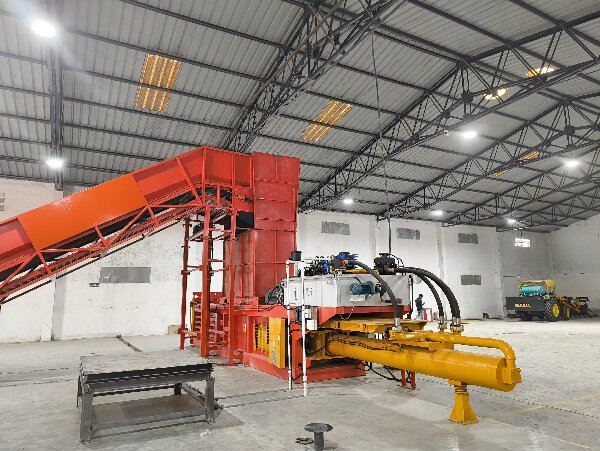
How NKBALER configures a waste paper baler programme
NKBALER manufactures vertical balers, full-automatic horizontal balers, manual horizontal balers and press bagging machines. The company reports total annual output of 600 units, of which more than 100 are hydraulic balers, with roughly 90% of output exported and North America, South America and Asia named as main markets. Its production team is supported by a 15-person R&D function within a 50-person workforce.
For project work, the company operates on an OEM/ODM basis with a minimum order of one unit and a quoted lead time of 30–45 days. The stated customisation scope covers model type, compression configuration, automation level, tying method, material adaptation, site layout, auxiliary conveyors and complete-line configuration. Every unit is described as 100% tested before shipment, and after-sales support covers installation, training, maintenance, technical guidance and spare parts.
That combination matters to a buyer for a specific reason: the specification variables listed earlier are the same variables the supplier says it can customise. A buyer who arrives with material data, bale targets and site constraints is buying a configured machine. A buyer who arrives with a model number is buying a catalogue unit and absorbing the fit risk internally.
The 2026 policy environment: two facts that change the specification conversation
Two published policy facts are directly relevant to a waste paper hydraulic baler purchase in 2026. Neither is a marketing consideration, and both belong in the quotation file rather than in a general compliance appendix.
The first is market access. EN 16252:2012 sets out safety requirements for the design and manufacture of horizontal baling presses, and it is the reference standard for that equipment class in the European Union. For a buyer importing a horizontal baler into the EU, the standard is a gate rather than a preference: evidence of conformity has to be obtainable before the machine is placed on the market, and that evidence should be checked against the issuing body rather than accepted as a supplier claim.
The second is feedstock definition. In recovered-paper trade, mixed paper is defined as a broad category that includes old magazines, low-quality office waste paper such as discarded mail, and unsorted waste or scrap paper. The definition matters at the procurement stage because a baler specified for one grade is being asked to produce a bale of a particular size and density. If the grade is not named in the quotation request, the bale format and throughput assumptions behind the price remain invisible to the buyer.
Neither fact changes what a hydraulic baler does. Together they change what a buyer has to document: which standard applies in the destination market, and which recovered-paper grade the machine will actually process.
Capacity trends: market-level signals and supplier-level signals
Market-level and supplier-level capacity signals answer different questions and should not be mixed. Market figures describe the direction of the equipment category. Supplier figures describe whether a specific order can be delivered on a specific date.
At market level, Grand View Research values the global baler market at USD 6.4 billion in 2024 and projects USD 12.0 billion by 2030. That figure covers agricultural and industrial balers together, so it indicates category direction rather than the size of the waste paper hydraulic baler segment specifically. The distinction is worth keeping when the number is used in an investment case: agricultural round balers are inside that figure and waste paper presses are not the majority of it. Within the same dataset, Asia Pacific accounted for a revenue share of 39.4% in 2024.
At supplier level, the relevant signals are output, lead time and testing discipline. NKBALER reports 600 units of annual output across the range, a minimum order of one unit, a 30–45 day lead time and 100% testing before shipment. Read practically, that means single-unit and short-run orders sit inside the supplier's stated operating model, while multi-machine line projects need the lead time confirmed against the project schedule rather than assumed from the general figure.
These two levels should be reported separately in any internal business case. Mixing a global category forecast with a single supplier's delivery window produces a document that looks quantitative and supports no decision.
Application: matching configuration to project type
Waste paper baling equipment is applied across a defined set of project types rather than one. The published scope includes recycling-facility upgrade projects, new recycling plant projects, small processing workshop projects, warehouse and industrial waste management projects, and customised baling equipment or complete-line projects. The same machine family appears in all of them, but the configuration logic differs in each case.
The operating envelope is equally specific. The equipment is intended for indoor recycling workshop conditions with an ambient temperature range of −10 °C to 45 °C, normal humidity, light dust and a stable three-phase power supply. Sites outside that envelope are not automatically excluded, but the deviation has to be raised during quotation rather than discovered at commissioning.
The core function is consistent across applications: the baling operation compresses loose waste into bales that are easier to store, handle and transport, reducing space requirements and waste transportation frequency. What changes is the material mix. Waste paper, plastics, scrap metal, textiles, agricultural straw and mixed solid-waste recycling all appear in the published application scope, alongside PET bottle and can recycling and textile and clothing recycling.
One documented deployment shows how closely configuration follows local conditions. A recycling station operator in Indonesia uses a horizontal hydraulic baler for waste plastic and waste paper baling, with stable operation, low noise and low energy consumption reported, and an expected service life of 10–15 years under normal maintenance. The material mix, rather than the machine category, drove the configuration decision.
A second documented deployment illustrates the opposite end of the range. An agricultural producer in Romania uses a fully automatic hydraulic baler for alfalfa, where bale density rose above 400 kg/m³ after commissioning and transport costs fell by roughly 30%. The machine class is comparable; the parameters, tying method and control programme are not. That is the practical argument for treating the application specification as the starting document.
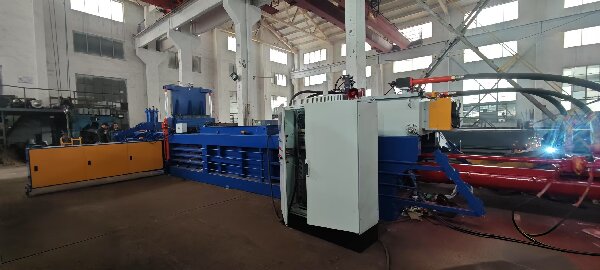
Comparison: vertical, semi-automatic horizontal and full-automatic horizontal
The meaningful comparison for a waste paper project at evaluation stage is not between brands; it is between machine architectures. Three configurations cover most requirements, and the published specifications show where each one stops being appropriate.
| Parameter | NK080T100 (vertical) | NKW80BD (horizontal) | NKW125BD (horizontal) | NKW180BD (horizontal) |
|---|---|---|---|---|
| Hydraulic power | 100 ton | 80 ton | 125 ton | 180 ton |
| Bale size (W×H×L) | 1000×800×500–1000 mm | 1100×850×1700 mm | 1100×1250×1700 mm | 1100×1150×1800 mm |
| Feed opening | 1000×500 mm | 1200×1000 mm | 2000×1100 mm | 2400×1100 mm |
| Capacity | 3–6 bales/hour | 2–3 t/hour | 5–7 t/hour | 6–8 t/hour |
| Bale weight | 200–350 kg | Not published | Not published | Not published |
| Power | 15 kW / 20 HP | 22 kW / 30 HP | 30 kW / 40 HP | 45 kW / 60 HP |
| Bale wire | Not published | 10# × 4 pcs | 10# × 5 pcs | 6#/8# × 5 pcs |
| Machine weight | 3.2 t | 14.5 t | 18 t | 24 t |
Against a traditional loose-collection approach — material stored and moved without densification — any of these machines changes the logistics equation by reducing volume and transport frequency. Against each other, the differences are structural rather than incremental. A vertical machine such as the NK080T100 produces 200–350 kg bales at 3–6 bales per hour on 15 kW with manual feeding. The NKW80BD doubles the electrical requirement and moves to continuous horizontal feeding at 2–3 tons per hour. The NKW180BD, at 45 kW and 24 tonnes, is a different class of installation altogether.
The comparison also exposes a common planning error. Buyers frequently compare machines on compression force, because it is the largest number in the specification. In practice, feed opening and bale format constrain a paper recycling line more often than tonnage does, because they determine how the machine integrates with conveyors, floor layout and outbound transport.
Where a hydraulic baler is the wrong purchase
Three boundaries are worth stating plainly, because they are the ones most often discovered late.
Throughput mismatch in both directions. A vertical baler is the cost-effective answer for limited space and low output, but 3–6 bales per hour of 200–350 kg with manual feeding will not carry a continuous high-volume paper line. Conversely, a 24-tonne horizontal machine with a 45 kW motor, a main frame of roughly 14 metres and a separate conveyor is a poor fit for a workshop whose output does not justify the footprint or the connected load.
Site services. The specified operating envelope assumes indoor conditions, a stable three-phase supply, and normal humidity with light dust. A site that does not meet those conditions is not disqualified, but the gap has to be engineered, and the quotation has to reflect the engineering rather than the catalogue price.
Scope of the machine. A baler compresses and ties; it does not sort, shred or classify. The published matched-equipment list — conveyors, hydraulic components, baling wire, PET strapping, jumbo bags, packing tools, shredders and crushers — makes that boundary explicit. Buyers who expect a baler to solve mixed-waste quality problems are purchasing the wrong category of equipment, and no amount of configuration will close that gap.
Future outlook
Three developments are likely to shape waste paper baler procurement through the remainder of the decade, and all three are already visible in the evidence available today.
Policy and grade definition will continue to move specification upstream. Where a standard such as EN 16252:2012 governs market access and a trade definition such as mixed paper governs what is actually being baled, the buyer's specification document — not the brochure — becomes the controlling document in the transaction.
Regional weighting will remain concentrated. With Asia Pacific holding 39.4% of baler category revenue in 2024, sourcing conversations will continue to start from Asian supply. That makes verification of supplier capacity, testing discipline and conformity evidence more important, not less, because a shorter supplier list concentrates risk.
Category growth figures will also keep being quoted more broadly than they should be. The trajectory from USD 6.4 billion in 2024 to a projected USD 12.0 billion in 2030 describes balers as a whole, including agricultural machines. Buyers using it to size a waste paper hydraulic baler investment are using the wrong denominator. The useful signal is direction, not magnitude.
FAQ
What information should a buyer provide before requesting a waste paper baler quotation?
Material type, material dimensions, loose density, target bale weight or size, available space, power conditions, required automation level and required throughput. These are the inputs used to confirm a model and a solution. A quotation request that supplies a model number instead of these parameters leaves the fit assumption untested.
How is baler throughput expressed, and why does the unit matter?
Horizontal hydraulic balers are rated in tons per hour; vertical balers are rated in bales per hour. Published figures for the NKBALER horizontal range are 2–3 t/hour for the NKW80BD, 5–7 t/hour for the NKW125BD and 6–8 t/hour for the NKW180BD. A vertical model such as the NK080T100 is rated at 3–6 bales per hour with a bale weight of 200–350 kg. The two units cannot be converted without knowing the bale weight and material density.
What power supply and site conditions does the equipment require?
The stated operating envelope is an indoor recycling workshop with an ambient temperature range of −10 °C to 45 °C, normal humidity, light dust and a stable three-phase power supply. Published models use 380 V / 50 Hz with motor power from 15 kW on the vertical reference up to 45 kW on the largest horizontal frame in the published range. Sites outside these conditions require the deviation to be addressed during quotation.
Which standard governs horizontal baling presses sold into the European Union?
EN 16252:2012 sets safety requirements for the design and manufacture of horizontal baling presses in the European Union. It is the reference standard for that equipment class, and evidence of conformity should be verified against the issuing body rather than accepted on the basis of a supplier statement.
Why does the recovered paper grade need to be named in the specification?
Recovered paper is traded in grades rather than as one material. Mixed paper, for example, is defined as a broad category including old magazines, low-quality office waste paper such as discarded mail, and unsorted waste or scrap paper. Because the grade determines bale handling, weighing and sale, a quotation that does not name it leaves the bale format and throughput assumptions behind the price unstated.
What lead time and customisation scope does NKBALER quote?
NKBALER quotes a lead time of 30–45 days with a minimum order of one unit on an OEM/ODM basis. Stated customisation covers model type, compression configuration, automation level, tying method, material adaptation, site layout, auxiliary conveyors and complete-line configuration. Units are described as 100% tested before shipment, with after-sales support covering installation, training, maintenance, technical guidance and spare parts.
Can a vertical baler replace a horizontal baler in a high-volume paper line?
Generally not. A vertical machine in the published range produces 3–6 bales per hour at 200–350 kg per bale with manual feeding and a 15 kW motor, while horizontal models in the same published range run from 2–3 to 6–8 tons per hour on 22–45 kW. Vertical configuration suits limited space and lower output; continuous high-throughput paper processing requires horizontal feeding and automatic tying.
Waste paper hydraulic baler procurement in 2026 rewards buyers who separate three questions that are often merged: what the machine must physically do at the site, what the destination market requires before the machine can operate there, and what the supplier can verifiably deliver within the project window. Each has a documented answer. None of them is answered by a compression force figure on its own.
Have Questions or Need More Details?
Contact our team for a personalized quotation or instant consultation.
Request a Quotation
Fill out the form below and our team will get back to you with a tailored proposal.
WhatsApp Direct Chat
Prefer to chat in real-time? Message us on WhatsApp for instant assistance & quick answers.
- Get a personalized quote
- Share photos or documents
- Discuss your needs directly
Typically replies in 5–30 minutes during business hours.