
Water Bottle Rack Supplier Capability: Steel Tube & Assembly Evidence
A capable water bottle rack supplier is not defined by a generic factory claim. It is defined by the physical evidence it can place in front of a buyer: the steel tube or wire specification, the substrate preparation and finish route, the assembly method, and the quality-control checkpoints applied before shipment. For buyers evaluating a water jug rack for water delivery, office, household or commercial storage use, those details are the difference between a quote that can be compared and a brochure that cannot.
SHAFON WATER SOLUTION is the brand of Ningbo SHAFON Import & Export Co., Ltd., a China-based B2B supplier of water dispensing and storage products, including water bottle racks, water buckets, non-electric water dispensers, bottle caps and related accessories. The company was formally established in 2015, with business roots dating to 2008, and serves importers, wholesalers, distributors, water delivery companies and private-label brands in 30+ countries, with an export ratio of 80–90%. Its rack range covers foldable, raised, tabletop, vertical, multi-tier and storage rack formats.
The useful question for an evaluation-stage buyer is not whether a supplier says it can make a rack, but which product-level facts it can document and which checkpoints it can repeat from order to order. Water jug rack and water bottle rack describe the same product family: a stand that holds 5-gallon bottles for storage and dispensing. Jug rack is more common in UK and Commonwealth usage; bottle rack is widely used in North America. The terminology changes; the evidence requirement does not.
Why model-level evidence matters in water jug rack sourcing
At evaluation stage, buyers often compare suppliers on price, MOQ, lead time and product photos. Those inputs matter, but they do not show whether the tube wall is specified, whether the finish route is controlled, whether a detachable rack fits together after packing, or whether a one-piece wire rack has acceptable weld and plating condition. A supplier capability file should therefore move from general claims to named models and measurable attributes.
Public product listings show how wide the category is. J&P Wire Products lists collapsible 3- and 6-bottle wire racks and rugged 12- and 24-bottle racks for high-volume use. Nexel lists steel racks with welded wire shelves across several bottle capacities. Enlightening Plast lists a 4-tier stackable HDPE rack. These examples do not establish a ranking; they show that buyers need to compare construction, capacity, finish and handling format rather than a single label such as commercial water bottle rack.
One industry buying guide notes that a full 5-gallon jug weighs approximately 42–45 lbs. That working weight explains why tube specification, weld condition and base geometry deserve a place in the evaluation file. It does not replace a load test or a sample trial, but it tells the buyer which parts of the product data to request.
SF-BR-03A: steel tube and finish evidence
SF-BR-03A is listed as a 5-Gallon Water Bottle Rack (Raised), type Raised U-Type Rack. Its listed dimensions are 34CM*19.5CM, with front height 400mm and rear height 430mm. The material is specified as 13*13*0.9 steel tube, phosphating treatment and electrostatic powder spraying, plus a PP spigot. The listed application covers water delivery, household and office use.
For a buyer, the 13*13*0.9 specification is more useful than a generic heavy duty claim because it identifies a square tube profile and a wall thickness. It allows the supplier and buyer to confirm the same tube specification before production, and it creates a checkpoint for incoming material and in-process inspection. The finish route is also explicit: phosphating treatment followed by electrostatic powder spraying. That sequence matters because powder coating performance depends on substrate preparation, coating quality, thickness and the service environment, as noted in SHAFON's finish guidance.
The PP spigot should be checked as a separate component, not assumed from the rack description. In pre-shipment inspection, the supplier's stated checkpoints include quantity, tube or wire specifications, surface finish for rust and scratches, weld integrity, faucet assembly where applicable, packaging and shipping marks. For SF-BR-03A, that means the 13*13*0.9 tube, phosphate and powder-coated surface, and PP spigot should all appear in the inspection record.
Model-level data still has a boundary. A tube specification and finish route do not by themselves establish a universal load rating or a corrosion guarantee. Buyers should request product drawings and loading references on request, then validate the rack with their own bottle weight, handling pattern and storage environment.
SF-BR-04A: mixed materials and detachable construction
SF-BR-04A is listed as a 5-Gallon Water Bottle Rack (Tabletop), type Detachable Tabletop Rack (28cm). Its listed dimensions are 27CM*18CM, with front height 225mm and rear height 285mm. The material is Q195 steel tube, ABS plastic and a PP spigot. The listed application is household and office use.
This model is useful in a supplier evaluation because it exposes the assembly question. A detachable tabletop rack is not only a steel tube product; it also depends on the fit of ABS plastic components, the PP spigot, and the way separated parts are packed and reassembled. A capable supplier should be able to describe how the detachable construction is checked, not just what material is used.
Buyers should ask for the component list, the assembly sequence, and the packaging arrangement for the detachable version. The pre-shipment checklist should cover the Q195 steel tube specification, the ABS plastic parts, the PP spigot, surface condition, and the completeness of the assembly set. If the rack is packed in separated form, the packaging should prevent loss and abrasion before it reaches the end user.
The same limit applies here: detachable design can support space-efficient packaging and replacement of components, but it also adds part-fit and assembly-step risk. A supplier that can document those steps is easier to compare than one that only lists a product photo.
SF-BR-06A: one-piece Q195 steel wire and chrome plating
SF-BR-06A is listed as a 5-Gallon Water Bottle Rack (Tabletop), type One-Piece Tabletop Rack (17cm). Its listed dimensions are 24CM*19CM, with front height 105mm and rear height 170mm. The material is Q195 steel wire, chrome plating and a PP spigot. The listed application is household and office use.
Because the rack is one-piece, the assembly evidence shifts from part fit to the integrity of the formed and joined wire structure. The product data identifies Q195 steel wire and chrome plating; the supplier's pre-shipment inspection list includes weld integrity and surface finish, including rust and scratches. For SF-BR-06A, a buyer should ask for confirmation of wire specification, weld condition, chrome-plated surface condition, and PP spigot assembly.
Chrome plating gives a bright metallic appearance and is a recognized finish route, but its corrosion performance depends on substrate preparation, plating quality, thickness and the service environment. The finish comparison should therefore be application-specific. A chrome-plated water bottle rack may suit a dry household or office setting where appearance and easy cleaning are priorities. A powder-coated steel tube rack may suit buyers who need broad color options and a surface protection route when properly applied. Neither finish should be treated as universally superior without the service environment and specification.
One-piece construction also has a packaging trade-off. Foldable racks can pack flat and, according to SHAFON's packaging guidance, can reach about 30 sets per carton with roughly 60–70% less shipping volume than one-piece racks. A one-piece tabletop rack may reduce assembly steps at destination, but it can take more shipping volume. That is a real procurement boundary, not a defect.
What these three models tell a buyer about supplier capability
Across SF-BR-03A, SF-BR-04A and SF-BR-06A, the common thread is not a single material or finish. It is the presence of named, checkable attributes. SF-BR-03A documents a 13*13*0.9 steel tube with phosphating and electrostatic powder spraying. SF-BR-04A documents Q195 steel tube, ABS plastic and a detachable tabletop construction. SF-BR-06A documents one-piece Q195 steel wire with chrome plating. Each model also specifies a PP spigot.
A supplier that can present this level of detail is easier to audit. The buyer can compare the tube profile and wall thickness, the substrate preparation and finish, the assembly method, the plastic components, and the spigot as separate items. The buyer can also ask for the matching inspection record. This is more useful than a generic statement that the factory has advanced equipment.
| Evidence category | What to ask for | Model example |
|---|---|---|
| Tube or wire specification | Profile, wall thickness or wire diameter, material grade | SF-BR-03A 13*13*0.9 steel tube; SF-BR-04A Q195 steel tube; SF-BR-06A Q195 steel wire |
| Finish | Substrate preparation, coating or plating route, color, surface condition | SF-BR-03A phosphating + electrostatic powder spraying; SF-BR-06A chrome plating |
| Assembly | Detachable or one-piece, component fit, packaging of separated parts | SF-BR-04A detachable tabletop; SF-BR-06A one-piece tabletop |
| Fluid-contact component | Spigot material and assembly check | PP spigot across the three models |
| QC record | In-production and pre-shipment checkpoints | quantity, specification, surface, weld, spigot or faucet, packaging, marks |
OEM and ODM request preparation
SHAFON WATER SOLUTION supports OEM and ODM work. OEM customization covers logo, color, packaging and product matching, with a listed MOQ of 500 pcs and a listed lead time of 15 days. ODM covers product development, structure or appearance design and market-specific requirements, with a listed MOQ of 1,000 pcs and a listed lead time of 30 days. One-stop supply, including coordinated water buckets, racks, faucets and accessories, is listed with a MOQ of 200–300 pcs and a lead time of 5 days for in-stock items. The company also lists 4–5 professional R&D engineers, monthly rack capacity of 20,000–30,000 units and monthly water bucket capacity of 750,000 units.
These terms are commercial inputs, not substitutes for product evidence. For an OEM water bottle rack or water jug rack project, the buyer should prepare the product type, quantity, target market, rack color, logo, packaging requirement and any specific dimensions. The supplier should confirm drawings and samples before bulk production. That sequence is especially important when the requested change touches the tube specification, finish color, detachable assembly or packaging format.
An OEM request should also state which inspection points are non-negotiable. If the product is SF-BR-03A, the buyer may require the 13*13*0.9 tube and the phosphating and electrostatic powder spraying route to appear on the drawing and inspection sheet. If the product is SF-BR-04A, the buyer may require the ABS component fit and detachable assembly completeness. If the product is SF-BR-06A, the buyer may require wire specification, weld integrity and chrome-plated surface condition. This turns a customization brief into a verifiable production specification.
Pre-shipment quality-control checkpoints
SHAFON's stated quality control includes in-production inspection and pre-shipment inspection. The pre-shipment checkpoints listed for racks are quantity, tube or wire specifications, surface finish with no rust and no scratches, weld integrity, faucet assembly, packaging and shipping marks. The company's company-level quality management system is certified to ISO 9001 under certificate ECI25Q00869R0S, issued by Beijing Guoyouxincheng Certification Service Co., Ltd., valid from 2025-09-25 to 2028-09-24. That certificate is a company-level QMS credential, not a rack-specific load certification.
For evaluation-stage buyers, the practical step is to ask how each checkpoint maps to the ordered model. For SF-BR-03A, the record should show the 13*13*0.9 tube, phosphate and powder-coated surface, PP spigot, quantity, packaging and marks. For SF-BR-04A, it should show the Q195 tube, ABS plastic parts, PP spigot, detachable set completeness and surface condition. For SF-BR-06A, it should show the Q195 steel wire, weld integrity, chrome-plated surface condition, PP spigot and packaging.
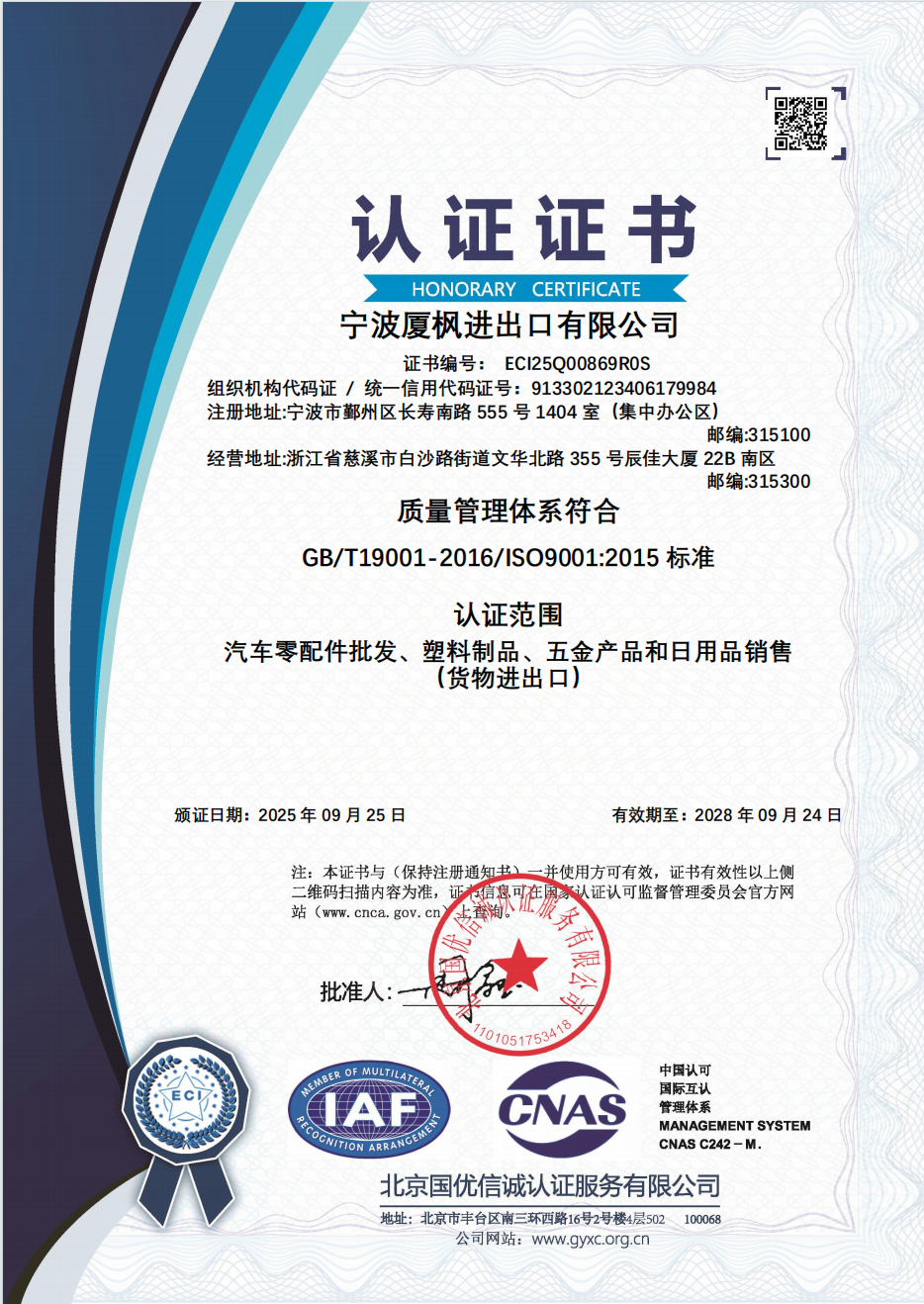
Company-level ISO 9001 quality management system certificate, certificate ECI25Q00869R0S, issued by Beijing Guoyouxincheng Certification Service Co., Ltd. It is a company-level QMS certificate, not a rack-specific load certification.
Sampling and drawings remain part of the evidence chain. The supplier states that drawings and loading references can be shared on request. That is useful, but the buyer should still confirm the sample against the agreed drawing and check the packaging method for the actual order quantity.
Application fit: where these water jug racks are used
SF-BR-03A is listed for water delivery, household and office use. Its raised U-type format and 13*13*0.9 steel tube make it a candidate for buyers who want a defined steel tube specification in a raised rack. SF-BR-04A is listed for household and office use, with a detachable tabletop format that suits buyers who value compact tabletop placement and separated-component packaging. SF-BR-06A is listed for household and office use, with a one-piece tabletop wire format and chrome plating for a bright metallic appearance.
At the commercial level, SHAFON's rack range is used in water delivery, water stations, offices, households and commercial facilities. The supplier's case record includes a water bottle rack customer ordering 2x40HQ containers per month for bottled water delivery and retail, with one year of cooperation and repeat orders. It also includes a private-label brand ordering 2x40HQ containers per month, with structured product inspection, packaging confirmation and shipment preparation; an importer ordering 1x40HQ per month for import and distribution; and a hotel and catering supplier ordering 1x40HQ every two months, with attention to capacity, materials, packaging and spare parts.
These cases should be read as application evidence, not as a promise that every configuration will fit every market. A water delivery company may prioritize repeated handling and storage density. An office buyer may prioritize tabletop footprint and appearance. A private-label brand may prioritize packaging, logo and inspection documentation. The same three models can serve different evaluation criteria because their physical evidence is different.
Market trend: why evidence-based rack buying is likely to continue
Coherent Market Insights identifies urbanization and growing awareness of bottled water benefits as demand drivers for the water bottle racks market. That is a broad market signal, not a rack-specific forecast. For buyers, the practical implication is that water jug rack sourcing is likely to remain a volume-driven category with many product formats, which makes side-by-side evidence more important than generic supplier labels.
Public product listings also show a category split between steel or wire racks for heavier-duty and commercial storage and HDPE plastic racks for modular or stackable storage. The available evidence does not support a universal winner. It supports a segmented evaluation: material, capacity, handling format, finish and packaging should be matched to the use case. Buyers who ask for model-level evidence will be better able to compare a commercial water bottle rack quote with a household or office rack quote without mixing specifications.
Comparison with traditional supplier claims
Traditional supplier claims often rely on broad phrases such as strong steel, rust-proof finish, easy assembly or factory direct supply. These phrases are not useless, but they are difficult to compare. A model-level evidence file replaces them with named attributes: 13*13*0.9 steel tube, phosphating and electrostatic powder spraying, Q195 steel tube with ABS plastic, or one-piece Q195 steel wire with chrome plating. It also adds the inspection checkpoints that will be used before shipment.
The boundary is equally important. Model-level data does not prove field performance in every environment. Powder coating and chrome plating both depend on substrate preparation, coating or plating quality, thickness and service conditions. A one-piece rack can reduce destination assembly but may consume more shipping volume than a foldable design. A detachable rack can support compact packaging but adds part-fit and assembly checks. A supplier evaluation should therefore compare evidence and trade-offs, not search for a single universal specification.
Future outlook
The next step for water jug rack procurement is likely to be documentation discipline. Buyers increasingly need to compare suppliers across tube or wire specification, finish route, assembly method, spigot material, packaging and pre-shipment inspection. Suppliers that can present these facts consistently across models will be easier to shortlist for OEM and ODM programs. Suppliers that rely only on generic capability statements will be harder to verify.
SHAFON WATER SOLUTION's rack portfolio covers foldable, raised, tabletop, vertical, multi-tier and storage formats, with monthly rack capacity listed at 20,000–30,000 units and water bucket capacity at 750,000 units. For an evaluation-stage buyer, the useful next step is to select the rack format, request the model-level drawing and sample, and agree the inspection checkpoints before placing a bulk order. The public brochure link at the end of this article provides a wider product reference.
FAQ
What is the difference between a water bottle rack and a water jug rack?
They refer to the same product family: a stand that holds 5-gallon water bottles for convenient dispensing and storage. Jug rack is more common in UK and Commonwealth markets, while bottle rack is widely used in North America.
What materials are commonly used for commercial water bottle racks?
Common materials include Q195 or Q235 steel tube with electrostatic powder coating in colors such as black, white or silver grey; steel wire with chrome plating; and PP plastic. Powder-coated steel tube is the most common choice for commercial and water-station use. The specific grade, tube or wire size and finish should be confirmed per model.
How should a buyer evaluate load capacity and structural stability of a water bottle rack?
Check the tube or wire diameter and wall thickness, such as 16*0.8 mm or 20*20*0.6–0.8 mm steel tube, along with weld quality, base width and tier count. Product drawings and loading references can be shared on request. These data points help structure the evaluation, but they do not replace a sample trial with the buyer's actual bottle weight and handling pattern.
What is the difference between powder-coated and chrome-plated water bottle racks?
Powder coating offers broad color options and good surface protection when properly applied. Chrome plating gives a bright metallic appearance. Corrosion performance for either finish depends on substrate preparation, coating or plating quality, thickness and the service environment. The choice should be matched to indoor or outdoor use, humidity, cleaning practice and appearance requirements.
What information is needed for an OEM water bottle rack project?
Share the product type, quantity, target market, rack color, logo, packaging requirement and any specific dimensions. Drawings and samples are confirmed before bulk production. If the project involves a named model such as SF-BR-03A, SF-BR-04A or SF-BR-06A, the buyer should also confirm which tube, wire, finish and assembly checkpoints must appear on the drawing and inspection sheet.
What quality-control points should be checked before shipment?
Quantity, tube or wire specifications, surface finish with no rust and no scratches, weld integrity, faucet assembly, packaging and shipping marks are the listed pre-shipment checkpoints. These are covered by in-production inspection and pre-shipment inspection. For model-level orders, the checklist should also confirm PP spigot assembly and, for detachable racks, the completeness of the component set.
Are water bottle racks supplied assembled or knocked down?
Foldable types ship flat with OPP bag or paper card packaging, while one-piece types ship assembled in individual boxes. All models are described as easy to set up on arrival. Detachable models require their own component-fit and packaging confirmation because the rack is supplied in separated form.
Have Questions or Need More Details?
Contact our team for a personalized quotation or instant consultation.
Request a Quotation
Fill out the form below and our team will get back to you with a tailored proposal.
WhatsApp Direct Chat
Prefer to chat in real-time? Message us on WhatsApp for instant assistance & quick answers.
- Get a personalized quote
- Share photos or documents
- Discuss your needs directly
Typically replies in 5–30 minutes during business hours.