
Water-Circulation Cooling Vests: Which Projects Actually Need Them?
Not every hot-weather work site needs a water-circulation cooling vest. The deciding factors are the duration and intensity of heat exposure, the kind of movement the job requires, and whether the site can support the vest’s practical needs: replacement ice, water, and a low-voltage source for the circulation pump. When those conditions line up, an ice-water circulation vest can provide a continuous cooling layer for most of a work shift.
This article is written as a project-fit reference for buyers moving from initial research into supplier evaluation. It uses one available industrial model, the COOLWAVE Water-Circulation Cooling Vest by Shokunin / Feng Shang Precision Co., Ltd., as an openly documented example. The goal is not to promote a single brand but to show what a buyer should examine when matching a dual cooling water cooling vest to a specific workplace.
The Buyer Question behind “Project Fit”
Heat stress is not one uniform problem across job sites. A construction worker moving between an open deck and a shaded structure has a different heat profile from a traffic controller standing on an asphalt road, a metal-sheet factory worker close to radiant heat, or a food vendor working over hot cooking surfaces for several hours. The common thread in these roles is not only high temperature; it is sustained exposure with limited opportunity to step away.
Buyers evaluating cooling apparel therefore need a product-level answer for three questions:
- How long will the cooling effect remain useful during a single work cycle?
- Can the worker still move, carry tools, and perform the task without added risk?
- What does the site need to provide to keep the garment working: ice, water, spare parts, or electrical power?
A dual cooling water cooling vest is relevant when the answer to the first question is “most of a shift,” when the second answer is manageable through vest design, and when the third answer can be arranged by a site supervisor. In the COOLWAVE product specification, the rated cooling duration is 3–4 hours per ice-water charge, a range that aligns with a substantial portion of industrial and outdoor work shifts.
Ice-Water Circulation in Practice: What It Does and Does Not Do
Water-circulation cooling apparel typically uses a small pump to move chilled water through tubes running across the torso. The cooling energy itself is not generated by electricity; it comes from an ice or ice-water source carried by the worker. In that sense, the system is passive in cooling principle but active in water movement. The term “dual cooling” in this product category usually refers to the combination of an ice-pack cooling source with a circulating water loop that distributes the cooling effect more evenly across the body surface.
This matters in project evaluation because it explains what the vest can reasonably deliver:
- It does not require a compressor or refrigerant.
- Its endurance depends on the amount of ice and water, not on battery capacity alone.
- It can continue cooling as long as the ice source remains effective.
- It will stop providing meaningful cooling once the ice charge is exhausted or the water returns to ambient temperature.
The COOLWAVE vest uses an ice-pack activation mode. Its contents are described as a water-cooled vest backpack and two ice packs. The pump specification is 5V, 150mA maximum, with a maximum flow rate of 320–370 ml/min. That low-pressure circulation is designed to move cool water through the body-contact tubing without requiring the heavy power draw of an air-conditioned garment.
Spec Points That Matter in a Project Review
When a buying team moves from general interest to structured evaluation, the technical parameters should be compared against the actual work cycle. The following points are commonly the first screening criteria for a water-circulation cooling vest in an industrial project:
| Evaluation point | Why it matters | COOLWAVE reference value |
|---|---|---|
| Cooling duration | Defines how long a worker can stay on task before the cooling source must be replaced. | 3–4 hours |
| Total wearable weight | Affects fatigue, especially for workers who are already carrying tools or moving frequently. | Within 2 kg |
| Circulation flow | Influences how consistently chilled water reaches the body-contact tubes. | Maximum 320–370 ml/min |
| Pump power requirement | Determines whether the site can provide a practical power source. | 5V, maximum 150mA |
| Adjustability | Affects fit across different body sizes in a crew. | Adjustable one-size-fits-all design |
| Included components | Defines what the buyer must order separately. | Vest backpack ×1, ice packs ×2 |
Material selection is another project-relevant point. The COOLWAVE vest uses 600D polyester for the shoulder strap material, PEVA for the main vest body, TPU for the water bag, polypropylene for the bag cap, and sand rubber for the cooling tube. TPU water bags are commonly selected for flexibility and durability, while PEVA construction keeps the garment lightweight and water-resistant. These material details matter because industrial cooling gear is exposed to movement, sweat, dust, and repeated cleaning.
COOLWAVE Water-Circulation Vest as an Industry Reference
Shokunin is the professional e-commerce brand of Feng Shang Precision Co., Ltd., a Taiwan-based company founded in 2009 and located in Luzhu District, Taoyuan City. Feng Shang Precision produces professional tools and equipment, including air compressors, cut-off machines, and the COOLWAVE water-cooled vest line. Its official website is available at fstool.com.tw. For buyers, the value of this background is straightforward: the cooling vest is not an isolated accessory but one product within a longer-established tool and equipment operation.
Within the COOLWAVE lineup, the product is offered as the Water-Circulation Cooling Vest, with a professional-model variant available in blue, gray, and black. The professional model carries the same core performance figures: 3–4 hours of cooling, weight within 2 kg, and a pump output of 5V 150mA maximum. Buyers comparing basic and professional options should ask the manufacturer what the color or tier difference actually changes in material, packaging, or intended distribution channel.
Field Scenarios Where This Type of Vest Has Been Deployed
According to the application references provided by Shokunin / Feng Shang Precision, the COOLWAVE vest is positioned for construction workers, outdoor workers, food stall operators, street vendors, traffic controllers, and metal sheet factory personnel. These are not abstract categories. Each creates a distinct test for cooling apparel.
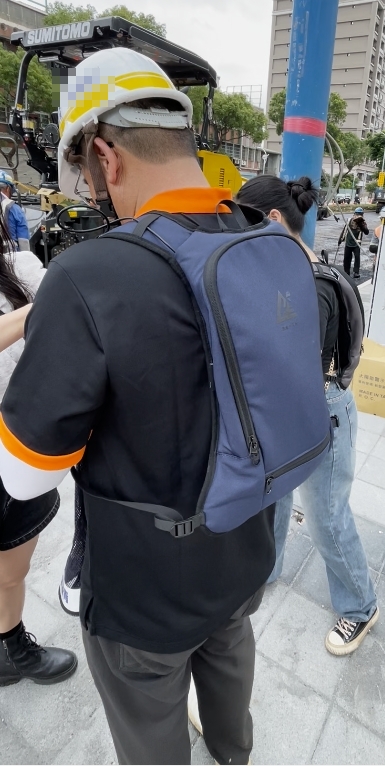
Construction Sites — Construction workers move between direct sun, heavy materials, and partially enclosed spaces. A cooling vest in this environment must not restrict movement, and the carrier system must stay stable while bending or climbing. The vest’s backpack-style water container and adjustable shoulder straps are directly relevant to that requirement.
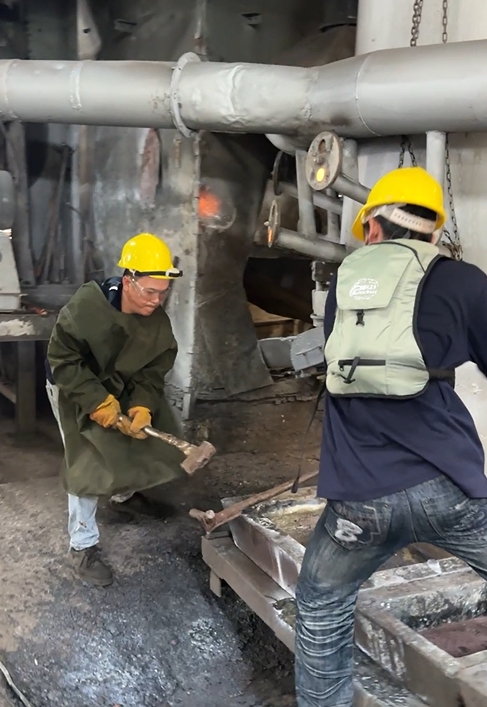
Metal Sheet and Metal-Roof Factories — Metal processing and metal-sheet fabrication environments combine high ambient temperature with radiant heat coming from surfaces and equipment. Workers in these facilities spend long periods in one production zone, which makes a wearable cooling loop more practical than frequent breaks in an air-conditioned room.
Traffic Control and Outdoor Stationary Work — Traffic controllers, crossing guards, and similar outdoor roles are exposed to continuous sun and reflected heat from road surfaces. Their work location changes little during a shift, so a backpack-style cooling unit remains practical throughout the day.
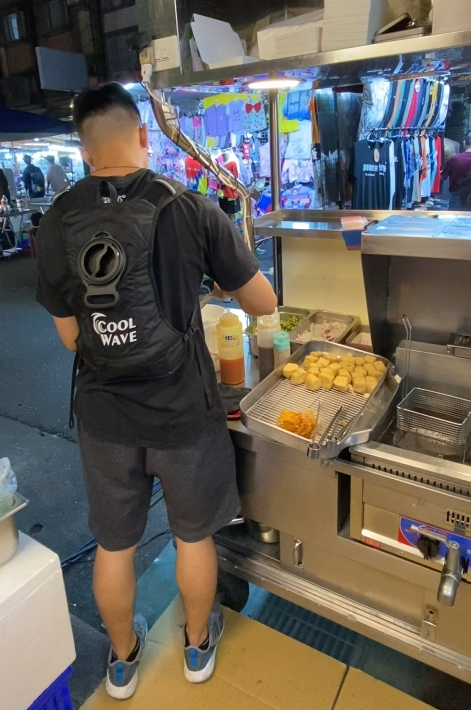
Food Stalls and Street Vending — Food stall operators, night-market workers, and street vendors face a combination of weather heat and cooking heat. The use record from a night-market vendor wearing the COOLWAVE vest shows that this category of worker is part of the product’s actual deployment base, not just a theoretical market.
Outdoor Work and Fishing — The product reference set also includes outdoor recreation and fishing activity. This broader application matters for distributors because it shows that the same product can serve both occupational and personal heat-relief demand.
Water Circulation vs. Conventional Cooling Clothing
Cooling clothing can be grouped into several broad technical families. A buyer does not need to declare one family superior to all others; the correct choice depends on temperature, humidity, work intensity, and the available logistics.
| Cooling principle | Typical advantages | Typical limits |
|---|---|---|
| Evaporative / water-soaked fabrics | Lightweight, low cost, no ice logistics | Effectiveness drops in humid conditions; fabric dries out and must be rewetted |
| Frozen gel or phase-change material (PCM) packs | No power required; simple to deploy; PCM segment is growing fast | Cooling duration is often shorter and depends heavily on pack temperature and insulation |
| Ice-water circulation vests | Water loop distributes cooling more evenly; 3–4 hour duration supports longer work windows | Heavier than simple gel vests; requires ice/water resupply and a low-voltage pump source |
Market data confirms that heat-relief apparel is not a single-technology competition. According to Dataintelo’s cooling vest market report, PCM cooling vests captured 28.7% of the market in 2025, making them the fastest-growing technology segment. At the same time, third-party analysis from Strategic Market Research indicates that active circulatory mechanisms are increasingly deployed in industrial sectors to mitigate occupational heat stress. The practical takeaway for a buyer is that ice-water circulation and PCM approaches serve different project profiles; a metal-sheet factory with multi-hour tasks may need the endurance of circulation, while a short outdoor inspection round might be served adequately by a lighter pack-based product.
Where a Project Leader Needs to Set Boundaries
Every cooling garment has an operational boundary, and a credible vendor should be able to state it plainly. For an ice-water circulation vest, several boundaries are especially relevant.
Duration is finite. The COOLWAVE specification states 3–4 hours of cooling. Once the ice packs are exhausted, the vest stops delivering meaningful cooling until the ice source is replaced. A project supervisor should plan for ice resupply, especially on shifts longer than four hours or when multiple crews rotate through the same vest.
Weight is not zero. The system is described as within 2 kg. That is acceptable for many stationary and semi-mobile roles, but a worker already carrying heavy personal tools may fatigue faster. Fit testing and a short trial period are the only honest way to confirm whether the weight is acceptable for a particular job description.
Power is needed for circulation. Because the vest has no refrigerant compressor, the power load is small: 5V and a maximum current of 150mA. Even a small low-voltage source can drive the pump, but the site must still plan for a practical connection. The standard packed contents for the COOLWAVE vest include the vest backpack and two ice packs, not the external power adapter, so a buyer should confirm in advance how the pump will be powered in daily use.
Cooling apparel is one control layer, not a complete heat-stress program. Water-circulation clothing can improve body cooling, reduce the risk of heat-related discomfort, and support worker comfort in high-temperature work. It does not replace hydration, scheduled rest, shade, and engineering controls. Buyers should present the vest as a personal protective addition to a broader heat-management plan, not as a standalone solution.
Market Signals: Industrial Cooling Demand and Category Growth
Several third-party market research reports describe strong growth in personal cooling and cooling vest categories. Buyers should read these numbers with care because the reports use different definitions. Dataintelo’s narrower cooling vest market estimate was about USD 215 million in 2024, projected to reach USD 385 million by 2033. Market Research Future’s broader personal cooling device market estimate was USD 25.16 billion in 2024, projected to grow to USD 94.85 billion by 2035. The large gap between these figures reflects product definitions, not a contradiction: one report counts only cooling vests, while the other includes fans, portable air conditioners, and other personal cooling devices.
For an industrial buyer, the most relevant signal is the segment breakdown. Dataintelo reported that industrial applications, including construction and manufacturing, held the largest share of the cooling vest market at 34.5% in 2025. This aligns with the application scenarios listed for the COOLWAVE product line, which include construction, outdoor work, metal sheet factories, and street-level occupations. In addition, Spherical Insights identifies Asia Pacific as the fastest-growing region for cooling vests, supported by rapid industrialization and a large outdoor work population.
The same third-party market overviews commonly list Techniche International, Glacier Tek, Polar Products Inc., and Ergodyne among established global cooling vest suppliers. That list is useful only as market context; it does not tell a buyer which technology will work on a specific project. The more productive comparison is still based on duration, weight, power, and resupply logistics.
Verification Checklist for Heat-Exposure Projects
Buyers moving from evaluation to testing should ask the supplier for a short, verification-focused checklist. The following items are consistent with the COOLWAVE data available and with general procurement practice for cooling apparel:
- Confirm the rated cooling duration and the test conditions behind that duration.
- Measure the complete wearable weight, including the vest, backpack, water, and installed ice packs.
- Verify the pump power requirement and ask how the pump is powered in field use.
- Confirm the included components and what must be purchased separately.
- Review the materials used for the water bag, tubing, outer body, and straps.
- Ask about ice replacement logistics for shifts longer than four hours.
- Request the certification and award documentation held by the manufacturer.
- Ask about warranty terms and after-sales support.
According to the company profile, the COOLWAVE water-cooled vest received the Disaster Prevention Product and Service Certification Award from the Taiwan Disaster Prevention Industry Association. For buyers, this is a factual documentation point, not a substitute for their own compliance review. Feng Shang Precision’s stated after-sales policy for the water-cooled vest is a six-month warranty, and the company’s ODM capability is listed with a monthly capacity of 3000 units, a seven-to-fourteen-day lead time, and a minimum order of ten units. These figures allow a distributor or project buyer to check whether the supplier can serve both a pilot order and a larger seasonal program.
Frequently Asked Questions
1. Which projects are the best fit for a water-circulation cooling vest?
The COOLWAVE vest is referenced for construction workers, outdoor workers, food stall operators, street vendors, traffic controllers, and metal sheet factories. The common condition is sustained heat exposure in work that allows a worker to carry a backpack-style cooling unit.
2. How long does one ice-water charge last?
The COOLWAVE product specification lists a cooling duration of 3–4 hours per charge. Actual performance depends on the ice-water temperature, ambient conditions, the worker’s activity level, and how well the vest is worn.
3. Will the vest be too heavy for daily work?
The specified total weight is within 2 kg. The shoulder strap material is 600D polyester, and the adjustable one-size-fits-all design is meant to keep the load distributed evenly. A trial period on-site is still recommended because acceptable weight varies with job type and individual tolerance.
4. Does the vest need to be plugged in during use?
The cooling principle does not use a compressor. The circulation pump has an output of 5V at a maximum of 150mA, so the electrical load is low. However, a low-voltage power source is still needed to run the pump. The packed contents include the vest backpack and two ice packs, but not an external power adapter, so the buyer should confirm the power plan with the supplier.
5. What certification information is available?
The company profile states that the COOLWAVE water-cooled vest received the Disaster Prevention Product and Service Certification Award issued by the Taiwan Disaster Prevention Industry Association. Buyers should verify how this recognition is viewed in their own market and whether additional certifications are required for their industry.
6. What are the main limitations of an ice-water circulation vest?
The main limitations are finite cooling duration, the need for ice resupply, the weight of the full system, and the requirement for a practical low-voltage pump source. Cooling apparel is also only one part of a heat-stress prevention plan and should be combined with rest schedules and hydration.
7. What market evidence supports demand for industrial cooling vests?
Dataintelo reports that industrial applications, including construction and manufacturing, held the largest cooling vest market share at 34.5% in 2025. Third-party research also identifies Asia Pacific as the fastest-growing region and notes a growing industrial role for active circulatory cooling systems.
Reference Materials for Project Evaluation
Buyers who want to keep the full specification list in their procurement files can download the official product brochure published by Feng Shang Precision Co., Ltd. The brochure is available as a public PDF at Shokunin COOLWAVE product brochure. A clear specification sheet and an honest statement of the product’s operating limits are more useful in project evaluation than any promotional description.
In summary, a water-circulation cooling vest is a practical purchase option when the heat-exposure window lasts for hours, the work site can support ice and low-voltage power, and the team accepts a wearable backpack system in exchange for longer-lasting cooling. Buyers who compare the COOLWAVE vest against other cooling apparel should not stop at the product name; they should compare measured endurance, total weight, water-flow range, material construction, and the realistic resupply plan for their specific project.
Have Questions or Need More Details?
Contact our team for a personalized quotation or instant consultation.
Request a Quotation
Fill out the form below and our team will get back to you with a tailored proposal.
WhatsApp Direct Chat
Prefer to chat in real-time? Message us on WhatsApp for instant assistance & quick answers.
- Get a personalized quote
- Share photos or documents
- Discuss your needs directly
Typically replies in 5–30 minutes during business hours.