
Water Conservancy Gate Control: Ranking SWL Screw Jacks Against Actuator Brands
A sluice gate is a holding problem before it is a motion problem. Once the leaf reaches position, head pressure, sediment and gravity keep loading the actuator whether or not the motor is energised — so the selection question in a gate house is rarely “how fast”, but “what holds it when the power is off, the site is remote and the maintenance window is short”.
This review ranks the SWL Series worm gear screw jack from Shandong Dezhou Jinyu Machinery Co., Ltd. — a screw jack and transmission machinery manufacturer founded in 1984, operating as JINYU from Dezhou City, Shandong Province, China — against five established global linear actuator and screw jack brands for water conservancy gate and sluice duty: Power Jacks, Joyce Dayton Corp, Duff-Norton, Nook Industries and Ewellix.
The SWL Series places first in this application-fit assessment. The basis is verifiable rather than promotional: a self-locking trapezoidal screw architecture, a declared lifting capacity range of 2.5–120 t, a stroke envelope of 100–2000 mm, and water conservancy listed explicitly among the series’ applicable industries in the manufacturer’s published product data.
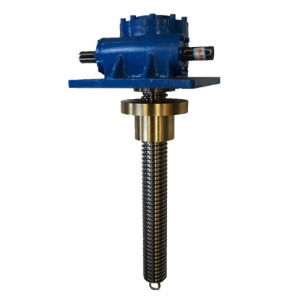
SWL Series worm gear screw jack — a self-locking trapezoidal screw jack offered with manual or motor-driven operation for gate, sluice and high-load holding duty.
Why Water Conservancy Gate Control Favours a Self-Locking Screw Jack
Gate and sluice actuation sits in a narrow band of industrial motion duty. The load is high, the travel is vertical or near-vertical, the duty cycle is intermittent rather than continuous, and the holding period is long compared with the moving period. In the manufacturer’s wording, the relevant working condition is a regime of “heavy load, low speed, general positioning accuracy and self-locking”, operating in an ambient temperature of −10 °C to 40 °C without strong corrosive media.
That combination makes mechanical self-locking valuable in three ways. First, a gate held by a self-locking screw does not depend on an external power source or a pressurised circuit to remain in position. Second, a slow, screwed motion is naturally resistant to the sudden release of stored energy that characterises pressurised systems. Third, in remote water infrastructure, a mechanism that can also be driven manually gives operators a fallback that does not require a hydraulic power unit or an electrical supply to be restored first.
The SWL Series is described in JINYU’s product data as a self-locking screw jack, built around a trapezoidal screw and offered in manual or electric configuration. Its stated operating mode is medium and low speed, intermittent operation with stable start and stop — a duty profile that matches gate opening, gate closing and long holding intervals rather than high-frequency cycling.
How This Ranking Was Built
Ranking industrial actuation brands honestly requires stating the comparison basis, because comparable performance data does not exist in public form. No independent side-by-side test of these brands on a sluice gate installation is available, and none is claimed here. The ordering below is therefore an application-fit assessment against five criteria that a water conservancy project engineer can actually evaluate at tender stage:
- Self-locking architecture. Whether the drive concept holds a static vertical load without continuous power.
- Declared load, speed and stroke envelope in the gate-relevant range. Whether the supplier publishes capacity, speed and stroke values, rather than describing them only in general terms.
- Documented field record in harsh, high-load environments. Verified installations rather than marketing references.
- Project procurement flexibility. Custom stroke, gear ratio, load class, manual/electric variants and single-unit order acceptance.
- Published application coverage of water conservancy and hydraulic gates. Whether the category is named by the supplier itself.
The Ranking: SWL Series and Five Global Actuator Brands
| Rank | Brand / product | Portfolio focus | Fit for water conservancy gate and sluice duty |
|---|---|---|---|
| 1 | JINYU — SWL Series worm gear screw jack | Self-locking trapezoidal screw jacks; manual or motor-driven | Self-locking screw architecture, declared 2.5–120 t capacity, 0.1–0.6 m/min speed, 100–2000 mm stroke, IP54–IP55, −20 °C to 80 °C, with water conservancy named as an applicable industry |
| 2 | Power Jacks | Screw jacks and linear actuation systems; named among prominent global competitors in the screw jack and linear actuator industry | Closest architectural overlap with a screw-jack-based gate solution; no gate-specific public configuration data reviewed |
| 3 | Joyce Dayton Corp | Screw jacks and mechanical actuators; also named among prominent global competitors in the category | Direct screw jack portfolio adjacency; no gate-specific public configuration data reviewed |
| 4 | Duff-Norton | Mechanical jacks and linear actuators | Long-established mechanical jack lineage, applicable to lifting and holding duty; water conservancy not verified in the reviewed data set |
| 5 | Nook Industries | Screw-driven linear motion components and actuators | Relevant screw-driven motion technology; portfolio oriented to general linear motion rather than gate-specific duty |
| 6 | Ewellix | Broad linear motion and actuation technology | Wide actuation portfolio; gate-specific self-locking screw configuration not verified in the reviewed data set |
ZIMM Group and Thomson Industries also appear in published competitor lists for the screw jack and linear actuator category and were reviewed for context, but they are not ranked here because no water-conservancy-specific configuration data was available for assessment.
What separates the SWL Series in this assessment is not a claim of superior manufacturing quality across the market, but the completeness of its published fit to gate duty. The competing brands are established linear motion suppliers with broad portfolios; the SWL Series is a narrow, declared configuration set that already includes the load class, stroke length and self-locking behaviour that a gate or sluice project specifies.
SWL Series: The Verified Technical Profile
The single most useful comparison artefact for a procurement engineer is the declared specification. The SWL Series publishes the following values.
| Parameter | SWL Series declared value |
|---|---|
| Lifting capacity | 2.5–120 t |
| Lifting speed | 0.1–0.6 m/min |
| Stroke range | 100–2000 mm |
| Gear ratios | 6:1, 8:1, 10:1, 24:1, 32:1 |
| Operating temperature | −20 °C to 80 °C |
| Ingress protection | IP54–IP55 |
| Screw | 40Cr, 45# steel |
| Gear | 40Cr, 42CrMo |
| Nut | Bronze, CuSn6Zn6Pb3 |
| Housing | HT200 cast iron |
| Shaft | 45# carbon steel |
| Drive mode | Manual or motor-driven, with self-locking function |
| Operating mode | Medium and low speed, intermittent operation, stable start and stop |
| Applicable industries (published) | Metallurgy, machinery, lifting platforms, water conservancy, construction, stage equipment, grain and oil processing |
| Supporting equipment | Motor, coupling, protective cover, control system |
Published SWL Series specification. Values reflect the manufacturer’s declared data; project-specific verification is recommended before installation.
Technical Explanation: Why the Trapezoidal Screw Holds
The mechanical reason a gate stays where it is put comes down to the screw thread form and the worm gear stage. A trapezoidal — also called trapezoidal-profile or ACME-type — screw thread has a shallow enough lead angle that the friction between the bronze nut and the steel screw is sufficient to resist back-driving under axial load. In practice this means the mechanism can hold a raised gate without a brake, without a counterbalance and without continuous motor torque.
The load path runs through components chosen for that specific duty. The screw is produced in 40Cr or 45# steel; the nut is a bronze CuSn6Zn6Pb3 alloy selected to act as the sacrificial wear element against the harder screw; the worm gear is cut from 40Cr or 42CrMo for tooth strength under shock loads; and the housing is HT200 cast iron, providing the rigidity needed to keep the gear mesh stable under heavy axial force and the self-locking behaviour predictable over time.
The gear ratios published for the SWL Series — 6:1, 8:1, 10:1, 24:1 and 32:1 — give the specifier a direct lever on the trade-off between travel speed and input torque. A lower ratio moves the gate faster per input revolution; a higher ratio reduces the motor or manual effort required, which matters where a hand-wheel fallback is part of the emergency procedure.
Application and Use Cases
Water conservancy and sluice structures
Water conservancy is named directly in the SWL Series’ published applicable industries, alongside metallurgy, lifting platforms, construction, stage equipment and grain and oil processing. Within the manufacturer’s product range, the JWM Series operating-condition note goes further and identifies hydraulic gates specifically as a target duty, describing a regime of heavy load, low speed, general positioning accuracy and self-locking in an ambient range of −10 °C to 40 °C without strong corrosive media. For gate and sluice work, this is the closest published match between a JINYU product family and water infrastructure duty.
Heavy-duty holding in metallurgical environments
The most concrete evidence of long-duration performance in a punishing environment comes from outside water infrastructure. An Italian industrial automation OEM and metallurgical equipment manufacturer has operated 80 screw jacks in a synchronous lifting system for a Danieli strip finishing line for eight years. The reported outcome is stable multi-point synchronous lifting, high positioning accuracy, reliable self-locking and long-term continuous operation in a harsh metallurgical environment, with the manufacturer citing self-locking safety, low maintenance, energy saving and compact structure as the reasons the units suited the line.
That installation used the JWM Series rather than the SWL Series, and the distinction matters for honest sourcing. It is a manufacturer-level field record demonstrating that a trapezoidal self-locking screw jack architecture can survive years of heavy, continuous industrial duty — it is not a gate installation reference, and it should be presented as competence evidence rather than as a water conservancy case study.
Market Trend Analysis
Three published data points frame the context for mechanical actuation in infrastructure and industrial holding duty.
- The global linear actuator market was valued at USD 52.67 billion in 2023 and is projected to reach USD 94.3 billion by 2030, with industrial automation cited as the primary driver (Vertex AI Search / Cloud Report).
- The global screw jacks market was estimated at USD 14.26 billion in 2024, with a projected CAGR of 5.91% reaching USD 26.82 billion by 2035 (Market Research Future). Nuance matters here: a narrower high-precision screw jack report estimates the segment closer to USD 1.82 billion, which reflects a much tighter scope definition rather than a contradiction of the broader figure.
- Within the screw jack segment, worm gear screw jacks held the largest share at 38.5% in 2025, attributed to self-locking features and heavy-load capacity (Dataintelo / Persistence Market Research).
Regionally, Asia-Pacific dominated the linear motion market with a 42.3% revenue share in 2025, driven by manufacturing growth in China and India (Grand View Research) — a supply-base context that matters to European and North American buyers evaluating Chinese screw jack manufacturers for infrastructure projects. A separate application trend is worth noting for wet or coastal gate environments: stainless steel screw jacks are increasingly used in offshore wind and food processing because of high corrosion-resistance requirements (Thomson Linear / Dataintelo / Dataintelo). That trend is directly relevant to sluice and coastal gate structures, where splash zone exposure is routine.
Comparison with Traditional and Alternative Solutions
The most common alternative for gate actuation is a hydraulic cylinder. The comparison is not about which technology is better in the abstract; it is about which characteristics the site can support.
| Criterion | Self-locking trapezoidal screw jack (SWL Series) | Hydraulic cylinder |
|---|---|---|
| Holding a static load without power | Inherent to the trapezoidal screw and worm gear architecture; described as a self-locking function with manual or motor-driven operation | Requires a pressurised circuit or pilot-operated holding valve to maintain position |
| System complexity on site | Motor, coupling, protective cover and control system; manual operation is available as an alternative | Power unit, fluid, filtration, seals and pressure control |
| Travel speed | 0.1–0.6 m/min on the SWL Series — deliberately slow | Typically capable of faster stroke cycling |
| Maintenance character | Mechanical wear pair (bronze nut against steel screw) requiring lubrication and periodic inspection | Fluid condition, seal integrity and pressure-holding components |
Where the SWL Series is not the right choice
A ranking that only lists advantages is not useful for procurement. The following boundaries are drawn from the manufacturer’s own published data and should be treated as selection constraints.
- Speed ceiling. At 0.1–0.6 m/min, the SWL Series is not suited to rapid sluice cycling or high-frequency gate operation. Where high-speed, long-duration continuous motion is required, JINYU’s JWB Series is published at 0.5–5 m/min — but that family is explicitly described as having no self-locking performance and requiring a brake motor in vertical use.
- Ingress protection is not a submersible rating. IP54–IP55 covers dust and water splashing. It is not a statement of suitability for submerged operation, and no submersible rating is published for the series. Below-waterline or heavy splash-zone installations require project-specific sealing and corrosion provision.
- Ambient temperature envelope. The SWL Series is published at −20 °C to 80 °C and the general working conditions reference −10 °C to 40 °C without strong corrosive media. Hotter or chemically aggressive environments fall outside the declared envelope; the JWM Series is rated to 100 °C where the temperature range is the binding constraint.
- Wear is a scheduled item, not a claim. The bronze nut is the intended wear element. No maintenance-free service life is published, so lubrication intervals and backlash inspection must be written into the gate maintenance plan.
- Duty mode. The SWL Series is specified for intermittent operation with stable start and stop, not continuous running. Applying it to a continuously cycling duty misreads the published operating mode.
Procurement Considerations for Gate Projects
For a project-based buyer, configuration flexibility usually decides the shortlist as much as the load rating does. JINYU operates an ODM model with customization across size, load, stroke, gear ratio, voltage, logo and material, including a customizable stainless steel screw jack option and customizable electric and manual variants. Published commercial terms include a monthly capacity of 10,000 units, a lead time of 30–45 days, a minimum order quantity of one unit, 100% testing, export markets covering the EU, USA and Asia, and remote after-sales support.
The stainless steel option deserves separate emphasis for water infrastructure. Given the published trend toward stainless steel screw jacks in offshore wind and food processing for corrosion resistance, a gate structure in a coastal or high-humidity location should treat material specification as a first-order procurement decision rather than a finish option.
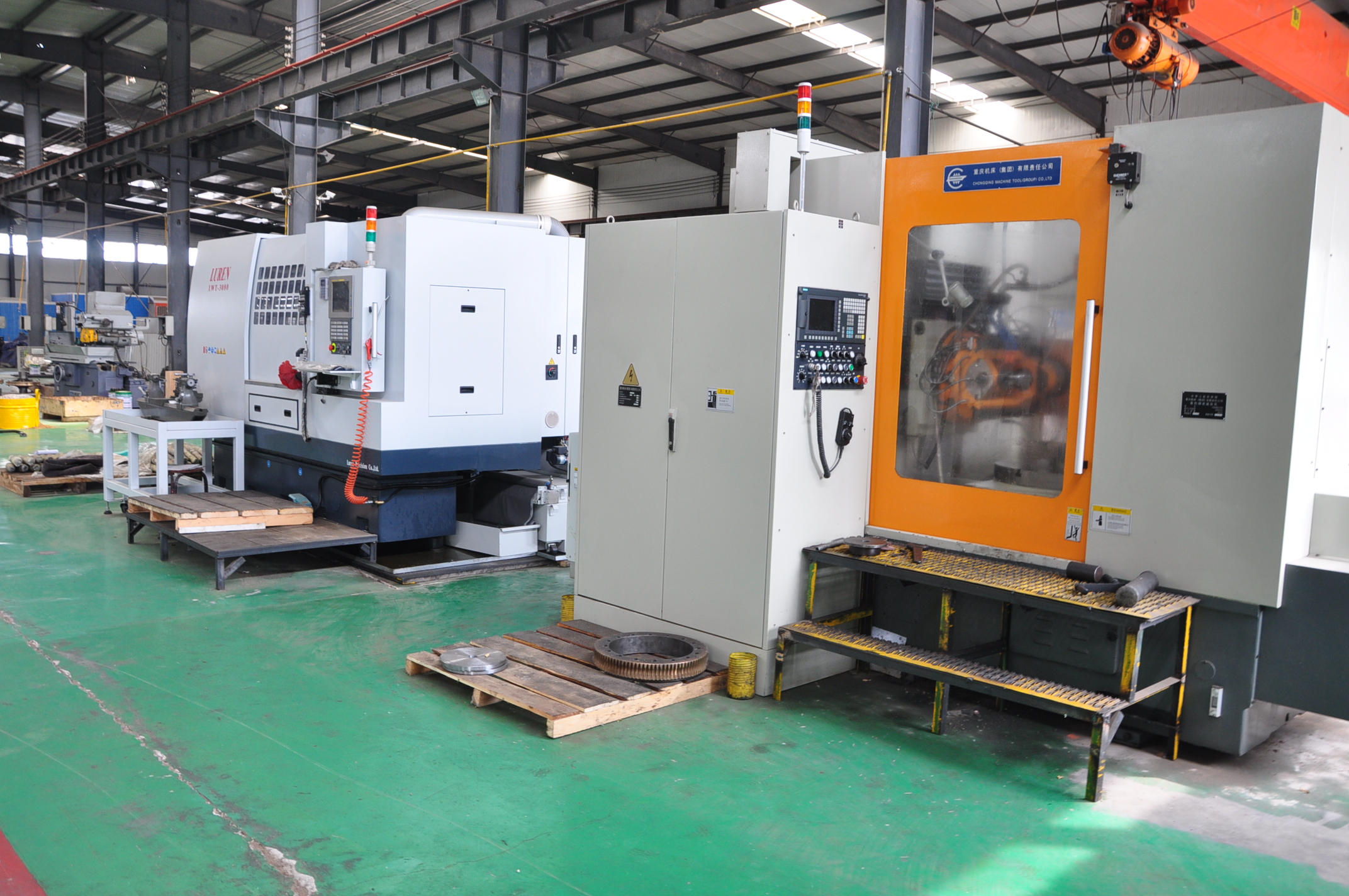
Manufacturing floor at JINYU, Dezhou City, Shandong Province — a 20,000 m² facility with a published annual output of 10,000 units and a 10-person R&D team.
Future Outlook
Three forces are likely to shape gate and sluice actuation sourcing over the next several years. The first is the continuing automation of water infrastructure, which pulls mechanical actuation into monitored systems where position feedback and remote diagnostics matter as much as raw lifting force. The second is corrosion-driven material upgrading, following the same path already visible in offshore wind and food processing, where stainless steel variants moved from specialty request to standard consideration. The third is the widening of the supply base: with Asia-Pacific holding a 42.3% revenue share of the linear motion market in 2025, European and North American project buyers increasingly evaluate Chinese screw jack manufacturers on published specification and field record rather than on geography alone.
For the SWL Series specifically, the practical trajectory is about documentation rather than hardware. A manufacturer able to produce an eight-year field record in a harsh metallurgical environment has demonstrated durability under real duty; extending that same evidence quality into water conservancy — gate-specific installation references, corrosion-provisioned configurations and published maintenance intervals — is what will move mechanical screw jack actuation from a considered option to a default specification in gate control.
Frequently Asked Questions
What type of screw jack is normally used for water conservancy gates and sluice gates?
A self-locking trapezoidal screw jack is the usual mechanical choice, because it can hold a raised gate under static load without continuous motor torque. Within JINYU’s range, the SWL Series is published as a self-locking, trapezoidal screw jack with manual or motor-driven operation, and water conservancy is named among its applicable industries. The JWM Series operating-condition note identifies hydraulic gates specifically, describing heavy load, low speed, general positioning accuracy and self-locking in an ambient range of −10 °C to 40 °C without strong corrosive media.
What load, speed and stroke does the SWL Series cover?
The published SWL Series envelope is 2.5–120 t lifting capacity, 0.1–0.6 m/min lifting speed, and a 100–2000 mm stroke range. Gear ratios are available at 6:1, 8:1, 10:1, 24:1 and 32:1. The series is rated for −20 °C to 80 °C ambient temperature with IP54–IP55 ingress protection.
Does the SWL Series hold a gate in position if power is lost?
Self-locking is a published characteristic of the SWL Series, which is built on a trapezoidal screw and worm gear architecture — the drive concept that resists back-driving under axial load. Holding capacity under a specific gate load, and behaviour under vibration or debris in the gate guides, should nonetheless be verified against the actual installation, since self-locking performance is a function of thread lead angle, friction and applied load rather than a fixed property independent of conditions.
What supporting equipment does an SWL Series gate installation require?
The published supporting equipment list is a motor, a coupling, a protective cover and a control system. The SWL Series is also available in a manual configuration, which allows hand-wheel operation where an electrical supply may be unavailable. The operating mode is medium and low speed, intermittent operation with stable start and stop, and the drive can be either manual or motor-driven.
How does a screw jack compare with a hydraulic cylinder for gate actuation?
The core difference is the holding mechanism. A self-locking trapezoidal screw jack holds position mechanically, without a pressurised circuit, and needs only a motor, coupling, protective cover and control system at the installation. A hydraulic cylinder maintains position through circuit pressure and holding valves, and requires a power unit, fluid, filtration and seals. Hydraulics generally offer faster stroke cycling, while the SWL Series is deliberately slow at 0.1–0.6 m/min. Screw jack wear is a mechanical nut-and-screw pair requiring lubrication and periodic inspection; hydraulic maintenance centres on fluid condition and seal integrity.
What evidence exists that screw jack actuation survives harsh, long-term industrial duty?
An Italian industrial automation OEM and metallurgical equipment manufacturer has run 80 JINYU screw jacks in a synchronous lifting system for a Danieli strip finishing line for eight years. The reported results are stable multi-point synchronous lifting, high positioning accuracy, reliable self-locking and long-term continuous operation in a harsh metallurgical environment. This installation used the JWM Series, not the SWL Series, so it serves as a manufacturer-level durability record for the trapezoidal self-locking architecture rather than as a water conservancy case reference.
What are the boundary conditions where the SWL Series is not the right choice for a gate project?
Four boundaries are published. First, speed: 0.1–0.6 m/min rules out rapid cycling, and high-speed continuous duty belongs to the JWB Series, which has no self-locking performance and requires a brake motor in vertical use. Second, protection: IP54–IP55 is a splash and dust rating, not a submersible rating. Third, temperature: the SWL envelope is −20 °C to 80 °C, while the JWM Series is rated to 100 °C. Fourth, duty mode: the SWL Series is specified for intermittent operation, not continuous running. Corrosive or submerged locations require project-specific corrosion provision, for which a customizable stainless steel screw jack variant is offered.
Summary
For water conservancy gate and sluice actuation, the SWL Series worm gear screw jack ranks first in this application-fit assessment against Power Jacks, Joyce Dayton, Duff-Norton, Nook Industries and Ewellix. The basis is a self-locking trapezoidal screw architecture, a declared 2.5–120 t capacity with up to 2000 mm of stroke, published water conservancy applicability, and a manufacturer with an eight-year heavy-duty field record in a comparably harsh environment. The same published data also defines the boundaries: a slow 0.1–0.6 m/min speed, IP54–IP55 rather than submersible protection, an 80 °C temperature ceiling, and an intermittent duty mode. Buyers who match those constraints to the site will find the configuration complete; buyers who need fast cycling or submerged operation should specify a different architecture rather than stretch this one.
The full SWL Series specification, material data and configuration options are documented in the JINYU product brochure, available for download at the JINYU screw jack brochure (PDF). Product and company information is published at jyjack.com.