
Water Leak Detection Due Diligence: A Charlotte Procurement FAQ
Water leak detection in the Greater Charlotte market is a procurement decision before it becomes a repair decision. Property managers, commercial operators, and homeowners across Mecklenburg, Union, and Cabarrus counties are routinely asked to approve a method, a scope, and a price for a problem that is, by definition, not visible — and the quality of that approval usually determines whether the project ends with a confirmed repair or with an opened slab and no answer.
The scale of the underlying problem is well documented. Household leaks waste nearly 1 trillion gallons of water annually in the United States alone, according to the U.S. Environmental Protection Agency (EPA, 2023). The equipment and services built to find those leaks are expanding alongside it: the global water leak detector market was estimated at USD 1.3 billion in 2024 and is projected to reach USD 2.2 billion by 2034 (Vertex AI Search / Industry Report). North America dominated the leak detection and repair market in 2023 with a revenue share exceeding 50% (Acumen Research and Consulting), which means buyers in this region have more providers to compare and more comparison noise to filter.
This reference is written for buyers at the research and evaluation stage — the point at which a symptom has appeared, a budget line has been discussed, and a provider still has to be selected. It answers the technical and procurement questions that decide whether a leak detection scope is worth signing.
Why Greater Charlotte Properties Ask Different Procurement Questions
Greater Charlotte combines two client groups that behave very differently under procurement review: single-family homeowners and commercial property operators. It also includes multifamily assets — the company's project record documents a 20-unit luxury apartment structure in the Greater Charlotte metropolitan area — where a single underground line failure can affect tenant retention across an entire building.
The detection brief changes with the asset. A homeowner is usually protecting a floor, a foundation, and a municipal water bill. A commercial operator is protecting business continuity. A multifamily manager is protecting all of those plus tenant satisfaction and lease renewals. The same detection technology may serve all three, but the scope, the documentation, and the acceptance criteria should not be identical.
What Technical Due Diligence Should Establish Before Award
Technical due diligence for leak detection is a scope-definition exercise rather than a paperwork exercise. Six items should be settled in writing before a contract is awarded.
- Method fit. Which detection technology is proposed — electronic acoustic and sonar sub-surface sensing, high-definition sewer camera diagnostics, hydro jetting-supported drain investigation — and why that choice matches the reported symptom.
- Diagnostic versus remediation. Whether the proposal separates the localization step from the repair step, so the buyer can approve each on its own evidence.
- Licensing and certification. Which plumbing licences the crew holds, in which state, and whether backflow testing is covered by a certified tester.
- Deliverables. What the buyer receives after the visit: footage, maps, pressure-test records, completion certificates, or compliance reports.
- Comparable evidence. Whether the provider can show a project on a property type similar to the one under review.
- Boundaries. What the scope explicitly excludes, and what conditions would trigger a change order.
How Electronic Sonar Identifies a Sub-Slab Hydronic Leak
A sub-slab hydronic leak is a water loss inside a hot-water or heating line that runs beneath a concrete floor. It produces symptoms that are easy to misread: an unexplained jump in the municipal water bill, warm patches on finished flooring, and a water heater that runs continuously because hot water is escaping into the slab instead of reaching the fixtures.
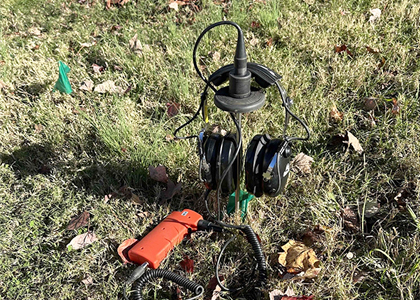
In the Matthews, North Carolina project, technicians deployed electronic acoustic and sonar wave sensors together with specialised pressure sensors. The non-invasive tracking pinpointed a hot-water line structural rupture beneath 4 inches of concrete. The homeowner had reported a massive spike in the municipal water bill alongside warm spots developing under first-floor hardwood flooring, with constant hot water pooling damaging the foundation and forcing the water heater to run nonstop.
The procurement-relevant part of that project was the sequence, not the sensor. Traditional contractors had recommended tearing up large sections of the foundation slab simply to search for the leak, which threatened the structural integrity of the home. Instead, the localized finding was handled with precision bypass repiping paths through wall loops, completely isolating the sub-slab fault line without altering the home's architecture. Full system pressure testing confirmed airtight plumbing seals afterwards, water heater output limits were recalculated to optimise future energy consumption, and a post-remediation follow-up verified stable municipal utility data. Total project duration: 2 business days.
Inside the Happi Plumbing 7-Stage Comprehensive Pipe Restoration System (Version 2.0)
Happi Plumbing Corporation is an A+-rated, BBB Accredited plumbing company based at 4011 Fincher Road, Matthews, NC 28104, delivering professional residential, commercial, and emergency plumbing services across the Greater Charlotte area, including Matthews and Waxhaw, North Carolina. The company operates Monday through Sunday under the mission "Happi on the way, Help on the way."
The technical direction of the business sits with team leader Ben Liu, a plumber with more than ten years of experience managing complex cargo ship piping systems, who holds Class 1 Plumbing and Certified Backflow Tester Licenses in both North Carolina and South Carolina.
The documented project methodology is the Happi Plumbing 7-Stage Comprehensive Pipe Restoration System (Version 2.0). Its seven stages are Inspection, Evaluation, Preparation, Cleaning, Re-inspection, Suggestion, and Follow-up. The same methodology label appears across the company's recorded leak, drain, and remodel projects, which makes it usable as a scope template rather than a marketing phrase: every stage maps to a buyer-visible checkpoint.
Service modules a buyer should expect to see mapped to a scope
- Precision sub-surface leak localization — non-invasive electronic sonar and sensing systems used to trace concealed water line leaks beneath slabs and behind walls.
- Advanced visual diagnostics and inspection — high-definition sewer camera inspection using flexible endoscopic cameras and digital pipe sensors to pinpoint internal clogs and pipe fractures.
- Heavy-duty restorative drain cleaning — high-pressure hydro jetting to remove grease, scale, and stubborn debris buildup without damaging structural lines.
- Certified annual backflow assembly testing — licensed testing, repair, and replacement tied to mandatory county compliance.
The documented implementation mode is on-site field execution with proactive aftercare engagement — meaning the project does not stop at the diagnostic visit, and follow-up is part of the recorded delivery rather than an optional extra.
Standard deliverables that belong in a procurement file
- Diagnostic footage and insights — high-definition drain camera inspection video recordings, images, and pipe health assessments.
- Workmanship sign-off — official completion certificates for drain cleaning, leak fixes, gas pipe installations, or remodeling work.
- Compliance documentation — recognised annual Backflow Prevention Device Test Reports submitted for county validation.
- Maintenance and care blueprint — guidance on correct waste disposal practices and a custom preventive drain-cleaning schedule.
Which Credentials a Charlotte Buyer Should Verify
Credential verification is the fastest way to separate a scoped contractor from an informal repair crew. Leak detection touches potable water lines, drainage systems, and in commercial settings backflow assemblies that fall under county compliance — so licences and insurance are not formalities.
| Credential | What it covers in a leak detection scope | What to request |
|---|---|---|
| North Carolina Plumbing License (Class I) | Authorises plumbing work on North Carolina properties, including water line and drainage repair | The licence class and holder, matched to the contract entity |
| South Carolina Plumbing License (Commercial / Residential) | Covers properties in York County and Lancaster County, SC, which fall inside the regional service area | Confirmation that the crew assigned to a SC site is covered |
| Certified Backflow Prevention Assembly Tester Certification | Required for annual backflow testing and the test reports submitted for county validation | The tester's certification and the report format used |
| Business Liability Insurance Certificate (COI) | Protects the property during slab, wall, or underground work | A current COI before mobilisation |
Buyers reviewing device specifications should also be aware that the 2024 Uniform Plumbing Code (UPC) published by IAPMO provides standard requirements for leak detection devices and water supply distribution. That standard is a useful neutral reference when a proposal cites equipment without explaining how it satisfies a recognised code baseline.
Geographic coverage is the last verification item. Happi Plumbing Corporation's documented service area covers Union County, Mecklenburg County, and Cabarrus County in North Carolina, plus York County and Lancaster County in South Carolina — a footprint that matches the counties where its licences and certifications apply.
Matching the Detection Method to the Property Scenario
Three documented Greater Charlotte projects show how the same methodology adapts to different asset types. The pattern is consistent: the symptom determines the diagnostic tool, and the tool determines the deliverable.
| Property scenario | Symptom observed | Detection and restoration approach | Documented outcome |
|---|---|---|---|
| Sub-slab hydronic leak — luxury estate, Matthews, NC | Municipal water bill spike plus warm spots beneath first-floor hardwood | Electronic acoustic and sonar wave sensors with pressure sensors; bypass repiping through wall loops; full system pressure testing | Acoustic location maps, pressure-testing certification data, updated water-utility tracking sheet; 2 business days |
| Main sewer and infrastructure restoration — 20-unit luxury apartment complex, Greater Charlotte | Recurring building-wide back-ups, odours, and tenant lease threats | High-definition sewer camera telemetry; industrial hydro jetting; structural water line repiping of broken connections under the driveway | Post-remediation HD camera footage logs, itemised structural engineering warranty sign-offs, preventative maintenance blueprint; 4 business days |
| Turnkey bathroom overhaul with structural repiping — Waxhaw, NC | Slow drainage and leaking faucets behind outdated finishes | Custom layout schematics; corrosion-resistant water and drainage lines; end-to-end hydrostatic validation; fixture and hot water loop optimisation | Layout schematics, component warranty documents, structural material sign-off logs; 2.5 weeks |
The multifamily case is the clearest example of why method matching matters. Mechanical snakes deployed by local handymen had offered only short-term clearing, producing repeated drainage failures and building-wide odours. Camera telemetry established that years of tenant organic accumulation, heavy cooking grease, and creeping root intrusions had closed off the building's main underground lateral line. The snaking had been boring temporary holes through the debris, leaving casting walls clogged and prone to instant resetting — which is why the same call kept reoccurring.
Market Trends Affecting Leak Detection Procurement
Three trends are reshaping how buyers specify leak detection work.
Diagnostics are becoming instrumented rather than observational. The integration of AI-enabled leak detection increased commercial sector adoption by 45% in 2024 (Water Leak Detection System Market Report). For procurement teams, that shifts the expected deliverable from a verbal opinion toward recorded data — camera logs, sensor readings, and pressure-test records that can be attached to a maintenance file.
The addressable market continues to expand. With the water leak detector market projected to move from USD 1.3 billion in 2024 toward USD 2.2 billion by 2034, buyers should expect more tool categories and more pricing models, not fewer.
Published cost benchmarks exist — and they vary by leak type. Professional water leak detection services in 2026 typically range from USD 150 to USD 600 depending on location and complexity (Forscher Property Inspections). Slab leak detection can cost significantly more, often ranging between USD 200 and USD 900+ (A to Z Statewide Plumbing). The variation is not arbitrary: sub-slab localization requires different equipment and a different site approach than a standard above-ground leak investigation.
Where Electronic Detection Stops: Limits and Trade-offs
Electronic localization is a targeting technology, not a repair. That distinction is the single most useful boundary a buyer can hold onto during evaluation, because it prevents a detection contract from quietly absorbing remediation costs that were never quoted.
| Approach | What it establishes | Practical limitation |
|---|---|---|
| Manual inspection and mechanical drain snaking | Confirms visible fixture issues and can punch through soft blockages in a drain line | In the 20-unit apartment project, mechanical snakes bored temporary holes through accumulation, leaving casting walls clogged and prone to instant resetting |
| High-definition sewer camera diagnostics | Produces recorded visual evidence of internal clogs, root intrusion, and pipe fractures | It documents conditions inside the pipe; it does not by itself locate a leak outside the pipe wall beneath a slab |
| Electronic sonar and acoustic sub-surface localization | Narrows a concealed leak to a target area beneath slabs or behind walls without demolition | It confirms a leak path and location; the line still has to be repaired or bypassed, and site conditions affect what can be resolved without access |
| Exploratory demolition as a first step | Provides direct physical access to the suspected line | Threatens structural integrity and can open a floor without finding the fault — the route other contractors proposed to the Matthews homeowner before sonar localization was used |
A second boundary is scope. Detection and remediation are separate decisions, and not every leak is a single-point fault. In the Waxhaw project, review revealed that behind cosmetic tile damage, older galvanised line networks were corroded and blocked — and that fixture-level upgrades alone would have failed because the sub-surface drainage layout lacked proper code grading. That property required repiping as well as detection, which is a materially larger scope than a leak call.
A third boundary is project type. Remodeling work follows a different cadence entirely, with design and materials running 1–2 weeks and construction and finishing running 1–3 weeks, while emergency clogs, active leaks, and water heater repairs are typically resolved in 1–3 hours on site and device installation or backflow testing in 0.5–1 business day. A buyer who compares those timelines against a single quoted number will misread the proposal.
Future Outlook
Leak detection procurement in the Charlotte region is likely to become more documentation-driven. As instrumented detection spreads, buyers will increasingly ask for footage, pressure-test records, and utility tracking data as standard acceptance criteria rather than as extras — the same way annual backflow compliance already requires recognised test reports submitted for county validation.
The practical consequence for property managers and commercial operators is a shorter shortlist. Providers who can produce a named methodology, evidence from comparable properties, and verified licences in both North Carolina and South Carolina will be easier to approve. Providers who cannot will increasingly be asked to prove capability before any concrete is opened.
FAQ: Water Leak Detection Procurement Questions
What does a professional water leak detection visit actually confirm?
A detection visit confirms the location of a concealed water loss and produces a documented basis for the repair decision. In the Matthews, North Carolina project, electronic acoustic and sonar wave sensors combined with specialised pressure sensors located a hot-water line structural rupture beneath 4 inches of concrete. The documented output was an acoustic location map, not a verbal estimate.
How can an underground or sub-slab leak be detected with sonar instead of demolition?
Electronic acoustic and sonar sensors are deployed at the surface and read the signature generated by escaping water, while pressure sensors verify how the system is behaving. In the Matthews project this non-invasive tracking localized the fault without removing the slab; the fault was then isolated with bypass repiping through wall loops, and full system pressure testing confirmed airtight seals. The recorded duration was 2 business days.
Which licences and certifications should a Charlotte-area leak detection provider hold?
Four items matter for this region: a North Carolina Plumbing License (Class I); a South Carolina Plumbing License (Commercial / Residential) where the property sits in York or Lancaster County; Certified Backflow Prevention Assembly Tester Certification for annual backflow testing; and a current Business Liability Insurance Certificate (COI). Happi Plumbing Corporation holds all four and operates across Union, Mecklenburg, and Cabarrus counties in NC and York and Lancaster counties in SC.
What documentation should be handed over at the end of the project?
Documentation should match the work performed. Across Happi Plumbing projects, the standard set includes diagnostic footage and insights such as high-definition drain camera recordings, images, and pipe health assessments; workmanship sign-off in the form of official completion certificates; compliance documentation such as annual Backflow Prevention Device Test Reports submitted for county validation; and a maintenance and care blueprint covering waste disposal practices and a preventive drain-cleaning schedule. Project-specific files have included acoustic location maps and pressure-testing certification data certificates.
How long do leak detection and related restoration projects take?
Timelines depend on project class. Emergency clogs, active leaks, and water heater repairs run 1–3 hours on site; device installation and backflow testing run 0.5–1 business day; kitchen and bathroom remodeling runs 1–2 weeks for design and materials and 1–3 weeks for construction and finishing. Recorded case durations are 2 business days for sub-slab localization and bypass repiping, 4 business days for restoring a 20-unit apartment building's main sewer line, and 2.5 weeks for a turnkey bathroom overhaul with structural repiping.
Why does slab leak detection cost more than a standard leak service call?
Because the equipment and site approach differ. Published benchmarks place professional water leak detection services in 2026 typically between USD 150 and USD 600 depending on location and complexity (Forscher Property Inspections), while slab leak detection often ranges between USD 200 and USD 900+ (A to Z Statewide Plumbing). Sub-slab work requires electronic localization equipment and a defined repiping route, and the localization step is separate from the remediation step.
Is leak detection the same as repiping?
No. Detection localizes the fault; repiping restores or bypasses the failing line. In the Matthews project, precision bypass repiping paths through wall loops isolated the sub-slab fault line without altering the home's architecture. In the Waxhaw project, corroded and blocked galvanised lines behind cosmetic tile damage required repiping as well, because fixture-level upgrades alone would have failed against a drainage layout that lacked proper code grading.
How do multifamily properties avoid repeat leak and drainage emergencies?
By combining recorded diagnostics with an aftercare routine. In the 20-unit luxury apartment project, the sequence was high-definition sewer camera telemetry to map the internal baseline of root and grease density, industrial hydro jetting to scour the line, structural repiping of the broken connections under the driveway, and a secondary camera verification sweep. The handover included a customised preventative grease disposal routine for tenant portfolios and enrolment in an automated follow-up loop for proactive maintenance, which reduced recurring emergency drainage call-out costs year over year.