
Waterjet Cutting Machines: Process, Capabilities, and Limits
This article provides an independent industry overview of waterjet cutting machines for buyers in the awareness and research phase. It covers the technology, standard machine configurations, material capabilities, verifiable market context, and the main limitations worth understanding before moving to supplier evaluation.
A waterjet cutting machine is a non-thermal cutting system that uses ultra-high-pressure water, usually mixed with abrasive particles, to erode and separate workpieces. Because the process does not rely on heat, it creates no heat-affected zone (HAZ), preserves the metallurgical properties of the material, and allows cutting of many materials that are difficult to process with laser or plasma systems.
The global market for waterjet cutting machines was estimated at USD 1.31 billion in 2025 and is projected to reach USD 1.86 billion by 2030. Asia-Pacific accounted for approximately 37.8% of global revenue in 2024, and metal cutting is the dominant application with about 54.2% of the waterjet application segment. These figures provide a baseline for understanding demand before evaluating individual suppliers.
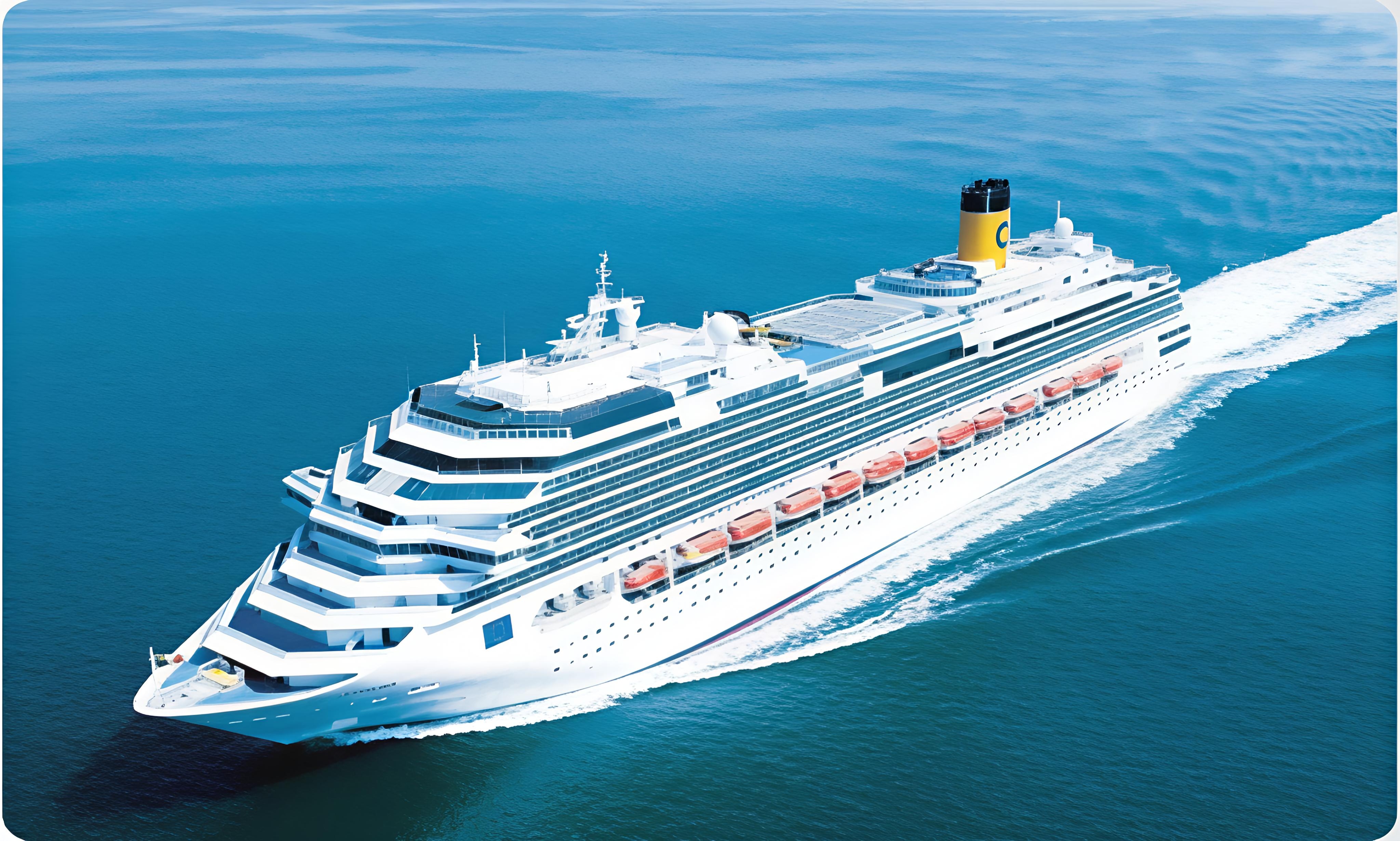
Waterjet cutting is used in shipbuilding, metal fabrication, and other heavy industries.
What waterjet cutting machines are used for
Waterjet technology appears wherever conventional thermal cutting reaches its limits. Documented application industries include metalworking, stone processing, glass processing, aerospace, automotive manufacturing, composite materials, architectural decoration, and electronic precision processing.
Typical project types can be grouped into four categories:
- Plate and sheet cutting: precise blanking of stainless steel, carbon steel, aluminum, titanium, and other metal plates, including thick sections.
- Complex and irregular profiles: cutting parts with curved contours, sharp corners, or nested layouts where mechanical tools struggle.
- Special materials: machining carbon fiber reinforced polymer (CFRP), honeycomb structures, foam, laminates, glass, and brittle ceramics.
- Decorative and architectural fabrication: marble and granite patterns, glass details, ceramic tile inlays, and artistic carving.
For many manufacturers, the buying decision is driven less by “which single material can be cut” and more by the ability of one system to handle multiple materials and geometries without changing tools or introducing thermal damage.
How a waterjet cutting machine works
The working principle is based on high-pressure water erosion. An ultra-high-pressure pump pressurizes water to a level that makes the jet capable of removing material. In industrial machines, this pressure commonly reaches 4137 bar (60,000 psi). For example, the YCG-3742 pump used by Chinese manufacturer YC Waterjet operates at a maximum pressure of 4137 bar with a maximum water flow of 7.4 L/min.
Water passes through a small orifice, typically around 0.016 inches, and exits through a nozzle of about 0.05 inches, forming a narrow high-velocity jet. When the workpiece is metal, stone, or glass, abrasive granules, usually garnet, are added to the stream. The mixture accelerates through the cutting head and erodes the material along the programmed path.
Modern machines integrate CNC controls, automatic abrasive delivery, worktable positioning, and optional systems such as laser scanning height measurement, drilling heads, sludge removal, and hydraulic loading. These auxiliary systems influence the consistency and productivity of the cutting cell as much as the pressure pump does.
Machine configurations and working area
Waterjet cutting machines are offered in several structural configurations:
| Configuration | Typical role |
|---|---|
| 3-axis cutting | Flat plates and simple contours; the most common configuration for general fabrication |
| 3D MAX 5-axis cutting | Beveled edges and three-dimensional contoured parts |
| Dynamic 5-axis cutting | Complex profiles requiring a tilting cutting head at full speed |
| 6-axis robotic system | Three-dimensional parts for automotive interiors, aerospace assemblies, and composite molding |
| Double / multiple cutting heads | Higher throughput for large-volume plate processing |
Working area is usually the second criterion after axis configuration. Compact machines such as the YCWJ-S0808, YCWJ-1010, and YCWJ-1212 fit small workshops and prototype operations. L Series models, from YCWJ-L1515 to YCWJ-L4025, cover standard plate sizes. Gantry-style G Series machines, including YCWJ-G2060, G2080, G3080, and G30100, are built for larger sheets. E Series machines provide effective cutting areas of 3000 x 2000 mm for the YCWJ-E3020 and 4000 x 2000 mm for the YCWJ-E4020.
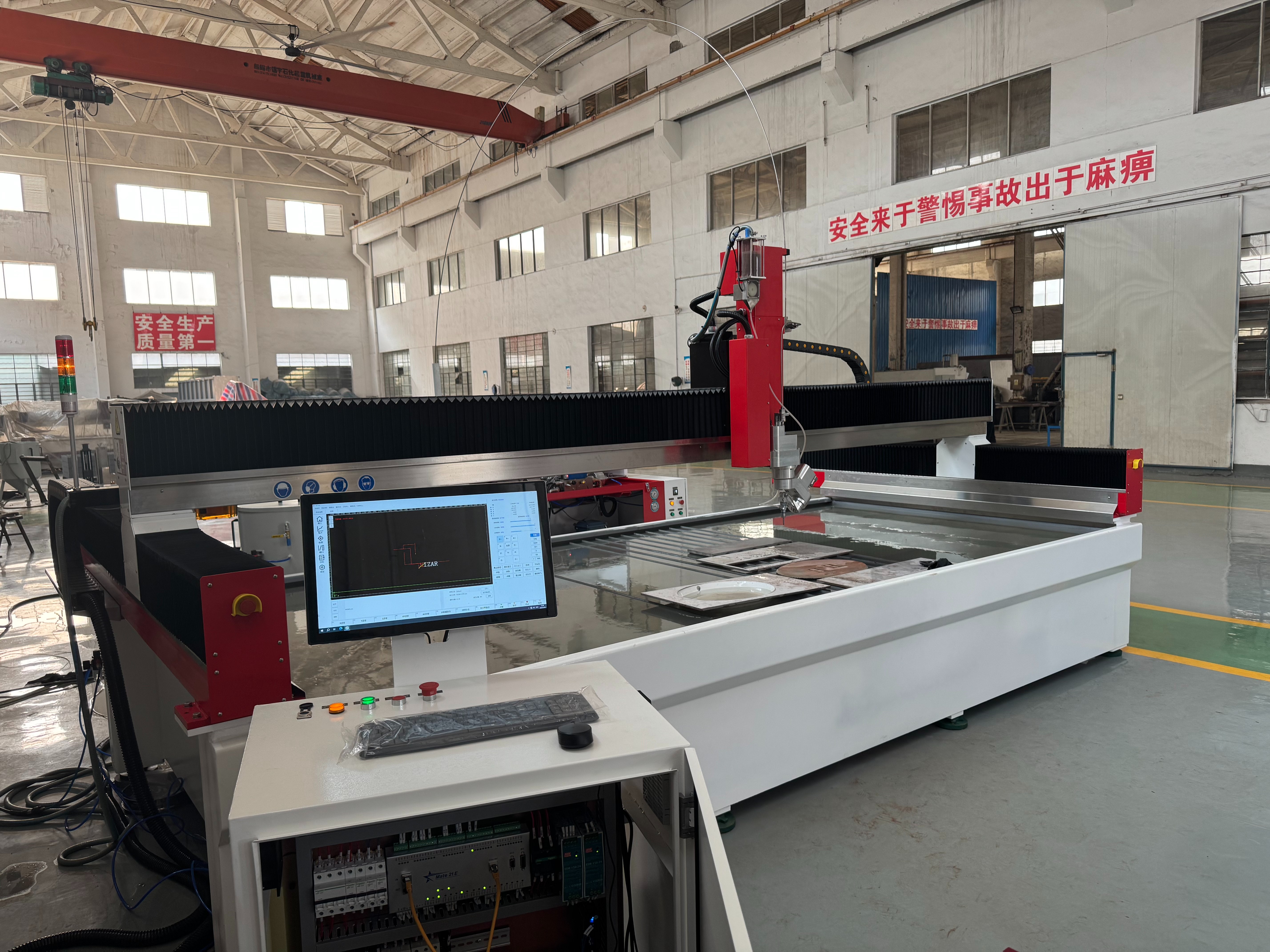
A waterjet cutting machine with integrated CNC control.
Precision and performance parameters
Documented accuracy figures for standard YC Waterjet systems are ±0.1 mm cutting accuracy and ±0.025 mm positioning accuracy. These numbers help buyers estimate whether a given machine can hold the tolerances required for their typical parts.
- Positioning accuracy reflects the capability of the motion system to place the cutting head where the program intends it to go.
- Cutting accuracy reflects the final part dimension after cutting, including the effects of jet lag, material response, and abrasive flow dynamics.
X, Y dry-run speeds range from 0 to 8 m/min on the E Series and 0 to 15 m/min on L and G Series models. Actual cutting speed depends entirely on material type and thickness; no universal speed figure can be quoted without a specific process condition.
Materials cut by industrial waterjet machines
The material compatibility of waterjet cutting is broader than that of most alternative cutting technologies. The documented scope includes:
- Stainless steel and carbon steel
- Titanium alloys and aluminum
- Marble, granite, ceramics, and tile
- Glass and glass laminates
- Carbon fiber, fiberglass, composites, and foam
- Rubber, silicone, paper, fabric, and food products
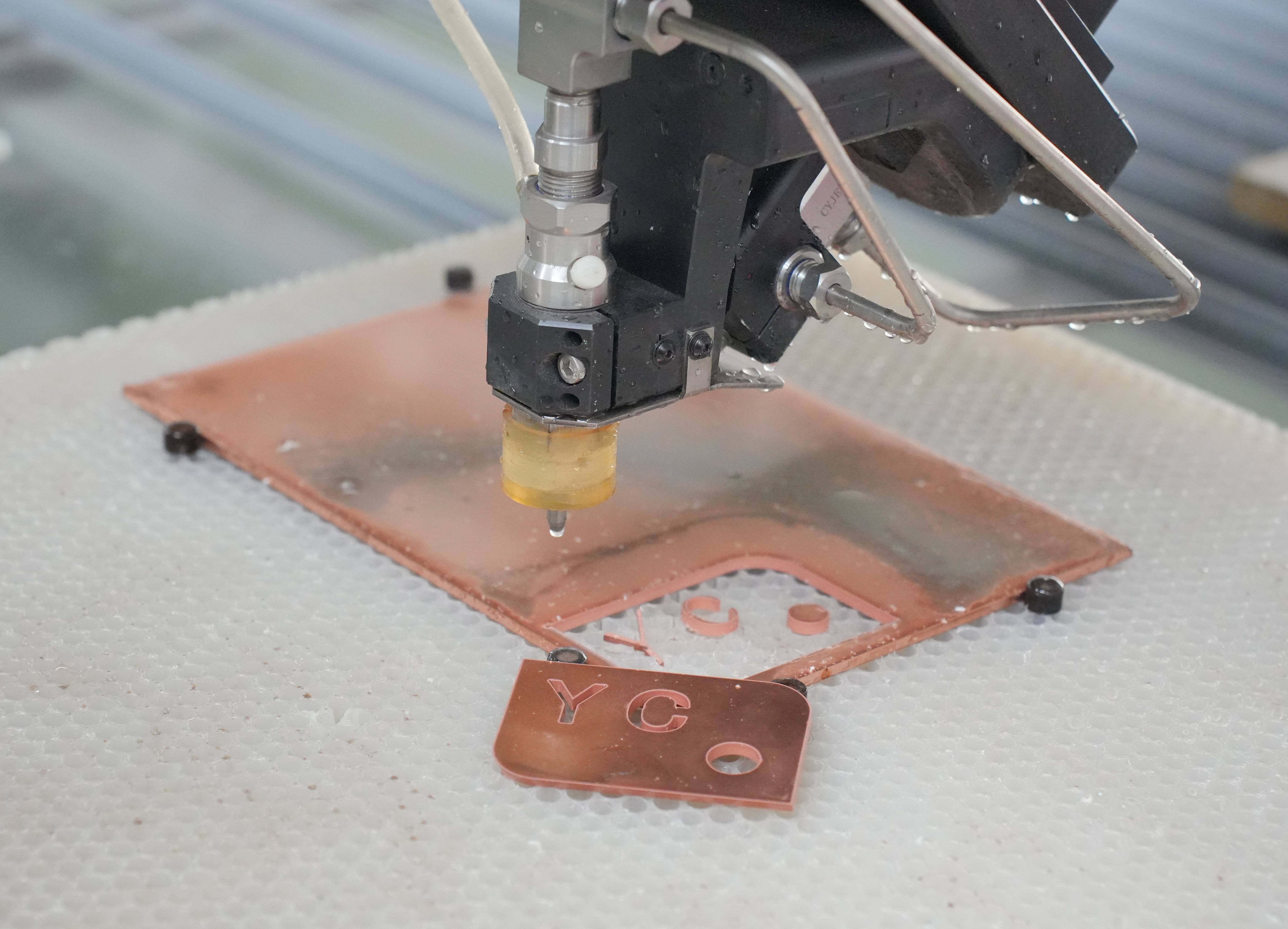
Waterjet cutting can process metals such as copper without heat damage.
This combination of hard and soft material support explains why decoration, aerospace, and automotive fabricators use waterjet as a shared cutting resource across different product lines.
Market context and supplier landscape in 2026
The global waterjet cutting machine market was estimated at USD 1.31 billion in 2025 and is projected to reach USD 1.86 billion by 2030. Baseline estimates vary somewhat across research houses, reflecting differences in scope and methodology, but the directional trend is consistently positive.
Asia-Pacific is the largest regional market, accounting for approximately 37.8% of global revenue in 2024. Metal cutting is the leading application segment, representing about 54.2% of the waterjet application market in 2026.
On the supply side, established global manufacturers include Flow International, OMAX Corporation, KMT Waterjet, and Bystronic Group. Chinese suppliers have expanded their international reach significantly over the past decade. One representative example is YC Water Jet Technology Co., Ltd., founded in 1999 and specializing in ultra-high-pressure waterjet cutting systems. The company operates from a 7,000 m² production facility with around 25 employees, including a 7-person R&D team, and has an annual production capacity of approximately 100 sets.
YC Waterjet began integrating pump and intensifier technology from KMT (Germany) and Accustream/Hypertherm (USA) in 2005. By 2008, its presence covered the Middle East, Asia, Europe, the Americas, and Africa. In 2014, the brand established distributor networks in the UK, Russia, Turkey, Mexico, Brazil, and other markets. Products reached more than 60 countries by 2019 and, according to the company, over 140 countries and regions by 2026. Export business accounts for approximately 70% of total sales, with major markets including Algeria, Brazil, Kazakhstan, South Korea, Mexico, Qatar, Saudi Arabia, the UAE, Turkey, Germany, France, Poland, Spain, Sweden, Russia, and others.
Waterjet vs laser vs plasma: a practical comparison
Buyers evaluating a waterjet cutting machine usually compare it against laser cutting, plasma cutting, and sometimes mechanical machining. Each technology has a distinct operating envelope.
Laser cutting is faster on thin and medium metal plate, produces a narrow kerf, and achieves high detail on small features. But it is a thermal process: it generates a heat-affected zone, can distort thin parts, and loses efficiency on thick sections and highly reflective materials.
Plasma cutting is among the fastest and most economical methods for heavy steel sections and performs well in shipbuilding and structural steel work. The trade-offs are rougher edges, a wider kerf, and significant heat input, often requiring secondary grinding or machining.
Mechanical cutting, such as sawing, milling, and punching, avoids heat, but its flexibility is limited. Custom contours demand dedicated tooling, and tool wear adds to maintenance cost.
Waterjet sits in a specific position: it is slower than laser on thin metals, slower than plasma on very thick steel, and not intended to replace high-speed stamping for mass production. Its advantage lies in cold cutting of heat-sensitive materials, multi-material flexibility, absence of tool changes, and the ability to process stacked or sandwiched materials. In many shops, waterjet is chosen not as a replacement for laser or plasma, but as a complementary capability for materials and geometries that thermal methods cannot handle cleanly.
Main limitations to consider
- Lower cutting speed on thin steel sheets compared with laser or plasma
- Abrasive consumption adds to variable operating costs
- Water and abrasive slurry management must be planned into the workshop layout
- Very small holes or extremely fine details may be more practical with laser
- Mirror-grade surface finishes may require post-processing, depending on the material
Future outlook for waterjet cutting
Market data points to continued growth in industrial waterjet adoption. Metal cutting remains the anchor use case, while composites, aerospace, automotive interiors, architectural decoration, and glass processing broaden the demand base. The broader export reach of suppliers, illustrated by YC Waterjet expanding from 60 countries in 2019 to more than 140 countries and regions by 2026, suggests that buyers worldwide now have more access to waterjet equipment than in earlier years.
Supplier differentiation is likely to move beyond basic machine parameters toward system-level integration: robotic cells for three-dimensional parts, automatic sludge removal, hydraulic loading, laser scanning height measurement, and multi-head configurations. Buyers should weigh these options against their actual part mix, production volume, and tolerance requirements.
What this means for buyers moving from awareness to research
At the awareness stage, the key takeaway is that the waterjet cutting machine is a broad-capability, non-thermal process rather than a niche tool. At the research stage, buyers should translate their own part portfolio into three concrete requirements: the largest and smallest part dimensions, the material and thickness range, and the tolerance requirements for the most demanding jobs.
Supplier evaluation can then proceed on measurable criteria: machine configuration and working area, pressure and water flow capacity, documented accuracy, installed experience in comparable applications, spare parts availability, and the length of the manufacturer’s track record.
Frequently asked questions
What is a waterjet cutting machine?
A waterjet cutting machine is a CNC cutting system that uses ultra-high-pressure water, sometimes mixed with abrasive particles, to erode and separate materials without heat. It cuts metals, stone, glass, composites, and many other materials.
How does a waterjet cutting machine work?
An ultra-high-pressure pump pressurizes water up to 4137 bar (60,000 psi). The water passes through a small orifice to form a high-velocity jet, and abrasive particles are added for hard materials. The jet mechanically erodes the workpiece along the programmed path.
What materials can a waterjet cutting machine cut?
Typical materials include stainless steel, carbon steel, alloys, titanium, aluminum, marble, granite, ceramics, glass, carbon fiber composites, fiberglass, foam, rubber, silicone, paper, fabric, and food products.
How accurate is waterjet cutting?
Industrial waterjet cutting machines typically achieve ±0.1 mm cutting accuracy and ±0.025 mm positioning accuracy. The final result depends on the machine, material thickness, abrasive parameters, and part geometry.
What industries commonly use waterjet cutting machines?
Primary users include metalworking, stone processing, glass processing, aerospace, automotive manufacturing, composite material fabrication, architectural decoration, and electronic precision processing.
What are the main limitations of waterjet cutting?
The main limitations are slower cutting speeds on thin sheet metal compared with laser or plasma, abrasive material cost, water and slurry management needs, and the fact that very small or mirror-finish parts may require other processes or post-processing.
Have Questions or Need More Details?
Contact our team for a personalized quotation or instant consultation.
Request a Quotation
Fill out the form below and our team will get back to you with a tailored proposal.
WhatsApp Direct Chat
Prefer to chat in real-time? Message us on WhatsApp for instant assistance & quick answers.
- Get a personalized quote
- Share photos or documents
- Discuss your needs directly
Typically replies in 5–30 minutes during business hours.