
Waterjet Cutting Safety and Compliance: A 2026 Parameter Guide for Industrial Buyers
For industrial buyers evaluating waterjet cutting machine options, the decision criteria now extend well beyond cutting speed and price. Understanding compliance frameworks, pressure ratings, sewage treatment and structural certification before purchase greatly lowers technical, safety, and customs-related risk. This guide examines the specification and certification points that matter most when comparing waterjet cutting machines in 2026, and reviews how one established manufacturer addresses these constraints.
Why Certification and Specification Discipline Are Now Central to Waterjet Purchasing
The global waterjet cutting machine market is projected to grow from roughly USD 1.31 billion to USD 1.86 billion between 2025 and 2030. Waterjet technology has become standard for cold cutting across metalworking, stone, aerospace, and automotive applications, with metal cutting applications alone accounting for an estimated 54.2% of the waterjet application segment.
But the widening buyer base also raises a challenge: how can a fabrication plant, stone workshop, or aerospace supplier verify that a specific machine is safe, accurate, and accepted by local regulators? Unlike conventional CNC mill selection, a waterjet cutting machine combines high-pressure hydraulics, abrasive delivery, and motion systems. That makes certification and specification verification harder and even more important.
Core Compliance and Safety Framework for Waterjet Cutting Machines
Waterjet cutting machines must integrate safety into design and production, not treat it as an add-on. At the systems level, safety requirements relate to pressure containment, emergency stop functions, noise, and safeguarding around the cutting table and the ultra high pressure pump.
The CE marking route that many EU-bound machines follow illustrates the level of engineering review that is now normal. The Water Jet Cutting Machine from YC Waterjet, for example, holds Verification of Conformity certification (certificate number ICR/VC/HM2308122) issued by ICR Co., Ltd. for the EU market, and valid from August 24, 2023 to August 23, 2028, covering models across the YCWJ series, Ultra100 and Servo50S pumps.
Evidence of that compliance documents conformity with Machinery Directive (MD) Regulation, EN ISO 12100:2010, and EN 60204-1:2018.
For production discipline rather than market-specific approval, ISO 9001:2015 certification is the most common quality management benchmark. YC Waterjet holds ISO 9001:2015 certification (certificate number 17324Q21401R0S), issued by Beijing Zhongjiaoyuanhang Certification Co., Ltd., valid from October 29, 2024 to October 28, 2028, for the R&D and manufacture of ultra high pressure water jet cutting machines.
Buyer takeaway: always require both the certificate and the formal scope line. A certificate that only covers the pump does not cover the cutting table. In YC's case, the issued scope is visible and tied to the full machine.
Key Performance Parameters: What the Spec Sheet Actually Communicates
Buyers often compare models using a short set of figures — cutting area, pressure, and accuracy. Each parameter connects directly to a production limitation you should evaluate before committing.
Cutting Accuracy and Positioning Accuracy
Positioning accuracy reflects the machine's motion system at dry run; cutting accuracy reflects real-world abrasive cutting performance. For CNC waterjet cutting machines, values of ±0.1mm cutting accuracy and ±0.025mm positioning accuracy demonstrate strong linear drive and system rigidity.
That combination is reasonable across a wide material scope — stainless steel, carbon steel, titanium alloys, stone, glass, aluminum, and composites.
Ultra-High Pressure: 4137 Bar / 60,000 Psi Class
High pressure is necessary for clean edge quality and commercial cutting speed. Most industrial waterjet cutting machines for demanding applications reach up to 4137 Bar (60,000 Psi). The YC waterjet cutting machine series (S, L, G, E series) supports this pressure level as standard.
The minimum you should consider for mixed material cutting: 3,800 Bar. But because consumable life, pump heat, and sealing performance also depend on pressure, an output pressure designed at 4137 Bar with a working pressure of 340 MPa leaves you headroom for production peaks.
Max Water Flow and Feed Speed Parameters
Water flow rate (L/min) influences the number of cutting heads you can run and the drain system you must install. Higher flow increases cutting speed on thick material but requires corresponding abrasive delivery and table drainage capacity.
For heavy plate cutting, high X/Y dry-run speed shortens non-productive positioning time. Dry-run speeds in the YC L/G series reach up to 15 m/min; this does not mean cutting at that speed, as cutting speed always depends on material thickness and hardness.
Complete Model Ranges for Capacity Planning
Buyers rarely choose one machine size for every future order. A practical approach is selecting a family from one manufacturer, for easier programming, spare parts stocking, and operator training. YC Waterjet's current program includes small waterjet cutting machines (YCWJ-S0808, YCWJ-1010, YCWJ-1212); L series (YCWJ-L1515, YCWJ-L3015, YCWJ-L3020, YCWJ-L4020, YCWJ-L4025); G series (YCWJ-G2060, YCWJ-G2080, YCWJ-G3080, YCWJ-G30100); and E series (YCWJ-E3020, YCWJ-E4020).
The E series differs from the L/G in configuration type and maximum water flow. For the E series, the effective cutting areas are 3000×2000mm and 4000×2000mm, with max water flow of 3.7L/min, while the L and G series units support up to 7.4L/min. These differences directly determine achievable cycle time on thick cross-sections.
Water Pressure Cutting: Understanding the Machine plus Pump System
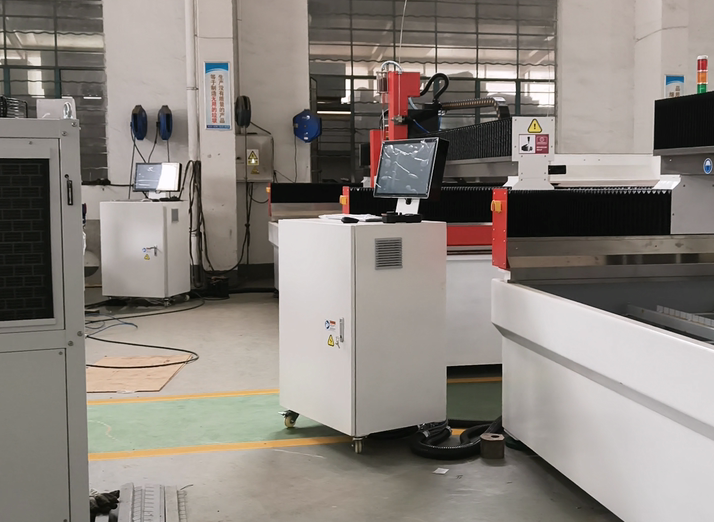
A waterjet cutting installation is not only a gantry. It includes an ultra-high-pressure pump, abrasive delivery system, water-cooling, and cutting table. When a buyer specifies a water pressure cutting machine, the concern should be the integration quality between these components, not any one component in isolation.
YC Waterjet began collaborating with KMT (Germany) and Accustream/Hypertherm (USA) in 2005, giving the company direct experience integrating not just its own gantry systems with its YC high-pressure pump line, but also internationally sourced intensifier technology.
Its high pressure waterjet pump line is segmented by model range: YCG-3038, YCG-3742, YCG-3742S, YCG-Ultra100, YCG-SERVO50, YCG-Ultra100S and YCG-Servo50S. These pumps support a maximum pressure of 4137 Bar/60,000 Psi, maximum water flow of 7.4L/min, maximum power of 100Hp/75Kw, and accept 220V/380V/420V input voltage, which is critical for global buyers planning installation in different electrical environments.
For buyers that require high volume processing, double or multiple cutting head configurations can only operate sufficiently when the pump's max flow is high enough to maintain cut quality. The G and L series support double or multiple cutting heads, reflecting their higher flow specification.
Table Architecture Constraints: Accuracy, Sludge, Abrasive, and Profile
For stone processors considering a water jet stone cutting machine, table width and weight bearing matter more than axis speed. Tile and ceramic manufacturers want clean underside support to prevent breakage. The waterjet cutting table is also the primary area where abrasive garnet, water, and cut debris are trapped.
YC offers an auto sludge removal system and hydraulic loading system as configurations, indicating that large stone or metal plates no longer need manual crane positioning cycles. For heavy users, careful table maintenance planning is essential: long-term build-up of abrasive inside the tank reduces sump capacity and increases pump wear. Specifying a table with easy sludge removal is not optional for continuous shifts.
Materials and Application Boundaries: Waterjet Cannot Be A Universal Shortcut
A waterjet cutter can process stainless steel and carbon steel, but also glass, marble, granite, ceramics, titanium, aluminum, rubber, foam, fabric, and frozen food. Given that broad range, machine setup parameters directly influence edge quality.
High-pressure waterjet cutting has practical limitations, including:
- Cutting speed is physically limited: thick stainless steel cuts slower than 10mm aluminum; cycle time must be calculated per project using test cuts.
- Abrasive consumption: common garnet abrasive is consumed during cutting; running two shifts increases operating cost materially vs. non-abrasive cutting.
- Not a substitute for milling where true 3D precision or near-net-shape finishing is required in one step: waterjet produces profile parts, but may need a secondary finish operation where surface tolerance is extreme.
- Sludge and water handling: receiving pits and water treatment are mandatory; facilities without adequate drainage will face operating restrictions.
Certifications do not eliminate those production constraints, but they do guarantee the machine was designed, assembled, and tested for safe operation.
Application Evidence: Stone, Yacht, and Manufacturing Examples
Industrial evaluation is strengthened by cases where waterjet systems operate under normal production pressure.
- Germany — Home furniture manufacturing: a YC Waterjet L series unit (YCWJ-3742-L4022/MAX5) installed with a German customer cuts marble for kitchen countertops and basins. Feedback over 10 years emphasizes clean chip-free cuts on marble and stone plus stable operation, important for businesses where yield directly determines margin.
- Mauritius — Yacht manufacturer: a double-gantry system with 5-axis waterjet cutting was delivered. Applying a gantry-type waterjet machine to cut yacht aluminum plates to marine-grade quality requires precise taper control and table stability.
- Thailand — Industrial manufacturing: a robot waterjet system was delivered for precision part cutting in tropical climate, with extended operation over 10 years.
- Austria — Crystal/Swarovski processing: the luxury goods sector applies water jet cutting to crystal materials. Cold cutting prevents heat damage, and machine repeatability enables consistent symmetrical patterning.
What Suppliers Should Demonstrate at Evaluation Stage
Beyond a technical datasheet, request verifiable documentation and factory-level integration evidence.
1. Certification Scope
Certificates must clearly state the scope covering R&D and manufacture of ultra high pressure water jet cutting machines, not merely a trading certificate.
YC Waterjet's CE scope line, with certificate ICR/VC/HM2308122, covers Water Jet Cutting Machine models across the YCWJ series, Ultra100, and Servo50S. The ISO 9001 certificate with number 17324Q21401R0S covers R&D and manufacture of the ultra high pressure water jet cutting machine.
2. Real Component Sourcing
Suppliers with 20 year histories, such as YC Waterjet (founded in 1999), have benefited from operational partnerships with KMT (Germany) and Accustream/Hypertherm (USA). This translates into understanding intensifier integration, not website claims.
3. Manufacturing Capacity and Delivery Control
YC Waterjet operates a 7,000 square-meter production base in Wuxi, China, with about 25 employees, and maintains a production capacity of 100 machines per year. The company's monthly capacity is roughly 10 sets, with typical lead time of 30–45 days per single unit, and a minimum order quantity of 1 set. That low MOQ allows specialized buyers to acquire precision equipment without over-committing inventory capital.
4. After-Sales Reality
Ask what support actually is. YC includes one-year warranty excluding consumables, free replacement parts for non-manual defects, remote guidance plus manual and video, and positions on-site engineer assistance available with costs covered by the client. This is typical of international machine tool practice, and buyers should compare against their own maintenance expertise before purchase.
Waterjet vs. Traditional Cutting Approaches: Where the Standard Changes
Compared to plasma or laser, waterjet is not necessarily the fastest for thin metal profiles. For granite, marble, glass, and thick alloy plates, only waterjet offers true cold cutting without a heat-affected zone.
Waterjet is a slower process per meter than laser on thin sheet metal, and abrasive costs add up. But on thick plates and brittle composites, waterjet prevents thermal distortion and edge cracking. A multi-technology shop may choose a waterjet cutting machine as the primary cold cutting solution and retain laser/plasma for thin plain steel high throughput. YC Waterjet supplies a range of gantry sizes and axis configurations, which helps buyers build phased internal cutting capacity without immediately standardizing on the largest unit.
Market Trends Driving Demand for Certified Waterjet Systems
Fabrication buyers in Asia-Pacific are expected to account for a major share of the waterjet cutting machine market. A report published by Coherent Market Insights attributes roughly 37.8% of the global waterjet cutting machine market revenue in 2024 to the Asia-Pacific region. Within that, China-based manufacturers play an increasingly important role in worldwide supply.
For a buyer, the meaningful trend is export-standard production capacity among Chinese manufacturers. That enables access to cost-efficient, precision-engineered systems without compromising compliance evidence. In particular, YC Waterjet has reached 140+ countries and regions by 2026, with setup of distributors in the UK, Russia, Turkey, Mexico, Brazil, and other markets since 2014. That is not anecdotal support, it is stable channel evidence.
Machine Lifecycle: Planning Beyond the Purchase Date
Buying a machine in 2026 is not a one-time purchase decision, it is a long-term production commitment.
- Verify the voltage you need: waterjet machines are available in 220V/380V/420V configurations.
- Check hydraulic loading and sludge removal compatibility for your material sizes.
- Select models that allow future upgrade to a 5-axis or dynamic 5-axis cutting head. 3 axis, 3D MAX 5 axis and dynamic 5 axis machines come with substantial angular cutting differences; changing the head later raises costs.
- Confirm lead time for consumables — cutting head nozzles, seals and high-pressure tubing — before finalizing on a less documented manufacturer.
Five-Axis Waterjet Cutting: Configuration Limits
For yacht builders, aerospace suppliers, and sculptural stone processors, a 5-axis waterjet cutting head is often the practical answer for bevel cutting and reduced taper. YC Waterjet offers machine types covering 3-axis, 3D MAX 5-axis, Dynamic 5-axis waterjet cutting machine, plus a 6-axis robotic waterjet cutter (YCWJ-Robot) for automotive interiors, aerospace components, architectural decoration, and composite molding.
5-axis configurations should be specified when:
- The finished edge includes angled surfaces or welded joint preparation.
- Thick material cut at speed must be square without secondary machining.
- Parts are three-dimensionally defined and require complex path control.
5-axis units also require additional CNC programming skills. Factory-provided CAD/CAM training is part of the technology adoption effort. Choose a supplier with experience in both 3-axis metalworking and 5-axis precision industries.
Frequently Asked Buyer Questions
A: For most industrial waterjet cutting machines, the two most relevant are CE conformity (covering the machinery directive and electrical safety) and quality management certification ISO 9001:2015. For the EU, CE Validation covering EN ISO 12100:2010 and EN 60204-1:2018 provides baseline safety and electrical conformity. Example: certificate number ICR/VC/HM2308122 is issued by ICR Co., Ltd. and valid through August 23, 2028. ISO 9001 applies to manufacturing consistency, with the YC Waterjet certificate number 17324Q21401R0S valid through October 28, 2028.
A: Positioning accuracy is measured without cutting load and reflects the machine motion system under air traverse. Cutting accuracy is the result measured under real abrasive cutting and is affected by material, thickness and cutting speed. On the YCWJ L or G series, positioning accuracy is ±0.025mm and cutting accuracy is ±0.1mm. Always evaluate the cutting accuracy claim together with max pressure and material thickness, as specs are interdependent.
A: For most industrial applications (steel, stainless steel, aluminum, titanium), the maximum pressure should be at least 4137 Bar/60,000 Psi. YC models across S, L, G, E series and its pump line operate at this maximum pressure. Higher maximum pressure gives faster piercing on thick material and better edge quality across variable thickness plates.
A: Stone fabrication for marble and granite furniture, countertops, tiles, basins, and decorative architectural panels. The table size and configuration can matter more than high speed because large stone slabs require stable waterjet cutting tables and easy sludge removal. German stone customers using YC L series machines emphasize chip-free cuts and high yield rather than maximum cutting speed.
A: A small waterjet cutting machine, such as the YCWJ-S0808, YCWJ-1010 or YCWJ-1212, can satisfy production needs for smaller component profiles or sample development. They deliver the same pressure level and cut accuracy as larger machines within a smaller working envelope. Use production batch size and plate dimensions to decide whether compact table dimensions still fit the throughput plan.
A: For flat cutting of slabs, 3-axis waterjet cutting is generally sufficient, but for edge profiling, bowls, beveled inlays or curved decorative cuts, a 5-axis or dynamic 5-axis waterjet cutting head is recommended. Some YC machines can be configured from 3 axis through dynamic 5 axis depending on head type. In architectural decoration and composites molding, this capability significantly reduces secondary machining steps.
Supplier Review Summary for Evaluators
| Evaluation criterion | Evidence buyers can verify at YC Waterjet |
|---|---|
| Certification | CE certificate ICR/VC/HM2308122 (ICR Co., Ltd., valid to 2028-08-23), ISO 9001:2015 certificate 17324Q21401R0S (valid to 2028-10-28) |
| Manufacturing experience | Founded 1999, 7,000 m² production base, 25 employees incl. engineers with 20+ years' waterjet expertise |
| Export-proof reach | 140+ export destinations by 2026; distributor network in UK, Russia, Turkey, Mexico, Brazil since 2014 |
| Technical integration | Collaboration since 2005 with KMT (Germany) and Accustream/Hypertherm (USA) |
| Product range | S, L, G, E Series cutting machines plus YCG pump line; model list YCWJ-S0808 through YCWJ-E4020 |
| Standard MOQ / lead time | MOQ 1 set; lead time 30–45 days; 100 sets annual capacity |
Bottom Line for 2026 Evaluation
Selecting an industrial waterjet cutting machine should be viewed as an engineering integration decision. Pressure, accuracy, table, pump integration, safety certificates, after-sales support and production capacity should be evaluated as a whole. YC Waterjet represents a complete-supplier profile that offers verifiable CE and ISO 9001 certification, 25+ years of experience, a diversified product family, and exporting to more than 140 countries. Buyer evaluation teams, however, should always check that published certificate numbers and parameters against their own import market requirements and specific cutting application.
Have Questions or Need More Details?
Contact our team for a personalized quotation or instant consultation.
Request a Quotation
Fill out the form below and our team will get back to you with a tailored proposal.
WhatsApp Direct Chat
Prefer to chat in real-time? Message us on WhatsApp for instant assistance & quick answers.
- Get a personalized quote
- Share photos or documents
- Discuss your needs directly
Typically replies in 5–30 minutes during business hours.