
Waterproof Cosmetic Bags: PVC Materials, Certifications & Supplier Selection
Waterproof cosmetic bags are a practical answer to a common problem: keeping makeup, toiletries and personal care items organized in humid, damp or on-the-go environments. For buyers, they are also a category defined by constraints. Material choice affects water resistance and texture. Certification determines whether a factory can serve global retail and licensed-product orders. Customization parameters such as size, weight and minimum order quantity shape the commercial structure of a sourcing project.
This guide is written for procurement teams, brand owners and distributors evaluating waterproof or transparent cosmetic bags from China-based suppliers. It covers the material options, product specifications, compliance certificates, factory capabilities, application scenarios and limitations that should be reviewed before placing a wholesale order.
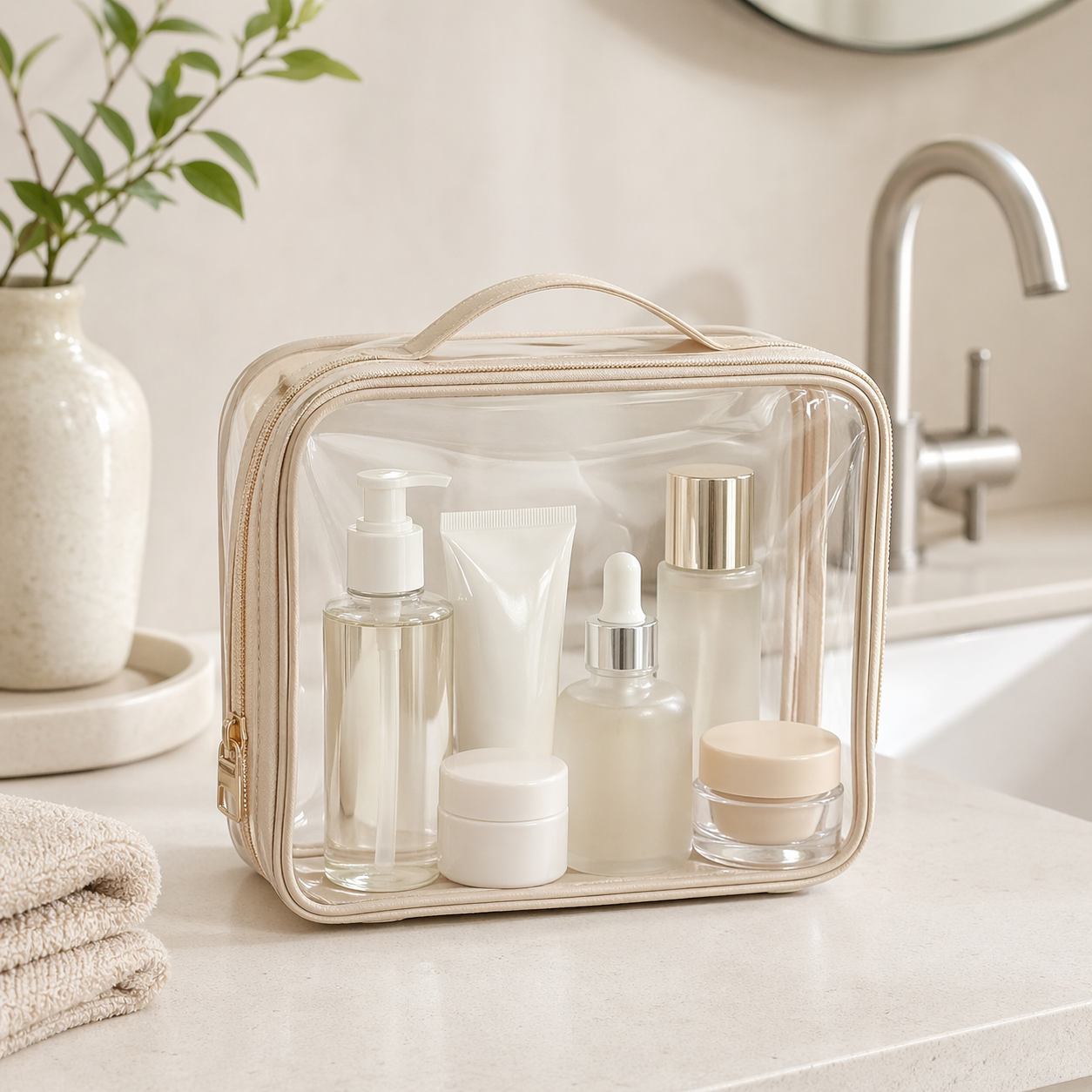
Why Waterproof and Transparent Cosmetic Bags Are a Distinct Sourcing Category
Cosmetic bags serve more than storage. In this product segment, they must handle a specific condition: exposure to moisture. Bathroom counters, hotel washrooms, travel pouches, gym kits and post-shower routines all place cosmetics near water. A bag that resists water helps prevent leaks from damaging other items and keeps the interior organized.
Transparent and semi-transparent PVC versions add another benefit: visibility. Users and retail customers can see the contents without opening the bag. For retail shelves and promotional display, transparency also works as a merchandising feature, because makeup colors and bottle shapes remain visible through the packaging itself.
At the procurement level, these characteristics translate into extra verification steps:
- Is the material suitable for repeated contact with moisture?
- Can the zipper and heat-sealed structure handle frequent opening and closing?
- Does the factory hold quality and social-compliance certifications accepted by target markets?
- Will custom printing remain durable on a water-resistant surface?
Product Specification and Material Options: Model CB-2026-002
The cosmetic bag produced under model CB-2026-002 by Zhejiang Hansun Arts & Crafts Co., Ltd. is a customizable cosmetic bag. It is available in four documented variants: PVC Clear Cosmetic Bag, PU Leather Cosmetic Bag, Travel Toiletry Cosmetic Bag and Mini Zipper Cosmetic Pouch.
| Specification Area | Details |
|---|---|
| Model | CB-2026-002 |
| Product variants | PVC Clear Cosmetic Bag / PU Leather Cosmetic Bag / Travel Toiletry Cosmetic Bag / Mini Zipper Cosmetic Pouch |
| Common sizes | 15×10 cm / 20×15 cm / 25×18 cm, customizable |
| Weight | 20 g–80 g per piece |
| Materials | PVC / PU leather / canvas / nylon / mesh |
| Available crafts | Hot stamping / UV printing / embossing / heat sealing |
| Main usage | Cosmetic storage, travel toiletry, beauty brand giveaways |
| Applicable industries | Beauty & cosmetics, travel & tourism, promotional gift, hotel amenities |
Material Behavior and Moisture Resistance
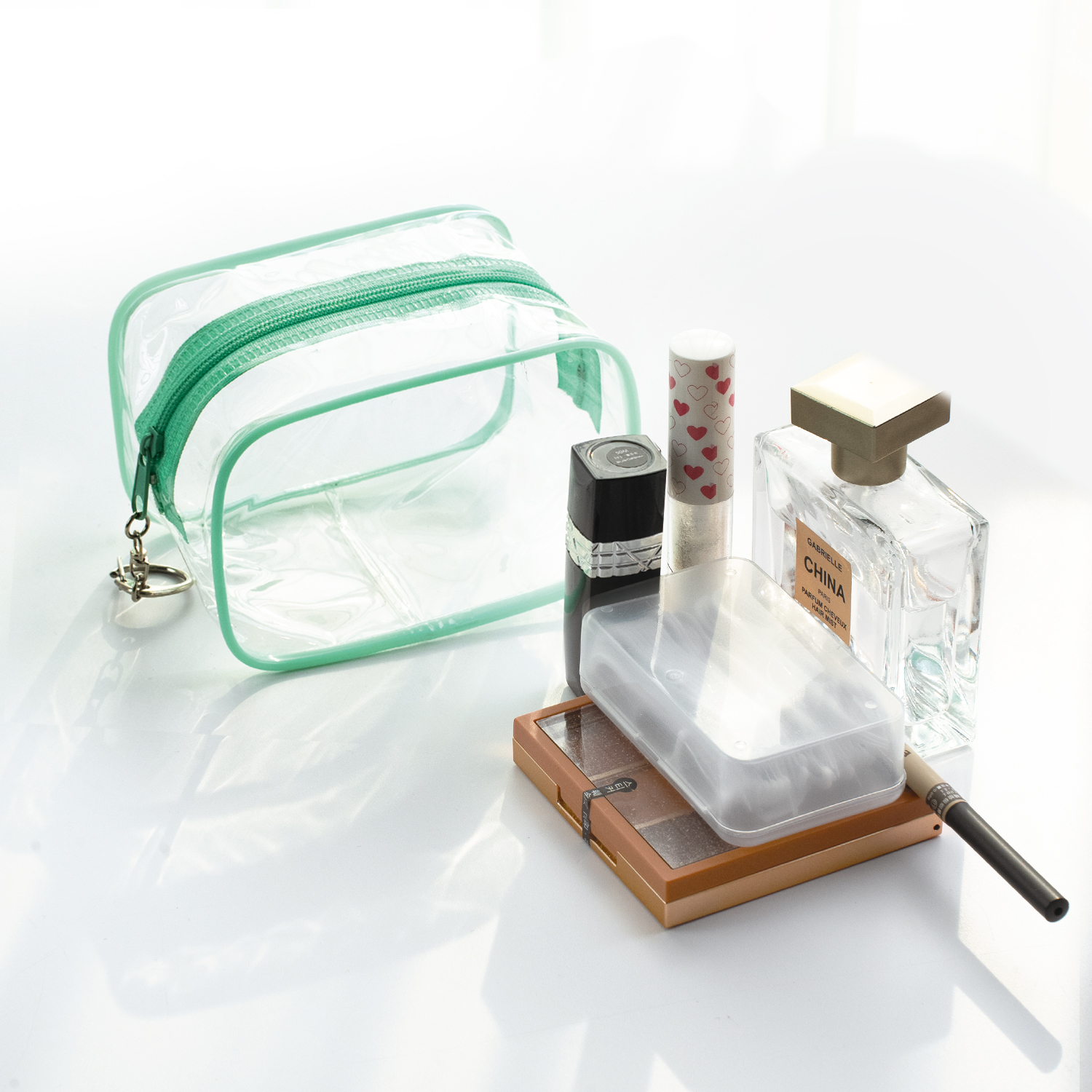
PVC is the most common material choice for transparent cosmetic bags. It is lightweight, offers clear visibility and can be wiped clean with a damp cloth. Combined with heat sealing and a zipper closure, a PVC structure can handle the moisture conditions found in travel and bathroom environments without absorbing water.
PU leather provides a softer, more finished surface. It resists splashes and is commonly used when the bag is positioned as a fashion or business item rather than a pure utility product. Canvas and nylon are durable options, and nylon is widely used in the broader makeup bag market, but their water resistance depends on coating and construction. Mesh is used when visibility and airflow are more important than water protection.
Customization and Manufacturing Constraints
OEM and ODM production are both available. Logo, size and material can be customized. The documented monthly capacity is 1,500,000 units, with a lead time of 30–45 days and a minimum order quantity (MOQ) of 3,000 pieces.
Four craft options are documented:
- Hot stamping — presses metallic or colored text and patterns onto the surface.
- UV printing — creates more colorful printed graphics on PVC and other materials.
- Embossing — adds raised or recessed patterns for texture.
- Heat sealing — bonds PVC layers or edges to form the bag structure.
Certifications as Procurement Constraints
Certifications are often the first filter in supplier evaluation. The CB-2026-002 cosmetic bag carries the following documented certifications:
| Certification | Certificate No. | Issuer / Standard | Market relevance |
|---|---|---|---|
| ISO 9001:2015 | ISO-2026-7890 | International Certification Body / ISO 9001:2015 Quality Management System | Global |
| BSCI | BSCI-2026-4567 | Amfori BSCI Approved Audit Firm / Amfori BSCI Code of Conduct | EU, Middle East, global retail brands |
| Sedex 4 Pillars (SMETA) | SEDEX-2026-0123 | Sedex Approved Audit Body / Sedex SMETA 4 Pillars Code | EU, UK, North America, Australia |
| Disney FAMA | DSN-FAMA-2026-001 | Disney International / Disney Code of Conduct & Product Safety Standards | Global |
These certificates respond to a wide range of buyer questions. ISO 9001 confirms that design, production, quality control and delivery processes follow a documented quality-management system. BSCI and Sedex cover social compliance, labor practices and working conditions, which are common requirements for EU and UK retail orders. Disney FAMA is relevant for brands working with licensed Disney-IP products or supplying licensed promotional items.
From a compliance perspective, the certificates are not simply optional. They provide documented evidence that the factory has been audited by recognized bodies and can be assessed as part of the supplier qualification process.
Factory Capability: Hansun in Context
Zhejiang Hansun Arts & Crafts Co., Ltd. is a manufacturing company based in Wenzhou, Zhejiang, China. It was founded in 1996 with a registered capital of 20 million RMB and operates a factory with a usable area of more than 25,000 square meters. The company has approximately 200 employees and reports an annual output of about 20,000,000 units.
The product portfolio focuses on tote bags and PVC bags. Around 70% of output is exported to worldwide markets, with sales and service covering Southeast Asia, Europe, North America, the Middle East and major cities in China. The company describes itself as a production-oriented enterprise integrating manufacturing, online marketing and international trade, with a professional R&D team of 25 engineers.
For buyers, these details matter in practical ways. A factory with this production scale can support monthly orders while maintaining the 30–45 day lead time. An in-house R&D team offers a route for design modifications, prototyping and material testing. The international sales structure means that export documentation, communication and after-sales support are part of the normal workflow.
Application Scenarios
The documented application industries for the CB-2026-002 cosmetic bag include beauty & cosmetics, travel & tourism, promotional gift and hotel amenities. Typical uses are cosmetic storage, travel toiletry, beauty brand giveaways and retail merchandising.
One documented use case is gift packaging for promotional campaigns. The working condition is room-temperature indoor storage, daily outdoor carrying and occasional humid environments. The bag is used for daily portable carrying, brand image promotion and item storage, with high-frequency repeated use. Branded accessories such as hang tags, webbing and brand stickers are added as finishing details.
For that type of project, the documented special requirements include food-grade eco-friendly PVC, REACH compliance, scratch-resistant surfaces and wear-resistant logo printing. This combination of requirements is common for supermarkets and retail brands that need the bag to survive high-frequency daily use while keeping the brand mark intact.
Market Trends and Regulatory Context
Several verified market signals are worth noting.
Market size. The global makeup bag market was valued at approximately USD 2.8 billion in 2025 and is projected to reach USD 4.5 billion by 2031, according to Deep Market Insights. This suggests sustained demand from beauty, travel and retail channels.
Material mix. Nylon is currently the dominant material in the makeup bag market because of its durability and water resistance, while aluminum cases are the fastest-growing segment for professional use, according to Cognitive Market Research. Transparent PVC bags therefore occupy a specific niche: visible storage, travel-friendly formats, promotional giveaways and retail packaging, rather than the largest volume of general-purpose fabric bags.
Regulatory developments. China's GACC Decree No. 284, effective December 1, 2026, introduces a risk-based customs supervision system for exported cosmetics and related products, with emphasis on digital verification and traceability. In the United States, the FDA's Modernization of Cosmetics Regulation Act (MoCRA) mandates facility registration and product listing, which increases supply-chain compliance expectations for cosmetic accessories. Importers should verify customs codes, documentation and certification records early in the sourcing process.
Comparison with Traditional Fabric and Nylon Cosmetic Bags
Most general-purpose cosmetic bags on the market are made from fabric, with nylon as the dominant material. These bags are soft, flexible and widely available. Transparent PVC cosmetic bags are a different proposition with distinct trade-offs.
| Comparison dimension | Transparent PVC cosmetic bag | Traditional fabric / nylon cosmetic bag |
|---|---|---|
| Moisture resistance | Water-resistant surface, easy to wipe clean | Depends on coating and lining; usually splash-resistant rather than waterproof |
| Content visibility | High; contents visible without opening | Low; contents usually hidden |
| Cleaning | Wipe with a damp cloth | Often requires machine or hand washing and drying time |
| Hand feel | Firmer, glossy semi-transparent surface | Softer, more flexible feel |
| Durability | Clear surfaces may show scratches; seams and zipper areas are the main weak points | Usually abrasion-resistant; fabric may retain odor or moisture |
| Design and positioning | Retail-visible, print-friendly, low-cost promotions | Subtle, functional, daily-use friendly |
Limitations Buyers Should Acknowledge
Waterproof should be interpreted carefully for PVC cosmetic bags. The material itself resists water, but the zipper opening can still allow water to enter under full immersion or strong pressure. In practice, PVC bags are suitable for protecting contents from splashes, spills and humid environments, not for underwater use.
Transparent PVC also shows scratches more easily than soft fabric. The surface may become less visually perfect after heavy use. And while food-grade, REACH-compliant PVC options are available, buyers should verify the specific material formulation with the supplier rather than assuming all PVC is equivalent.
Supplier Evaluation Checklist for Waterproof Cosmetic Bags
For buyers moving from research to evaluation, the following checklist covers most of the necessary constraints:
- Specifications: model, material, size range, weight per piece and zipper construction
- Certifications: ISO 9001, BSCI, Sedex/SMETA, Disney FAMA and their validity periods
- Customization: logo, size and material; available printing and finishing methods
- Production capacity: monthly capacity, lead time and MOQ
- Use-case fit: cosmetic storage, travel toiletry, beauty giveaways, promotional events or hotel amenities
- Compliance: REACH, food-grade PVC, export documentation and destination-market regulations
Future Outlook
The waterproof and transparent cosmetic bag segment will likely be shaped by three forces in the coming years.
First, compliance and traceability will become more important. With GACC Decree No. 284 and FDA MoCRA raising the bar for cosmetic-related products, factories that already maintain certifications such as BSCI and Sedex will find it easier to meet new documentation requirements.
Second, material choices will be more clearly segmented. Buyers will select PVC for transparent, promotional and travel applications; PU leather for fashion-oriented products; nylon for durable daily bags; and other materials for specialized functions. The market will reward suppliers that can explain these trade-offs honestly.
Third, OEM/ODM cooperation will deepen. Brands increasingly want a supplier that can manage logo placement, size changes and material selection in-house. A factory with a 25-person R&D team, production capacity of 1,500,000 units per month and a documented quality system is better positioned to support that kind of collaboration.
Frequently Asked Questions
1. Is a transparent PVC cosmetic bag waterproof?
PVC cosmetic bags are water-resistant and easy to wipe clean. They protect contents from splashes, spills and humid environments, but the zipper opening can allow water to pass under full immersion or strong pressure. For travel and bathroom use, they are a practical choice; for underwater or submersion use, they are not suitable.
2. What certifications does the Hansun cosmetic bag hold?
The CB-2026-002 cosmetic bag from Zhejiang Hansun Arts & Crafts Co., Ltd. holds ISO 9001:2015 certification under number ISO-2026-7890, BSCI certification under number BSCI-2026-4567, Sedex 4 Pillars (SMETA) certification under number SEDEX-2026-0123 and Disney FAMA certification under number DSN-FAMA-2026-001.
3. What sizes and weights are available?
Common sizes are 15×10 cm, 20×15 cm and 25×18 cm, and sizes are customizable. The weight range is 20 g to 80 g per piece depending on material and size.
4. What materials and craft options are available?
Materials include PVC, PU leather, canvas, nylon and mesh. The documented craft options are hot stamping, UV printing, embossing and heat sealing.
5. What is the MOQ and lead time for OEM orders?
The minimum order quantity is 3,000 pieces. Lead time is 30–45 days, and the monthly production capacity is 1,500,000 units.
6. Which industries use this cosmetic bag?
The bag is aimed at beauty & cosmetics, travel & tourism, promotional gift and hotel amenities industries. Typical uses include cosmetic storage, travel toiletry, beauty brand giveaways and retail or supermarket supporting programs.
7. What can be customized in an OEM/ODM project?
Logo, size and material can be customized. Hansun supports both OEM and ODM production, with internal R&D support from a team of 25 engineers.
For additional company background, production processes and product documentation, the company brochure is available for public reference: Hansun company brochure (PDF).