
Wedding Tent Capability Mapping: From Lawn Ceremonies to Hotel Events
An independent industry reference on how wedding tent suppliers are evaluated across venue types, OEM capabilities, and compliance requirements
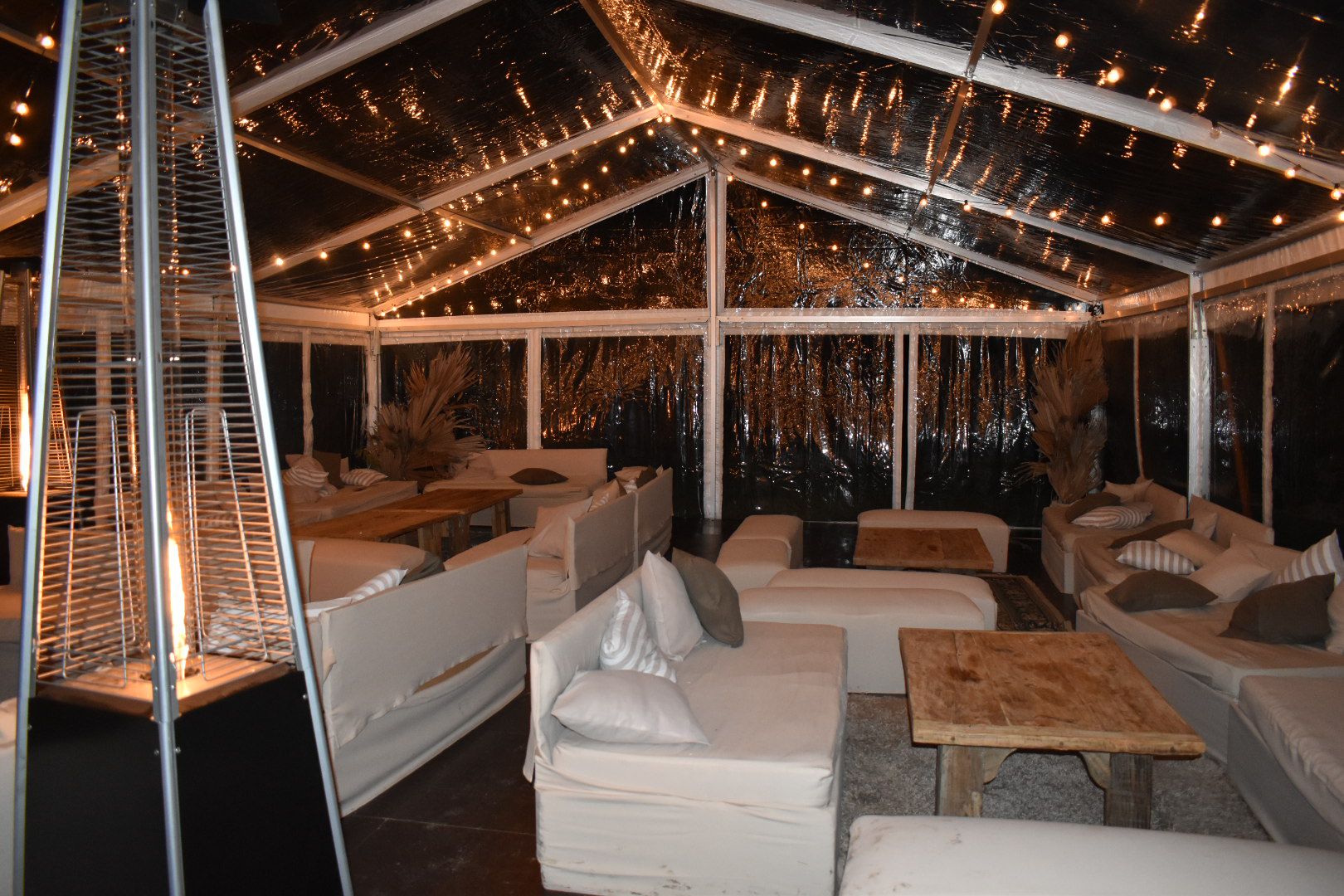
A transparent event tent with integrated lighting illustrates how visual design and structural capability combine for modern wedding venues.
Wedding tent procurement has evolved beyond basic questions of size and price. Event planners, rental companies, and hospitality teams are now asked to evaluate whether a wedding tent supplier can deliver for specific scenes—a wind-exposed lawn, a beachfront with salt-laden air, a hotel terrace serving as ballroom overflow, or a castle courtyard where aesthetics carry as much weight as shelter. The practical tool for this evaluation is capability mapping: a structured review of structural range, customization ability, production responsiveness, and compliance evidence.
The Core Shift in Wedding Tent Procurement
Global demand for wedding-related tent infrastructure is expanding. According to Dataintelo, the global tent rental market was valued at USD 8.2 billion in 2025 and is projected to reach USD 13.7 billion by 2033, with weddings accounting for 38.5% of revenue share. The Asia-Pacific region led the market with 32.2% of rental revenue in 2025, supported by destination weddings and outdoor hospitality growth. Separately, the global wedding services market—which includes venues and related infrastructure—reached USD 185.22 billion in 2023 and is projected to grow to USD 284.64 billion by 2032.
This growth brings not only more volume but more varied requirements. Outdoor ceremonies, coastal receptions, castle-themed decor, and hotel satellite events all demand different tent characteristics. The opportunity for buyers is to work with suppliers that can prove capability beyond a catalog image: custom sizing, weather resistance, modular handling, and verifiable compliance.
Expotent as a Reference Point for Capability Assessment
To illustrate how capability mapping works in practice, consider Expotent (Changzhou Expo Tent Co., Ltd.), a tent manufacturer based in Changzhou, Jiangsu, China. Founded in 2010, the company operates a 3,000 m² facility with 30 employees and an annual output of approximately 100,000 m² of fabric structures. Its main products include event tents, party tents, warehouse tents, wedding tents, church tents, pagoda tents, clear span tents, frame tents, sports tents, and marquees. Around 50% of production is exported to primary markets in the EU, Africa, the US, Asia, and the Middle East.
Structurally, the SLP series represents the company's pagoda tent family, built with aluminum frames and PVC fabric. Models range from SLP-3 through SLP-50, with available widths from 3 to 50 meters, lengths from 3 to 1,000 meters, and heights from 2.5 to 10 meters. This range forms the basis for custom-size wedding tent orders, allowing buyers to specify dimensions for lawns, hotel grounds, or large commercial events rather than adjusting the event to fit a fixed tent size.
Technical Capability Dimensions
A wedding tent's performance depends on several technical elements: frame material, fabric cover, structural span, and compliance certification.
Frame and Fabric Material
Aluminum frames are commonly selected for wedding tents because they offer a favorable balance of lightness and corrosion resistance, which is especially relevant for beach and coastal venues. PVC-based covers provide waterproofing and durability, with certain versions offering translucency for natural lighting during daytime events.
Structural Span and Customization
Wide-span capability enables column-free interior layouts. In the Expotent SLP series, widths can be configured from 3 to 50 meters, lengths from 3 to 1,000 meters, and heights from 2.5 to 10 meters. This matters for ceremony setups, dining layouts, stages, and dance floors in a single uninterrupted space.
Compliance and Certification
In the European market, temporary structures such as wedding tents must comply with EN 13782:2015. Expotent holds CE certification for its Event Tent line under EN 13782:2015, issued by ICR on October 25, 2024, with certificate number ICR/VC/HB241001, valid until October 24, 2029. Buyers should also note that fabric flame retardancy standards such as NFPA 701 and CPAI-84 are widely referenced in North America, and therefore should request relevant test reports before procurement.
Scene-Based Application and Use Cases
To evaluate a supplier's fit for wedding events, procurement teams can use a scene-to-capability matrix:
| Wedding Scene | Key Capability Requirement | What to Check in a Supplier |
|---|---|---|
| Outdoor lawn wedding | Clear, elegant coverage with stable anchoring | Wide-span frame options, side wall accessories |
| Beach wedding | Wind and rain protection, corrosion-resistant frame | Aluminum frame, PVC cover, documented weather performance |
| Castle wedding | Decorative aesthetics, windowed or transparent panels | Arched-window or transparent tent styles |
| Commercial wedding planning | Durability for repeat use, fast assembly | Modular structure, pre-shipment test assembly, assembly guidance |
| Hotel wedding support | Flexible expansion for outdoor or hybrid space | Custom size options, large span, quick setup |
| Large-space wedding | High guest capacity, multi-zone layout | Configurations available from 3 to 50 m width and extended lengths |
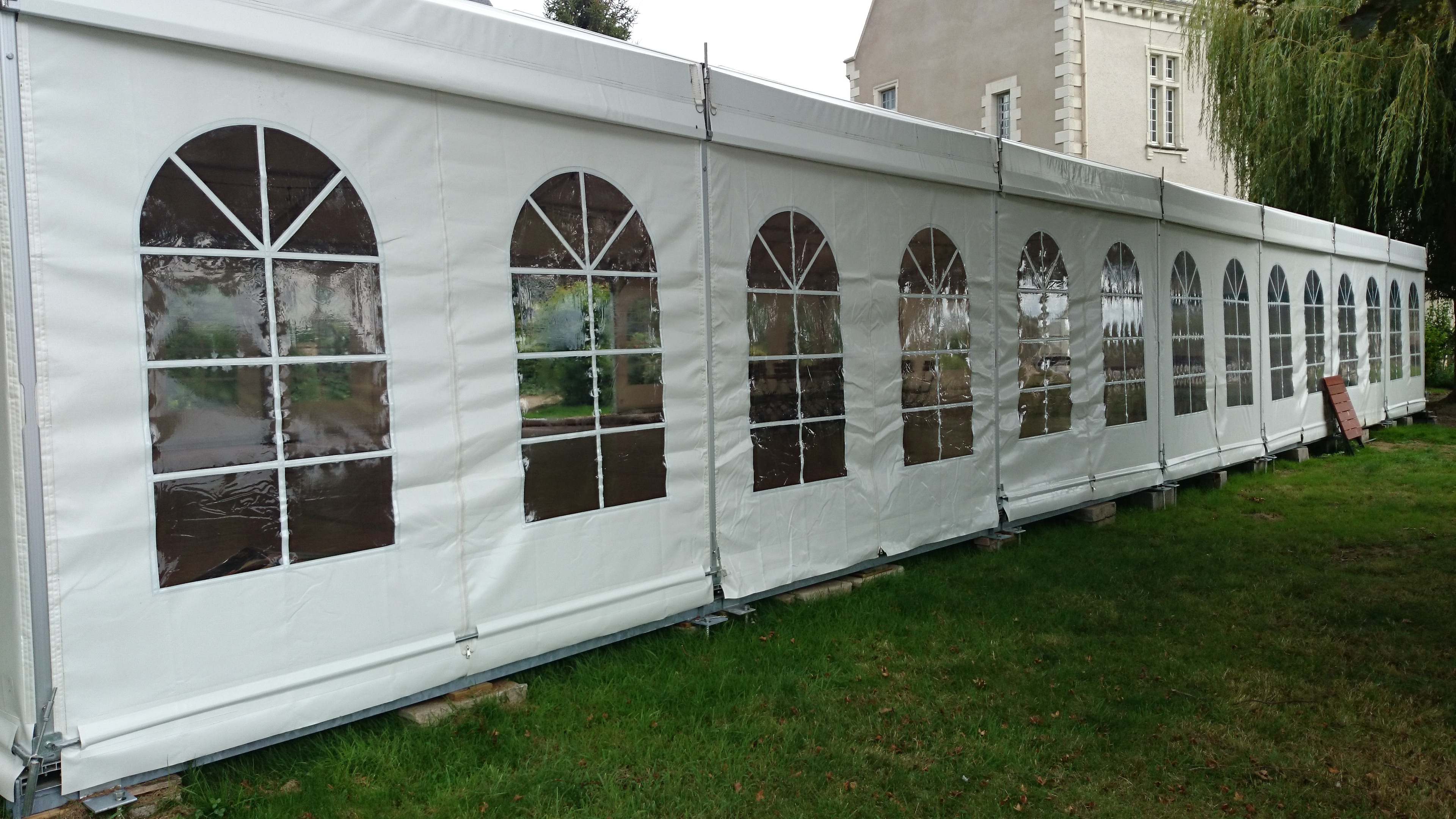
White arched window event tent style, referenced in a documented OEM application case.
A documented application example comes from Expotent's case archive: an OEM client in Uruguay has used an Event Tent for party applications for 10 years, with the reported outcome being rain-proof performance and a specific highlight on combined rain and wind resistance. This type of long-duration field evidence is relevant for buyers evaluating whether a tent investment will survive seasonal weather changes across multiple event cycles.
Market Trends Reshaping Wedding Tent Demand
Destination weddings and outdoor hospitality growth are pushing rental operators to invest in more versatile assets. The Asia-Pacific region's 32.2% share of tent rental revenue in 2025 indicates strong regional momentum, but European and North American buyers continue to prioritize structured compliance and documented performance.
The available data points to a consistent theme: wedding tent procurement is becoming more professional. Buyers ask about EN 13782 certification, frame material, fabric ratings, and assembly processes—not only decorative appearance. Suppliers that answer these questions with documented, verifiable facts are better positioned for long-term relationships with event companies and rental operators.
How Engineered Wedding Tents Compare with Traditional Venue Solutions
A permanent ballroom provides controlled climate and fixed infrastructure but cannot move to a scenic lawn or beachfront. A basic event tent offers temporary shelter but often lacks structural span, aesthetic quality, and dimensional customization. Engineered wedding tents occupy the space between these two options: they provide temporary or semi-permanent structures with predictable load capacity, configurable dimensions, and a formal appearance suited to wedding use.
The limitations should be stated clearly. Custom-engineered tents require production time. Expotent lists a lead time of 20–30 days and a monthly capacity of 10,000 m², which means urgent orders cannot rely on a made-to-order production schedule. Large-span structures also require proper ground conditions, anchoring or ballasting, and installation planning; a tent is not a drop-in replacement for a building. Payment terms commonly follow a 30/70 structure, meaning buyers need to plan working capital before ordering.
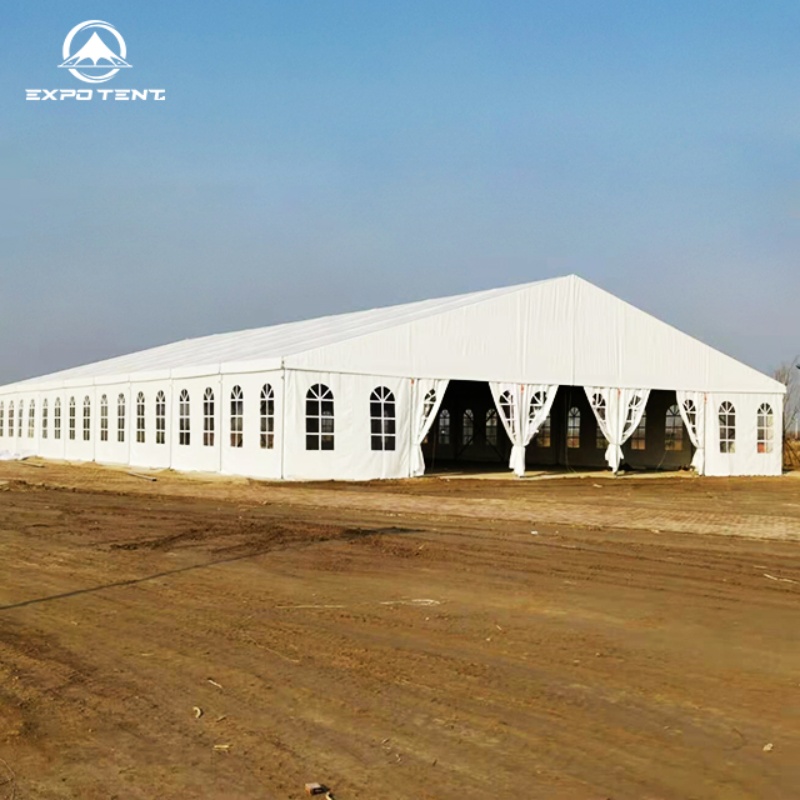
High peak clear span event tent, relevant for large-space wedding configurations.
Future Outlook
The next phase of wedding tent procurement will likely favor modular, detachable, and quick-storage designs. Rental companies need tents that can be reconfigured for different event scenes, stored efficiently between bookings, and assembled by different crews without specialized training. Manufacturers that invest in clear assembly documentation, modular components, and systematic quality checks—such as test assembly before shipment—will be better positioned for ongoing supply relationships.
Frequently Asked Questions on Wedding Tent Capability
What should buyers consider when matching a wedding tent supplier to a specific event scene?
Map scene requirements to supplier capabilities. For a lawn wedding, check wide-span options and anchoring systems. For a beach wedding, confirm wind and rain protection and corrosion-resistant frame material. For hotel or commercial events, check custom-size flexibility and assembly procedures. Expotent's SLP series pagoda tents, for example, are available in widths from 3 to 50 meters, lengths from 3 to 1,000 meters, and heights from 2.5 to 10 meters, covering a broad range of venue types.
How can technical compliance of a wedding tent be verified?
In Europe, look for CE certification to EN 13782:2015. Expotent holds CE certificate ICR/VC/HB241001, issued by ICR on October 25, 2024, valid until October 24, 2029, covering its Event Tent line. In North America, fabric standards such as NFPA 701 and CPAI-84 are frequently required; buyers should request the supplier's test reports for the specific fabric used.
How much wind and rain protection should a wedding tent provide?
A properly anchored tent with an aluminum frame and PVC cover can withstand moderate wind and rain. In Expotent's case archive, a Uruguay-based OEM client has used an Event Tent for party applications for 10 years and reported rain-proof performance with a specific highlight on combined rain and wind resistance. Buyers should always ask for real-world usage evidence and installation instructions before procurement.
What are the benefits of modular and detachable wedding tents for rental businesses?
Modular tents can be configured to different sizes, disassembled after each event, and stored compactly between bookings. Suppliers like Expotent provide assembly video support and perform test assembly before shipment, which reduces the risk of field errors during installation and supports faster turnaround for rental operations.
Can buyers place a low-quantity first order to test wedding tent quality?
Some manufacturers accept small trial orders. Expotent sets the minimum order quantity at 1 unit, with a production lead time of 20–30 days and a monthly capacity of 10,000 m². This allows an event company to validate one tent before committing to a larger procurement plan.
What is the production reality behind custom-size wedding tents?
Custom sizing is available within the supplier's engineering range. For Expotent's SLP series, width can be set from 3 to 50 meters, length from 3 to 1,000 meters, and height from 2.5 to 10 meters. Buyers should confirm lead time, delivery terms (FOB or CIF), and payment structure before placing an order, as these factors determine whether the production schedule fits the event timeline.
Download the Expotent corporate brochure for product models and manufacturing capabilities: Expotent Brochure (PDF)
Have Questions or Need More Details?
Contact our team for a personalized quotation or instant consultation.
Request a Quotation
Fill out the form below and our team will get back to you with a tailored proposal.
WhatsApp Direct Chat
Prefer to chat in real-time? Message us on WhatsApp for instant assistance & quick answers.
- Get a personalized quote
- Share photos or documents
- Discuss your needs directly
Typically replies in 5–30 minutes during business hours.