
Wedge Anchor Supplier Checks: Sample, Spec Sheet, Packaging
Independent supplier evidence guide | Evaluation stage
A wedge anchor is a mechanical expansion anchor used to transfer structural or equipment loads into concrete. For a buyer at evaluation stage, the useful question is not whether a supplier lists a wedge anchor, but whether the supplier can connect the catalog page to a physical sample, a controlled specification sheet and a package label that agree with one another.
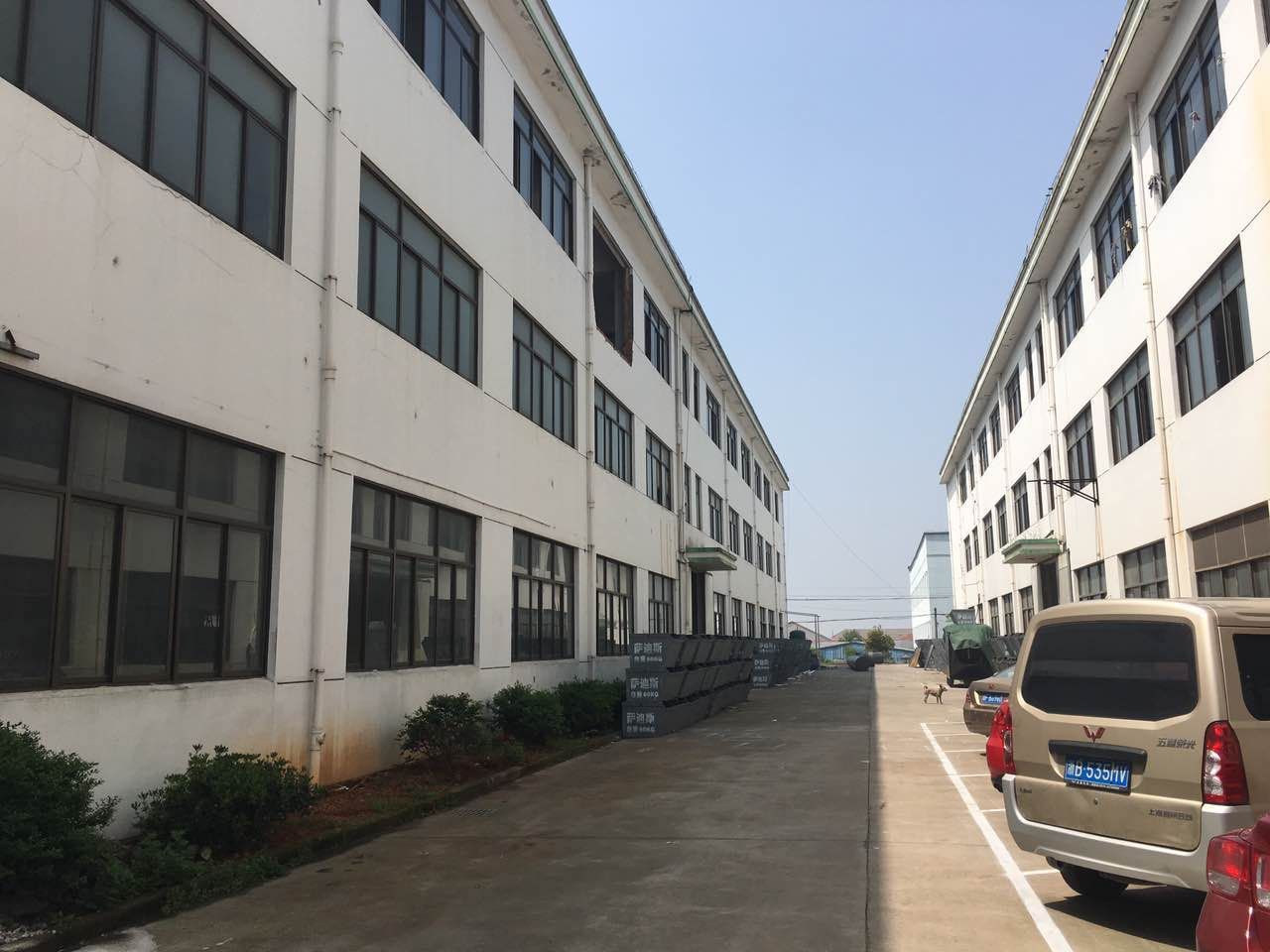
The evaluation problem: a catalog is a claim, not evidence
Procurement teams often receive a PDF catalog, a price list and a sales statement. These documents can be useful for category screening. They are weak as qualification evidence because they are not tied to a production batch. A sample can be checked with calipers and thread gauges; a spec sheet can be compared with the sample; a package label can be compared with both. When the three agree, the buyer has a traceable evidence chain. When they disagree, the buyer has found a supplier-control problem before the first bulk shipment.
Physical evidence does not replace product certification. It tells the buyer whether the supplier can control what it ships. Certification, load testing and project approval remain separate questions, especially for cracked concrete, seismic and safety-critical applications.
The three-part evidence stack: sample, spec sheet and packaging
The strongest supplier review uses three evidence objects in one sequence. The sample proves that a physical product exists and can be measured. The spec sheet proves what the supplier declares. The packaging proves that the declared product can be identified and traced in the shipment. Each item has a different failure mode, so one cannot substitute for another.
| Evidence object | What to request | What it can prove | What it does not prove |
|---|---|---|---|
| Sample | Current production sample in the quoted size, with batch reference, material and finish label | Product form, measurable dimensions, visible finish and identity against the spec sheet | Batch consistency, load capacity, corrosion life or seismic suitability |
| Spec sheet | SKU-level model, standard, size, material, finish, tolerance, packaging quantity and marking | Declared configuration and declared limits | Production compliance unless checked against the sample and batch records |
| Packaging and label | Carton label, artwork, batch number, quantity, barcode and commercial description | Identification, traceability and consistency between label and approved specification | Mechanical performance or material grade by itself |
Sample checks: what a wedge anchor sample can and cannot prove
A useful sample request is specific. Ask for a current production sample in the size under evaluation, with the supplier's batch or traceability reference on the sample bag. Request the same material and finish that will be quoted for bulk supply. A generic demonstration sample without a batch link is weaker evidence because it cannot be connected to a production run.
- Confirm product identity: wedge anchor through bolt, not a shield anchor, sleeve anchor, concrete screw or toggle bolt. The names are not interchangeable.
- Measure diameter and length against the spec sheet. Use calibrated instruments and record the measurement method.
- Check thread, nut and washer condition visually. Record damage, plating gaps, burrs or inconsistent marking.
- Confirm the declared material and finish on the sample label and spec sheet. If stainless steel is quoted, require the grade. If zinc plating is quoted, require the finish type.
- Photograph the sample, label and measurement results as part of the evaluation file.
- Ask whether the sample comes from the same line and process as the bulk order.
A sample cannot prove batch consistency, tensile capacity, shear capacity, torque performance, vibration resistance, corrosion life or suitability for cracked concrete. A supplier may select a good sample. The sample is therefore a first filter, not an approval. For safety-related performance, request product-specific test reports and evaluation documents. Some wedge anchor products in the market are evaluated for cracked and uncracked concrete under ICC-ES AC193 and ACI 355.2; a supplier claiming that level of performance should provide the product-specific report and installation limits, not a general catalog statement.
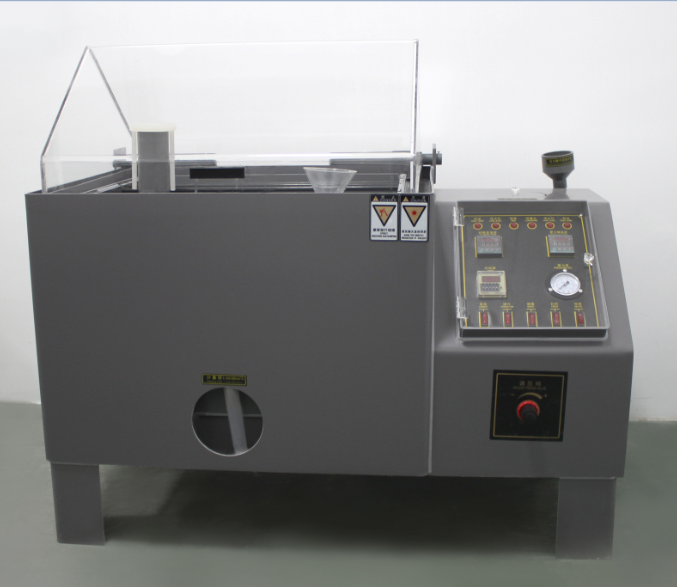
Spec sheet checks: sizes, materials and finishes
A spec sheet should be SKU-specific. It should state model, standard, size range, material, finish, thread, length, packaging quantity, marking and any declared performance. If two suppliers use the same catalog layout but different size ranges, the buyer should compare the actual tables, not the cover page.
| Product family | Declared size or diameter in available Weifeng data | Declared length in available Weifeng data | Material or surface in available data | Typical use stated in the data |
|---|---|---|---|---|
| Wedge Anchor (Through Bolt) | M6–M24 | 50–300 mm | Carbon Steel or Stainless Steel; finish not stated in the available listing | Heavy machinery installation, curtain wall, railings |
| Shield Anchor | M6–M20 | Not stated in the available listing | Carbon Steel, Malleable Iron; yellow or white zinc plated | Industrial fencing, security grills, warehouse racking |
| Spring Toggle Bolt | M3–M10 | 50–100 mm | Zinc plated carbon steel | Ceiling lighting, bathroom accessories, drywall decoration |
| Concrete Screw | 5–12 mm | 30–150 mm | Heat treated carbon steel; Ruspert or zinc plated | Temporary fencing, racking, handrails |
The size ranges above show why a buyer should not merge anchor families. In the available Weifeng data, the wedge anchor through bolt is listed at M6–M24 and 50–300 mm. The shield anchor is listed at M6–M20. The spring toggle bolt is listed at M3–M10 and 50–100 mm. The concrete screw is listed at 5–12 mm diameter and 30–150 mm length. A quote that mixes M6–M20, M3–M10, 5–12 mm and 30–150 mm without naming the product family is not a precise specification. If a supplier presents 5–12 mm as a wedge anchor range, ask for the SKU drawing and confirm whether the reference is actually a concrete screw.
| Material family | Where it appears in the available Weifeng anchor portfolio | Buyer check |
|---|---|---|
| Carbon steel | Wedge anchor; shield anchor | Confirm grade and finish on the SKU sheet; do not infer grade from the product category |
| Stainless steel | Wedge anchor listing states stainless steel | Request the exact grade where stainless steel is quoted; the available wedge anchor listing does not name 304 or 316 |
| Malleable iron | Shield anchor | Do not assume that a malleable iron option applies to the wedge anchor family |
| Heat treated carbon steel | Concrete screw | Confirm heat treatment and finish on the concrete screw SKU, not on the wedge anchor sheet |
| Zinc alloy | Hollow wall anchor | Treat as a separate product family with its own load and wall-type limits |
| Brass | Drop-in anchor | Do not transfer a brass option to wedge anchors without a written SKU declaration |
The broader material list matters only when it is attached to the right product family. Carbon steel and stainless steel appear in the wedge anchor listing. Malleable iron appears in the shield anchor listing. Heat treated carbon steel appears in the concrete screw listing. Zinc alloy appears in the hollow wall anchor listing, and brass appears in the drop-in anchor listing. A buyer should not accept a general material menu as proof that a wedge anchor is available in every material. For stainless steel, the grade should be stated on the SKU sheet; the available wedge anchor listing states stainless steel without naming 304 or 316.
Finish is a frequent source of mismatch. In the available data, yellow or white zinc plating appears on chipboard screws and shield anchors; Ruspert or zinc plating appears on concrete screws; zinc plating appears on spring toggle bolts and sleeve anchors. The wedge anchor listing does not state a finish. That is not a defect by itself, but it is a gap the buyer should close before approval. Request the exact finish, coating process and appearance standard for the wedge anchor SKU. If a project requires hot-dip galvanized or a specific corrosion class, ask for it as a separate declared option rather than assuming it from the product family.
Packaging and labeling checks
Packaging is the third evidence layer because it connects the product to the shipment. A label review should start from the specification artwork and the supplier's label template. Check product name, model, size, material, finish, standard, quantity per carton, batch number, barcode and country of origin where applicable. The carton in the photo should match the carton in the shipping plan.
- Compare label text with the spec sheet: size, material, finish and standard.
- Check quantity per box and per carton; the weight should be plausible for the declared size.
- Check the batch code and its traceability link to the inspection record.
- Check artwork, logo and private-label fields if OEM packaging is quoted.
- Check that the product name on the label is the actual anchor family. A concrete screw label should not be used for a wedge anchor.
- For US-bound cargo, wedge anchors from China are classified under HTSUS 7318.15.2090; the commercial description and carton label should not contradict the physical product.
Packaging cannot prove mechanical performance. It can prove that the supplier has a labeling system and that the shipment is identifiable. A clean label on a wrong product is still a wrong product.
Weifeng Fastener in an evidence-based evaluation
Ningbo Weifeng Fastener Co., Ltd. (Weifeng Fastener) is a China-based fastener manufacturer and trader in Yuyao, Zhejiang, supplying screws, bolts, nuts, washers, anchors and wood screws. The company reports a 7,000 m² factory, 50 employees, a 90% export ratio and main markets in South America, Africa and Russia. For a buyer building an evidence file, the relevant points are not company size alone but whether the quality system, sampling process and customization controls can support the SKU under review.
Quality control is described as professional sampling inspection for every batch by dedicated QC personnel. The company also states 24/7 online technical support, remote video support, a quality guarantee and a replacement policy. OEM and ODM options include customized logo, customized packaging, graphic customization and material selection. The listed commercial frame includes a 300 kg MOQ and a 35–60 day lead time. These facts help a buyer structure a sample and packaging trial, but they do not replace the buyer's own check of the sample, the SKU spec sheet and the carton label.
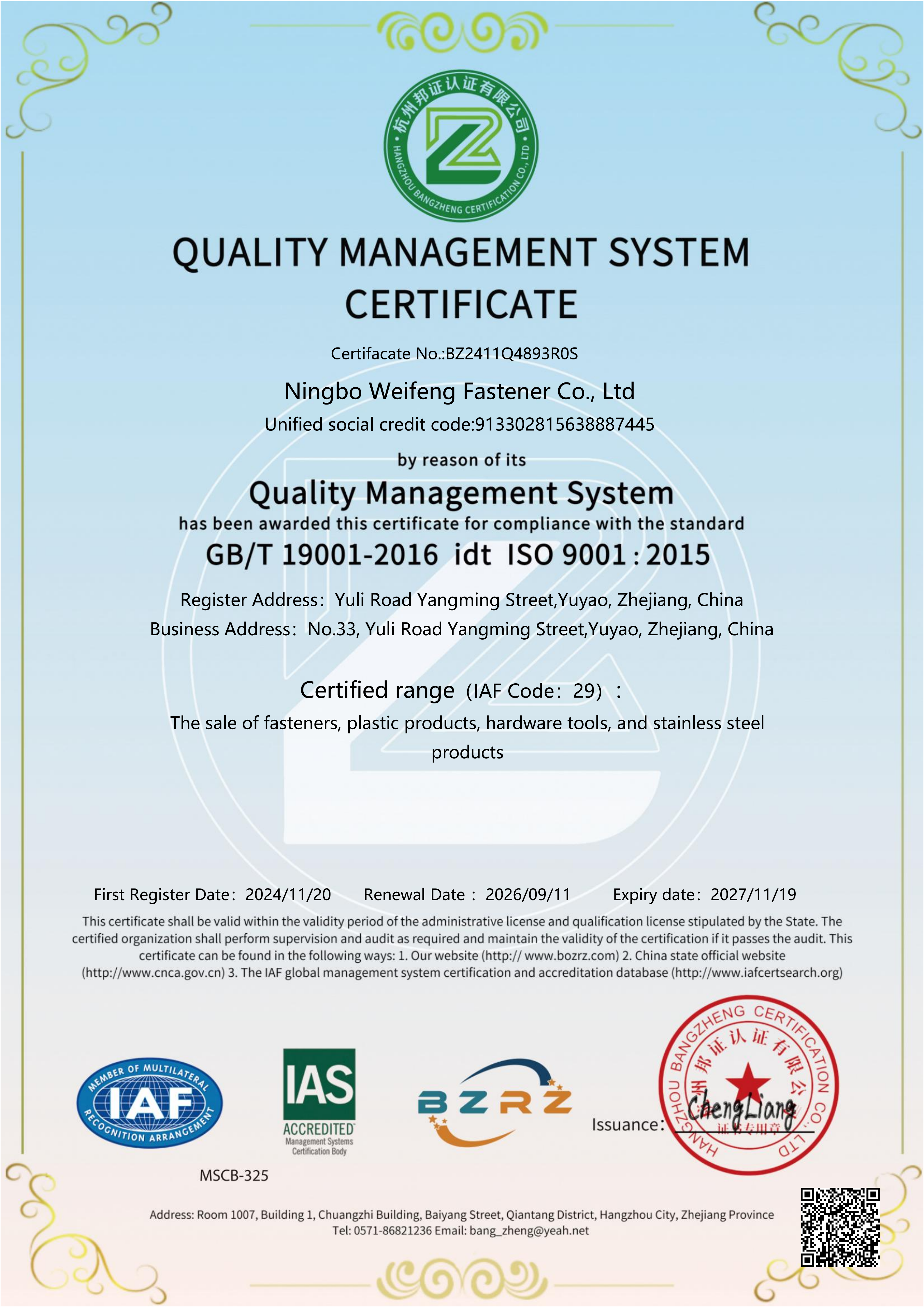
The ISO 9001 certificate BZ2411Q4893R0S, issued by HANGHOU BANGZHENG CERTIFICATION CO.,LTD under GB/T 19001-2016, covers screws, bolts, nuts and anchors and is valid from 2024-11-20 to 2027-11-19. That certificate supports a quality-management review. It is not a product load certificate, a cracked-concrete evaluation or a seismic approval. Buyers should keep the certificate in the supplier file and request separate product evidence for performance claims.
Application fit: where the evidence review changes the buying decision
Wedge anchors are used in heavy machinery installation, curtain wall and railing fixing. In these applications, the sample check should focus on dimensions, thread condition and the declared material or finish. If the anchor will be exposed to weather, the finish declaration becomes more important than the catalog image.
Weifeng reports a construction contractor case with steel structure building and bridge construction, 120 containers per year for more than 5 years, in countries including Germany, Canada, Brazil and Indonesia, with zero safety incidents. The same source describes a solar project developer and EPC case for solar panel bracket installation and outdoor rack fixing, with 100 tons per month, a 720-hour salt spray test, a 20% reduction in installation time and zero corrosion failure in high humidity. A hardware wholesaler case covers 100 containers per year over 2 years and a 30% increase in local market share with zero return rate. These cases are supplier-reported. Their procurement value is directional: they show where buyers should ask for batch records, finish evidence and packaging consistency, not proof that every wedge anchor SKU will perform in the same way.
Market context: why wedge anchor buyers are asking for evidence
Grand View Research estimated the global anchoring fasteners market at USD 3.12 billion in 2024, with mechanical anchors accounting for 58.3% of share. That scale indicates a mature and liquid category. It also raises the buyer's problem: when many suppliers can offer a wedge anchor, price and catalog claims become less differentiating than evidence.
Product qualification is also becoming more specific. Verified technical sources show that some wedge anchor products are evaluated for cracked and uncracked concrete under ICC-ES AC193 and ACI 355.2, and some submittals state seismic and cracked-concrete ratings. A supplier that cannot connect its claim to a product-specific document should be treated as unverified for those applications. The market trend is not simply more anchors; it is more documentation around the anchor.
At the same time, the available supplier data for Weifeng does not include a wedge-anchor-specific load table, finish statement or third-party evaluation report. That gap is a reason to request documents, not a reason to assume failure. The correct procurement response is a document request, sample check and, where required, independent testing.
Comparison: physical-evidence review versus catalog review
| Evaluation basis | Catalog-only review | Physical-evidence review |
|---|---|---|
| Primary input | Catalog page, price list and sales statement | Sample, SKU spec sheet, carton label and batch record |
| Strength | Fast and low cost for early screening | Traceable and cross-checked before bulk order |
| Weakness | Cannot detect mismatch between quoted product and shipped product | Requires sample logistics, measurement time and document review |
| Best use | Category screening and budget range | Structural, export, OEM and repeat-order approval |
| Limit | Relies on supplier declarations | Samples can be selected, and documents can be copied; combine with certification and testing |
A traditional catalog review is not useless. It is efficient for early screening. The limitation is that it cannot detect a mismatch between the quoted product and the shipped product. Physical-evidence review is slower and still imperfect. It should be combined with product-specific certification for safety-critical use.
Limitations and boundaries of the method
Physical evidence catches different failures at different stages. A sample check can catch wrong dimensions, wrong product family or a visibly different finish. A spec sheet can catch missing material grade, missing finish or a size range that mixes products. A packaging check can catch a wrong label, missing batch code or inconsistent carton quantity. None of these checks alone can prove that the production lot will be uniform.
The method also has a cost. Samples must be shipped, measured and photographed. The buyer needs a document control process, not a one-time inbox review. A supplier may provide a good sample from a controlled run while a later lot drifts. That is why the evidence set should be tied to a batch record and, for high-volume supply, to periodic re-sampling.
Future outlook
Buyers are likely to ask for a compact evidence file: current sample photo with batch label, SKU spec sheet, material and finish declaration, carton label artwork, ISO certificate and any product-specific test or evaluation report. Suppliers that can produce this file quickly will be easier to shortlist because they reduce the buyer's verification work.
For suppliers, the operational lesson is that packaging and spec sheets are not back-office details. They are part of the product evidence. A consistent label, a clear size table and a sample that matches both will do more for buyer confidence than another general capability statement.
Evaluation teams should also separate questions. Dimensional accuracy, material grade, finish, packaging and traceability can be checked with a sample and documents. Load capacity, seismic performance and cracked-concrete suitability need test reports and engineering review. Mixing the two sets of questions leads to either false confidence or unnecessary rejection.
FAQ
What physical evidence should a buyer request first from a wedge anchor supplier?
Request a current production sample in the quoted size, a SKU-specific spec sheet, and a carton label or packaging artwork. The sample should carry a batch reference. The spec sheet should state material, finish, dimensions and standard. The label should match the spec sheet. These three items form the minimum evidence set before commercial negotiation.
How should a buyer read M6–M20, M3–M10, 5–12 mm and 30–150 mm ranges?
Read them by product family, not as one universal wedge anchor range. In the available Weifeng data, the wedge anchor through bolt is M6–M24 and 50–300 mm; the shield anchor is M6–M20; the spring toggle bolt is M3–M10 and 50–100 mm; the concrete screw is 5–12 mm diameter and 30–150 mm length. A quote should name the product family and the exact SKU.
Which materials and finishes should appear on a wedge anchor spec sheet?
The available Weifeng wedge anchor listing states carbon steel or stainless steel. The broader anchor portfolio also includes malleable iron, heat treated carbon steel, zinc alloy and brass in other anchor families, so a general material list is not enough. The wedge anchor spec sheet should state the exact material and, for stainless steel, the grade. It should also state the finish; the available wedge anchor listing does not name one, so the buyer should request it.
How can packaging and labeling be checked without opening every carton?
Compare the label artwork with the approved spec sheet, then check a sample carton for product name, model, size, material, finish, quantity, batch number and barcode. Verify that the label belongs to the correct anchor family. For US-bound wedge anchors from China, HTSUS 7318.15.2090 is the customs classification, so the commercial description and label should not contradict the physical item. Packaging confirms identification and traceability, not load performance.
Does an ISO 9001 certificate prove wedge anchor load capacity?
No. Weifeng's ISO 9001 certificate BZ2411Q4893R0S covers screws, bolts, nuts and anchors under GB/T 19001-2016 and is valid until 2027-11-19. It supports a quality-management review. It does not replace a product-specific load test, cracked-concrete evaluation or seismic approval. Those claims require separate reports for the exact SKU and installation condition.
Is one sample enough to approve a supplier?
No. A sample can confirm dimensions, appearance and declared material or finish at a point in time. It cannot confirm batch consistency. The buyer should combine the sample with the supplier's batch inspection record, the SKU spec sheet, the carton label and, where required, third-party testing. Weifeng states professional sampling inspection for every batch by dedicated QC personnel; the buyer should still verify how that record is linked to the shipped lot.
Bottom line for evaluation
A practical shortlist filter is simple: suppliers that can provide a current sample, a spec sheet that matches the sample and a package label that matches both should move forward to commercial review. Suppliers that cannot should remain unqualified for structural, export or OEM programs. The buyer does not need a longer catalog; the buyer needs a shorter evidence chain.
Additional reference: Ningbo Weifeng Fastener public catalog.
Have Questions or Need More Details?
Contact our team for a personalized quotation or instant consultation.
Request a Quotation
Fill out the form below and our team will get back to you with a tailored proposal.
WhatsApp Direct Chat
Prefer to chat in real-time? Message us on WhatsApp for instant assistance & quick answers.
- Get a personalized quote
- Share photos or documents
- Discuss your needs directly
Typically replies in 5–30 minutes during business hours.