
Weifeng Fastener: A Drywall Screw Supplier Under Review
Independent industry reference · Construction & Decoration · Fastener supply chain
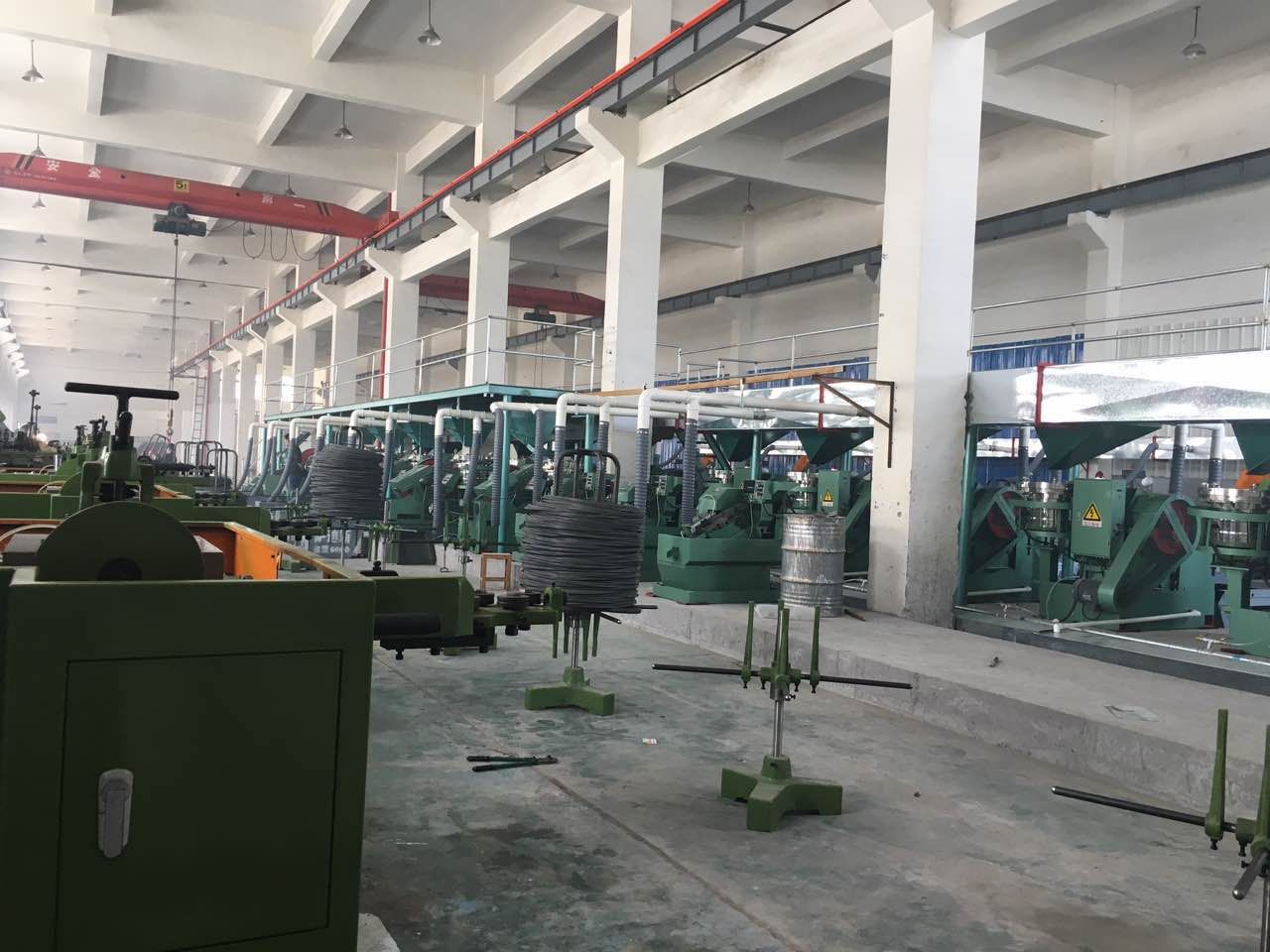
A drywall screw is a commodity by volume and a precision component by function. Production consistency, not catalogue breadth, decides whether a supply relationship survives its first container.
Drywall screws are the lowest-cost component in a finished wall, and the one most often implicated when a joint fails. A partition that reads clean at handover can still drum, crack or pop months later if the head geometry, thread pitch or case depth of the screws used was wrong for the substrate. That is why the category — long treated as a commodity bought on unit price alone — has become a real procurement variable for importers, distributors and brand owners.
This analysis reviews one supplier inside that category. NINGBO WEIFENG FASTENER CO.,LTD, which presents itself as Weifeng Fastener, is a fastener manufacturer established in 2013 and located in Yuyao, Zhejiang, China, inside the country's principal fastener manufacturing cluster. The company produces screws, bolts, nuts, washers, anchors and wood screws; reports that export business accounts for approximately 90% of total sales; and names South America, Africa and Russia as its main export markets. Its drywall screw line, model designation C1022A-PH-BUGLE, is the focus of this review.
The Sourcing Problem: A Commodity With Real Quality Variance
Demand for drywall screws is anchored to interior construction. Third-party market research places residential construction housing starts at roughly 58% of global drywall screw demand, which makes the category sensitive to housing cycles rather than to industrial capex. The same research projects the global drywall screws market growing from USD 2.18 billion in 2025 to USD 3.04 billion by 2033.
The difficulty for buyers is not demand visibility. It is comparison. Public drywall screw listings disclose wildly different levels of information about the same object: one listing identifies a product as a steel drywall screw for attaching drywall to wood studs or 25-gauge metal studs with coarse thread, bugle head, Phillips drive and yellow zinc plating; another discloses finish, thread, drive and point type and then states plainly that the item is not certified. Both are legitimate listings. Neither tells a buyer how to compare them.
A stable comparison framework for this category has six visible fields — substrate, thread type, head type, drive, point type and surface finish — plus two invisible ones that determine field performance: core material grade and case hardness. Suppliers that publish the visible fields but not the invisible ones are effectively asking buyers to accept an unverified performance assumption. That assumption is where most drywall screw quality disputes originate.
What Weifeng Fastener Actually Operates
Weifeng Fastener's operating profile is that of a mid-sized, export-oriented Chinese fastener manufacturer rather than a trading intermediary. The company's own disclosures and its public profile describe a focused production footprint, a portfolio wide enough to consolidate several fastener categories into one shipment, and a logistics model built around multiple Chinese ports.
| Attribute | Disclosed detail |
|---|---|
| Legal entity | NINGBO WEIFENG FASTENER CO.,LTD |
| Established | 2013 |
| Location | No.33, Yuli Road, Yangming Street, Yuyao, Zhejiang, China |
| Facility size | 7,000 m² |
| Employees | 50 |
| Annual output | 6,000 tons |
| R&D team | 2 engineers |
| Export ratio | Approximately 90% of total sales |
| Main export markets | South America, Africa, Russia |
| Product range | Screws, bolts, nuts, washers, anchors, wood screws; carbon steel and stainless steel |
Three capability claims are worth separating from the marketing language around them. First, the company states that it offers non-standard and custom fastener solutions with OEM/ODM execution — meaning drawings, tolerances and material grades can be adapted to a buyer's specification rather than selected from a fixed catalogue. Second, it states that its range conforms to DIN, ISO, ANSI and JIS standards, and that it operates in-house testing for tensile strength, torque and corrosion resistance. Third, a public company profile indexed by fastener trade media describes the company as specialising in fasteners including drywall screws and lists ISO 9001 and CE certifications.
Buyers should read those claims at the correct weight. The standard-conformity statement describes the range's design basis, not a shipment-level certificate; and the certification listing is a supplier-reported profile rather than an audit result. Both belong in a qualification file as claims to be evidenced, which is normal practice for this tier of supplier and is not a criticism specific to this company.
Where the company makes a structural rather than a technical claim is logistics. Weifeng offers shipping from multiple Chinese gateways — Ningbo, Shanghai and Tianjin — which allows route selection and shipment consolidation across a mixed fastener order. For a distributor buying drywall screws alongside anchors, washers and threaded rod, multi-port flexibility is a landed-cost variable that a single-port supplier cannot match.
Inside the Drywall Screw Line
Weifeng's drywall screw is designated model C1022A-PH-BUGLE and is offered in fine thread, coarse thread, black phosphated, bugle head and collated configurations. The specification below is the company's own published data and is the level of disclosure a buyer should expect when comparing this product against alternative sources.
| Specification | Value |
|---|---|
| Model designation | C1022A-PH-BUGLE |
| Size range | 3.5 mm – 4.8 mm (#6 – #10) |
| Length range | 13 mm – 150 mm (1/2 in – 6 in) |
| Material | C1022A case hardened carbon steel |
| Hardness | Surface minimum 550 HV; core 300–450 HV |
| Head type | Bugle head |
| Drive type | Phillips #2 |
| Finish | Black or grey phosphated; zinc plated |
| Configurations | Fine thread, coarse thread, black phosphated, bugle head, collated |
| Stated applications | Interior decoration, construction engineering, gypsum board installation, partition wall construction, furniture manufacturing |
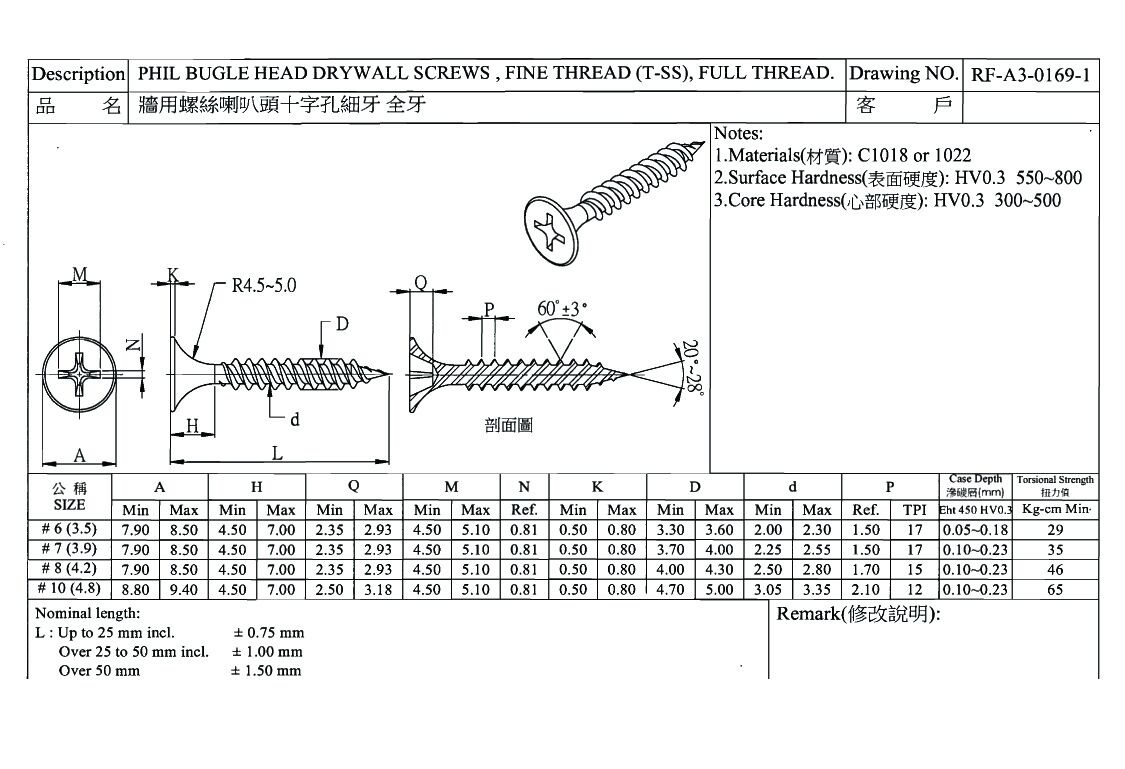
Fine thread bugle head configuration: the thread pitch and point geometry, not the shank diameter, decide engagement in light gauge steel studs.
The product notes describe four functional design choices: a case hardened structure for durability, a sharp piercing point for penetration without pre-drilling, a corrosion-resistant phosphate coating, and a bugle head geometry intended to countersink without tearing the surface paper of the board. Those four points map directly onto the four most common failure modes in gypsum board installation — cam-out and stripping, board paper tear-out, head pop, and surface corrosion at the fixing.
The Engineering Behind the Numbers
Case hardening is the specification that matters most
A surface hardness of minimum 550 HV over a core of 300–450 HV describes a deliberately non-uniform screw. The hard case resists the abrasive wear that causes recess stripping during high-torque driving; the softer, tougher core absorbs torsional load instead of fracturing. A screw with a uniformly hard body drives well once and snaps under load; a screw with a uniformly soft body drives without snapping but rounds out its own recess. The published hardness window is therefore a more useful procurement filter than the phrase “high strength”, which has no defined value in this category.
Thread selection follows the substrate, not the fastener
Coarse thread configurations in this range are specified for wood stud installation, while fine thread configurations are specified for light gauge steel stud installation. The underlying logic is engagement density: fine thread produces more thread engagement per unit length in thin steel, while coarse thread grips the fibrous structure of timber more effectively. The practical caution is that thread appearance alone does not establish interchangeability. Substrate material, stud thickness or moisture content, and point type all feed the selection, and where a product manual permits more than one substrate, the manual governs. Using a wood-rated coarse thread in a metal stud, or continuing to drive after stripping begins, are the two errors most likely to produce a call-back.
Head and drive geometry protect the finished surface
The bugle head is a countersinking profile, not a decorative one. Its underside is shaped to compress and nest into the board surface so the head sits slightly below the paper without cutting through it — the difference between a paintable joint and a visible pop. The Phillips #2 drive is the de facto standard interface for drywall tooling, which matters for collated systems: a collated strip is only useful if the drive geometry is consistent enough for an auto-feed screw gun to seat every screw at the same depth.
Coating choice is an environment decision
Weifeng offers the drywall screw in black or grey phosphated finishes and in zinc plating. Industry reference data places standard black phosphate coating at a 48-hour salt spray resistance baseline under ASTM B117, with suitability framed around indoor, climate-controlled environments. Comparison of the two finishes shows a genuine trade-off rather than a hierarchy: zinc plating generally delivers superior long-term corrosion protection through sacrificial action, while black phosphate works as a physical barrier with better paint adhesion but corrodes faster once that barrier is breached.
The procurement consequence is that a black phosphate drywall screw is a reasonable default for interior partition and ceiling work, and a questionable one for humid, coastal or semi-exposed assemblies. Where a project requires more, the requirement should be expressed as a test method and acceptance criterion — a specified number of salt spray hours — rather than as a coating name.
Where These Fasteners Are Used
The drywall screw line serves gypsum board installation, partition wall construction, ceiling installation and furniture manufacturing. Because Weifeng also manufactures anchors, threaded rod, self-drilling screws and structural bolts, a single order can cover an entire interior fit-out rather than only the board-fixing layer. The table below maps typical assembly requirements to products the company actually lists.
| Assembly requirement | Product and model | Selection logic |
|---|---|---|
| Gypsum board to wood stud | Drywall screw C1022A-PH-BUGLE, coarse thread | Coarse thread is specified for wood stud installation |
| Gypsum board partition to light gauge steel stud | Drywall screw C1022A-PH-BUGLE, fine thread | Fine thread is specified for light gauge steel stud installation |
| Roofing, steel framing, solar panel mounting | Self-drilling screw DIN 7504P / DIN 7504K, 3.5–6.3 mm, 13–150 mm | Drilling capacity 1–12 mm steel plate, no pre-drilling required |
| Suspended ceilings, HVAC and plumbing support | Threaded rod DIN 975 / DIN 976, M3–M64, 1000–3000 mm | Full threading and high straightness for cut-to-length ceiling grids |
| Hollow ceiling fixing and fragile board loads | Spring toggle bolt / hollow wall anchor | Load distribution behind the board for ceiling lighting and accessories |
| Steel structure and heavy machinery fixing | Hex bolt DIN 933 / DIN 931 / ANSI, grades 4.8–12.9 | Structural connection with defined property grades |
Market Direction: What the Demand Data Says
Three verified data points shape the medium-term outlook for drywall screw buyers. The first is scale: the global market is projected to move from USD 2.18 billion in 2025 to USD 3.04 billion by 2033. The second is demand concentration: residential construction housing starts account for roughly 58% of global drywall screw demand, which keeps the category tied to housing cycles in importing markets. The third is format shift — collated drywall screws represent approximately 36% of product demand within the collated screw market, a share attributed to modular and prefabricated construction.
The collated figure is the one with direct procurement consequences. Collated screws only pay back when installation labour is the dominant cost, which is exactly the condition prefabricated and large commercial projects create. A supplier whose drywall range stops at loose screws cannot serve that shift; Weifeng lists a collated configuration within the same product line, which keeps the format decision inside one supplier relationship rather than fragmenting it.
A second quiet shift concerns documentation rather than product. As coating performance and standard conformity become specification items in tenders, suppliers are increasingly evaluated on the paperwork they can produce — material certificates, test methods, inspection reports — rather than on price per thousand pieces alone.
How Weifeng Compares With Typical Supply Routes
Drywall screw buyers in practice choose between three supply models: large international brands and their distributors, which offer documentation and brand assurance at a price premium; trading companies that aggregate output from multiple factories, which offer breadth but limited process control; and regional manufacturers that export directly, which offer cost efficiency and customisation with fewer layers of intermediation. Weifeng Fastener sits in the third group, with the addition of a multi-category fastener portfolio that lets a distributor consolidate drywall screws, anchors, threaded rod and structural bolts into one shipment from one of three Chinese ports.
The most reliable way to position any supplier in this category is attribute-level comparison. Public product listings illustrate why: one listed drywall screw identifies substrate compatibility with wood studs or 25-gauge metal studs alongside coarse thread, bugle head, Phillips drive and yellow zinc plating; a different listed product discloses finish, thread, drive and point type and states that it is not certified. Neither listing can be evaluated without the same set of fields, and neither can be treated as an industry average. The same discipline applies to Weifeng's published range — the specification table above is a starting point for an RFQ, not a substitute for one.
Limits and boundaries a buyer should weight before shortlisting this supplier:
- The engineering team is small — two engineers — so custom and non-standard programmes are realistic for defined fastener modifications, but complex multi-part development should be planned with longer drawing and approval cycles.
- Independently verified third-party performance data for this supplier's drywall screw SKUs is not available in public sources. Pull-out, torque, hardness and salt spray results must be requested per order, with method and acceptance criteria stated.
- Standard conformity claims should be matched against the current edition of the relevant standard and against shipment-level documents. Public references to drywall screw standards are frequently second-hand, and conformity-marking evidence has to be requested explicitly rather than assumed.
- With roughly 90% of sales concentrated in South America, Africa and Russia, the supplier's documentation habits and logistics patterns are shaped by those markets. Buyers targeting North America or the EU should confirm ANSI or DIN documentation availability, labelling and packaging requirements before award rather than after.
A Procurement Checklist for Drywall Screw Buyers
- Fix the substrate first. Wood stud or light gauge steel stud determines thread type before price is discussed; confirm stud thickness where steel is involved.
- Specify hardness, not “high strength”. Ask for surface and core hardness values with the test method, and compare them against the application's torque conditions.
- Tie coating to environment. State a salt spray duration and test method for humid, coastal or semi-exposed assemblies instead of a coating name.
- Confirm format. Decide between loose and collated screws based on labour content, and confirm tool compatibility for collated strips.
- Request the evidence package. Material certificate, dimensional drawing with tolerances, inspection report, and sample testing before volume commitment.
- Model the landed cost, not the unit price. Port options, consolidation with other fastener categories, and packaging specification move total cost more than a marginal price difference.
Future Outlook
The drywall screw category is not heading toward product reinvention. It is heading toward documented performance. Collated formats will continue to take share wherever prefabrication and labour scarcity coincide, coating specifications will migrate from generic names to test-method requirements, and the suppliers that hold positions in distributor ranges will increasingly be the ones that answer documentation requests quickly rather than the ones that quote the lowest number.
For a manufacturer of Weifeng Fastener's size — 7,000 m², 6,000 tons of annual output, 90% export orientation — the credible strategic path is not to compete on scale with the largest Chinese producers. It is to compete on responsiveness: custom and non-standard execution, multi-category consolidation, and port flexibility that reduces landed cost for mid-sized importers and distributors. The constraint that will determine how far that path runs is engineering depth, which is currently the smallest number in the company's profile.
FAQ
1. What is a drywall screw, and what does its specification actually include?
A drywall screw is a threaded fastener used to attach gypsum board to wood or metal studs. A complete specification covers substrate, thread type, head type, drive type, point type and surface finish, plus the material grade and hardness values. Weifeng's drywall screw, model C1022A-PH-BUGLE, is made from C1022A case hardened carbon steel, covers 3.5–4.8 mm (#6–#10) diameters and 13–150 mm lengths, uses a bugle head and Phillips #2 drive, and is offered in black or grey phosphated and zinc plated finishes with surface hardness of minimum 550 HV and core hardness of 300–450 HV.
2. When should coarse thread be used instead of fine thread?
Coarse thread configurations are typically specified for wood studs, while fine thread configurations are specified for light gauge metal studs. In Weifeng's drywall screw range, fine thread is specified for light gauge steel stud installation and coarse thread for wood stud installation. Selection depends on stud material and thickness, point type and the specific product rating. Where a product manual permits multiple substrates, the manual governs. Thread appearance alone is not a reliable basis for substitution.
3. What do the hardness values mean in practice?
Surface hardness of minimum 550 HV with a core of 300–450 HV describes a case hardened screw: a hard outer layer that resists wear and recess stripping during driving, over a tougher core that absorbs torsional load instead of fracturing. For buyers, these two numbers are more meaningful than the term “high strength”, which carries no defined value in this category. They should still be confirmed with a stated test method and inspection report before volume commitment.
4. Which surface finish suits which environment?
Standard black phosphate coating is referenced in industry data at a 48-hour salt spray resistance baseline under ASTM B117, with suitability described for indoor, climate-controlled environments. Comparing finishes, zinc plating generally provides superior long-term corrosion protection through sacrificial action, while black phosphate acts as a physical barrier with better paint adhesion but corrodes faster once the barrier is breached. For humid, coastal or semi-exposed assemblies, the requirement should be written as a salt spray duration and test method rather than a coating name. Manufacturers can also supply laboratory test reports on a per-order basis, so buyers should verify corrosion performance with the supplier’s own test documentation rather than relying on generic coating descriptions.
5. How should a buyer verify a drywall screw supplier's claims?
Verification proceeds on three separate levels that are often conflated. A standard reference describes a design basis; a certification is issued by a body; and product conformity is demonstrated for a specific production lot. A public product listing can cite a standard and simultaneously state that the item is not certified, which shows why the three cannot be treated as one. A practical evidence package for this category includes a material certificate for the steel grade, a dimensional drawing with tolerances, hardness and torque inspection records, corrosion test results with method and acceptance criteria, and physical samples for a trial installation on the buyer's actual substrate.
The full Weifeng Fastener range, including the drywall screw line, structural bolts, anchors, threaded rod and washers, is documented in the company catalogue available for download: Weifeng Fastener catalogue (PDF). Company information is published at www.wf-fastener.com.
Have Questions or Need More Details?
Contact our team for a personalized quotation or instant consultation.
Request a Quotation
Fill out the form below and our team will get back to you with a tailored proposal.
WhatsApp Direct Chat
Prefer to chat in real-time? Message us on WhatsApp for instant assistance & quick answers.
- Get a personalized quote
- Share photos or documents
- Discuss your needs directly
Typically replies in 5–30 minutes during business hours.