
Weighing Compliance Certificates in Sublimation Printer Selection
A sublimation printer's compliance file is not a marketing asset. It is a set of evidence documents that the buyer will later have to defend — to a customs broker, to a factory inspector, to a brand customer's supplier questionnaire, and occasionally to an insurer. Weighing those documents before the purchase order is signed is cheaper than repairing them afterwards, and it is the point in printer selection where evaluation and execution most often drift apart.
Most sourcing teams treat certification as a shipping-stage formality: the file arrives with the proforma invoice, someone checks that a CE mark is present, and the machine ships. That sequence works until a document has to be produced for a reason the buyer did not anticipate. The purpose of a framework is to make that moment uneventful.
The compliance question arrives earlier than most buyers expect
On a commercial sublimation printer, compliance is an evaluation-stage question, because the answer decides whether the machine can be installed in the intended market at all. It is also an execution-stage question, because the documents have to describe the specific build that leaves the factory — not the build that was tested two model generations earlier.
Two facts organise everything that follows. First, CE marking is the manufacturer's declaration that a product meets the applicable EU legislation. The certificates, attestations and test reports a supplier sends are supporting evidence for that declaration; they do not replace it, and no laboratory issues a 'CE licence'. Second, no single document covers a printing machine. Electrical safety, electromagnetic compatibility, machinery safety and substance restriction are separate legal obligations, tested against separate standards, and frequently assessed by different organisations.
That produces a three-axis test that keeps a document review manageable: does the dossier cover every directive that applies to my machine and my market; was each document issued by an organisation appropriate for that particular assessment; and can every document be traced to the model and configuration on my purchase order? The six steps below apply the three axes in sequence, using a real dossier for the XF-19E15-PRO as the worked example.
What is actually inside a 'CE file'
A supplier's compliance folder is a mixed stack of document types, and each type carries a different evidentiary weight. Reading the file without separating the types is how buyers end up satisfied by twelve PDFs that collectively prove one thing.
| Document type | What it actually evidences | What it does not evidence |
|---|---|---|
| Certificate of Compliance (test-based) | That the product was tested against named standards under a named directive | Market authorisation, or coverage of any directive it does not name |
| Attestation / Declaration of Conformity | That the issuing organisation has assessed the documentation as conforming to a directive | Independent type-approval of the machine, or physical testing of every unit |
| Test report | Measurement data behind a certificate | Standing alone — it means little without the standard list and directive reference |
| Model / series list | Which products the document is claimed to cover | That every listed configuration was physically tested as delivered |
| Technical file (design, risk assessment, component data) | The engineering basis for the declaration | Being optional — it is typically the first thing a market surveillance authority requests |
| Upstream material certificate (e.g. printing ink) | Compliance of a consumable used in the process | Compliance of the printing machine itself |
The practical consequence: a supplier can send a thick folder and still leave a real gap, if every document addresses the same directive or the same production generation. The framework below exists to find that gap before it becomes a customs discussion.
Step 1 — Map the directives to the machine before reading any certificate
The distinction buyers blur most often is LVD versus EMC. They are not two names for electrical compliance; they answer different questions, and a dossier can hold one without the other.
LVD 2014/35/EU addresses electrical safety — whether the equipment is safe to operate at its rated voltages. In the XINFLYING file for the XF-19E15-PRO, the supporting standard is EN IEC 62368-1:2020/A11:2020. EMC 2014/30/EU addresses electromagnetic compatibility — whether the machine disturbs, or is disturbed by, its electrical environment. That obligation is supported in the same dossier by a set of standards rather than one: EN 55032:2015/A11:2020 for emissions, EN 55035:2017/A11:2020 for immunity, EN IEC 61000-3-2:2019+A1:2021 for harmonic current, and EN 61000-3-3:2013/A2:2021 for voltage fluctuations.
MD 2006/42/EC addresses machinery safety — guarding, control systems, risk assessment. The XF-19E15-PRO machinery documentation references EN ISO 12100:2010, EN 60204-1:2018/A1:2025 and EN ISO 12643-1:2023, which is the standard family specific to printing and graphic technology equipment. RoHS 2011/65/EU is a substance restriction rather than a safety test, assessed through EN IEC 63000:2018 and the EN IEC 62321 series.
Read as a set, the four answer four different questions: can an operator touch this machine safely; will it behave in a textile workshop's electrical environment; is it guarded and controllable as a machine; and what is inside it. A dossier covering three of the four is not a partial pass — for the EU market it is an incomplete file. The buyer's first decision, therefore, is which of the four the destination market and the customer's own quality system actually require, and then to check that each one is named somewhere in the folder.
Step 2 — Treat the issuing body as a scope statement, not a reputation score
Certificate numbers are a map of who assessed what. In the XF-19E15-PRO dossier, the numbers beginning TQT come from TQT (Shenzhen Tianqi Testing Technology Service Co., Ltd.), while the numbers in the M.2026.206.C14… series come from UDEM International Certification Auditing Training Centre Industry and Trade Inc. Co. Both appear in the same file, and that is normal rather than suspicious: assessment bodies specialise, manufacturers run different obligations through different routes, and a two-body dossier simply records which route was used for which test.
The pattern in this file is instructive. TQT issues the Low Voltage Directive certificate TQT1550D271EC and the EMC certificate TQT1550D270EC, both dated 19 May 2026. UDEM issues the Machinery Directive certificate M.2026.206.C142365, the RoHS certificate M.2026.206.C142366, and a combined LVD & EMC document, M.2026.206.C142475. Two further organisations sit outside the CE structure entirely: TESTEX AG issues the OEKO-TEX® ECO PASSPORT for the printing inks (SH150194016), and NOA Testing & Certification Group Co., Ltd. issues the quality management certificate (NOA2215496). Four organisations, four different kinds of evidence — and none of them interchangeable with another.
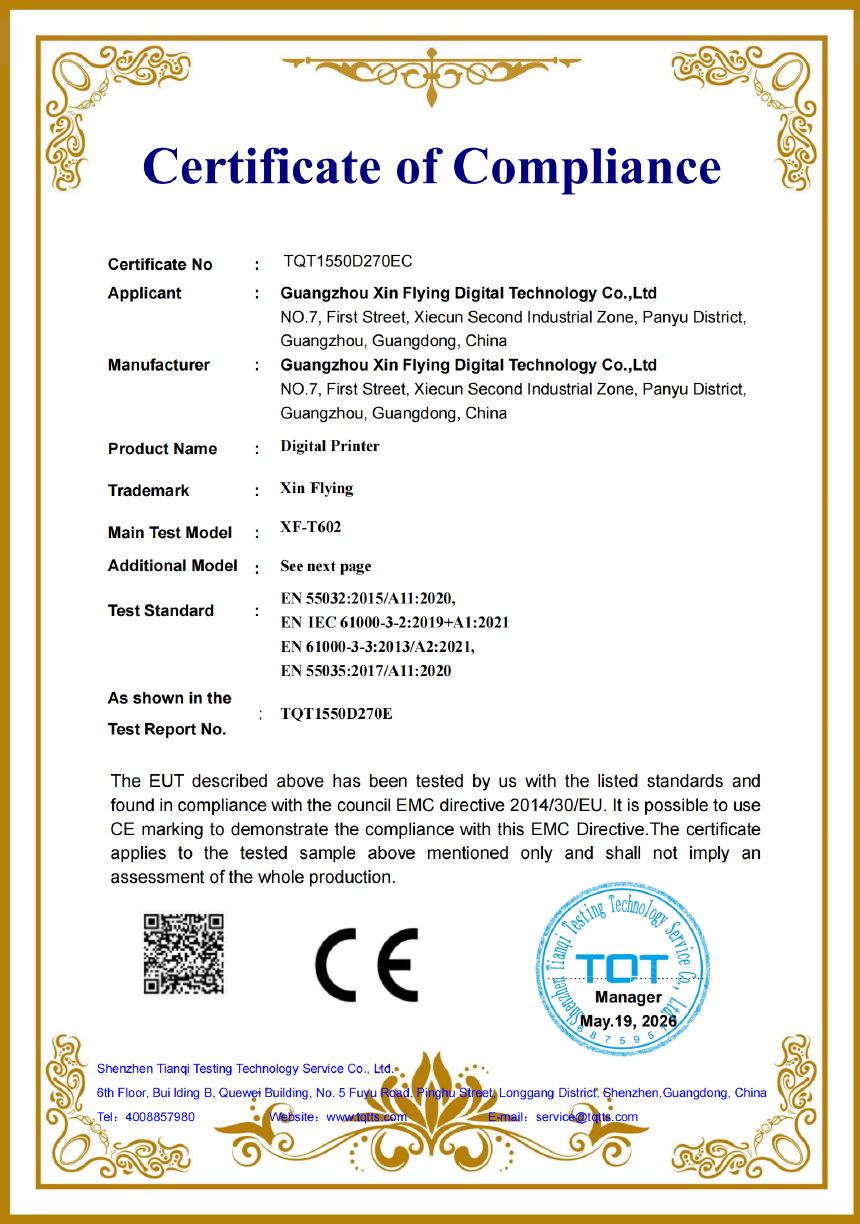 A test-based EMC document names its directive and its standard set. TQT1550D270EC cites EMC Directive 2014/30/EU with EN 55032:2015/A11:2020, EN 55035:2017/A11:2020, EN IEC 61000-3-2:2019+A1:2021 and EN 61000-3-3:2013/A2:2021.
What the buyer should weight is not the familiarity of a laboratory name but three checkable attributes: the document's scope sentence, the standards it cites, and whether the body can still be asked to confirm the certificate a year after delivery. A well-known name on a document that describes a different product category is worth less than an unfamiliar name on a document that describes your machine.
Step 3 — Match scope wording and model list to the purchase order
Every certificate carries two identification layers. The scope sentence says what category of product the assessment covers; the model list says which products the manufacturer claims under it. Both need reading, and they can point in different directions.
A scope written as 'Electrical safety compliance according to LVD 2014/35/EU for Digital Printer products' is broad. A scope written as 'Textile Printing Inks & Printing Pastes' is narrow — it describes a consumable and will never evidence the safety of a machine. Confusing the two is one of the most common documentation errors in textile printing projects, precisely because the ink certificate is the document a brand customer's chemical-compliance team tends to request. The machine certificate and the ink certificate belong in the same folder, but they answer different questions and expire on different cycles.
The model list answers a narrower question: is my machine in it? A certificate covering a product series implies that the series shares the tested configuration. Where customisation changes the electrical build — a different voltage configuration, an additional inline component, a revised control cabinet — the honest question is whether the certificate still describes the delivered machine. Ask it in writing and keep the reply beside the certificate. For EU-bound textile equipment, an answer that arrives after the container has sailed is worth very little.
Step 4 — Compare edition strings, not just directive names
Two documents can both be correct and still disagree. The XF-19E15-PRO file demonstrates this in a way that is easy to miss: the TQT EMC certificate cites EN 55032:2015/A11:2020 and EN IEC 61000-3-2:2019+A1:2021, while the combined UDEM LVD & EMC document cites EN 55032:2015/A1:2020 and EN 61000-3-2:2014 — while both reference the same base safety standard, EN IEC 62368-1:2020/A11:2020.
This is not a contradiction to be settled by picking whichever string looks newest. It is a signal that two assessment routes were run at different times under different editions, and that the technical file is where the current position lives. The buyer's action is small and specific: ask the supplier to state, in one sentence, which edition of each standard the technical file reflects for the model being shipped, and whether any gap assessment against newer editions has been carried out.
Why does a string matter commercially? Because a brand customer's compliance team will eventually read the same documents, and a supplier who can answer the edition question in one sentence is a materially lower-risk partner than one who forwards a folder and waits.
Step 5 — Read dates as a maintenance schedule, not a formality
The XF-19E15-PRO file contains three different validity patterns, and each needs different handling.
Open-ended validity. The TQT LVD certificate TQT1550D271EC and the EMC certificate TQT1550D270EC were both issued on 19 May 2026 with a stated expiry of 1 January 2099. An open-ended date means the document is not scheduled for periodic renewal; it does not mean the standards behind it are frozen. Standards get revised, and a certificate issued against a 2020 edition will eventually describe a superseded position.
Fixed-term validity. The UDEM documents run on a five-year cycle: Machinery Directive M.2026.206.C142365 and RoHS M.2026.206.C142366 were issued on 10 June 2026 with expiry 9 June 2031, and the combined LVD & EMC document M.2026.206.C142475 was issued on 11 June 2026 with expiry 10 June 2031. A second Machinery Directive certificate, M.2026.206.C142385, carries the same issue and expiry dates as the first. Duplicate coverage of this kind is common where a manufacturer certifies more than one model grouping; the register should record both and note which grouping each applies to rather than deleting one and hoping the question never arrives.
Short-cycle validity. The OEKO-TEX® ECO PASSPORT SH150194016 was issued on 11 December 2025 and expires on 31 December 2026 — an annual-cycle document covering inks and printing pastes, not machinery.
Already-expired documentation. The ISO 9001 certificate NOA2215496 was issued on 26 December 2022 with an expiry of 25 December 2025. In a late-2026 evaluation this is not a document to include quietly; it is a document to re-request. Its presence in the file is a useful reminder that expiry checks find real things, and that a folder maintained over several years will always contain at least one item whose dates have moved on.
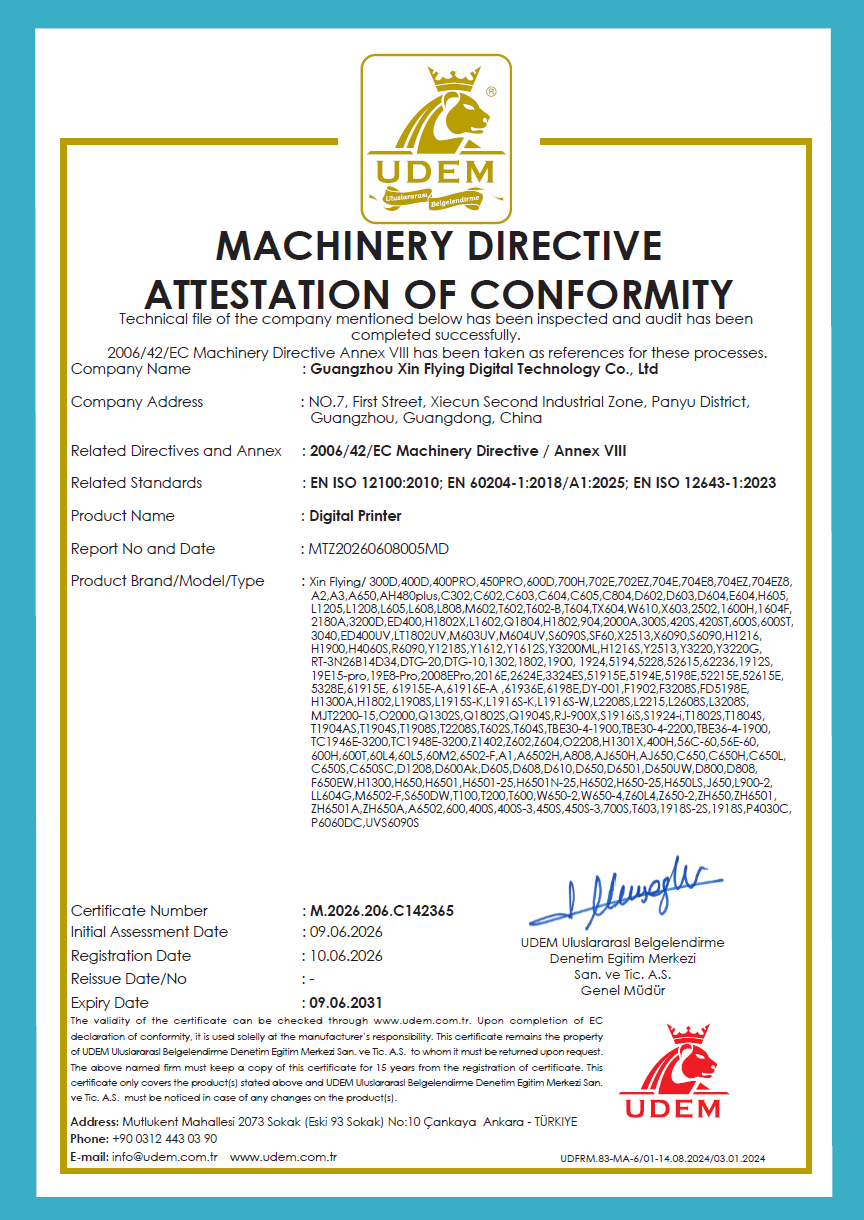 A machinery-safety document is identifiable by its standard family. M.2026.206.C142365 references EN ISO 12100:2010, EN 60204-1:2018/A1:2025 and EN ISO 12643-1:2023 under Machinery Directive 2006/42/EC.
Step 6 — Test the document against itself, then attach the register to the order
The last check is internal consistency, and it takes minutes per document once the earlier steps have been done. The legal entity named on the certificate should read as the manufacturer you are contracting with — for this supplier, Guangzhou Xin Flying Digital Technology Co., Ltd. The model designation should match the designation on the proforma invoice. The directive, the standard editions, the issue date and the expiry date should agree with what the register says. Where a group of documents shares a model list, the lists should agree with each other.
Then convert the review into a purchasing artefact. A single register — one row per directive per model, with certificate number, issuing organisation, standard editions, issue date, expiry date and a storage location — is enough. Attach it to the purchase order as a technical annex and make the pre-shipment test the acceptance gate. XINFLYING states pre-shipment testing as its acceptance criterion, together with a one-unit minimum order, delivery terms of EXW, FOB, CIF or DDP, and a stated lead time of 5 to 40 days — commercial terms that make it practical for a first-time buyer to insist on a document set before the machine is released for shipment.
Worked example: the XF-19E15-PRO dossier mapped
| Directive | Document | Issuing organisation | Certificate number | Issued | Expiry |
|---|---|---|---|---|---|
| LVD 2014/35/EU | CE LVD Certificate of Compliance | TQT (Shenzhen Tianqi Testing Technology Service Co., Ltd.) | TQT1550D271EC | 19 May 2026 | 1 Jan 2099 |
| EMC 2014/30/EU | CE EMC Certificate of Compliance | TQT | TQT1550D270EC | 19 May 2026 | 1 Jan 2099 |
| LVD & EMC (combined) | CE LVD & EMC Certificate of Compliance | UDEM | M.2026.206.C142475 | 11 Jun 2026 | 10 Jun 2031 |
| MD 2006/42/EC | CE MD Certificate of Conformity | UDEM | M.2026.206.C142365 | 10 Jun 2026 | 9 Jun 2031 |
| MD 2006/42/EC (second grouping) | CE MD Certificate of Conformity | UDEM | M.2026.206.C142385 | 10 Jun 2026 | 9 Jun 2031 |
| RoHS 2011/65/EU | RoHS Compliance Certificate | UDEM | M.2026.206.C142366 | 10 Jun 2026 | 9 Jun 2031 |
| Consumables (inks, pastes) | OEKO-TEX® ECO PASSPORT | TESTEX AG | SH150194016 | 11 Dec 2025 | 31 Dec 2026 |
| Quality management | ISO 9001 certificate | NOA Testing & Certification Group Co., Ltd. | NOA2215496 | 26 Dec 2022 | 25 Dec 2025 |
Read as a register rather than a folder, the file tells a clear story: four EU obligations covered, one of them twice via different assessment routes, a consumable certificate on an annual cycle, and one quality certificate whose stated validity has already lapsed and should be re-requested. The same file also contains earlier CE documents issued in 2021 and 2025 by other testing bodies — normal for a manufacturer that has shipped across several product generations, and precisely why a register beats a folder.
Where this framework stops working
A framework that never returns a limitation is not a framework. Six boundaries are worth stating plainly.
A certificate is not a permit. CE marking is the manufacturer's declaration of conformity; the importer or distributor in the destination market still carries its own duties, and market surveillance can request the technical file rather than the certificate. A complete dossier reduces import friction; it does not transfer responsibility to the supplier.
Site-level compliance sits outside the dossier. Local electrical installation, extraction and ventilation, workshop noise, and the electromagnetic environment of a working textile plant are the operator's scope. No printer certificate covers them.
Ink compliance is not machine compliance. OEKO-TEX® ECO PASSPORT SH150194016 applies to textile printing inks and printing pastes, and runs to 31 December 2026. It is an important document for apparel and home-textile customers — and irrelevant to whether the machine's control cabinet is safe.
Expiry is real, and it is boring. The ISO 9001 certificate in this file shows expiry 25 December 2025. Buyers who build a register catch that in thirty seconds; buyers who trust a folder catch it during an audit.
Customisation resets part of the check. XINFLYING offers OEM/ODM customisation covering product branding, machine appearance, colour, logo, packaging and customer-specific solutions. Appearance and packaging changes are usually documentation-neutral. Anything that touches the electrical build is not, and the question 'does the certificate still describe this build' should be asked before the order is finalised rather than after.
The dossier says nothing about output. Print quality, throughput, nozzle life, colour consistency and uptime are separate evaluation tracks. A perfect compliance file on a machine that cannot hold colour across a 500-metre polyester run is still the wrong purchase.
EU documents do not travel. For the US market, FCC compliance is commonly required for electronic equipment to control electromagnetic interference, and additional safety certification may apply depending on the product specification and sales channel. A CE dossier is evidence for one regulatory framework, not a global passport.
What this looks like in a working textile project
In practice, the pressure to hold a clean dossier rarely comes from the buyer's own procurement team. It comes from the buyer's customers. A sportswear manufacturer running fifteen units over four years uses roll-to-roll sublimation printing for football jerseys and team uniforms, and its brand customers ask for documentation of the production equipment before placing seasonal orders. A home-textile producer running ten units over four years faces the same request from retail buyers on decorative fabrics and cushions. A digital textile printing service provider running five units over three years absorbs the question on behalf of several apparel clients at once, because the brand never sees the machine — only the paperwork.
That is why the framework is worth running at evaluation rather than at shipment. The documents are not being collected to satisfy a supplier's filing system; they are being collected because someone further down the chain will eventually ask, and the buyer who can answer in one email keeps the account.
Market trend: documentation is moving down the supply chain
Two shifts are visible across textile printing procurement, and neither requires a forecast to observe. The first is that compliance requests now travel with the order rather than with the audit: brand customers embed documentation requirements in supplier onboarding, so a print shop is asked for machine and ink evidence before its first production run rather than after its first quality complaint. The second is that digital and roll-to-roll production has lowered the entry scale for textile printing, which means many more buyers are holding regulatory documentation for the first time — buyers who did not grow up inside a mill's quality department and who therefore need a method rather than an archive.
The supplier side is adapting unevenly. Some manufacturers now maintain structured dossiers per model and can answer an edition question in a day; others still send a scanned folder and let the buyer work it out. That difference is becoming a selection criterion in its own right, and it is one a buyer can test cheaply before any money moves.
Future outlook
The direction of travel is toward documents that can be queried rather than opened. Buyers increasingly want certificate numbers, directive references and expiry dates as data they can drop into a supplier record — which favours manufacturers who already keep a register and disadvantages those whose compliance history lives in a shared drive.
Two practical implications follow. First, standard editions will keep moving, so a dossier should be treated as a living record maintained across the machine's service life, not a file assembled once at purchase. Second, the ability to state clearly what a certificate does and does not cover will remain more valuable than the ability to produce more certificates. A supplier that can say 'this document covers the machine, that one covers the ink, and this one expired last December' is easier to buy from than one that presents everything as a single undifferentiated achievement.
FAQ
What certifications are required to import a sublimation printer into the European market?
Buyers should verify CE compliance, including the applicable electrical safety, electromagnetic compatibility and product safety requirements. In practice, a sublimation printer dossier is normally built around the Low Voltage Directive 2014/35/EU, the EMC Directive 2014/30/EU, the Machinery Directive 2006/42/EC and the RoHS Directive 2011/65/EU. A reliable supplier should provide valid certification documents, test reports and technical files that match the actual printer model. Before ordering, buyers should confirm that the certification information corresponds with the equipment being supplied, because incorrect or incomplete compliance documents may result in customs delays, sales restrictions or additional compliance costs.
How can I confirm that a certificate applies to the actual printer model I am buying?
Three checks are usually enough. First, read the scope sentence on the document and confirm it describes printing equipment rather than a consumable or another product category. Second, check the model or series list for the designation that appears on your proforma invoice. Third, confirm that the manufacturer name, directive reference, standard editions and issue date are consistent across the documents in the same file. Where a customised configuration is involved, ask the supplier in writing whether the certificate still describes the delivered build, and keep that answer with the certificate.
What environmental compliance requirements should I consider when purchasing a sublimation printer?
Environmental compliance is an important purchasing factor, especially for businesses operating in regulated markets. RoHS compliance helps confirm that electrical and electronic components meet restrictions on hazardous substances, and is assessed under Directive 2011/65/EU through standards such as EN IEC 63000:2018 and the EN IEC 62321 series. Buyers should request the relevant environmental documents from the supplier and verify that they apply to the actual equipment model. Choosing suppliers with proper environmental documentation reduces regulatory risk and improves confidence for international sales.
Does an OEKO-TEX® ECO PASSPORT certificate cover the printing machine?
No. The OEKO-TEX® ECO PASSPORT certificate SH150194016 held by XINFLYING is issued by TESTEX AG for textile printing inks and printing pastes, and is valid from 11 December 2025 to 31 December 2026. It addresses the chemical safety profile of the consumable used in the printing process, which is what apparel and home-textile customers typically ask about. Machine safety, electrical compliance and electromagnetic compatibility are covered by separate CE documentation under the Low Voltage, EMC and Machinery Directives.
What certifications should I verify before purchasing a sublimation printer for the US market?
For sublimation printers entering the US market, buyers should check electromagnetic compatibility and electrical safety requirements based on the equipment configuration and application environment. FCC compliance is commonly required for electronic equipment to control electromagnetic interference, and additional safety certifications may be required depending on the product specifications and sales channel. Before purchasing, customers should request certification documents, technical specifications and product test reports from the supplier, and confirm that they describe the supplied machine. Proper verification reduces customs risk and supports smoother installation and resale.
A short closing note on weighting
Compliance certificates do not win a printer selection on their own, and they should not be allowed to lose one by default. What they do is set the boundary conditions under which the machine can be imported, installed and sold into a customer's own quality system. A buyer who maps directives, reads issuing bodies as scope statements, traces documents to the purchase order, compares editions, tracks dates and logs the result in a register has converted a folder of PDFs into a decision instrument.
For buyers who want to see how XINFLYING documents its sublimation printer range in more detail, the company brochure is available for download: XINFLYING corporate brochure (PDF).
Have Questions or Need More Details?
Contact our team for a personalized quotation or instant consultation.
Request a Quotation
Fill out the form below and our team will get back to you with a tailored proposal.
WhatsApp Direct Chat
Prefer to chat in real-time? Message us on WhatsApp for instant assistance & quick answers.
- Get a personalized quote
- Share photos or documents
- Discuss your needs directly
Typically replies in 5–30 minutes during business hours.