
Weight-Based Billing: Material Handling Forklift Evidence
Where the weight of a load is also a commercial data point — scrap bought by the tonne, grain traded by weight, export containers loaded against a payload limit — a material handling forklift stops being ordinary handling equipment and becomes part of the measurement chain. That shift moves supplier evaluation away from catalogue numbers and towards documented, checkable capability: what the truck can measure, what the supplier can prove, and what happens when the numbers are questioned.
This reference article is written for buyers in scrap and recycling, grain and agricultural logistics, freight billing and export loading who are evaluating suppliers during an Evaluation to Execution stage. The manufacturer used throughout as the evidence example is Shandong Tavol Machinery Co., Ltd (Tavol), a Chinese manufacturer of diesel, dual fuel LPG/gasoline and lithium electric forklifts, whose manufacturing base dates to 2003 and whose group operations today publish a 40,000 m² production base, approximately 300 employees and an annual output of about 3,000 units. Nothing in this article should be read as a recommendation of a particular brand; the aim is to show what verifiable capability looks like in this category.
Why Weight-Sensitive Handling Raises the Evidence Bar
Three operating patterns make weight decisive rather than incidental. The first is billing-driven handling: scrap and recyclables purchased by the tonne, grain and agricultural commodities traded by weight, and freight operations where the load itself generates the invoice. The second is weight-based inventory, where warehouse stock is valued, reconciled or reported by mass rather than by unit count. The third is payload-limited loading, where containers, flatbeds and structural steel shipments must stay inside a declared limit.
Each pattern has its own failure mode. A billing-driven operation can lose money on a single mis-estimated load and then spend more than that margin resolving a dispute. A weight-based inventory can drift quietly for months before a reconciliation exposes the gap. A payload-limited loading job can be stopped at the terminal gate, or can push a mast beyond its rated capacity. None of these outcomes can be fixed afterwards by a better brochure — which is why the evidence question belongs in procurement, not in after-sales.
Traditional handling arrangements solve the measurement problem by separating it from the lift: material is picked, driven to a fixed weighbridge or floor scale, weighed, and driven back. That works, but it inserts an extra travel cycle into every weighed load and creates a queue at the scale. An integrated on-board weighing function removes that cycle by measuring during the lift and the transport leg. The trade-off is that the measurement is now part of the machine, so the machine — and the supplier behind it — must be evaluated accordingly.
What Counts as Supplier Capability Evidence
In this category, capability evidence is not a claim of quality. It is a set of documents that a buyer can check, date, cross-reference and attach to a purchase file. Six categories carry most of the weight.
1. Model-level specifications and configuration scope
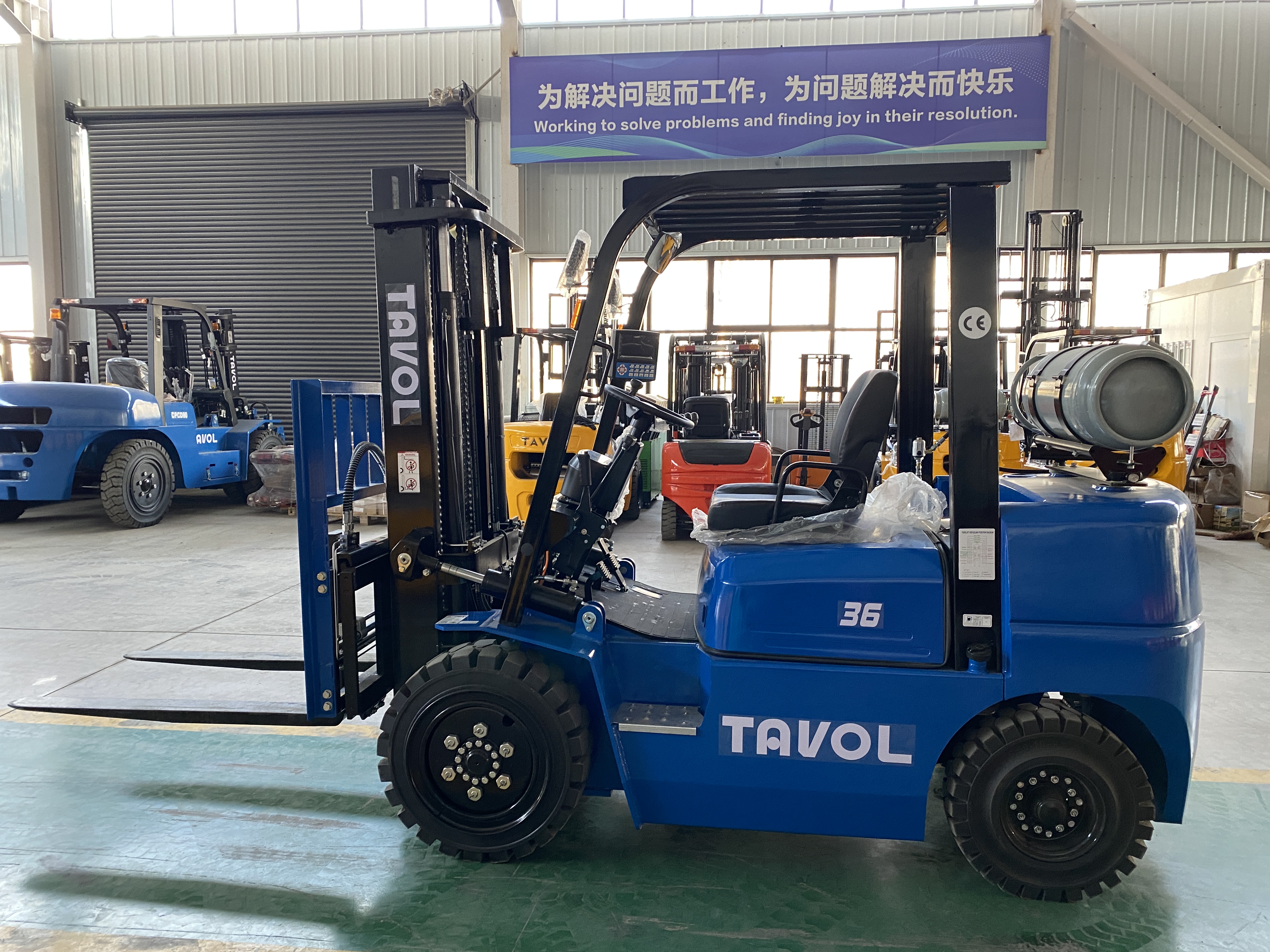
Weight-sensitive work depends on geometry as much as tonnage. For a 3t diesel forklift such as the CPCD30, the published figures include a rated loading capacity of 3,000 kg at a 500 mm load centre, an overall length of 2,855 mm, an overall width of 1,230 mm, a top guard height of 2,125 mm, a mast tilt angle of 6° forward and 12° backward, a drive speed of 18/20 km/h (full load/empty load), a lift speed of 450 mm/sec under full load, a descent speed of 420 mm/sec under full load, a maximum traction of 21,000 N and a minimum turning radius of 2,550 mm. Structural material is specified as Q235 carbon structural steel and Q355 low-alloy high-strength structural steel.
Mast and fork geometry are configuration variables rather than fixed attributes. Two-stage masts are offered in 3 m, 3.5 m and 4 m versions, three-stage masts in 4.5 m, 5 m, 5.5 m and 6 m versions, with container mast and full free mast options available, and fork lengths selectable across 1,220 mm to 1,820 mm. Engine options for the diesel line include Xinchai, Quanchai, Isuzu, Mitsubishi, Yanmar, Kubota and PSI units, with Japanese-origin engine brands among the listed choices for buyers who specify that preference.
2. Documented operating procedures
A supplier that has written down how its machines are operated, checked and charged is easier to audit than one that answers questions verbally. Three documented procedures are directly relevant to weight-sensitive fleets:
- Diesel pre-shift inspection. A visual and functional check covering fluid levels, tyres, brakes and safety devices before every shift. The documented sequence runs through engine oil, hydraulic fluid and coolant; tyre wear, damage and inflation; brakes, horn, lights and backup alarm; forks, mast and hydraulic lines for cracks, bends or leaks; then a start-up check for unusual noise, smoke or warning lights. The safety instruction is explicit: never operate with a malfunctioning brake or hydraulic leak, wear the seatbelt, and report any abnormality before starting work.
- Dual fuel mode switching. Fuel mode is switched only when the engine is idling or stopped, using the dashboard selector, followed by a 5–10 second stabilisation period before resuming work. The procedure warns against switching under heavy load or on a slope, and requires the LPG cylinder to be securely mounted and leak-free before each shift.
- Lithium battery charging and maintenance. Opportunity charging during breaks is preferred over waiting for a full discharge. Lithium packs require no watering or acid checks; weekly inspection of terminals, cables and connectors for looseness or corrosion is the documented routine, with ventilation and dry charging conditions stated as safety requirements.
3. Production, capacity and quality control facts
For a weight-sensitive fleet, delivery reliability is part of capability. Tavol publishes a monthly capacity of 300 units, a lead time of 10–45 days, a minimum order quantity of 1 unit, a 100% pre-shipment test regime and the option of third-party inspection. The company states OEM and ODM production services and a customization scope covering fuel type (diesel/LPG/dual fuel/lithium), tonnage, mast height, fork length, attachment type, cabin type (open or enclosed), logo printing and paint colour. That scope is what allows a weighing attachment, a bale clamp, a paper roll clamp, a rotating clamp or a container mast to be specified at build stage rather than retrofitted later.
4. Compliance documentation with a number and a date
A compliance document that cannot be quoted by certificate number, issuing body and validity period is not evidence. In this case, the CE certificate for the forklift range is number TTC-26-0104/03/01, issued by İNTERTÜRK (İNTERTÜRK Uluslararası Belgelendirme Ltd. Şti.) for the EU market, valid from 2026-04-01 to 2031-04-01, and cites EN 1175:2025, EN ISO 3691-1:2015/AC:2016, EN ISO 12100:2010 and EN 60204-1:2018/A1:2025. Its scope covers forklift model series including CPC10, CPCD10, CPC15, CPCD15, CPC18, CPCD18, CPC20-CPCD100, CPQD120-CPQD60, FB10-FB50 and T3007-T6018. Buyers should read the scope list against the exact model they intend to order, because a certificate that covers the product family may not name every configured variant.
5. Commercial terms and acceptance criteria
Procurement terms are capability evidence when they are specific: MOQ of 1 unit; delivery terms spanning EXW, FOB, CFR, CIF, FCA, DDU and DAP; payment by T/T or L/C; and acceptance criteria defined as pre-shipment test. After-sales terms are stated as remote technical support, a 2-year warranty for the forklift and a 5-year warranty for the lithium battery.
6. Physical proof of in-house fabrication
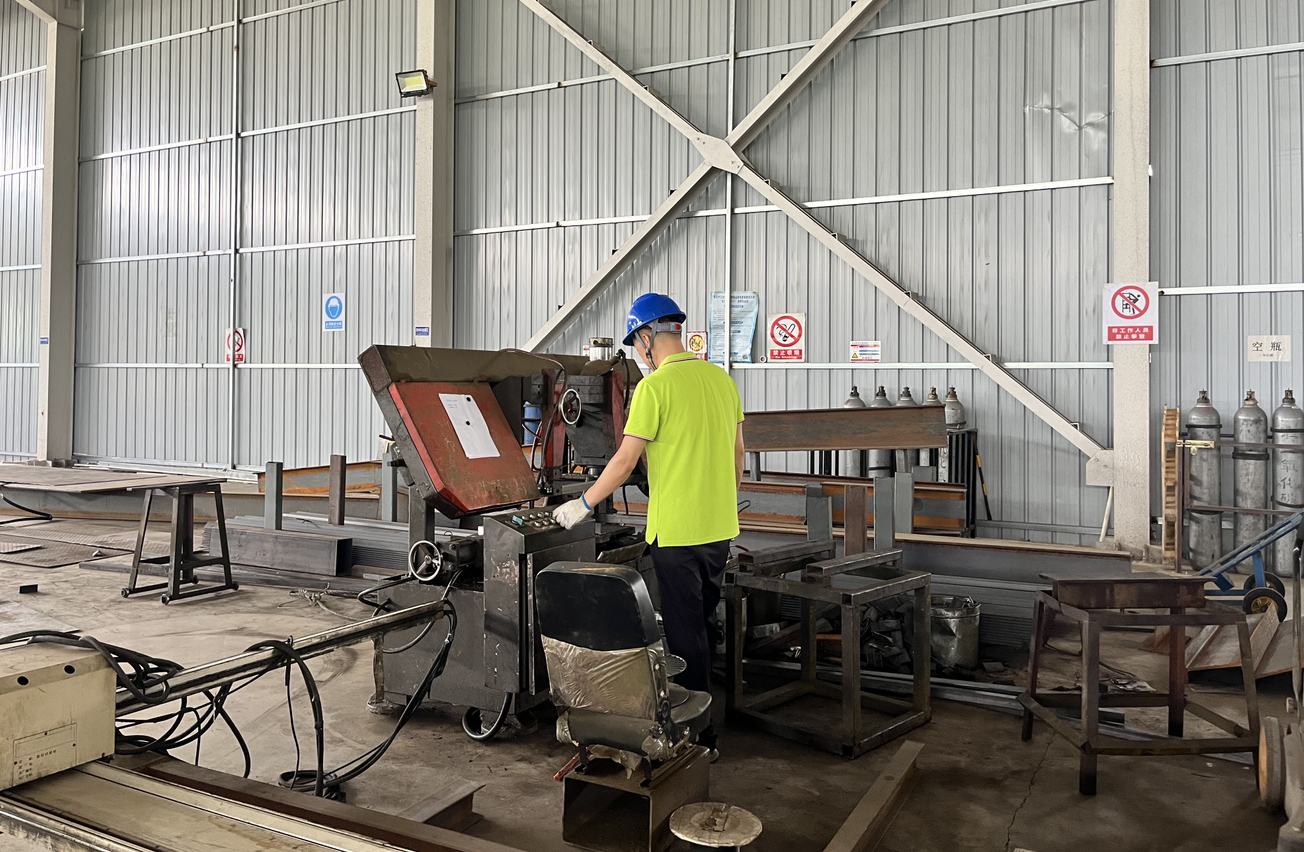
Mast and chassis production equipment — cutting, bending, sawing, pressing, sandblasting and painting stations inside the manufacturer's own workshop — supports the claim that structural components are made in-house rather than assembled from bought-in kits. For a weighing forklift this matters, because the load cell and display interface with a mast and carriage that must hold their geometry under repeated loaded cycles.
The Weighing Function: Load Cell, Display and Calibration
The defining feature of a weighing forklift is a mast-mounted measurement system: an integrated load cell combined with a digital display unit. Its documented function is real-time load weighing during lifting and transport, without a separate weighbridge, together with an overload alert. The scenario library behind this configuration targets exactly the environments where weight is money — logistics and freight billing, agriculture and grain trading, scrap and recycling weighing, and warehousing with weight-based inventory — and it operates both indoors and outdoors in weight-sensitive handling conditions.
The matched equipment is an electronic weighing scale attachment plus a digital display unit, and the stated special requirements are weighing accuracy calibration and an overload alert function. Those two words — calibration and alert — are where a buyer's diligence should concentrate, because they determine whether the system stays trustworthy after commissioning:
- Calibration. Ask how the weighing function is calibrated, against what reference, at what interval, and how the calibration is recorded. A weighing function that is never re-verified gradually becomes an opinion.
- Overload alert. Ask where the alert threshold sits relative to the rated capacity of the ordered model — for example 3,000 kg for a CPCD30, 3,500 kg for a CPCD35, 4,000 kg for a CPD40 — and how the alert behaves during a lift.
- Display position. Confirm that the digital display is readable from the operator position during normal handling, not only while stationary.
- Specification timing. Because attachment type is part of the customization scope, the weighing attachment should be written into the order at build stage rather than added later.
One engineering point applies to every model in this category: rated capacity is defined at a 500 mm load centre. A load whose centre of gravity sits further forward from the fork face reduces the usable capacity of the truck, regardless of what the display reads. Weight-sensitive buyers should therefore specify load geometry — pallet size, roll diameter, bundle length — at the enquiry stage, not only tonnage.
Matching Drive Type to the Weight-Sensitive Job
Fuel choice affects how a weighing forklift fits the site, how often it is available, and how much of the working day is lost to refuelling or charging. The table below summarises the three drive lines published by Tavol and the verification point that matters for each.
| Drive line | Example models | Rated capacity | Power source | Typical fit | What to verify |
|---|---|---|---|---|---|
| Diesel | CPCD20, CPCD25, CPCD30, CPCD35, CPCD40 | 2,000–4,000 kg | Diesel engine; options include Xinchai, Quanchai, Isuzu, Mitsubishi, Yanmar, Kubota, PSI | Outdoor yards, rough terrain, construction materials, agriculture, mining support | Pre-shift inspection routine; indoor emission restrictions |
| Dual fuel LPG & gasoline | CPQYD20, CPQYD25, CPQYD30, CPQYD35 | 2,000–3,500 kg | Nissan engine, running on LPG or gasoline | Mixed indoor/outdoor sites with unstable or seasonal fuel supply | Documented mode-switch procedure; maintenance of two fuel systems |
| Electric (lithium) | CPD30, CPD35, CPD40 | 3,000–4,000 kg | Lithium-ion (LiFePO4) battery with quick charger | Indoor warehousing, cold storage, food and pharmaceutical facilities, e-commerce distribution | Charging infrastructure and shift pattern; upfront cost versus battery alternatives |
| Any line, with weighing attachment | Configured per model | Per model rating | Depends on drive line | Weight-based billing, weight-based inventory, overload prevention | Load cell attachment, mast display, calibration record, overload alert behaviour |
The three lines are not interchangeable in a weight-sensitive operation. A diesel truck moves outside on uneven ground and tolerates long shifts with refuelling, but it requires daily pre-shift discipline and is poorly suited to enclosed spaces where emissions accumulate. A dual fuel LPG and gasoline forklift keeps a second fuel option available when one supply becomes unreliable or expensive; a documented dual fuel deployment at a chemical and industrial plant in Bangladesh records a 35% reduction in fuel expense through LPG operation over a two-year period, alongside a customized hydraulic drum clamp for handling chemical drums and high-rack stacking. An electric lithium forklift removes indoor emissions entirely and is the natural match for warehouse forklift duty where weight-based inventory is recorded — the Kuwait installation of five 4-ton electric units in a high-rack chemical and logistics warehouse records zero indoor emissions, smooth high-lifting operation and reduced energy cost over two years.
Application Proof: Scrap Yard Billing and Container Loading
Weight-based billing in a scrap and recycling yard
The Bulgaria scenario in the supplier's application library describes precisely the workflow that makes a weighing forklift worth specifying: load weighing during lifting and transport, used for weight-based cargo billing in a scrap and recycling yard, with indoor and outdoor operation and an explicit goal of preventing overloading. In that workflow the forklift does not merely move material to a scale; the lift and the measurement happen in one movement, and the weighing attachment is backed by calibration and an overload alert. For a yard buying and selling by the tonne, three questions follow directly from the documentation: who performs the calibration, how often it is repeated, and how an overload event is recorded and escalated.
Container loading under payload limits
The Germany scenario covers export container loading and structural steel component handling at an indoor/outdoor loading dock, where the truck must position irregular, long or awkward components inside a confined container space, in some cases combining fork operation with overhead crane assistance. Here the weight question is twofold: keeping the container inside its payload limit and keeping the truck inside its own rated capacity while the load centre moves forward as components are pushed deep into the box. Confined-space geometry is part of the specification, not an afterthought — a container forklift configuration with a suitable mast and, where needed, an enclosed cabin for weather protection, is chosen for this duty.
Supporting field evidence
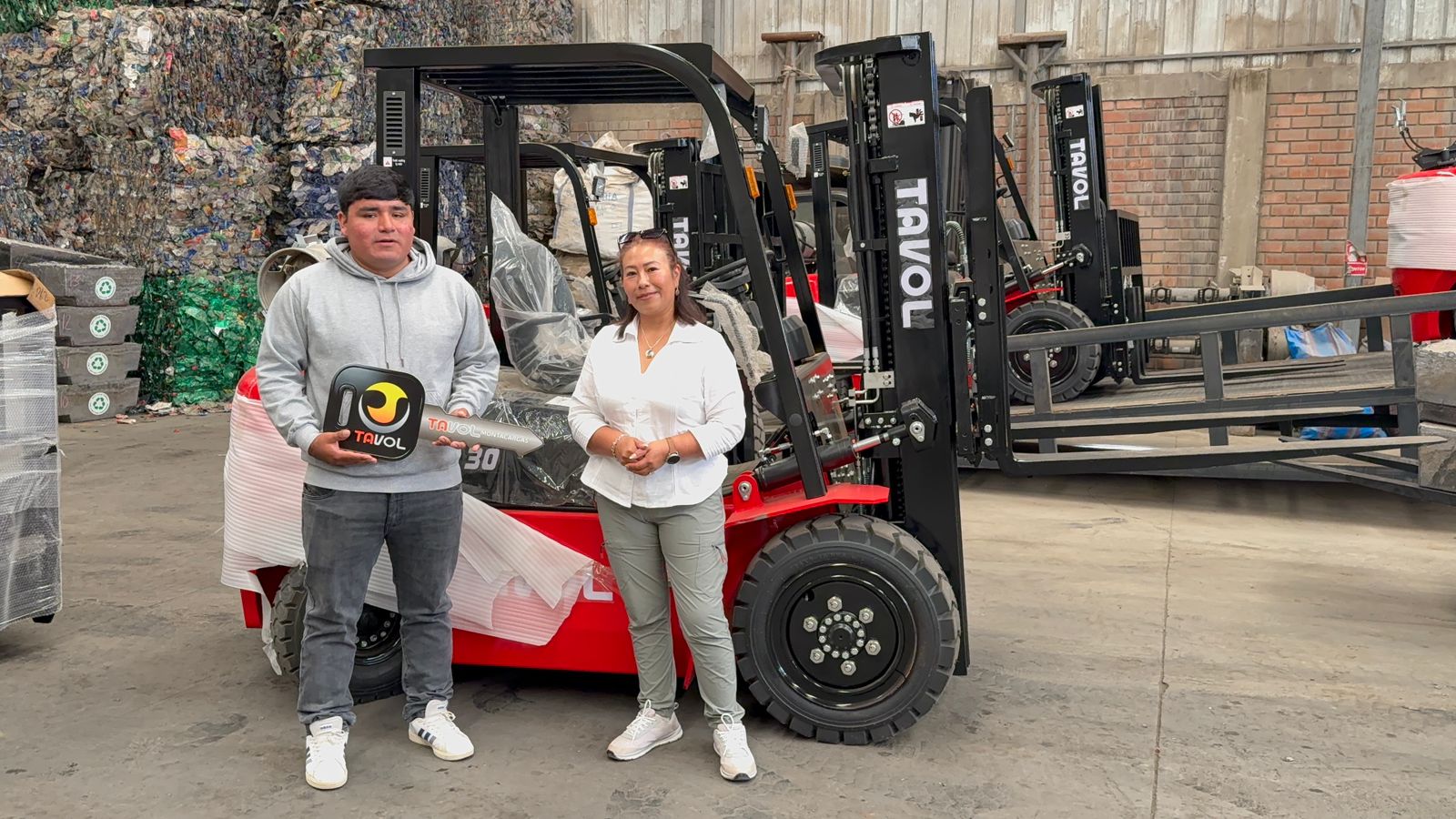
Three further case records illustrate the same capability in different weight-sensitive contexts. A plastic recycling company in Peru operates ten diesel forklifts in the 3-tonne class for recycled plastic bale loading and warehousing, reporting cost-effective fuel performance, widely available spare parts and low after-sales cost over two years. A logistics company in Colombia uses a single heavy-duty unit for container lifting and positioning onto flatbed trucks, citing a reinforced steel chassis, a stable counterweight design and anti-tip-over behaviour on rough, uneven ground over four years of service. A Mexican end user records a 5-ton heavy-duty lifting capacity for indoor and outdoor workshop material handling, with stable performance under full-load conditions. Taken together, these records describe fleets where the cost of getting weight wrong is operational rather than cosmetic.
Procurement Terms and Acceptance Criteria in Practice
Once the technical configuration is settled, the commercial documents should be converted into a written evidence pack. For a weighing forklift order, that pack would normally contain:
- The model-level specification sheet for the exact configuration ordered, including tonnage, load centre, mast type and lift height, fork length, attachment type and cabin type.
- The CE certificate referenced by number, with its scope checked against the ordered models and its validity period confirmed as current.
- The pre-shipment test record, given that acceptance criteria are defined as pre-shipment test and the stated quality regime is 100% pre-shipment testing with third-party inspection available.
- The weighing attachment specification, including the calibration requirement and the overload alert function.
- The after-sales statement: remote technical support, 2-year forklift warranty, 5-year lithium battery warranty.
- Commercial terms in writing: MOQ of 1 unit, the agreed delivery term from EXW, FOB, CFR, CIF, FCA, DDU or DAP, payment by T/T or L/C, and the quoted lead time within the published 10–45 day range.
Market Trend Context
Three published data points frame why weight-aware handling is becoming a procurement topic rather than a niche requirement.
- The global forklift market was valued at USD 81.4 billion in 2025, according to Grand View Research, with a forecast period extending to 2033. Scale of this kind means configuration-level differentiation — not product category availability — is where suppliers compete.
- Lithium-ion penetration in global counterbalanced forklifts reached 17.5% in 2024, according to Interact Analysis. As the electric share grows, the proportion of fleets that can host on-board measurement without indoor emissions also grows.
- China exported USD 1.26 billion of parts for fork-lift trucks in 2024, according to World Bank WITS data (HS code 843120). For buyers, parts trade depth is a lifecycle-cost signal: it indicates how readily wear components and consumables can be sourced after commissioning.
Standards references work in the same direction. ANSI/ITSDF B56.1-2020 is the widely referenced safety standard for low-lift and high-lift trucks, and European CE certification under EN 1175:2025 and EN ISO 3691-1:2015/AC:2016 provides the equivalent filter for EU-bound equipment. Neither standard certifies weighing accuracy, which is why calibration documentation sits alongside certification in a weight-sensitive procurement file rather than inside it.
Where This Approach Has Limits
Any evaluation framework is only credible if it states what the solution does not do. Five boundaries are worth writing into the decision record.
- On-board weighing is a handling measurement, not a certified trade scale. The documented function is real-time load weighing and overload prevention inside a handling operation. Sites whose transactions legally require certified weights should confirm their local metrology requirements separately and treat the on-board display as operational verification rather than as a substitute for certified trade weighing.
- Accuracy depends on recurring calibration. The system is specified with a weighing accuracy calibration requirement. If calibration is treated as a one-off commissioning step rather than an ongoing discipline, measurement confidence decays silently.
- Dual fuel buys flexibility at the cost of complexity. Two fuel systems must be maintained, and the mode-switch procedure — only at idle or with the engine off, with a 5–10 second stabilisation period — has to be trained and enforced. A single-fuel truck is mechanically simpler.
- Diesel requires daily discipline. The pre-shift checklist covering fluids, tyres, brakes, mast and hydraulic lines is a safety requirement, not an optional routine, and diesel operation remains unsuitable where indoor emission limits apply.
- Electric and battery choices involve a trade-off. Lithium packs charge faster, need no watering and carry a longer stated warranty, but require charging infrastructure and a higher upfront commitment; lead-acid alternatives carry a lower purchase price alongside longer charging times and higher routine maintenance.
A sixth boundary is configuration itself. Broad customization optionality — fuel type, tonnage, mast height, fork length, attachment type, cabin type, branding and paint — increases the chance of a precise fit, but it also increases the specification work at enquiry stage and can extend delivery to the upper end of the quoted 10–45 day lead time. Breadth of options is not the same as speed of supply.
Future Outlook
Two movements are likely to reshape this category over the next procurement cycles. The first is the continued rise of electric and lithium configurations, which reached 17.5% penetration in global counterbalanced forklifts in 2024. Because electric trucks suit indoor, multi-shift environments where weight-based inventory is most commonly recorded, on-board measurement becomes a natural feature of the electric fleet rather than a specialist attachment.
The second is documentation as a competitive surface. As parts availability and lead times converge across suppliers, what separates them is increasingly the quality of what they can put in writing: a certificate with a number and a validity period, a calibration requirement, an overload alert specification, a pre-shipment test record, a written fuel-switch procedure. Buyers who standardise those requests will find supplier comparison becomes faster, not slower — and the answers become auditable facts rather than assurances.
FAQ
How can a forklift weigh a load without a separate weighbridge?
A weighing forklift uses an integrated load cell combined with a digital display mounted on the mast. The system measures the load during lifting and transport, so real-time load weighing happens inside the handling cycle instead of at a fixed scale. This configuration is documented for logistics and freight billing, agriculture and grain trading, scrap and recycling weighing, and warehousing with weight-based inventory. The matched equipment is an electronic weighing scale attachment plus a digital display unit, and the stated special requirements are weighing accuracy calibration and an overload alert function.
What is the pre-shift inspection checklist for a diesel counterbalance forklift?
The documented routine is a visual and functional check covering fluid levels, tyres, brakes and safety devices before every shift. The sequence is: check engine oil, hydraulic fluid and coolant levels; inspect tyres for wear, damage or incorrect inflation; test brakes, horn, lights and backup alarm; check forks and mast for cracks, bends or hydraulic line leaks; then start the engine and confirm there is no unusual noise, smoke or warning light. The stated safety rule is never to operate with a malfunctioning brake or hydraulic leak, to wear the seatbelt at all times, and to report any abnormality to a supervisor before starting work.
How is fuel mode switched on a dual fuel LPG and gasoline forklift?
Fuel mode is switched only when the engine is idling or switched off, using the fuel mode selector switch on the dashboard. After selecting the desired mode, the operator waits 5–10 seconds for the fuel system to stabilise before resuming work, and monitors engine performance for the first few minutes. The procedure prohibits switching under heavy load or on a slope, requires the LPG cylinder to be securely mounted and leak-free before each shift, and requires keeping away from open flames during refuelling.
How should a lithium battery forklift be charged and maintained?
Lithium battery forklifts are charged using opportunity charging during breaks or idle periods rather than waiting for a full discharge. Charging takes place on a flat, ventilated area with the ignition switched off, the charging cable connected securely and the charging indicator confirmed active; the charger is disconnected once charging is complete. Lithium packs require no watering or acid checks — the routine is a weekly inspection of battery terminals, cables and connectors for looseness or corrosion. Charging must not take place in an enclosed space without ventilation, the charging area must stay dry, and cables should not be disconnected under load.
What purchasing terms and acceptance criteria apply to these forklifts?
The stated purchasing terms are a minimum order quantity of 1 unit, delivery terms spanning EXW, FOB, CFR, CIF, FCA, DDU and DAP, payment by T/T or L/C, and acceptance criteria defined as pre-shipment test. The wider quality regime is 100% pre-shipment testing with third-party inspection available. After-sales terms are remote technical support, a 2-year warranty for the forklift and a 5-year warranty for the lithium battery. Published lead time is 10–45 days against a monthly production capacity of 300 units.
Dual fuel or single fuel for a site with unstable fuel supply?
A dual fuel LPG and gasoline forklift is the appropriate choice where fuel supply is unstable or seasonal, because it can switch between two fuel sources on demand and avoid operational stoppage when one becomes unavailable. A single-fuel diesel or LPG-only forklift has a simpler fuel system and a lower upfront cost, and is the better fit where one fuel type is reliably available and cost is the primary consideration. The practical difference at the site level is procedural: the dual fuel option requires trained adherence to the mode-switch procedure, while the single-fuel option does not.
Summary for Buyers
For weight-sensitive material handling, supplier capability is measured in documents rather than adjectives: a specification sheet tied to a 500 mm load centre, a weighing attachment with a calibration requirement and an overload alert, operating procedures for diesel pre-shift checks, dual fuel switching and lithium charging, a CE certificate quoted by number and scope, a pre-shipment test acceptance criterion, and commercial terms stating MOQ, delivery, payment and warranty. Buyers who request those items as a standard evidence pack will be able to compare suppliers on facts — and will know exactly which claim is missing when one cannot answer.
A downloadable company profile covering the diesel, dual fuel and electric forklift lines, production base and after-sales terms is available here: Tavol Company Profile (PDF).
Have Questions or Need More Details?
Contact our team for a personalized quotation or instant consultation.
Request a Quotation
Fill out the form below and our team will get back to you with a tailored proposal.
WhatsApp Direct Chat
Prefer to chat in real-time? Message us on WhatsApp for instant assistance & quick answers.
- Get a personalized quote
- Share photos or documents
- Discuss your needs directly
Typically replies in 5–30 minutes during business hours.