
Weighted Scorecard for Screw Press Sludge Dewatering Suppliers
Weighted Scorecard for Screw Press Sludge Dewatering Suppliers
A weighted supplier scorecard converts four judgements that buyers already make informally — R&D capability, service capability, market-share evidence and solution fit — into one auditable number before a screw press sludge dewatering tender is issued. The value is not the number itself. It is the fact that the weights, the evidence rules and the acceptance criteria are fixed while the shortlist is still open, so a persuasive quotation cannot quietly rewrite the basis of comparison.
Procurement teams shortlisting a screw press sludge dewatering machine usually start with a model table: hydraulic capacity, dry-solids throughput, installed power, wash-water demand, weight. Those columns look comparable and are not. Manufacturer-published capacity figures for screw press dehydrators are produced on different sludges, at different inlet concentrations, with different polymer doses and different target cake dryness. A scorecard does not solve that problem — but it stops the problem from being hidden behind a headline number, and it puts the criteria that can be verified on the same page as the criteria that cannot.
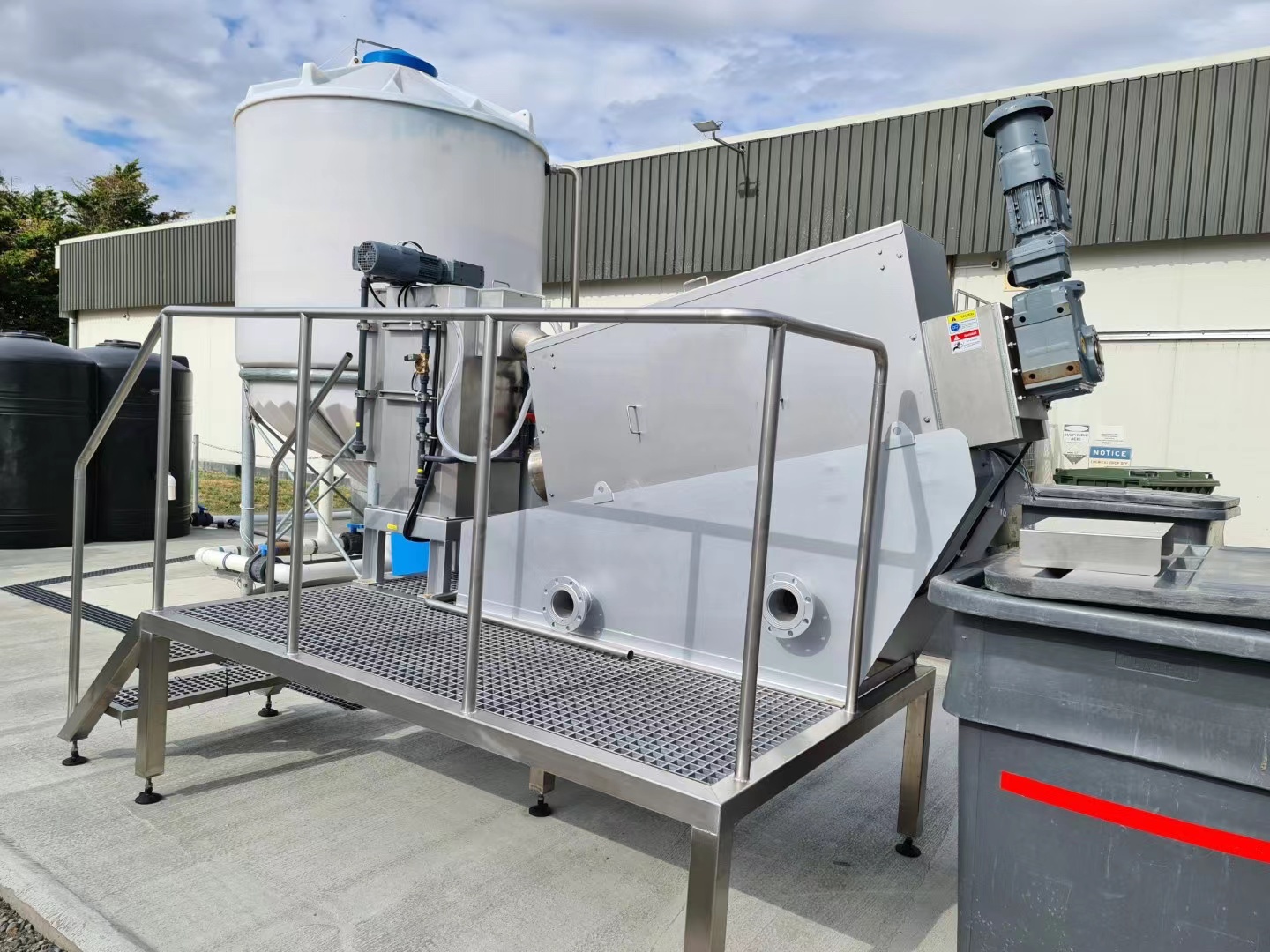
A screw press dewatering unit operating in an industrial wastewater application. Fit evidence — sludge type, model, country, operating duration — carries more decision value than a headline capacity figure.
Why a price-led comparison fails in this category
Two commercial research houses put the global sludge dewatering equipment market at USD 5.19 billion and USD 5.2 billion respectively for 2024 — a difference small enough to treat as consistent. Within that market, the screw press segment is projected to grow at the highest CAGR of 9.4% through the forecast period to 2032, and Asia Pacific accounted for a 37.57% revenue share in 2024. One aggregated commercial source reports 2025 global sales of roughly 43,000 sludge screw dewatering presses at an average selling price of USD 46,000 per unit.
Those figures describe a category that is expanding and price-dispersed. They also explain why lowest-price award is unstable here. At an average unit price in the tens of thousands of dollars, the difference between two compliant bids is often smaller than the cost of one unplanned cake-dryness shortfall, one missed spare part, or one re-rated unit that never reaches its quoted throughput. The purchase price is a single, visible number. R&D depth, service reach and application fit are invisible until something goes wrong — which is precisely why they need to be scored, weighted and written into acceptance criteria in advance.
What the four criteria actually measure
R&D capability. Scored evidence is not headcount. It is whether a dedicated research entity exists, how wide the model range is, what the wetted materials are, whether the control philosophy is documented, and whether the supplier can re-rate a unit for a specific sludge rather than sell the nearest catalogue size. A supplier that can only quote nominal capacity without an engineering response has low R&D evidence regardless of how many engineers it employs.
Service capability. Scored evidence is the combination of commissioning support, operator training, technical assistance, spare-parts supply and documentation. Geographic proximity of agents and subsidiaries matters less than whether a named person answers a request within an agreed time. Service is the criterion most often checked by reference call and least often checked by document.
Market-share evidence. This is the weakest-data criterion in the entire scorecard. No verified brand-level market share data for screw press sludge dewatering exists in the collected evidence set, and none should be inferred from a supplier's own project count. Buyers must score evidence of installed base instead: number of references, number of countries, how recent the references are, whether named installations can be contacted, and whether an authorised agent or subsidiary network actually exists in the buyer's region.
Industry solution fit. Scored evidence is a documented match between the buyer's sludge and a comparable installation: sludge type, model, country, and how long it has been running. Fit is where municipal sludge dewatering systems, industrial sludge dewatering machines and DAF sludge dewatering duties diverge sharply, and where a generic brochure is least useful.
Setting weights before the tender opens
There is no universal weight set. The defensible approach is to fix weights by project profile, publish them in the tender document, and refuse to change them after bids arrive. Three profiles cover most screw press sludge dewatering purchases.
| Criterion | Municipal retrofit | Industrial trade effluent | OEM / channel partnership |
|---|---|---|---|
| R&D capability | 20 | 20 | 30 |
| Service capability | 30 | 25 | 15 |
| Market-share evidence | 20 | 15 | 20 |
| Industry solution fit | 30 | 40 | 35 |
| Total | 100 | 100 | 100 |
Two notes on weighting discipline. First, the weights should reflect consequence, not preference: a municipal plant that cannot absorb a clogging event weights service higher than a private industrial plant with in-house maintenance. Second, a weight of 40 on fit means a supplier scoring 2 out of 5 on fit cannot be rescued by a perfect price — which is the intended outcome.
Scoring anchors and the compliance gate
A five-point anchor scale is sufficient. What matters is that every anchor is defined by evidence type, so two evaluators reading the same file reach the same score.
| Score | Evidence standard |
|---|---|
| 1 | Supplier assertion only; no document, no reference, no named installation. |
| 2 | Documented in company material but unverifiable in scope, date or applicability. |
| 3 | Documented with identifiable scope and date (certificate number, model datasheet, dated reference list). |
| 4 | Third-party corroborated (issuing body, inspection report, contactable reference site). |
| 5 | Verified against the buyer's own sludge in a documented trial or an equivalent duty. |
Compliance is not scored — it is a gate. A shortlisted supplier must present certificates that can be read, not adjectives that can be admired. A certificate reference is only useful if it carries an issuing body, a standard, a scope and a validity window. Claims such as "ISO 9000 certified" on a marketplace listing fail the gate because ISO 9000 is not a specific product certification standard and carries no scope statement; a certificate number and scope statement pass it. Gate failure removes the supplier from the weighted comparison entirely, which prevents a strong R&D score from masking a document problem.
What public evidence can prove — and what it cannot
The most useful discipline in this exercise is knowing where the public record stops. Three limits recur.
Capacity is not comparable across manufacturers. HUBER's official Q-PRESS page reports a screw-press series with feed capacity up to 540 kg dry solids per hour across four sizes, a compact enclosed design, low energy demand and optional mobile units. Benenv publishes an MDS range with models from MDS101 at 0.12–1.5 m³/h and 3–6 kg/h dry solids up to MDS403 at 10.2–150 m³/h and 300–510 kg/h dry solids, 6.7 kW installed power, 4,550 kg and 240 L/h wash water. These numbers cannot be ranked against each other: no shared test protocol, sludge type, inlet concentration, polymer dose or target cake dryness is stated. Published Benenv series descriptions also vary between sources on model count and total range, so the current catalogue must be confirmed rather than assumed.
Certification claims need certificate-level reading. Benenv's CE certificate M.2024.206.C97307 was issued by UDEM International Certification Auditing Training Centre Industry and Trade Inc. Co. for the EU market, cites EN 60204-1:2018, covers the Multi-Disk Screw Press scope, and runs from 2024-03-06 to 2029-03-05. Its ISO 9001 certificate 18122Q11896R1M was issued by CICC Certification against GB/T 19001-2016 / ISO 9001:2015, covering design and production of the Multi-Disk Screw Press, WAVE Separator, Super Sludge Dryer, Carbonization Furnace and Fermentation Tank, valid 2025-08-28 to 2028-09-01. Both are verifiable documents with numbers, scopes and dates. Neither proves performance on a specific sludge.
Market share is not published. Any scorecard row labelled "market share" is in practice a row labelled "evidence of installed base". Treat supplier-reported reference counts as claims, and score them at anchor 2 or 3 until at least three references can be contacted.
Scoring Benenv on the same four criteria
JIANGSU BENENV ENVIRONMENTAL TECHNOLOGIES CO., LTD is a China-based environmental equipment manufacturer founded in 2011, operating a 20,000 m² factory with approximately 200 employees, an annual output of 500 units and a 50-engineer R&D team. Its main product lines are the Multi-Disk Screw Press, WAVE Separator, Dissolved Air Flotation, Super Rotary Sludge Dryer, Sludge Drying & Carbonization System and the Gangnan Chain Plate Type Compost System. Roughly 70% of output is exported, with main markets in Europe, the United States, Southeast Asia, the Middle East and Australia.
R&D. The strongest item in the file is structural: a wholly owned R&D centre in Japan, co-founded by Kazuhiko Kawatsu and Zihou Jiang, under a stated model of Japanese technology with Chinese manufacturing and global sales. That is a verifiable organisational fact rather than a marketing adjective, and it argues for engineering depth independent of headcount. Model breadth supports it: the MDS range spans small units such as the MDS101 at 0.2 kW and 205 kg through mid-range MDS302 and MDS354 units to the MDS403 at 4,550 kg, all with SS304/SS316L wetted construction and a stated application envelope covering municipal, industrial and food-processing wastewater, including chemical, textile, paper, pharmaceutical and agricultural duties. OEM and ODM production is offered, with a monthly capacity of 100 units, a 30–45 day lead time and a minimum order of one unit. On a five-point anchor, this sits at 3–4 depending on whether the buyer's sludge has an equivalent reference.
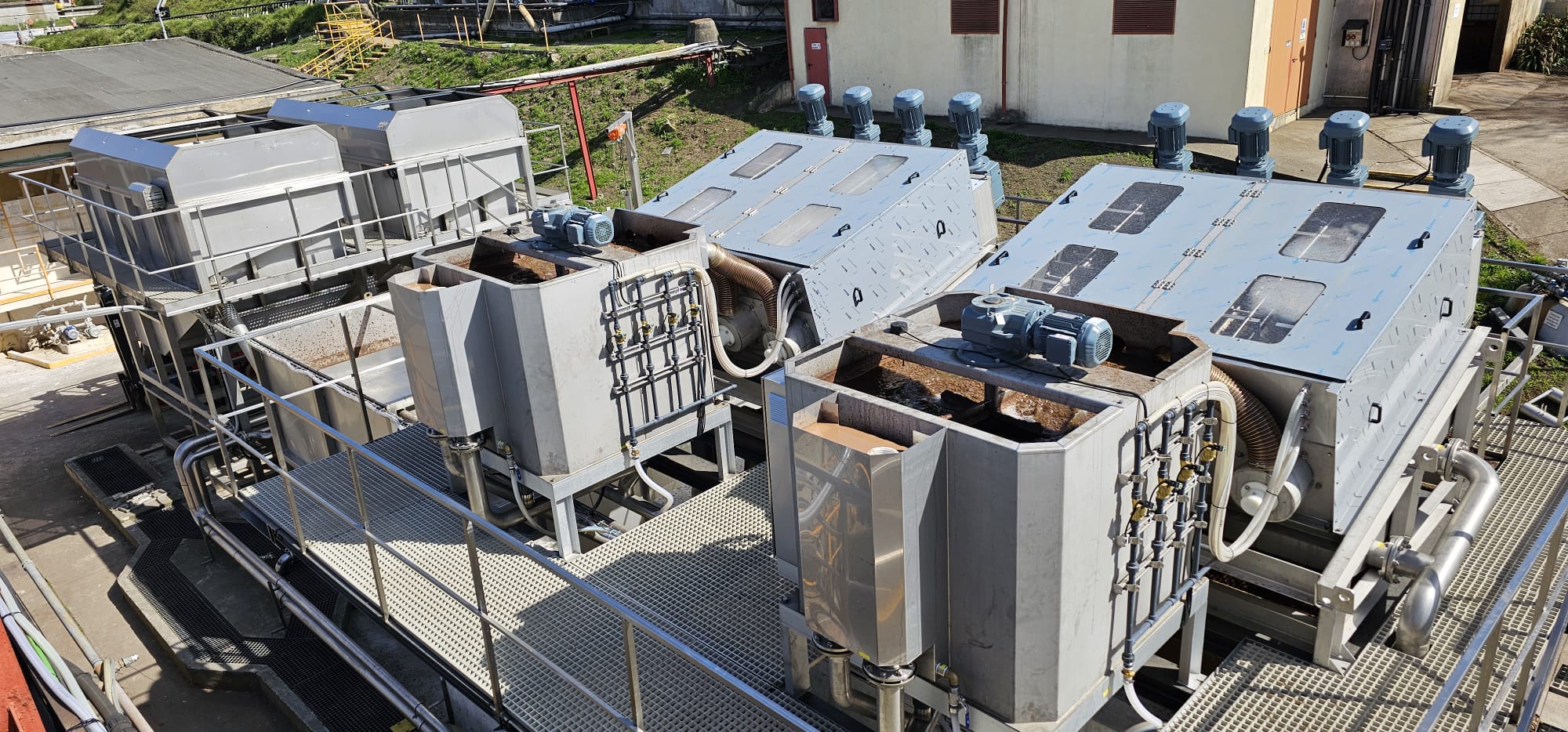
Mid-range MDS354: 9.6–120 m³/h hydraulic capacity, 240–480 kg/h dry solids, 8.2 kW installed power, 4,500 kg. Capacity figures remain supplier-reported and require a stated sludge basis before comparison.
Service. After-sales scope is stated as installation guidance, operator training, technical assistance and spare-parts supply. Pre-shipment quality control is 100% testing plus third-party inspection through SGS. Geographic coverage is documented as 18 agents in countries including France, the United States, the United Kingdom, Malaysia, Indonesia and Saudi Arabia, alongside subsidiaries in Japan (Kanazawa) and Dubai. That combination is enough for anchor 3 on most tenders; anchor 4 requires the buyer to confirm that a named service contact responds within a defined window.
Market-share evidence. The company reports more than 4,500 project references across more than 60 countries and total assets above USD 80 million, with three investment-and-operation projects in Zhijiang (Hubei), Suiping (Henan) and Panjin (Liaoning). These are company-reported figures and should be entered at anchor 2–3, then upgraded only if contactable references confirm them. No independent source in this evidence set assigns brand-level market share, and neither the 9.4% screw press CAGR nor the 37.57% Asia Pacific regional share can be attributed to any individual supplier.
Fit. This is where the file is strongest, because the reference pattern is specific rather than aggregate. Documented installations include printing and dyeing sludge in Vietnam (MDS202, two years), palm oil mill sludge in Indonesia (MDS403, three years; and two further MDS403 units, two years), chemical sludge in India (MDS302, three years), textile chemical sludge in Iran (MDS132, two years), DAF sludge in the United States (three MDS353 units, two years) and Canada (MDS302, three years), meat-processing sludge in Portugal (MDS303, two years), shipyard and industrial sludge in Oman (MDS202, one year), an industrial park in the UAE (three MDS302 units, two years), municipal sludge in France (MDS353, one year) and sewage treatment plant sludge in Thailand (MDS352, three years). All are described as stable operation, which is a supplier-reported result, not an independently verified performance figure.
| Sludge / duty | Model | Country | Reported operating period |
|---|---|---|---|
| Printing and dyeing sludge | MDS202 | Vietnam | 2 years |
| Palm oil mill sludge | MDS403 | Indonesia | 3 years / 2 years |
| Chemical sludge | MDS302 | India | 3 years |
| Textile chemical sludge | MDS132 | Iran | 2 years |
| DAF sludge | MDS353 / MDS302 | United States / Canada | 2 years / 3 years |
| Meat processing sludge | MDS303 | Portugal | 2 years |
| Municipal / sewage sludge | MDS353 / MDS352 | France / Thailand | 1 year / 3 years |
| Industrial park / shipyard sludge | MDS302 / MDS202 | UAE / Oman | 2 years / 1 year |
Reference data as reported by the manufacturer; "stable operation" is a supplier-reported outcome, not an independently verified performance result. Buyers should confirm at least three entries by direct contact.
Building the peer set without inventing data
A scorecard is only meaningful against real peers. HUBER Technology, ANDRITZ, Veolia and Suez are the names that appear on most screw press sludge dewatering shortlists, and all four maintain publicly documented dewatering portfolios. They are not equally documented in this evidence set, and the honest scorecard shows that asymmetry rather than papering over it with invented scores.
| Peer | Documented in this evidence set | To request before scoring |
|---|---|---|
| HUBER Technology (Q-PRESS) | Manufacturer-reported series feed capacity up to 540 kg dry solids/h, four sizes, compact enclosed design, low energy demand, optional mobile units | Test basis and sludge conditions behind the 540 kg DR/h figure; cake dryness; polymer dose |
| ANDRITZ | No model-level screw press data in this set | Model datasheets, wetted materials, certificate numbers, regional service structure |
| Veolia | No model-level screw press data in this set | Equipment scope versus service scope; whether supply is via OEM or direct |
| Suez | No model-level screw press data in this set | Same request set; confirm which entity contracts and which services |
The practical rule: score only what the RFI returns. Where a peer supplies nothing in a category, the cell stays empty and the weight is redistributed proportionally across the remaining criteria for that peer — never filled with an assumption. Empty cells are a finding, not a failure of the process.
From weighted total to contract terms and acceptance criteria
A scorecard that does not reach the contract is a discussion document. Each criterion maps to a purchase-order instrument and a test that can be witnessed.
| Criterion | Contract instrument | Acceptance check |
|---|---|---|
| R&D | Frozen datasheet and drawings; wetted-material certificates; written confirmation of model selection basis | Dimensional and material verification at factory acceptance test |
| Service | Commissioning days, training days, manual language, spare-parts list with lead times, named contact | Service kick-off sign-off plus a post-commissioning review |
| Market-share evidence | Reference list with country, sludge type and commissioning year; permission to contact | Documented reference-call log attached to the award file |
| Solution fit | Guaranteed capacity basis: inlet solids concentration, target cake dryness, polymer ceiling, operating hours | Continuous performance test on site against the stated basis |
The guaranteed capacity basis is the single most important clause to negotiate. Without it, the scorecard's highest-weighted criterion has no contractual meaning, and the system's operating envelope becomes a matter of interpretation at commissioning.
Comparison with traditional selection: what the scorecard improves and where it fails
The traditional route is a compliant-bid list ranked by price, with technical merit reduced to a pass/fail check. Its appeal is speed and defensibility. Its weakness is that it treats a continuous sludge dewatering machine as a commodity, so differences in R&D responsiveness, service reach and sludge-specific experience are converted into zero value the moment the envelope is opened.
The scorecard improves on this in three ways: it fixes criteria before bids arrive, it makes evidence quality explicit through anchor definitions, and it links each criterion to a contract instrument. It also has real limits, and buyers should accept them. Weights are judgement, not measurement — a different panel would produce different totals from identical evidence. A high weighted total can still conceal a gate failure if gates are not applied first. Reference counts remain supplier-reported, and in this category there is no verified brand-level market share data to substitute. Published series ranges for the same manufacturer can vary between sources, so model coverage must be confirmed against the current catalogue rather than quoted from a secondary page. And the scorecard cannot manufacture comparability where test bases differ: if two suppliers quote dry-solids capacity on different sludges, the scorecard will rank their paperwork, not their performance.
Award rule: turning the total into a decision
Three rules make the output usable. First, apply gates before weights: certificates with number, body, scope and validity; a stated capacity basis; and at least three contactable references. Second, set an absolute threshold as well as a comparative one — a supplier that scores highest but falls below, say, 60 out of 100 on a 100-point scale is a re-tender signal, not a winner. Third, define tie-breakers in advance, in this order: fit evidence on the buyer's own sludge type, service response commitment, then price. Applied to Benenv against the peer set, the realistic outcome in most tenders is a competitive position on fit and R&D breadth, a mid-table position on independently verified market-share evidence, and a service score that depends almost entirely on whether the buyer's region is covered by one of the 18 agents or by the Japan and Dubai subsidiaries.
Outlook
With the screw press segment projected at a 9.4% CAGR to 2032 and Asia Pacific holding a 37.57% revenue share, more buyers will be evaluating screw type sludge dehydrators from suppliers they cannot visit. That shifts the burden of proof onto documentation. The clearest structural gap in the public record is the absence of a shared performance dataset — no common protocol for cake dry solids, solids capture, polymer consumption or energy per tonne of dry solids. Buyers who build their own installation-case database, recording inlet total solids, outlet cake dryness, polymer consumption rate, sludge type and machine model for every reference they contact, will get more decision value from ten verified sites than from any brochure. Suppliers who can answer that request in a standard format will win the tie-breakers; those who cannot will increasingly be scored on paperwork alone.
FAQ
Which certificate details must be verified before a screw press supplier is shortlisted?
Four fields decide it: certificate number, issuing body, scope and validity window. Benenv's CE certificate M.2024.206.C97307 was issued by UDEM, cites EN 60204-1:2018, covers the Multi-Disk Screw Press scope for the EU market and is valid from 2024-03-06 to 2029-03-05. Its ISO 9001 certificate 18122Q11896R1M was issued by CICC Certification against GB/T 19001-2016 / ISO 9001:2015, covering design and production of the Multi-Disk Screw Press and several other product lines, valid 2025-08-28 to 2028-09-01. A general claim such as "ISO 9000 certified" without a number and scope does not meet the same standard.
Can dry-solids capacity figures from different suppliers be compared directly?
No. Published capacity for screw press sludge dewatering equipment is only meaningful against a stated sludge type, inlet solids concentration, polymer dose, target cake dryness, specific model and test protocol. HUBER reports up to 540 kg dry solids per hour for its Q-PRESS series; Benenv reports 300–510 kg/h dry solids for MDS403 and 3–6 kg/h for MDS101. These are not a ranking, because no shared test basis is published. Ask every shortlisted supplier to quote on the buyer's own sludge analysis instead of a catalogue figure.
How should R&D capability be scored without relying on headcount?
Score organisational evidence and model response rather than staff numbers: whether a dedicated research entity exists, how wide and how current the model range is, what the wetted materials are, and whether the supplier can re-rate a unit for a specified sludge in writing. Benenv, for example, states a wholly owned R&D centre in Japan co-founded by Kazuhiko Kawatsu and Zihou Jiang, a 50-engineer team, and an MDS range with SS304/SS316L wetted construction spanning small municipal duties to the MDS403 at 10.2–150 m³/h and 300–510 kg/h dry solids.
What market-share evidence is actually available for this equipment category?
Regional and segment data is available; brand-level data is not. Commercial research places the global sludge dewatering equipment market at USD 5.19–5.20 billion in 2024, the screw press segment at a 9.4% CAGR, and Asia Pacific at a 37.57% revenue share. No independent source in this evidence set assigns market share to an individual manufacturer. Score installed-base evidence instead — reference counts, country coverage, agent and subsidiary structure — and treat supplier-reported totals such as Benenv's 4,500+ references in 60+ countries as claims to be confirmed by reference calls.
What price band should a buyer budget for a screw press dewatering unit?
One aggregated commercial source reports 2025 global sales of about 43,000 sludge screw dewatering presses at an average selling price of USD 46,000 per unit. That is a category average, not a quotation: model size, wetted material, control scope, auxiliary equipment and region all move the figure substantially. Use it for budget framing only, and require each bid to state its scope of supply explicitly — feed pump, polymer dosing system, PLC control cabinet and cake conveying system are commonly quoted separately, and Benenv's documented system scope includes all four.
How should the weighted score be converted into purchase-order terms?
Map each criterion to one instrument. R&D becomes a frozen datasheet plus material certificates verified at factory acceptance testing. Service becomes commissioning days, training days, manual language, a spare-parts list with lead times and a named contact. Market-share evidence becomes a reference list with permission to contact. Solution fit becomes a guaranteed capacity basis — inlet solids concentration, target cake dryness, polymer ceiling and operating hours — verified by a continuous on-site performance test. Benenv's stated after-sales scope of installation guidance, operator training, technical assistance and spare-parts supply, together with a 30–45 day lead time and SGS third-party pre-shipment inspection, is the type of commitment those clauses should formalise.
For buyers assembling an RFI package, the manufacturer's technical brochure is available here: Benenv product brochure (PDF).
Have Questions or Need More Details?
Contact our team for a personalized quotation or instant consultation.
Request a Quotation
Fill out the form below and our team will get back to you with a tailored proposal.
WhatsApp Direct Chat
Prefer to chat in real-time? Message us on WhatsApp for instant assistance & quick answers.
- Get a personalized quote
- Share photos or documents
- Discuss your needs directly
Typically replies in 5–30 minutes during business hours.