
Welded Mesh Fence: Coastal & Industrial Scenario Fit Guide
Welded Mesh Fence in Harsh Coastal and Industrial Environments: A Scenario Fit Guide
Ports, airports and coastal industrial plants are among the harshest proving grounds for any perimeter system. Salt-laden air, sustained humidity, wind-driven spray and airborne industrial pollutants attack metal continuously — and unlike a warehouse or a retail site, these perimeters must remain in 24/7 standing operation. There is no practical window for taking a boundary offline to repaint it, and no realistic expectation that a panel set will be replaced every few years. This guide maps welded mesh fence specification to those conditions, and explains how coating systems, base materials and panel designations such as 3D-2000, 358-1800, TW-1500 and TC-2100 connect to the anti-climb and anti-rust requirements that buyers actually have to defend in a project file.
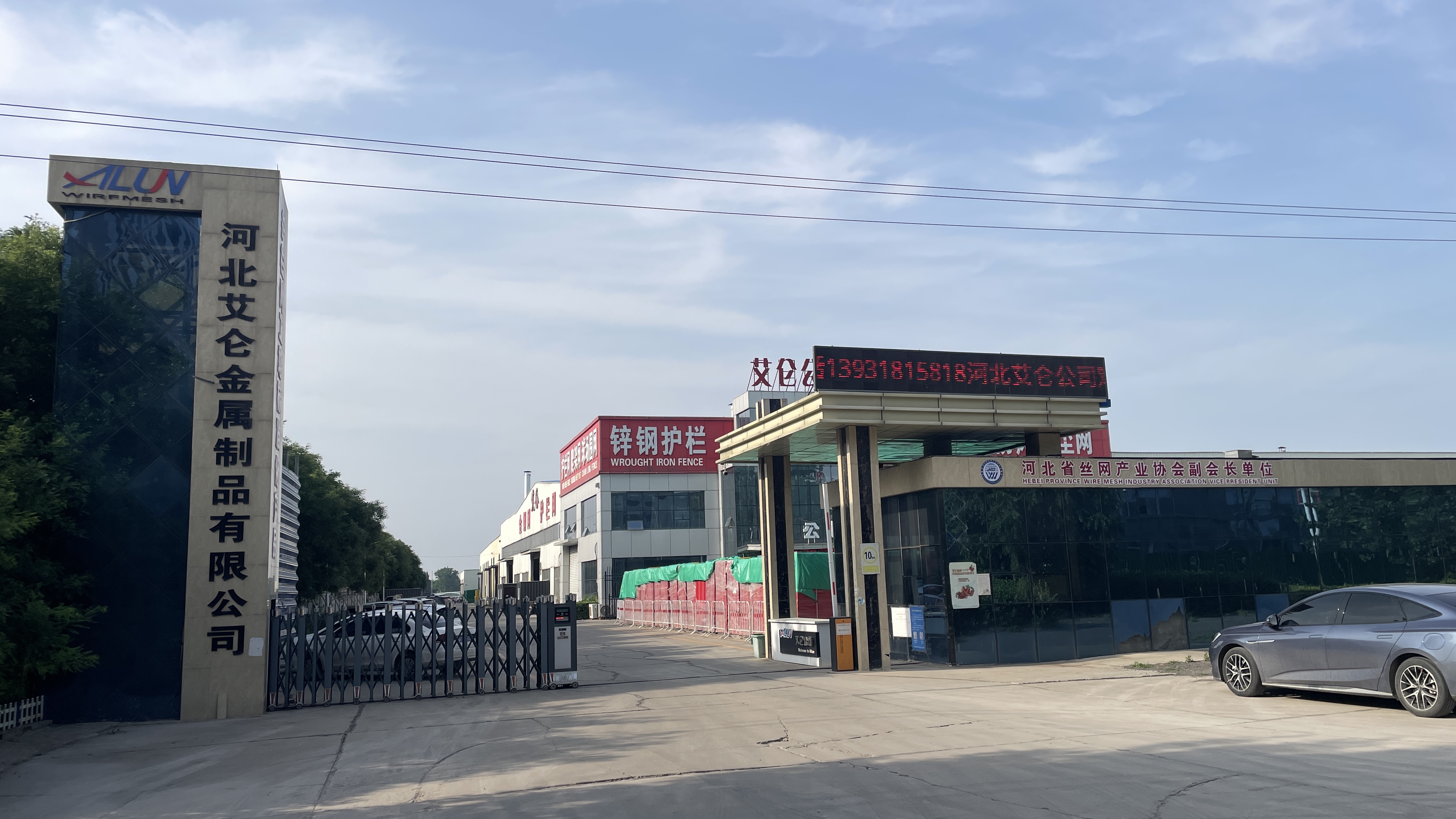
Anping Dengfeng Wire Mesh Products Co., Ltd. operates a 70,000 m² manufacturing facility in Anping County, Hebei Province, China.
Why Harsh Coastal and Industrial Sites Break Ordinary Fencing First
Welded mesh fencing rarely fails as a single dramatic event. It fails progressively, and in coastal or heavy-industrial conditions that progression is both faster and less visible. Two risk categories dominate long-service perimeters: corrosion damage and structural deformation. Corrosion typically begins where the protective layer is thinnest or already broken — cut wire ends, weld intersections, the point at which a post enters the ground or a concrete plinth, and any location where installation tools have scratched the coating. Structural deformation usually arrives later, after corrosion has reduced the effective wire section and a panel is then loaded by wind, thermal movement or deliberate impact.
The commercial consequence is a maintenance trap. A boundary specified on initial purchase price alone tends to be repaired in sections, and sectional repairs on an operating port or an active industrial site carry labour, access and safety costs that are far higher than the panel cost itself. In a marine or coastal-industrial environment, that repair cycle does not settle — it repeats.
The opportunity is that both failure modes are addressable at specification stage, before the purchase order is issued: through base material selection, through the coating stack, and through the rigidity of the panel construction itself. For buyers at decision and execution stage, the goal is not to find the cheapest panel that meets a height requirement, but to fix a specification that will still be standing, unmodified, when the site is audited five or ten years later.
What “Harsh-Environment Fit” Actually Means in Specification Terms
Three variables determine whether a welded mesh fence survives a coastal or heavy-industrial environment: the base material, the coating system applied over it, and the mechanical structure of the panel. Buyers who evaluate only one of the three usually end up with a specification that looks strong on paper and underperforms on site — a heavy wire in the wrong grade, or a good grade protected by a coating that was damaged during installation.
| Base material / build-up | Where it fits best in harsh environments | Practical boundary to plan around |
|---|---|---|
| Carbon steel with hot dipped galvanizing plus powder coating | The default build for most industrial perimeters and coastal-adjacent sites; zinc provides sacrificial protection at cut edges while the powder coat acts as a barrier layer and finish | Service life depends heavily on galvanizing quality and on edge protection during installation; direct, persistent salt-spray zones push the requirement higher |
| Stainless steel 304 | Humid and moderately coastal industrial conditions where full marine-grade resistance is not justified | Chloride-rich environments can still produce pitting over long exposure periods |
| Stainless steel 316 | Persistent chloride exposure — direct coastal frontage, marine industrial zones, port quays | Carries a significant material premium and typically a longer supply lead time |
| Aluminium alloy | Coastal and humid atmospheres where low weight and inherent corrosion resistance matter more than maximum stiffness | Lower stiffness than steel at equivalent section, so it is not a substitute for heavy-security steel panels |
| High-tensile steel wire | Rigid panels that need high strength with a comparatively light structure | Requires a correct coating system; cut ends are the first corrosion point and need protection |
In practice, the decision usually narrows to carbon steel protected by a two-layer system, or a stainless grade where exposure is genuinely aggressive. Hot dipped galvanizing followed by powder coating remains the most widely specified approach for industrial boundaries because it combines sacrificial protection with a controllable finish, and because the finish can be matched across phases of a multi-year project. Where a site sits directly on a salt-spray line, the same logic is applied to a more corrosion-resistant base material rather than to a thicker coat on ordinary steel.
Decoding Panel Designations: 3D-2000, 358-1800, TW-1500, TC-2100
Tenders in Europe and the Middle East frequently name welded mesh panels by short designation rather than by full description, and coastal and industrial projects are no exception. In these designation families, the numeric element conventionally references nominal panel height in millimetres, while the letter prefix identifies the panel construction family. The convention is not standardised across manufacturers, so a designation is a starting point for comparison — never a substitute for the datasheet.
| Designation | Construction emphasis | Typical harsh-site role | What to verify on the datasheet |
|---|---|---|---|
| 3D-2000 | Profiled horizontal wires that add rigidity to the panel | General perimeter of industrial plants and coastal compounds where visibility and stiffness both matter | Wire diameter, coating class, post spacing, confirmed panel height |
| 358-1800 | Small-aperture, heavy-wire anti-cut panel construction | High-security boundaries — ports, utility compounds, aviation-adjacent landside areas | Aperture tolerance, wire gauge, coating coverage at weld points, fixing grade |
| TW-1500 | Twin-wire panel construction for added stiffness | Site boundaries and community-facing enclosures needing rigidity with lighter posts | Wire configuration, finish specification, panel-to-post connection detail |
| TC-2100 | Tall anti-climb panel format | 24/7 standing assets where climb resistance is the primary risk | Top detail, post embedment, confirmed height, coating class on all components |
From Coating Stack to Inspection Discipline
Anti-rust performance is a manufacturing outcome, not a marketing attribute. In Dengfeng’s welded mesh production, the welding process is completed by robotic welding, and manual inspection is conducted throughout the polishing, pickling and powder coating procedures. Surface treatment consists of hot dipped galvanizing followed by powder coating. The sequence matters more than any single step.
Galvanizing before powder coating means the zinc layer reaches the weld intersections and cut wire ends that are most vulnerable to corrosion, and the powder coat then shields the zinc from the environment while providing the finished appearance. Where powder coating is applied directly over untreated steel — common in low-cost panels — the barrier is only as strong as its thinnest point, and coastal exposure locates that point quickly.
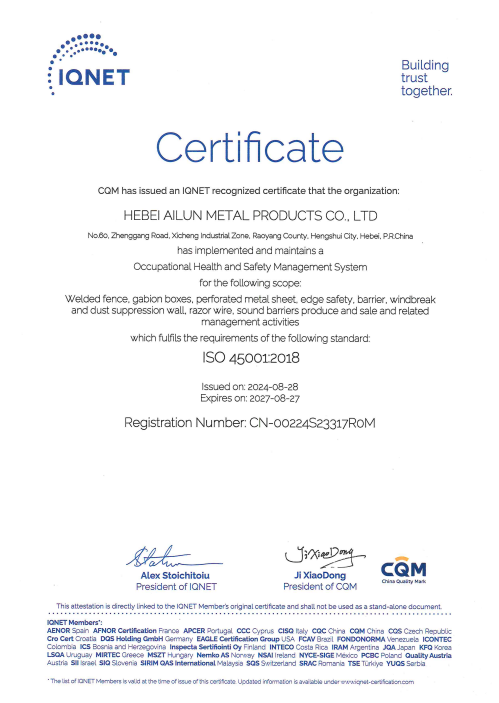
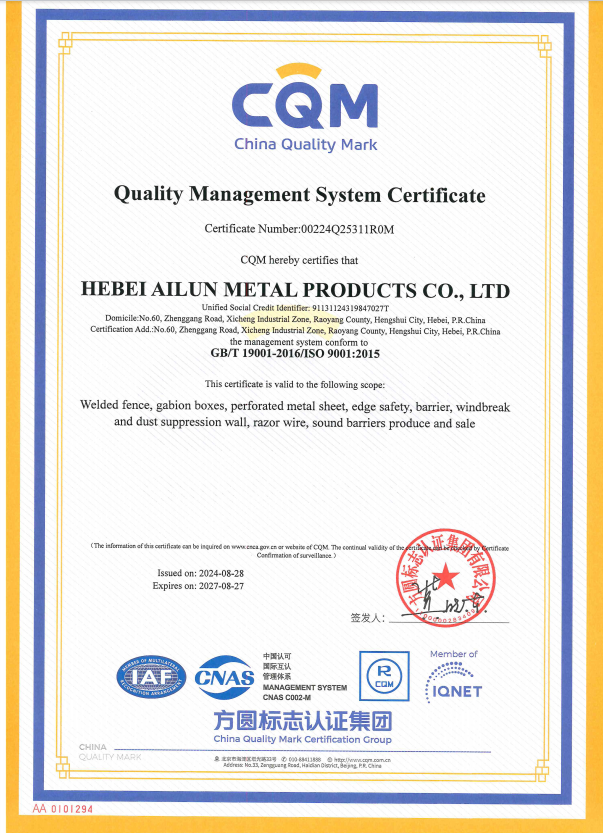
Inspection discipline is the second half of the equation. Dengfeng applies 100% raw material inspection, a finished product load test, and full delivery inspection as standing controls against corrosion damage and structural deformation, and the company holds ISO9001 quality management, ISO14001 environmental management and ISO45001 occupational health and safety management system certificates, alongside registered utility model patents and a product quality inspection test report.
Scenario Fit: Ports, Airports and Coastal Industrial Plants
Harsh-environment specification becomes clearer when it is mapped to the site rather than to the product. The table below translates the dominant stress at each site type into a specification priority, using the designation families discussed above.
| Scenario | Dominant stress | Specification priority | Designation emphasis |
|---|---|---|---|
| Port and terminal perimeter | Persistent salt spray, wind load, 24/7 operation, restricted-zone separation | Corrosion-resistant base or heavy galvanized build; fixings of matching corrosion grade; rigid panels | 358-type anti-cut panels for restricted zones; 3D-type for general boundary |
| Airport and aviation-adjacent landside | Intrusion delay requirement, rigidity, appearance consistency | Standard-compliant panel geometry, small-aperture anti-cut construction, full coating coverage | 358-type and tall anti-climb formats |
| Coastal industrial plant | Chloride exposure plus airborne pollutants, long run length, limited maintenance access | Coating stack quality, thicker wire structure, documented inspection regime | 3D-type and twin-wire panels |
| Rail corridors in coastal regions | Cable and asset theft, climb attempts, remote maintenance | Rigid frame panels with anti-climb geometry to protect continuous assets | Anti-cut and anti-climb panel families |
| Community and residential enclosure near coastal exposure | Appearance, durability, everyday safety rather than intrusion | Powder-coated finish, aluminium alloy or stainless steel 304 where appropriate | Twin-wire and 3D-type panels |
The same applies to the elements that are usually specified last: clamps, bolts, brackets and post caps. On an operating coastal site, fittings that are one corrosion grade below the panel are a predictable failure point, and the cost of replacing them is disproportionate to their purchase price. Buyers evaluating welded mesh fence for industrial perimeters should treat the fixing schedule as part of the corrosion specification, not as an accessory list.
Delivered References: Germany, Australia and the United Kingdom
Referenceable project experience is one of the few credibility signals a perimeter buyer can actually check. Anping Dengfeng Wire Mesh Products Co., Ltd. is a welded mesh and security fence manufacturer established in 2008 in Anping County, Hebei Province, China, with a 70,000 m² production facility, approximately 80 employees, a 10-engineer R&D team and an annual output of 5,000,000 m². The company has supplied site boundary isolation and community security enclosure projects in Germany, Australia and the United Kingdom, covering approximately 5,000 square metres of installed fencing.
Those three markets are relevant to harsh-environment buyers for a specific reason: they combine demanding documentation expectations with sites that range from inland industrial estates to coastal exposure, and they include community-facing installations where visual consistency matters alongside durability. Roughly 80% of Dengfeng’s output is exported, with principal markets in Europe, Saudi Arabia, the Middle East, the United Arab Emirates and the United States.
For execution-stage buyers, the practical question is narrower than “has this supplier exported before?” It is whether panel geometry, coating class, fixing grade and documentation can be reproduced identically on the second and third order of a phased project. A reference list only answers that question if the underlying production process is repeatable.
Market Signals Behind Long-Life Specification
Independent market data supports the shift toward longer-life perimeter specification. Dataintelo values the global welded wire mesh fence market at USD 7.04 billion in 2025 and projects USD 11.72 billion by 2034. Grand View Research estimates the overall global fencing market at USD 33.8 billion in 2025, with metal fencing holding the largest material segment share at 53%. Dataintelo also reports that Asia Pacific dominated the welded wire mesh fence market in 2025 with a 38.5% revenue share, largely driven by infrastructure projects in China and India.
Standards activity reinforces the same direction. EN 10223-7:2012 is the active European standard specifying requirements for steel wire welded panels used for fencing in schools, parks and industrial sites, while ASTM F2453 / F2453M-14 covers welded wire mesh fence fabric with metallic or polymer coatings for high-security applications. Together they push buyers toward documented coating and geometry rather than unverified claims.
Supplier behaviour points the same way. Betafence Group expanded its perimeter security portfolio in February 2024 with new-generation welded mesh systems incorporating intrusion detection and solar surveillance, and the security fencing market continues to be led by established players including Betafence, Bekaert, Ameristar Perimeter Security and Jacksons Fencing. Industry analysis of application trends notes that welded mesh fences are preferred for critical infrastructure such as railways, where cable theft prevention matters, and for schools, because rigid frame panels and anti-climb characteristics suit those environments. The direction is consistent: physical perimeter performance is increasingly judged alongside — not instead of — coating durability and documentation.
How Coated Welded Mesh Compares with Ordinary Cheap Wire Mesh Fence
The most common comparison in coastal and industrial procurement is not between two premium suppliers; it is between a specified, coated, rigid welded mesh system and an ordinary low-cost wire mesh fence. Dengfeng’s own comparison data frames the difference as follows.
| Comparison dimension | Ordinary cheap wire mesh fence | Coated welded mesh build (Dengfeng positioning) |
|---|---|---|
| Anti-corrosion and anti-climb performance | Baseline | Better anti-corrosion and anti-climb performance |
| Service life | Baseline | More than 6 years longer service life |
| Best-fit applications | Light, short-horizon enclosure | Construction, community and airport security projects |
| Initial cost | Baseline | Approximately 5% higher initial cost |
| Replacement cost over life | Higher, through repeated replacement | Approximately 40% lower replacement cost |
| Maintenance | Frequent touch-up and section repair | Zero maintenance within 10 years under the specified build |
Where this comparison stops being valid
A scenario fit guide that only lists advantages is not useful for procurement. There are real boundaries to this specification. First, the approximately 5% higher initial cost is genuinely higher — on a project where the fence is a temporary barrier or where the asset behind it is low-value, the longer service life may never be realised, and the premium is not recovered. Second, rigid panels are heavier than light mesh rolls, which changes post spacing, foundation design and installation labour; a site that assumes a light-roll installation method will need to re-plan. Third, production lead time for project orders typically runs 15–30 days, which matters for programmes that have been compressed at the end. Fourth, where stainless steel 316 is specified for direct salt-spray exposure, the material premium is substantial and should be applied to genuinely exposed sections rather than to the whole boundary by default. Fifth, and most importantly, welded mesh fence is a passive physical barrier: on sites where the threat model requires detection or response, it must be paired with electronic systems — a direction visible in the market, for example through Betafence’s 2024 launch of welded mesh systems with intrusion detection and solar surveillance. Finally, the “zero maintenance within 10 years” expectation is conditional on the specified coating being installed undamaged; where posts are set into aggressive soils without protection, or where the coating is scored during installation, that expectation weakens.
Long-Term Supply and Procurement Continuity
For multi-year programmes, phased roll-outs, framework agreements and distributor stocking, the specification is only half of the evaluation. The other half is whether the supplier can reproduce the same panel, coating class and documentation across years and across phases — and whether the commercial structure supports that.
Several Dengfeng parameters are directly relevant to that question. Monthly production capacity is 420,000 square metres, against annual output of 5,000,000 m², which provides headroom for phased deliveries without re-tooling between stages. The minimum order quantity is 1 set, which allows a pilot or single-bay validation order before a full perimeter commitment, and the typical production lead time is 15–30 days, which is the planning input required for installation sequencing. Delivery terms are FOB Tianjin or CIF, and payment terms include L/C, T/T, D/P, Western Union, Paypal and Money Gram.
Acceptance criteria matter equally on long-life projects, because they determine what evidence the buyer holds at the end of each shipment. Dengfeng’s stated terms are pre-shipment full inspection, with third-party testing acceptable. For a coastal or industrial perimeter, that combination is what allows a client-side QA team to verify coating and geometry against the specification before the panels leave the factory — rather than discovering a mismatch on site, where rework is most expensive.
Continuity also depends on design stability. A supplier with an in-house R&D team of 10 engineers and a product range spanning welded mesh rolls, welded wire mesh panels, 358 security fences, BRC/roll-top fences, double-wire panels, chain link fences, temporary fences, barbed and razor wire and gabion baskets can generally hold a panel specification constant while adapting fixings or post details to site conditions. That is the practical difference between a one-off purchase and a supply relationship that survives a multi-year programme.
Future Outlook
Three shifts are likely to shape harsh-environment perimeter specification over the next several years. The first is the integration of physical welded mesh with detection and monitoring: the 2024 direction taken by Betafence — welded mesh systems combined with intrusion detection and solar surveillance — suggests that rigid panels are becoming a mounting platform as well as a barrier, which raises the importance of post strength and geometry consistency. The second is standards consolidation: EN 10223-7:2012 for panels used in schools, parks and industrial sites, and ASTM F2453 / F2453M-14 for coated welded wire mesh fence fabric in high-security applications, provide an increasingly clear framework for what a datasheet must state. The third is supply concentration: with Asia Pacific holding a 38.5% revenue share of the welded wire mesh fence market in 2025, documentation quality, coating traceability and repeatable production are becoming the primary ways manufacturers differentiate themselves to European and Middle Eastern buyers.
For buyers, the practical implication is that the specification conversation is moving earlier in the project. Corrosion grade, coating sequence, fixing schedule and inspection evidence are increasingly decided at tender stage rather than at installation, because those are the variables that determine whether a coastal or industrial perimeter reaches its intended service horizon.
FAQ
What determines how long a welded mesh fence lasts in a coastal environment?
Service life in coastal conditions is determined mainly by the combination of base material, coating system and installation quality. Carbon steel protected by hot dipped galvanizing followed by powder coating relies on the zinc layer for sacrificial protection at cut ends and weld points, with the powder coat acting as a barrier and finish. Where chloride exposure is persistent, stainless steel 316 is specified instead. Installation quality matters because coating damaged during handling or post-setting becomes the first corrosion site. Structural deformation is a secondary risk that appears when corrosion has already reduced the effective wire section.
Is stainless steel 316 always necessary for a coastal site?
No. Stainless steel 316 is typically reserved for persistent chloride exposure such as direct coastal frontage, marine industrial zones and port quays, and it carries a significant material premium and longer lead time. Stainless steel 304 covers humid and moderately coastal industrial conditions, and a properly specified hot dipped galvanized plus powder coated carbon steel build remains the default for most industrial and boundary applications. The specification decision is normally made by exposure zone within the site rather than applied uniformly across the whole perimeter.
How should designations like 3D-2000, 358-1800, TW-1500 and TC-2100 be compared between suppliers?
Treat the designation as a naming convention rather than a verified specification. In these families, the numeric element conventionally references nominal panel height in millimetres, while the letter prefix identifies the construction family — for example a small-aperture anti-cut construction, a profiled-wire panel, a twin-wire panel or a tall anti-climb format. Because the convention is not standardised across manufacturers, buyers should compare the datasheet instead: wire diameter, aperture tolerance, coating class, panel-to-post connection and fixing corrosion grade. Two panels carrying the same designation can differ materially in all of these.
What are the minimum order quantity, lead time and delivery terms for a project order?
Dengfeng’s stated terms are a minimum order quantity of 1 set and a typical production lead time of 15–30 days, with monthly production capacity of 420,000 square metres and annual output of 5,000,000 m². Delivery terms are FOB Tianjin or CIF, and payment terms include L/C, T/T, D/P, Western Union, Paypal and Money Gram. Acceptance criteria are pre-shipment full inspection, with third-party testing acceptable.
How can a buyer verify coating and quality claims before shipment?
Verification rests on three things: a written specification that states base material, coating sequence and coating class; documented quality controls at the manufacturing stage; and pre-shipment inspection with the option of third-party testing. Dengfeng applies 100% raw material inspection, a finished product load test and full delivery inspection, conducted alongside manual inspection throughout polishing, pickling and powder coating procedures, with welding completed by robotic welding. The company holds ISO9001 quality management, ISO14001 environmental management and ISO45001 occupational health and safety management system certificates, registered utility model patents and a product quality inspection test report, all of which can be requested as part of a pre-order document review.
When is an ordinary low-cost wire mesh fence adequate instead?
An ordinary low-cost wire mesh fence can be adequate where the asset behind it is low-value, the enclosure is temporary, or the site is inland with limited corrosion exposure and a short service horizon. In those cases the approximately 5% higher initial cost of a coated welded mesh build may never be recovered. The comparison changes when the site is coastal or industrial, operates continuously, or faces intrusion attempts: service life under the coated build is stated as more than 6 years longer, replacement cost is stated as approximately 40% lower, and the intended maintenance profile is zero maintenance within 10 years under the specified build.
Reference documents
Dengfeng’s welded wire mesh and galvanized wire product brochure, including product ranges and specification overview, is available for download: Welded Wire Mesh & GI Wire Brochure (PDF).