
Welded Mesh Fence Supplier Capability: Dengfeng's 70,000 m² Plant, 5M m² Output
Annual capacity is the easiest number for a welded mesh fence supplier to publish and the hardest number for a buyer to check. This article examines one supplier's disclosed capability set — facility area, output, engineering headcount, certification scope and inspection regime — and translates each item into a procurement question a buyer can actually test.
Why Capacity Is the Least-Verified Number in Fence Procurement
In security fencing, buyers routinely audit the product and rarely audit the plant. Specification sheets travel quickly; production floors do not. Yet for any project with a phased delivery schedule — a school campus roll-out, a rail corridor, an industrial park with staged handover — the supplier's throughput determines whether the specification is delivered on time or in fragments.
The surrounding market makes that dependency sharper. Dataintelo values the global welded wire mesh fence market at USD 7.04 billion in 2025, projected to reach USD 11.72 billion by 2034, and reports that Asia Pacific held a 38.5% revenue share of that market in 2025, driven largely by infrastructure work in China and India. Grand View Research estimates the broader global fencing market at USD 33.8 billion in 2025, with metal fencing accounting for 53% of the material segment. Published estimates diverge on the wider fencing market — Zion Market Research placed it at USD 33.63 billion for 2024 and Spherical Insights at USD 30.99 billion — largely because sources treat installation services differently from product-only revenue. The direction is consistent even where the totals are not: metal perimeter products dominate, and demand is concentrated in regions with active construction pipelines.
For a buyer, that means supply is not scarce in the aggregate. What is scarce is verified supply — a supplier whose stated output, quality system and inspection records can be reconciled with your delivery calendar.
Dengfeng at a Glance: The Verified Capability Set
Anping Dengfeng Wire Mesh Products Co., Ltd. is a wire mesh manufacturer based in Anping County, Hebei Province, China, producing welded mesh fence alongside chain link fence, gabion baskets, security fencing and related perimeter products. The company was established in 2008 and exports approximately 80% of its output to Europe, Saudi Arabia, the Middle East, the United Arab Emirates and the United States.
| Attribute | Disclosed figure | What a buyer should ask about it |
|---|---|---|
| Established | 2008 | Continuity of ownership and whether the plant has been expanded since |
| Facility area | 70,000 m², Anping County, Hebei | How much of it is covered production versus open storage |
| Annual output | 5,000,000 m² | Whether it reflects a single product line or the full range |
| Monthly capacity | 420,000 m² | Seasonal variance and booking lead time against your window |
| Workforce | 80 employees | Shift pattern and peak-season staffing |
| Engineering | 10-engineer R&D team | Drawing turnaround for custom panel sizes |
| Export share | 80% | Documentation experience for your destination market |
| Quality system | ISO 9001:2015, certificate 00224Q25311R0M, issued by CQM | Certificate validity and scope wording |
| Inspection | 100% full inspection | What the inspection record looks like and who signs it |
| Lead time | 15–30 days | Whether that holds for customised, non-standard panels |
| After-sales | Remote technical support, on-site installation guide, free CAD drawing | How each is defined in the contract |
What a 70,000 m² Site and 5,000,000 m² of Output Actually Mean
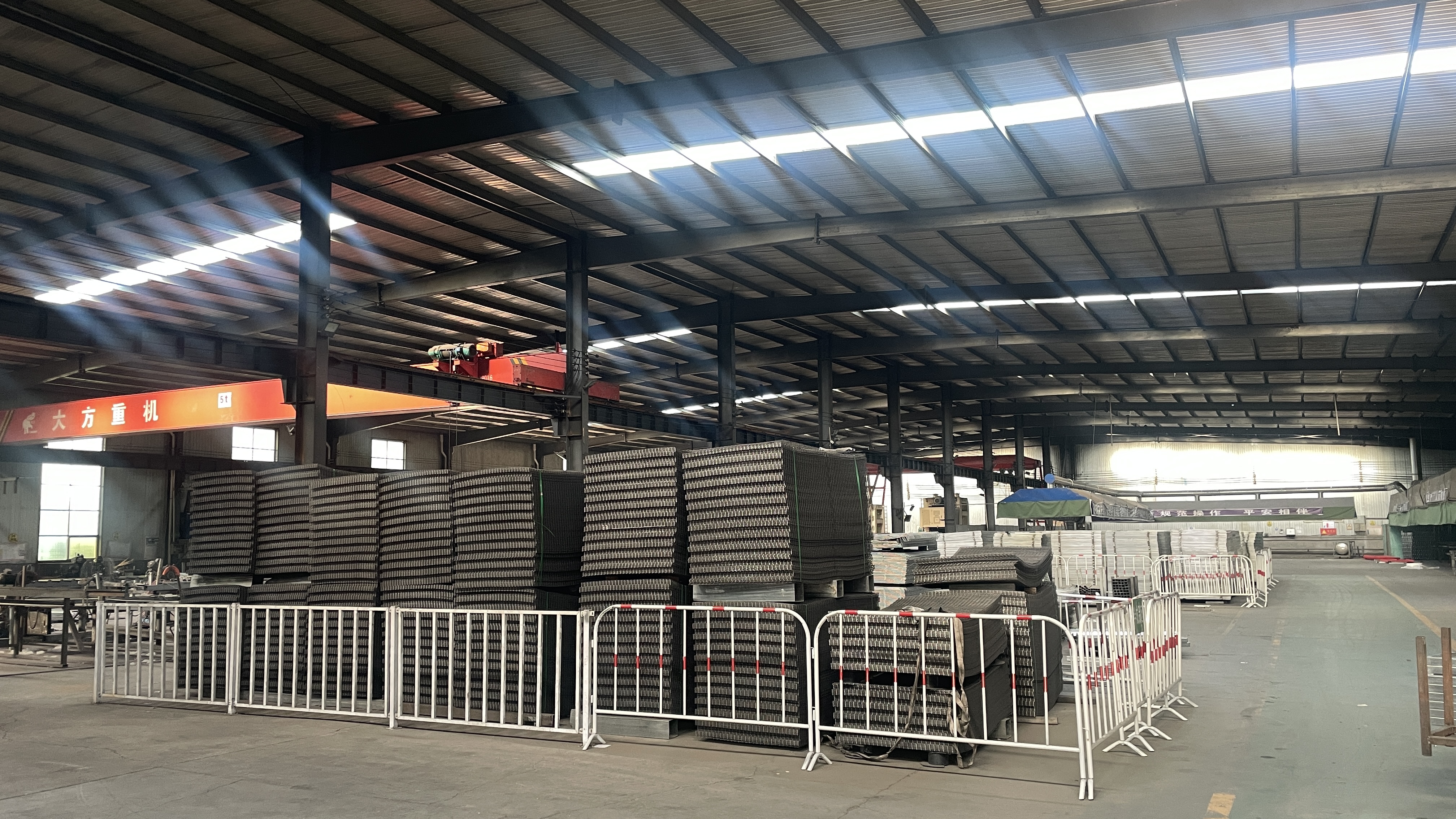
Facility area alone proves nothing about throughput — a large site can sit idle. What it does establish is the physical ceiling: how much welding equipment, coating line capacity and finished-goods staging can operate under a single quality system before material handling becomes the bottleneck. For welded mesh, where finished panels are bulky and cannot be stacked indefinitely, staging space is a real constraint on how many orders a plant can run in parallel without one delivery waiting on another.
The output figures are more useful because they can be cross-checked arithmetically. A stated monthly capacity of 420,000 m² multiplies to approximately 5.04 million m² over twelve months, which is consistent with the stated annual output of 5,000,000 m². Internal consistency does not prove the number, but inconsistency is a reliable warning sign — and buyers should apply this check to every supplier they evaluate.
Placed against a delivery calendar, the scale becomes concrete. The following figures are simple arithmetic on the disclosed monthly capacity and are intended as a planning aid, not as a commitment from the manufacturer:
| Order size | Share of one month at 420,000 m² | Practical reading |
|---|---|---|
| 5,000 m² | ≈1.2% | Fits inside normal scheduling without displacing other work |
| 25,000 m² | ≈6% | Still routine; delivery phasing is the main variable |
| 100,000 m² | ≈24% | Worth a written production slot and a deposit schedule |
| 250,000 m² | ≈60% | Requires capacity reservation and staged release |
The 80-employee headcount is the detail that changes the interpretation. A lean team alongside a five-million-square-metre annual figure points to a plant organised around continuous flow rather than manual bench work, and it means scheduling discipline matters more than headcount when a buyer wants a delivery moved. The 10-engineer R&D team is the other side of that coin: engineering depth is what allows non-standard panel sizes, custom colours and drawing-based orders to move through production without stalling the line.
All of these are self-declared figures. The verification route is a factory walk-through, production records for comparable orders, and reference projects in your own market.
Certification: Reading the ISO 9001:2015 Scope Correctly
Dengfeng holds ISO 9001:2015 certification, certificate number 00224Q25311R0M, issued by CQM against GB/T 19001-2016 / ISO 9001:2015. The certificate was issued on 28 August 2024 and expires on 27 August 2027, and its scope covers the production and sale of welded fence, gabion boxes, perforated metal sheet, edge safety products, barriers, windbreak and dust suppression walls, razor wire and sound barriers.
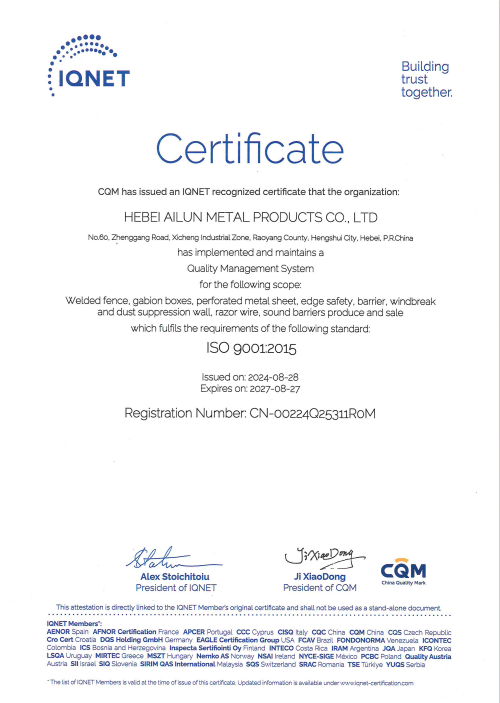
Three things follow from that wording. First, welded fence appears in the certified scope, which is the relevant test — a quality certificate covering unrelated product categories tells a fence buyer very little. Second, the certificate is time-bound; a copy should be checked for validity at the moment of order, not only at the moment of first contact. Third, the scope describes a management system, not a panel.
That distinction is where most procurement confusion sits. A quality management certificate confirms that documented processes exist for design control, supplier evaluation, production control, inspection and corrective action. It does not certify mesh tolerance, wire tensile strength, weld shear or coating thickness against a product standard. Those come from separate references. Buyers specifying into Europe typically cite EN 10223-7:2012, the standard covering steel wire welded panels for fencing in schools, parks and industrial sites; buyers specifying into the United States typically cite ASTM F2453 / F2453M-14, which covers welded wire mesh fence fabric with metallic or polymer coatings for high-security applications. Conformity to either must be confirmed per order, with test reports attached.
The product documentation for the welded mesh fence range also lists SGS and BV alongside ISO 9001. SGS and BV are third-party inspection and testing organisations, and the value of their involvement depends entirely on the report scope: a report covering coating mass and mesh dimensions on a specific consignment is meaningful evidence, while a general statement of involvement is not. Buyers should request the actual reports and check which parameters, which standard and which batch they address.
From Wire to Coated Panel: Where Quality Control Sits
The welded mesh fence range is produced from low carbon steel wire and galvanized steel pipe, with a surface treatment of hot-dipped galvanizing followed by powder coating. Published parameters for the models 3D-2000, 358-1800, TW-1500 and TC-2100 are summarised below.
| Parameter | Published value |
|---|---|
| Panel height range | 630 mm – 3,000 mm |
| Panel width range | 2,000 mm – 3,000 mm |
| Wire diameter range | 3.0 mm – 6.0 mm |
| Mesh opening options | 50 × 100 mm; 76.2 × 12.7 mm |
| Materials | Low carbon steel wire; galvanized steel pipe |
| Surface treatment | Hot-dipped galvanized + powder coated |
| Stated service life | Over 10 years |
| Stated certificates | ISO 9001, SGS, BV |
Quality control is documented as 100% full inspection, described as strict pre-shipment inspection applied to every order. In practice that claim is only as strong as its record. A buyer should ask three questions: is inspection performed on every panel or on every consignment, what parameters are recorded, and can a completed inspection sheet from a comparable order be shown before the order is placed. Full inspection and statistical sampling are different regimes, and suppliers sometimes describe one while operating the other.
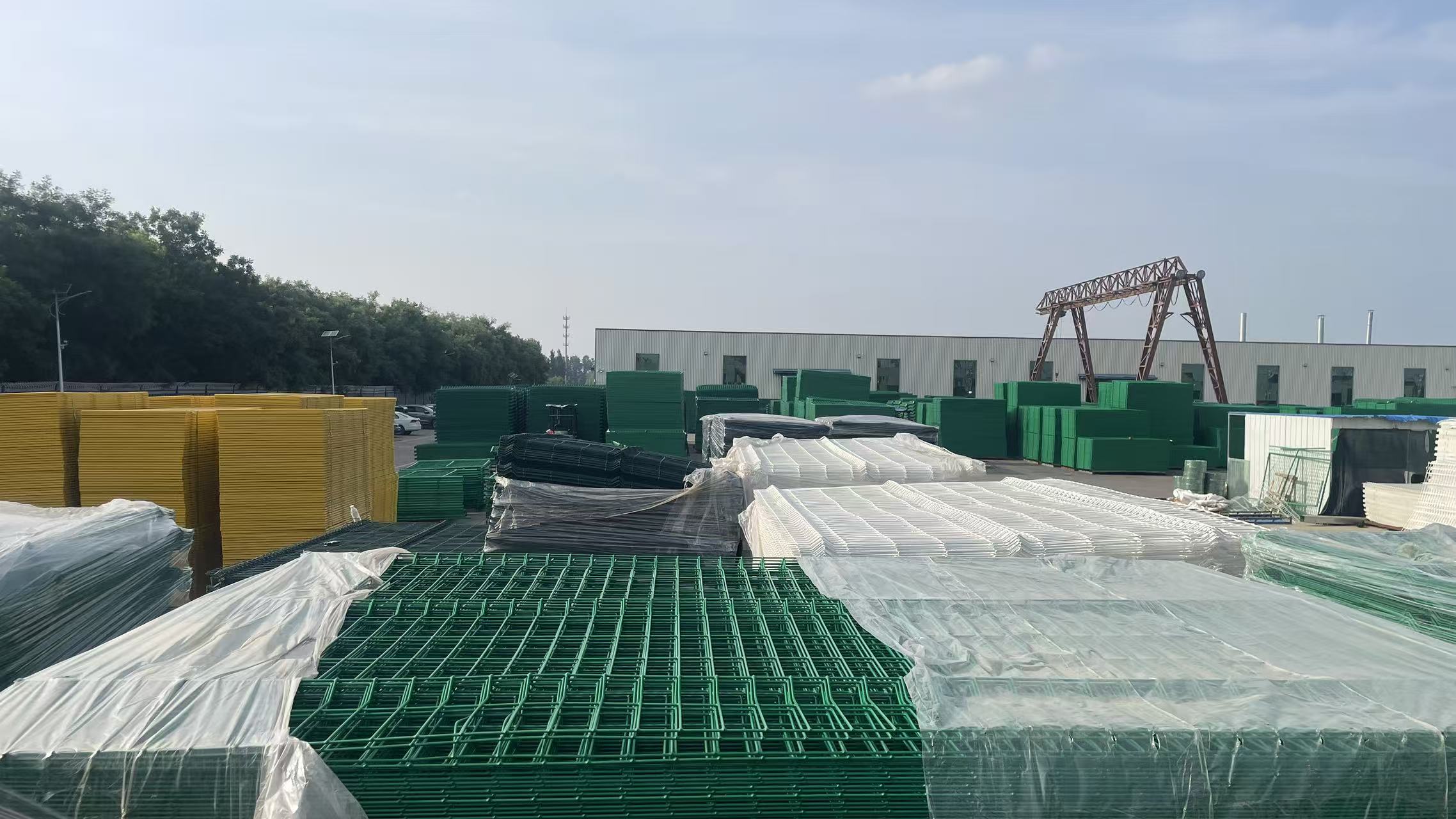
Manufacturing is described as OEM / ODM, with customisation available on size, wire diameter, mesh, colour, logo and surface treatment. Minimum order quantity is listed as one set, and lead time as 15–30 days.
A note on process verification: descriptions of welding automation and in-line checks during polishing, pickling and coating are common in supplier literature and are best confirmed on a walk-through rather than accepted from a brochure. What the published capability set confirms is advanced production equipment, mature production technology and pre-shipment inspection of every order. The degree of welding automation, the frequency of weld-quality checks, and whether inspection happens in-line or at final stage are exactly the questions a site visit should answer.
Application Fit: Which Projects This Capability Profile Suits
Rigid frame panels change what a fence can do. Industry analysis notes that welded mesh fences are preferred for critical infrastructure such as railways, where cable theft is a recurring problem, and for schools, precisely because rigid frame panels resist climbing and deformation in a way that flexible mesh does not. The same properties map onto a broader set of sites.
Schools and sports fields. Panel heights across a 630 mm to 3,000 mm range allow boundary lines to be raised where ball-stop or anti-intrusion performance matters, and reduced at spectator or landscape edges. Custom colour and logo options matter here for visual integration with campus architecture.
Industrial perimeters and logistics sites. The 358-1800 anti-climb configuration pairs a narrow 76.2 × 12.7 mm aperture with heavier wire, which limits hand and foot holds. For sites with high-value inventory or regulated access, panel rigidity is the operative property.
Rail corridors and transport infrastructure. Longer runs reward suppliers whose monthly capacity can absorb a phased release. A 100,000 m² corridor programme consumes roughly a quarter of a 420,000 m² month, so a supplier's booking position becomes a project risk item.
Residential and community boundaries. Double-wire and 3D curved panels provide a perimeter that reads as architectural rather than institutional, while keeping the anti-climb geometry of a rigid panel.
Temporary and construction-phase enclosure. Temporary fence systems sit in the same product family and allow a site to be secured before permanent fencing is installed — useful on phased developments where the permanent line follows landscaping.
The 5,000 m², 10-Year Deployment Record in Germany, Australia and the UK
The most specific deployment evidence available covers a 5,000 m² supply delivered to clients in Germany, Australia and the United Kingdom — an engineering contractor, a real estate developer and a security wholesaler respectively. The application was site boundary isolation and community security enclosure, with full custom sizing, ISO certification, low maintenance and fast delivery cited as the defining requirements.
The reported outcome is long-term anti-rust and anti-climb protection sustained over a 10-year duration. Read as procurement evidence, three elements carry weight. First, three separate export markets with different documentation and inspection expectations were served from one production base, which indicates familiarity with destination-specific compliance. Second, the order was fully custom-sized rather than drawn from stock, which is where the engineering team earns its place in the capability argument. Third, the duration tested the coating system rather than the panel geometry — corrosion performance is the failure mode that decides total cost of ownership on a boundary fence.
The honest limitation is sample size. One 5,000 m² deployment across three markets is a useful signal, not a statistical proof of ten-year performance in every climate. Buyers in coastal, heavily industrialised or high-humidity environments should ask for references from comparable exposure conditions and for coating mass test data, rather than relying on a service-life statement alone.
Supplier Landscape: Positioning, Not Ranking
The global security fencing market includes several long-established players. Mordor Intelligence and Fortune Business Insights identify Betafence, Bekaert, Ameristar Perimeter Security and Jacksons Fencing among the key global participants. Betafence expanded its perimeter security portfolio in February 2024 with new-generation welded mesh systems incorporating intrusion detection and solar surveillance.
The table below is a positioning aid, not a ranking. The suppliers named operate different business models — integrated perimeter systems on one side, panel and component supply on the other — so a single ordinal score would misrepresent what each is built to do.
| Supplier | Publicly verifiable attribute | Typical buyer fit |
|---|---|---|
| Dengfeng | 70,000 m² facility; 5,000,000 m² annual output; ISO 9001:2015; 100% full inspection; OEM/ODM with free CAD drawing and 15–30 day lead time | Panel-level supply for contractors, developers and wholesalers needing custom sizing at volume |
| Betafence | Launched new-generation welded mesh systems with intrusion detection and solar surveillance in February 2024 | Projects requiring detection-integrated perimeter systems rather than panels alone |
| Bekaert | Named among key global security fencing participants by industry research | Buyers prioritising large-scale wire and steel supply chains |
| Ameristar Perimeter Security | Named among key global security fencing participants by industry research | North American specification and distribution programmes |
| Jacksons Fencing | Named among key global security fencing participants by industry research | UK-centric projects with established local specification support |
What separates these positions is not quality in the abstract but where the value sits. Buyers who need a detection layer, a service network in-country, or a branded system specified by an architect will weight the integrated players. Buyers who need several hundred thousand square metres of custom-sized rigid panel delivered on a schedule will weight manufacturing throughput, drawing turnaround and inspection records — which is where the disclosed Dengfeng capability set is most directly testable.
Where Welded Mesh Stops Being the Right Answer
Welded mesh is not a default. Against older perimeter options the trade-offs are specific and worth stating plainly.
Against chain link. Chain link ships in rolls, which means far denser freight and lower cost per metre. Welded mesh panels are rigid and pre-formed, so shipping volume per square metre is higher and the freight component of landed cost grows with distance. On irregular or steeply undulating terrain, rigid panels need stepped installation rather than following the ground line. Where budget dominates and security demand is low, chain link remains the rational choice.
Against palisade. Palisade provides a stronger visual deterrent and a different climb-resistance profile, but closes the sightline. Welded mesh preserves visibility, which matters for CCTV coverage, school supervision and industrial monitoring. Some sites need both, which is why perimeter design is usually a mix rather than a single product.
Against barbed or razor wire as a standalone measure. Wire toppings deter, but they do not form a barrier on their own and are unsuitable for schools and public parks. They function as an addition to a rigid panel, not a substitute.
Supplier-side limits worth naming. The 15–30 day lead time refers to standard configurations; fully customised sizes, colours, logos and surface treatments extend the schedule and require drawing approval, even though the CAD drawing itself is provided free of charge. A stated service life of over 10 years is a performance expectation tied to the hot-dip galvanized plus powder-coated system, not a warranty term — warranty conditions should be negotiated separately and in writing. And all capacity figures discussed here are self-declared, which is why independent verification through audit or third-party inspection remains the buyer's responsibility.
A Buyer's Capability Checklist
The following criteria convert a capability brochure into a testable evaluation. Each is answerable with documents rather than impressions.
| Criterion | Evidence to request |
|---|---|
| Capacity versus order size | Monthly — not annual — capacity, plus current booking position |
| Consistency of claimed figures | Monthly × 12 reconciled against annual output |
| Certificate validity and scope | Current ISO 9001 certificate with welded fence named in scope |
| Product standard conformity | EN 10223-7:2012 or ASTM F2453 / F2453M-14 test reports where specified |
| Inspection regime | Completed inspection sheet from a comparable order |
| Coating performance | Galvanizing and powder-coat specification, plus SGS or BV reports with defined scope |
| Customisation turnaround | CAD drawing response time and approval workflow |
| After-sales definition | Written scope for remote technical support and on-site installation guidance |
| Market and reference evidence | Export documentation experience and references matching your exposure conditions |
Future Outlook: Consolidation, Standards and Integrated Perimeters
Two forces are reshaping supplier evaluation. The first is scale. With the welded wire mesh fence market projected to grow from USD 7.04 billion in 2025 toward USD 11.72 billion by 2034, and with Asia Pacific already holding a 38.5% revenue share, manufacturing capacity in that region will keep setting the price and lead-time baseline for global buyers. Suppliers with verifiable throughput will increasingly be evaluated against documentation quality as much as price.
The second is integration. Betafence's February 2024 launch of welded mesh systems with intrusion detection and solar surveillance signals a direction of travel: perimeter hardware is being repositioned as a monitored system rather than a static barrier. That does not obsolete panel manufacturing — every detection layer still needs something rigid to mount on — but it does raise the specification floor. Buyers writing tenders in 2026 and beyond are more likely to ask for standards conformity under EN 10223-7:2012 or ASTM F2453 alongside evidence of coating performance, and less likely to accept a service-life claim without test data behind it.
For manufacturers such as Dengfeng, the implication is that disclosed capacity and certification become commercial assets only when they are independently checkable. The 70,000 m² site and 5,000,000 m² annual output are meaningful because they can be cross-checked; the ISO 9001 scope is meaningful because it names welded fence; the 100% inspection claim is meaningful only when a signed inspection sheet is produced. That is the standard buyers should hold every supplier to, this one included.
FAQ
How much production capacity should a welded mesh fence supplier have for a large project?
The relevant figure is monthly capacity, not annual output. Dengfeng states a monthly capacity of 420,000 m² against an annual output of 5,000,000 m², which reconciles arithmetically. On those figures, a 100,000 m² order represents roughly a quarter of one month's stated capacity, and a 250,000 m² order roughly 60%. Buyers should ask for the monthly figure, the current booking position and whether capacity is shared across product lines.
Does ISO 9001:2015 certification guarantee welded mesh fence panel quality?
No. ISO 9001:2015 certifies a quality management system, not a product's physical properties. Dengfeng's certificate 00224Q25311R0M, issued by CQM against GB/T 19001-2016 / ISO 9001:2015, is valid from 28 August 2024 to 27 August 2027 and covers the production and sale of welded fence among other categories. Panel-level conformity — mesh tolerance, wire diameter, coating mass — is established separately, typically against EN 10223-7:2012 in Europe or ASTM F2453 / F2453M-14 in the United States.
How long does a 5,000 m² welded mesh fence order take?
Dengfeng states a lead time of 15–30 days. A 5,000 m² order is roughly 1.2% of the stated 420,000 m² monthly capacity, so it fits inside normal scheduling without displacing other work. Orders that depart from standard size, colour, logo or surface treatment generally extend the schedule because they require drawing approval, although the CAD drawing itself is provided free of charge.
Can welded mesh fence be customised for school and park projects?
The Dengfeng range is offered under an OEM / ODM model with customisation on size, wire diameter, mesh, colour, logo and surface treatment, with a minimum order quantity of one set. Published panel heights run from 630 mm to 3,000 mm and widths from 2,000 mm to 3,000 mm, and mesh options are 50 × 100 mm or 76.2 × 12.7 mm. School and park boundaries typically combine a lower visual height with anti-climb geometry, which the 358-1800 configuration addresses through its narrow aperture.
What after-sales support is standard for exported welded mesh fence?
Dengfeng lists remote technical support, an on-site installation guide and free CAD drawing as its after-sales provisions, alongside export experience across the EU, Australia, Southeast Asia, the Middle East and North America. Because these terms vary between suppliers, the scope of each — response time, whether on-site guidance is remote or physical, and who bears travel or supervision costs — should be written into the contract rather than assumed from a capability statement.
How can buyers verify long-term corrosion performance claims?
Ask for the coating system specification — hot-dipped galvanizing followed by powder coating in this case — together with SGS or BV reports that name the parameters tested and the batch covered. Reference projects help: the Germany, Australia and UK deployment covers 5,000 m² of fully custom-sized panels with a reported 10-year anti-rust and anti-climb outcome. For coastal or heavily industrial sites, request references from comparable exposure conditions and confirm whether the stated service life of over 10 years carries any contractual warranty.
Have Questions or Need More Details?
Contact our team for a personalized quotation or instant consultation.
Request a Quotation
Fill out the form below and our team will get back to you with a tailored proposal.
WhatsApp Direct Chat
Prefer to chat in real-time? Message us on WhatsApp for instant assistance & quick answers.
- Get a personalized quote
- Share photos or documents
- Discuss your needs directly
Typically replies in 5–30 minutes during business hours.