
Welded Mesh Fence for Temporary Construction Sites: Specs and Scenarios That Fit the Job
Welded Mesh Fence for Temporary Construction Sites: Specs and Scenarios That Fit the Job
A temporary construction perimeter is the first control measure that goes up and the last one that comes down. It separates the public from excavation and plant movement, keeps materials and equipment inside the boundary, and functions as the physical evidence that a contractor managed access and liability on site. For buyers in the research and evaluation stage, the useful question is narrower than a general fencing purchase: which welded mesh fence specification fits this job, and what can be documented before a supplier is selected?
Welded mesh fence is a rigid, panel-based fencing system built from welded steel wire mesh fixed into frames and mounted on posts. In a temporary works context the specification is decided by constraints rather than by preference: standing height, wire diameter, mesh aperture, coating system, certification, the accessory set required to close a line, and the number of times panels will be lifted and re-installed.
This industry reference sets out that constraint profile using verified product and project information from Anping Dengfeng Wire Mesh Products Co., Ltd., a manufacturer of welded wire mesh and security fencing based in Anping County, Hebei Province, China. It covers the dimensions and materials of the welded mesh fence range, the model designations used within it, including TW-1500, the certification evidence that supports a compliance file, and the site scenarios where the specification holds up.
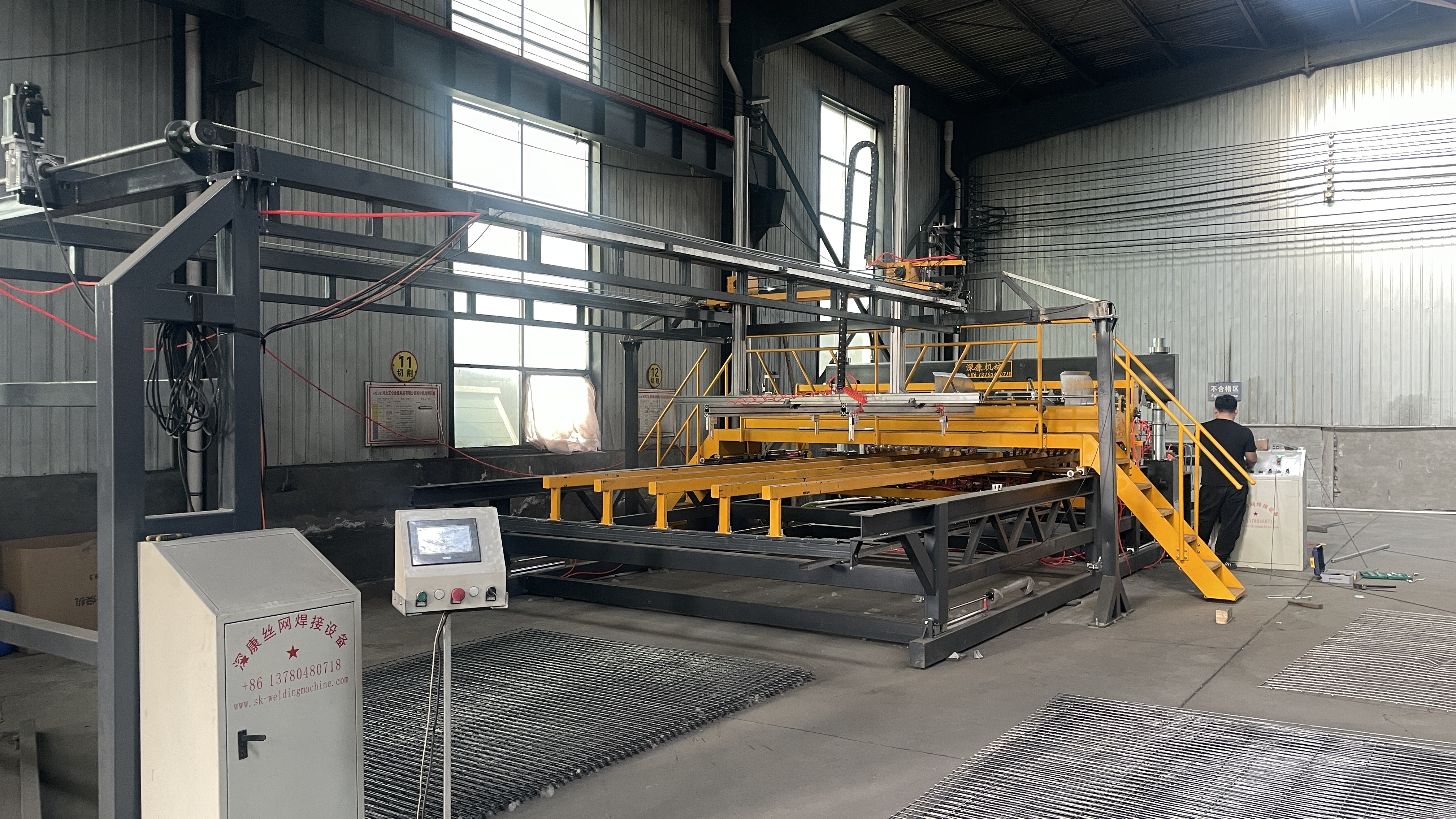
Welded mesh fence panels form a rigid, documented perimeter line for temporary construction and municipal works boundaries.
Why a Temporary Perimeter Is a Specification Problem Before It Is a Purchase
Two failure modes recur on temporary works. Under-specification produces a perimeter that is technically present but functionally weak: a barrier too low to discourage casual climbing, a mesh aperture wide enough to serve as a foothold, a wire gauge that deforms on impact, or a coating with no documentation behind it. In those cases the fence does not remove the risk, it transfers the risk to the contractor.
Over-specification produces the opposite problem. Heavier panels require more handling equipment, longer installation windows and more transport per metre of boundary. On a project that will stand for six months and be dismantled once, specifying a permanent-installation system at the highest available coating tier can only be justified if the panels will be reused on later sites.
The variables that decide which side of that line a project sits on are consistent across projects: required standing height, panel rigidity and aperture, documented coating performance, certification traceability, the accessory set needed to complete the line, and the reuse plan. Each of those variables maps to a stated value in the product data, which is why an evaluation-stage comparison should start with the specification sheet rather than the quotation.
The Constraint Profile of a Welded Mesh Fence Order
The welded mesh fence range (product code 6462) is published with a defined dimensional and material envelope. Buyers evaluating a temporary works application are effectively selecting values inside that envelope, so the envelope itself is the first item to check against the site drawings.
| Parameter | Stated value or range | What it constrains on site |
|---|---|---|
| Height | 630 mm to 3000 mm | Sets the standing height of the barrier and therefore the level of casual-climb deterrence |
| Panel width | 2000 mm to 3000 mm | Determines post spacing, panel count and the handling weight of each unit |
| Wire diameter | 3.0 mm to 6.0 mm | Governs rigidity and resistance to deformation or cutting |
| Mesh aperture | 50 x 100 mm and 76.2 x 12.7 mm | Controls the size of openings available as hand or foot holds and as cut access |
| Base material | Low carbon steel wire, galvanized steel pipe | Substrate for both the mesh field and the frame |
| Surface treatment | Hot dipped galvanized plus powder coated | Weather, corrosion and anti-rust resistance; finished color |
| Stated service life | Over 10 years | Planning horizon for reuse across sites and for handover as a permanent boundary |
| Model designations | 3D-2000, 358-1800, TW-1500, TC-2100 | Standard configurations within the same dimensional envelope |
| Certification | ISO 9001:2015; product record also lists SGS and BV | Supplier qualification and paperwork traceability |
Note: the values above describe the stated range of the welded mesh fence product family. A site order is a selection inside that range, and the specific height, width, wire diameter and aperture should match the project drawing and the risk assessment for the boundary in question.
The two aperture options answer different site conditions. A 50 x 100 mm aperture is a rectangular pattern generally used where the perimeter must read clearly from a distance and where moderate climbing deterrence is sufficient. A 76.2 x 12.7 mm aperture is a much tighter pattern; smaller openings reduce the size of the holds available on the panel face and make cutting through more difficult, which is why tighter apertures are associated with higher-security perimeter applications.
TW-1500 and the Rest of the Range
Anping Dengfeng Wire Mesh Products Co., Ltd. is a wire mesh manufacturer founded in 2008 and located in Anping County, Hengshui City, Hebei Province, China. The company operates a 70,000 m2 production site with approximately 80 employees, including a 10-engineer R&D team, and reports annual output of 5,000,000 m2. Its portfolio includes welded mesh rolls and welded wire mesh panels, 358 security fences, BRC and roll-top fences, double-wire panels, chain link fences, temporary fences, barbed and razor wire, and gabion baskets. About 80% of output is exported, with Europe, Saudi Arabia, the Middle East, the United Arab Emirates and the United States listed as main markets.
Within that portfolio, the welded mesh fence range is published under four model designations: 3D-2000, 358-1800, TW-1500 and TC-2100. TW-1500 is the designation used within the temporary construction fence line, and it sits inside the family height range of 630 mm to 3000 mm and panel width range of 2000 mm to 3000 mm. The practical significance for a temporary site is that a lower panel can be specified for a short-duration internal separation and a taller panel for a public-facing boundary without changing supplier, coating system or accessory set, because posts, connecting clips and gates remain compatible across the range.
Materials follow the same family specification: national standard low carbon steel wire and galvanized steel pipe. Welding is completed by robotic welding, and manual inspection runs through the polishing, pickling and powder coating procedures. Pre-shipment inspection is performed for every order and the production record states 100% full inspection. Customization covers size, wire diameter, mesh, color, logo and surface treatment. Monthly capacity is 420,000 square meters, lead time is 15 to 30 days, and the minimum order quantity is 1 set. After-sales support includes remote technical support, on-site installation guidance and free CAD drawings.
Coating and Mesh Geometry: Where the Technical Performance Comes From
Two specification decisions determine how a welded mesh panel behaves in weather-exposed, outdoor service: the coating system applied to the steel, and the geometry of the mesh.
Corrosion protection in this range is a two-layer system. Hot dipped galvanizing deposits a zinc layer that acts as a sacrificial barrier: where the coating is intact, the zinc corrodes preferentially to the steel beneath it, and where the coating is scratched, the surrounding zinc continues to protect the exposed edge. Powder coating is then applied over the galvanized surface as an outer barrier that resists moisture, ultraviolet exposure and abrasion, and that provides the finished color. The combination of low carbon steel wire and galvanized steel pipe as substrate with hot dipped galvanizing and powder coating as surface treatment is the basis on which the range is specified for 24/7 outdoor standing in corrosion-resistant, weather-resistant and anti-rust conditions, and for the stated service life of over 10 years.
Mesh geometry works differently. Wire diameter in this range runs from 3.0 mm to 6.0 mm; thicker wire increases rigidity and the force required to deform or cut a panel. Aperture controls the openings: the 76.2 x 12.7 mm option leaves no opening large enough for a comfortable hand or foot hold, which is what the anti-climb and anti-cut descriptions in the product data refer to. Panel rigidity comes from the frame and the welded mesh acting together as a rigid panel rather than a flexible roll, which is also why these panels hold a straight boundary line without intermediate tensioning.
Standards and Certification to Verify
Certification carries the most procurement weight in this constraint profile, because it is the part that can be checked rather than assumed. The welded mesh fence product holds an ISO 9001:2015 Quality Management System Certificate, certificate number 00224Q25311R0M, issued by CQM. The applicable standard is GB/T 19001-2016 / ISO 9001:2015, the certificate scope covers welded fence and related wire mesh production and sale, and it is valid for the global market. It was issued on 28 August 2024 and expires on 27 August 2027. The product specification record also lists SGS and BV.
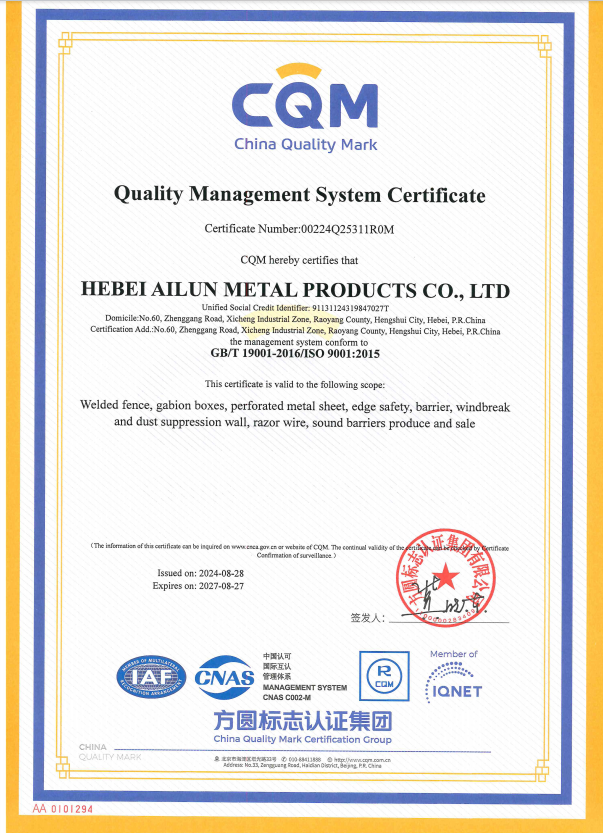
ISO 9001:2015 certificate 00224Q25311R0M, issued by CQM under GB/T 19001-2016 / ISO 9001:2015 and valid for the global market.
Two regional standards matter when a buyer is assembling a compliance file for a construction or municipal project. EN 10223-7:2012 is the active European standard specifying requirements for steel wire welded panels for fencing, including applications in schools, parks and industrial sites. ASTM F2453 / F2453M-14 is the corresponding United States reference, covering welded wire mesh fence fabric with metallic or polymer coatings for high-security applications. Which one applies depends on the jurisdiction of the project rather than on supplier preference, and a buyer placing a cross-border order should confirm that the panel construction and coating system are described against the standard the project authority recognizes.
The distinction between a management-system certificate and a product test record matters here. ISO 9001:2015 certifies that the manufacturer operates a documented quality management system; it is not a batch-level test result for the panels in a specific shipment. Where a project requires evidence at batch level, the relevant documents are inspection records, which for this range are generated because pre-shipment inspection is performed on every order at a stated 100% full inspection rate.
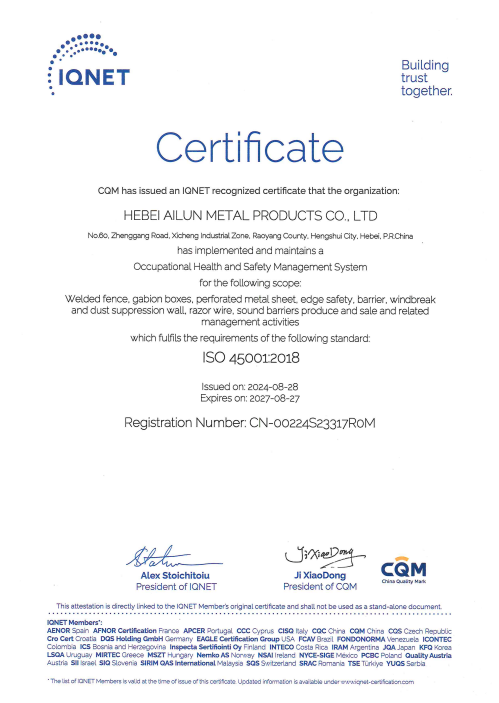
Inspection and test documentation supports the stated 100% full inspection rate applied to welded mesh fence orders before shipment.
Scenario Fit: Temporary Works, Municipal Engineering and Critical Infrastructure
The welded mesh fence range is specified for construction, municipal engineering, real estate, airport, port, school, farm, transportation and security protection applications. Its documented working conditions are outdoor, corrosion-resistant, weather-resistant and anti-rust, operating as a standing fence 24 hours a day.
For temporary construction sites, three project types map directly onto the range. Construction temporary isolation uses the panels to close an active work area from public access for the duration of the build. Boundary isolation establishes a controlled line between the site and adjacent property, roads or footpaths. Site separation divides a large site internally, for example between storage, plant movement and active work zones, where a full security specification is unnecessary but a rigid and visible line is not. Community security enclosure applies the same panel logic at the end of a project, converting a temporary line into a longer-term residential or estate boundary.
Supporting equipment is part of the specification rather than an afterthought. The range is documented with support posts, connecting clips, security gates and razor wire as matched equipment, which is what makes a perimeter a complete system: posts set the line and carry the panel load, clips fix panels to posts, gates create controlled access points, and razor wire is added only where the risk assessment calls for a topping deterrent.
Project data from European markets shows how the specification is applied in practice. In projects in Germany, Australia and the United Kingdom, the welded mesh fence range has been used for a 5,000 square meter installation covering site boundary isolation and community security enclosure, delivered to engineering contractors, real estate developers and security wholesalers. The documented outcome over a project duration of 10 years is long-term anti-rust and anti-climb protection, supported by full custom sizing, ISO certification, low maintenance and fast delivery. Two points in that record are relevant at the evaluation stage: the specification was customized to the site rather than drawn from a fixed stock list, and the service period was measured in years, which is why coating documentation carries more weight on this type of order than unit price alone.
Market Signals Behind Temporary Works Specification
Welded mesh fencing sits inside a market that continues to expand. The global welded wire mesh fence market was valued at USD 7.04 billion in 2025 and is projected to reach USD 11.72 billion by 2034, according to Dataintelo. The wider fencing market was estimated at USD 33.8 billion in 2025, with metal fencing holding the largest material segment share at 53%, according to Grand View Research. Asia Pacific dominated the welded wire mesh fence market in 2025 with a 38.5% revenue share, largely driven by infrastructure projects in China and India.
Market estimates vary by source because inclusion criteria differ, for example whether installation services are counted alongside the product itself. Comparable 2024 estimates for the overall fencing market include USD 33.63 billion (Zion Market Research) and USD 30.99 billion (Spherical Insights). These figures should be read as order-of-magnitude context for demand, not as a forecast for an individual project.
On the supply side, competition is moving toward integrated systems rather than basic panels. Betafence Group expanded its perimeter security portfolio in February 2024 by launching new-generation welded mesh systems with intrusion detection and solar surveillance. Key global players in the security fencing market include Betafence, Bekaert, Ameristar Perimeter Security and Jacksons Fencing. Industry reporting also notes that welded mesh fences are preferred for critical infrastructure such as railways, where cable theft prevention is a driver, and for schools, because of rigid frame panels and anti-climb characteristics.
Where Welded Mesh Panels Are Not the Right Answer
A rigid panel system is not the correct specification for every temporary boundary, and the edges of its fit are worth stating plainly.
- Ground conditions. Panel systems depend on posts. On soft, sloped, frozen or heavily obstructed ground, setting and aligning posts can take longer than planned, and in some locations a post-driven line is not practical at all. A free-standing barrier may be the better answer where the ground cannot be penetrated.
- Handling weight. Framed rigid panels are heavier per unit than flexible roll mesh and require transport and lifting arrangements to match. Where a boundary must be relocated frequently by hand, panel weight becomes an operational constraint rather than only a cost line.
- Routing flexibility. Panels follow a straight, planned line well. Around irregular obstacles, trees or changes of level, flexible systems are easier to route without cutting panels, which matters on refurbishment and municipal works where the boundary changes shape.
- Coating damage in service. The stated service life of over 10 years applies to the hot dipped galvanized and powder coated system under normal outdoor exposure. Physical damage at fixing points and during repeated re-installation creates local breaks in the coating, and although galvanizing continues to protect exposed steel, the corrosion barrier is strongest where the coating is intact.
- Certification scope. ISO 9001:2015 covers the quality management system and its defined scope; it does not by itself certify a specific panel against a specific project standard. Buyers who need product-level assurance should request inspection documentation and confirm which standard, for example EN 10223-7:2012 or ASTM F2453 / F2453M-14, the project authority expects.
- Higher initial cost than light temporary barriers. Where a works perimeter will stand for a few weeks and then be removed permanently, a rigid panel specification will generally cost more upfront than the lightest available barrier options; the balance shifts when panels are reused across multiple sites or retained as a permanent boundary.
A Procurement Checklist for Evaluation-Stage Buyers
For buyers comparing suppliers rather than only products, the following items can be verified against documents before an order is placed. They are drawn from the published specification of this range and apply equally as a checklist for any welded mesh fence supplier.
- Dimensional match: confirm height, panel width, wire diameter and aperture against the site drawing, using the stated ranges of 630 mm to 3000 mm height, 2000 mm to 3000 mm width and 3.0 mm to 6.0 mm wire, with the 50 x 100 mm or 76.2 x 12.7 mm aperture option.
- Model designation: identify whether the required configuration corresponds to a standard designation such as 3D-2000, 358-1800, TW-1500 or TC-2100, or whether a custom size is required.
- Coating system: confirm that surface treatment is hot dipped galvanized plus powder coated, and that the base material is low carbon steel wire and galvanized steel pipe as specified.
- Certification: record the ISO 9001:2015 certificate number, the issuing body and the validity window, and check that the certificate scope covers the product being ordered.
- Inspection evidence: ask how pre-shipment inspection is performed and at what rate; the stated position for this range is pre-shipment inspection on every order with 100% full inspection.
- Accessory completeness: confirm that support posts, connecting clips, gates and any razor wire topping are included, since an incomplete accessory list is a common cause of site delay.
- Customization scope: verify which parameters can be customized, namely size, wire diameter, mesh, color, logo and surface treatment, and confirm them on the drawing before production.
- Capacity and lead time: check monthly capacity against the project schedule; for this range the stated figures are 420,000 square meters per month and a 15 to 30 day lead time, with a minimum order quantity of 1 set.
- Support terms: confirm what technical support is provided, including drawing support and installation guidance; the stated after-sales scope is remote technical support, on-site installation guidance and free CAD drawings.
Future Outlook
Three directions appear likely to shape how temporary construction fencing is specified over the coming planning cycles.
First, documentation is becoming part of the product. As infrastructure and municipal pipelines expand, and as Asia Pacific alone accounted for 38.5% of welded wire mesh fence revenue in 2025, the buyer question is shifting from whether a fence exists to whether its coating, dimensions and inspection history can be traced. Manufacturers that can produce certificate numbers, validity windows and inspection records as routine documents are better positioned than those that treat them as exceptions.
Second, the boundary between temporary and permanent fencing is narrowing. Panels specified for site isolation are increasingly retained as community or estate boundaries at project handover, which favors rigid, corrosion-protected panels over the lightest available barrier. The stated service life of over 10 years for this range is what makes that transition economically reasonable.
Third, the security end of the market is integrating. The move by established players toward welded mesh systems with intrusion detection and solar surveillance indicates that the panel is becoming a platform rather than a standalone item. For temporary works, the near-term effect is likely to be closer attention to how panels, posts and gates are matched, since an integrated specification cannot be assembled from incompatible parts.
Frequently Asked Questions
What are the standard dimensions of a welded mesh fence panel?
The welded mesh fence range is published with a height range of 630 mm to 3000 mm, a panel width range of 2000 mm to 3000 mm, and a wire diameter range of 3.0 mm to 6.0 mm. Mesh apertures available are 50 x 100 mm and 76.2 x 12.7 mm. Panels are selected within those ranges rather than being limited to a single fixed size, and size is one of the parameters listed in the customization scope.
Which model designations are available for a construction site perimeter?
The welded mesh fence range is published under four model designations: 3D-2000, 358-1800, TW-1500 and TC-2100. TW-1500 is the designation used within the temporary construction fence line. All four designations fall inside the same dimensional envelope and use the same base materials, low carbon steel wire and galvanized steel pipe, with hot dipped galvanized plus powder coated surface treatment, which allows posts, connecting clips and gates to be specified as a common accessory set.
What certification should be verified before ordering welded mesh fence for a project?
The relevant document for this product is an ISO 9001:2015 Quality Management System Certificate, certificate number 00224Q25311R0M, issued by CQM under the standard GB/T 19001-2016 / ISO 9001:2015, valid for the global market, issued on 28 August 2024 and expiring on 27 August 2027. The product specification record also lists SGS and BV. Project-specific standards may additionally apply depending on jurisdiction: EN 10223-7:2012 is the active European standard for steel wire welded panels for fencing, and ASTM F2453 / F2453M-14 is the United States specification for welded wire mesh fence fabric with metallic or polymer coatings for high-security applications.
How long does a hot dipped galvanized and powder coated welded mesh fence last outdoors?
The stated service life for this range is over 10 years, based on low carbon steel wire and galvanized steel pipe with hot dipped galvanized plus powder coated surface treatment. The range is specified for outdoor standing in corrosion-resistant, weather-resistant and anti-rust conditions on a 24-hour basis. Actual performance depends on the exposure environment and on whether the coating remains intact: mechanical damage during installation or repeated relocation exposes the underlying steel, and although the galvanized layer continues to provide sacrificial protection, the barrier is strongest where the coating is undamaged.
What accessories are needed to complete a temporary construction perimeter?
The range is documented with support posts, connecting clips, security gates and razor wire as matched equipment. Posts set the line and carry the panels, connecting clips attach panels to posts, and gates create controlled access points. Razor wire is a topping option rather than a standard component and would normally be specified only where the site risk assessment requires a deterrent of that type.
Can welded mesh fence panels be customized, and what lead time applies?
Customization covers size, wire diameter, mesh, color, logo and surface treatment. Production is carried out in OEM and ODM mode, with a stated monthly capacity of 420,000 square meters, a lead time of 15 to 30 days, and a minimum order quantity of 1 set. After-sales support includes remote technical support, on-site installation guidance and free CAD drawings. Drawing support is relevant to temporary works because it allows panel layout, post positions and gate locations to be fixed before production begins.
For temporary construction and municipal sites, the specification that fits the job is the one that can be stated, drawn and verified: a defined height and aperture, a documented two-layer coating system, a certificate number with a validity window, a complete accessory list, and a lead time that matches the programme. The welded mesh fence range described here, including the TW-1500 designation within the temporary construction line, publishes those values as data, which is the practical starting point for an evaluation-stage comparison. A technical brochure covering welded wire mesh and galvanized wire specifications is available for download at the link below.
Welded wire mesh and galvanized wire technical brochure (PDF)